A wish list for the next Constitution
American democracy is being tested in a way unseen since at least the Civil War. It might be time for a new Constitution.
A wish list for the next Constitution
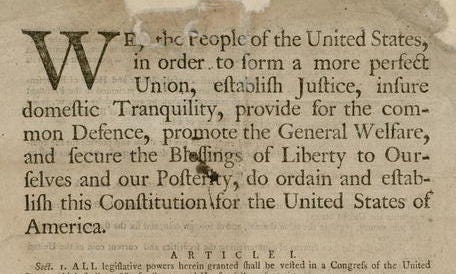
A 1787 printing of the Constitution. (Image by Library of Congress; public domain)
American democracy is being tested in a way unseen since at least the Civil War. Set aside the way Donald Trump is smashing norms, ignoring courts, and profiting from corruption — even before Trump, legislators and presidents were unable to enact popular laws and programs due to limitations in the Constitution’s design. (This frustration with Congress arguably paved the way for Trump, a would-be strongman who vowed to get his way despite custom and the law.) It’s bad enough that some are suggesting a significant rewrite of the Constitution.
It’s worth pointing out that the 1789 Constitution has held up pretty well, considering the Founding Fathers had little existing work about governing a democratic republic to crib from. But the intervening 200-plus years have shown us many other models of democracy, to the point where modern political scientists don’t recommend looking back to the US as a model any more. (If you want to see what they do recommend, read this handy guide on how to write a new constitution for your post-conflict country.) And let me just remind you that Thomas Jefferson himself was against the idea of a static Constitution lasting generations.
Now, I am not a lawyer, but even I have a pretty good idea of what the Constitution’s weak points are. Here’s what I would want to see to address these issues in a new “Constitution of 2025.”
The presidency
Curtailment of pardon powers. Giving the president the power to pardon was well-intentioned, but many presidents have pardoned allies or questionable figures, and Trump has shown how pardons can be horribly abused to subvert the law. It’s best to dilute or even remove these powers from the president.
Presidential immunity and presidential crimes. As we have discovered in the past decade, the existing safeguards against the president simply committing crimes to benefit himself or his friends using public power are weak and indirect. We need stronger, more explicit guardrails: a better definition of the standards for and punishments for impeachment, identifying who can investigate and prosecute the president and why, and laying out explicitly what acts the president has immunity for (hopefully almost none) and what he doesn’t.
Defining emergency declarations. The concept of a “national emergency” wasn’t really a possibility in 1789 when news took weeks or months to travel from one side of the country to the other. The concept of an “emergency” that justifies extraordinary action needs to be defined, as well as how it can be curtailed by Congress and the courts when the president gets out over his skis.
No unitary executive. Let’s just nip this concept in the bud. Even if our Founding Fathers had intended for the president to wield all the power in the executive branch, Trump is showing us what a bad idea that is. Executive branch officials should have a loyalty to the Constitution and responsibility to Congress and the courts separate from their political loyalty to the president.
National popular vote. Goodbye Electoral College! Nobody likes you.
Congress
Multiple-member House districts. Having each House district elect a single representative makes intuitive sense, but it rewards gerrymandering and mutes the voices of members of the party (or parties) that didn’t get a plurality. Switching to multi-member districts, in which each state has the same number of representatives but clustered into larger districts of 3 to 5 members, would avoid this. They would allow better representation for, e.g., Democrats in rural Texas and Republicans in urban New Jersey, as well as give a fighting chance for third-party candidates.
Expand the size of the House. The House has been fixed at 435 voting members since 1913, even as the country has more than tripled in population. If we expanded the House following the cube root law — the observation that the size of a legislature’s lower house tends to be about the cube root of the country’s population, and which roughly held for the House until 1913 — the size of the House should be 693 members today.
Elect Senators via party lists. Today’s Senate is very different than the one imagined by the Founding Fathers, and indeed operates very differently than it did just a generation ago. Senate elections are increasingly nationalized, as voters hold their nose to vote for mediocre candidates of their own party, knowing partisan coalitions matter more than having their state represented well. Likewise, the Connecticut Compromise (which led to a House with proportional representation but a Senate with every state represented equally) makes less sense when the largest state is so many times larger than the smallest. Instead, voters should be asked to vote for a party, not a person, with seats in the Seante being awarded proportionally to the national party vote. This would give Democrats in conservative areas and Republicans in liberal ones a real chance to influence the outcome, as well as ensuring a couple seats for minor parties (like Libertarians) that might have the power to break partisan gridlock.
Redefine advise and consent. Right now, the Senate has the ability to bottle up a new president’s nominees simply by not scheduling them for a vote. (How well does this work? Ask Supreme Court Justice Merrick Garland.) The Senate’s power to “advise and consent” to nominations isn’t defined in the Constitution, so the next one should redefine it: a president’s picks should be assumed to take office unless the Senate takes the time to vote them down. This would ensure the people get the executive branch they voted for while ensuring the Senate could still have a say.
No more shutdowns, no more debt ceilings. Government shutdowns and the debt ceiling crises are dumb self-inflicted wounds on our economy. Eliminating them could take the form of legislation, but laying out specific rules for continuing government operations in lieu of a new budget and forbidding separate debt ceilings will make us look less foolish in the eyes of the world.
Taxation. Congress should have the explicit power to levy whatever kind of tax is necessary — sales, income, and excise, but also wealth and land value, as necessary.
The courts
Reform the Supreme Court. There are multiple possible routes to a less politicized court. One concept is to appoint justices for 18-year terms every 2 years, ensuring every president gets to appoint two per term; older judges rotate off. Another idea is to increase the size of the Court but randomly select nine justices to hear each case. This would randomize the Court’s ideological makeup and discourage activists from bringing cases where they think a partisan court would rule in their favor.
Ethics rules for federal officials. Congress should have the ability to set ethics rules for itself, the president, presidential appointees, federal judges, and the Supreme Court. Yes, I’m looking at you, Clarence Thomas.
The Constitution and the American people
Amend the amendment process. Political scientists have noted that the current system to amend the Constitution is far more difficult in America than in other constitutional democracies. A better system might put amendments, once passed out of Congress, to be put to a simple national plebiscite. To succeed, an amendment would need to garner both a majority of the national vote and a majority vote in a majority of states.
Political spending is not free speech. Few people other than the rich think it should be. If speech is speech but campaign spending is not, the latter can be regulated by Congress; the new constitution should say so.
Regulation of firearms. Another popular demand: give Congress power to regulate ownership of weapons for public safety and health. Better yet, allow states to make stricter rules than the federal government but not looser ones.
The fourth branch of government. Just as the current Articles I through III describe the legislature, the executive, and the judicial branches, an article should define the role of the citizenry — in a democracy, the “fourth branch” of government. From an editorial standpoint, this would be the place to round up miscellaneous rights found in the amendments in today’s Constitution and add explicit guarantees of the right to vote, the right to privacy, and incorporate the text of the Equal Rights Amendment.
A new Constitution including these features would be simultaneously much different from our current system and also very recognizable. (The Schoolhouse Rock cartoon “I’m Just a Bill” would still apply, for example.) I believe a new Constitution along these lines would be better at translatating the popular will to action while preserving important safeguards.
But as we’re discovering, there’s no way of writing a law that by itself ensures the blessings of liberty to ourselves and our posterity. We will still depend on electing good people to represent us. Constitutions, it turns out, only work when we obey them.
메타데이터
- post_id
- 82128756b196
- slug
- a-wish-list-for-the-next-constitution-82128756b196
- url
- https://medium.com/@brecchie/a-wish-list-for-the-next-constitution-82128756b196
- canonical_url
- https://medium.com/@brecchie/a-wish-list-for-the-next-constitution-82128756b196
- author_url
- https://medium.com/@brecchie
- status
- ok
- fetched_at
- 2026-07-14 15:35:44