Vinyl Sticker Thickness Guide: Mils, Microns & Premium Quality
Don’t waste money on flimsy custom stickers. Learn the science of vinyl sticker thicknes and find the premium sweet spot with Okaystickers.
Custom Vinyl Sticker Thickness 101: The Ultimate Guide to Mils, Microns, and Choosing the Perfect Weight for Your Designs
You’ve poured your heart into a new graphic design, illustration, or brand logo. It looks flawless on your 4K monitor. But when you transition that digital art into a physical product, something goes wrong. You order a batch of custom stickers, and when they arrive, they feel like thin, grocery-store receipts. Within two weeks on a water bottle, the edges turn white, curl up, and the ink scratches off.
In the custom printing and merchandise world, sticker thickness is the ultimate silent killer of quality. Whether you are a B2B brand manager ordering 10,000 die-cut stickers for a global product launch, an indie artist selling sticker packs on Etsy, or just someone who wants to print a cool design for a local skate crew, understanding vinyl sticker thickness is the difference between a premium product and wasted money.
Many people mistakenly assume that “thicker always means better.” Others try to cut costs by buying the thinnest vinyl available. Both approaches are traps.
As a veteran in custom packaging and vinyl engineering, I am going to pull back the curtain on the science, manufacturing secrets, and real-world performance of vinyl sticker thickness. By the end of this guide, you’ll know exactly how to read a manufacturer’s spec sheet, how to avoid common industry scams, and how to pick the perfect thickness for your specific project using **Okaystickers** standards.
1. Mils, Microns, and Points: Speaking the Secret Language of Sticker Printers
If you open a professional printing spec sheet, you won’t see thickness measured in inches or millimeters. Instead, you’ll see terms like Mils, Microns, or GSM. Let’s demystify these terms immediately so you can talk to any printing factory like an industry insider.
What is a “Mil”? (The North American Standard)
The most common point of confusion for beginners is the word Mil. A mil is NOT a millimeter. * A mil is one-thousandth of an inch (0.001 inches).
- To put this in perspective, a standard piece of office printer paper is about 4 mils thick. A human hair is roughly 3 mils thick.
- If a sticker company tells you their vinyl is 6 mils thick, they mean it is 0.006 inches thick.
What is a Micron? (The Global/Metric Standard)
If you buy stickers internationally or look at European or Asian manufacturing data, you will see Microns (µm).
- A micron is one-millionth of a meter, or one-thousandth of a millimeter.
- The conversion is simple: 1 mil is approximately equal to 25.4 microns.
- Therefore, a 6 mil sticker is roughly 150 microns thick.
What about GSM or Points?
- GSM (Grams per Square Meter): This measures weight, not thickness. It is typically used for the paper backing liner, not the vinyl itself.
- Points: Used in the cardboard and paperboard industry (1 point = 1 mil). You rarely see this used for vinyl, but if you do, now you know they are identical.
The Golden Rule of Sticker Sourcing: Always confirm whether a manufacturer’s thickness quote includes or excludes the paper backing liner. A cheap 2 mil vinyl stuck to a thick 8 mil paper liner feels like a 10 mil product in your hand, but once you peel it off, you are left with a flimsy, low-quality sticker. At **Okaystickers**, we always quote the applied thickness (vinyl + laminate + adhesive), independent of the backing liner.
2. The Multi-Layer Anatomy of a Premium Vinyl Sticker
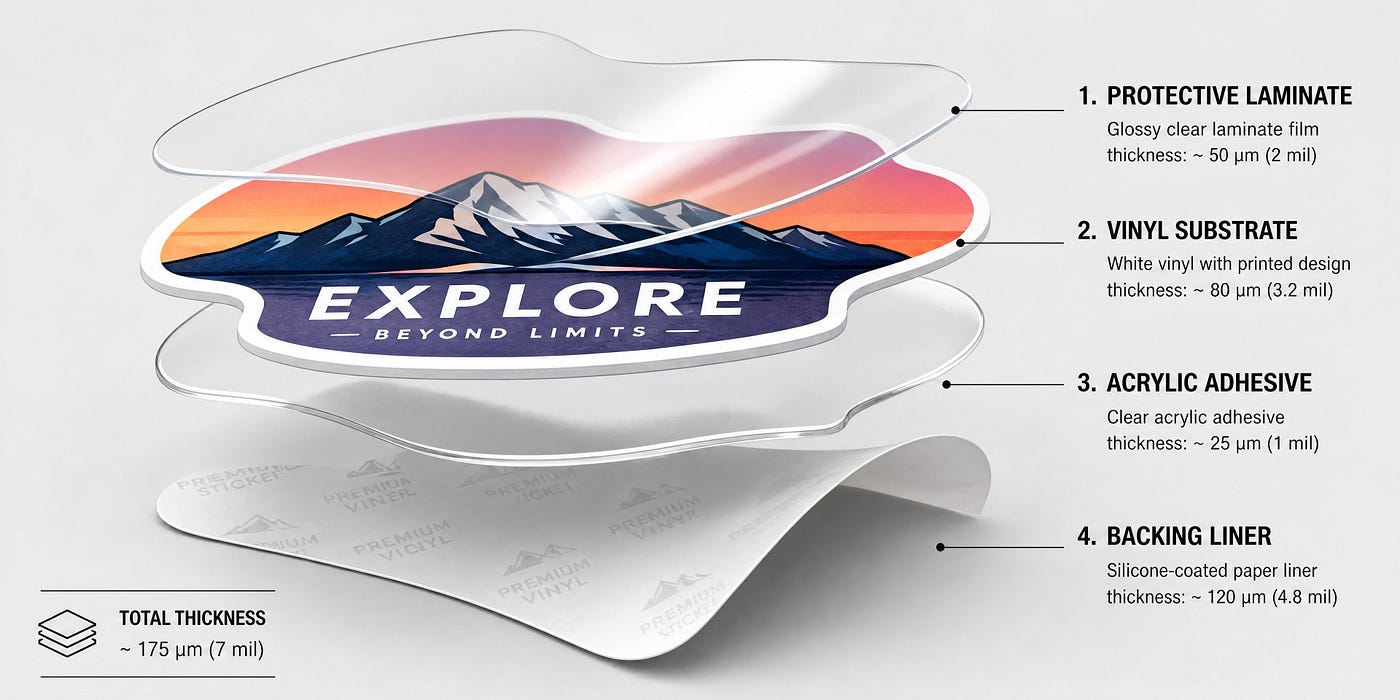
A professional-grade vinyl sticker is not just a single sheet of plastic with ink on it. It is a highly engineered, three-layer sandwich designed to resist UV rays, friction, water, and chemical exposure.
To understand thickness, you must understand these three distinct layers:
┌────────────────────────────────────────────────────────┐ ▲
│ 1. Overlaminate Layer (Clear UV/Scratch Protection)    │ │
├────────────────────────────────────────────────────────┤ │ Total Applied
│ 2. Vinyl Base Substrate (Cast or Calendered PVC + Ink) │ │ Thickness
├────────────────────────────────────────────────────────┤ │
│ 3. Adhesive Layer (Acrylic Pressure-Sensitive Glue)   │ ▼
└────────────────────────────────────────────────────────┘
==========================================================
│ 4. Release Liner (The Paper Base - Peeled and Discarded)│
└────────────────────────────────────────────────────────┘
Layer A: The Overlaminate (1.5 to 3.0 mils)
This is the transparent top coat. Its sole job is protection. It shields the printed ink from the sun’s ultraviolet rays (which cause fading) and physical abrasion (like keys scratching a sticker inside a backpack). Laminates come in various finishes like high-gloss, silky matte, holographic, or glitter.
Layer B: The Vinyl Substrate (2.0 to 4.0 mils)
This is the core material, usually made of Polyvinyl Chloride (PVC). This layer holds the ink. There are two primary ways this vinyl is manufactured, which fundamentally affects how its thickness behaves:
- Calendered Vinyl: Made by melting PVC and squeezing it through massive, heavy rollers (like rolling out cookie dough). It is thicker, stiffer, cheaper, and excellent for flat surfaces. However, it retains internal stress and wants to shrink over time when exposed to heat.
- Cast Vinyl: Made by dissolving PVC in a liquid solvent and pouring it onto a casting sheet. It is thinner, highly flexible, premium, and has zero material “memory.” It will never shrink or pull back from edges.
Layer C: The Adhesive (1.0 mil)
The glue. High-end stickers use a solvent-based acrylic permanent adhesive. It needs enough thickness to fill the microscopic pores of the surface it’s being stuck to (like textured plastic or powder-coated hydroflasks).
3. The Ultimate Sticker Thickness Master Matrix
How thick should your sticker actually be? This deep-dive comparison table breaks down real-world performance, feel, and applications across the entire industry spectrum.
📌 2.0 to 3.0 mils (50 to 75 µm) — Thin Film
- Tactile Hand-Feel: Ultra-thin, highly conformable; feels like a wrap or protective film rather than a traditional sticker.
- Best Real-World Use Cases: Product labels for cosmetic jars, curved wine bottles, spice tins, and industrial serialization plates.
- Durability & Lifespan: Low outdoor resistance unless heavily laminated. Highly prone to tearing during the peeling process.
- The Verdict & Brand Perception: Industrial/Utilitarian. Perfect for high-volume corporate packaging where the sticker needs to blend seamlessly into the container, but poor for standalone retail merchandise.
📌 4.0 to 5.0 mils (100 to 125 µm) — Economy Class
- Tactile Hand-Feel: Standard, lightweight, and noticeably flexible.
- Best Real-World Use Cases: Budget promotional giveaways, envelope seals, event handouts, and temporary indoor labeling.
- Durability & Lifespan: Moderate. Will last 1 to 2 years outdoors before edges begin to degrade under harsh weather.
- The Verdict & Brand Perception: The Budget Choice. Great for keeping unit costs ultra-low when giving away thousands of stickers at a trade show or concert, but lacks a premium punch.
📌 6.0 to 7.5 mils (150 to 190 µm) — The Premium Gold Standard
- Tactile Hand-Feel: The Premium Sweet Spot. Thick, substantial, heavy-duty, with an expensive, high-end weight.
- Best Real-World Use Cases: Die-cut laptop stickers, streetwear brand merchandise, hydroflasks, skateboard decks, and car bumpers.
- Durability & Lifespan: Exceptional. 3 to 5+ years of outdoor life. Completely waterproof, dishwasher safe, and highly UV resistant.
- The Verdict & Brand Perception: The Professional Baseline. This is the exact specification engineered by **Okaystickers**. It screams luxury and commands high retail value for artists and premium brands alike.
📌 8.0 to 10.0 mils (200 to 250 µm) — Heavy-Duty Industrial
- Tactile Hand-Feel: Extremely stiff, rigid, and feels like a sheet of thin cardstock plastic.
- Best Real-World Use Cases: Heavy machinery decals, construction hard hat stickers, oil field safety warning labels, and dirt bike graphics.
- Durability & Lifespan: Maximum physical abrasion resistance. Can easily withstand rock impacts and chemical spills.
- The Verdict & Brand Perception: Over-Engineered for General Merch. While it sounds impressive on paper, it is far too stiff for everyday consumer items. The material’s memory means edges will actively resist wrapping around tight curves.

4. 3 Counter-Intuitive Secrets Only Sticker Industry Insiders Know
When ordering stickers, most people look at the price and the design file. But if you want to get true value for your money, you need to understand the physics of vinyl conversion. Here are three insider secrets that printing factories rarely share with the public.
Secret #1: The Physics of “Material Memory” and Why Thicker Can Fail
There is a common misconception that a 10 mil sticker will last longer on a water bottle than a 6 mil sticker. This is mathematically and physically false.
PVC plastic possesses a trait called material memory. When a thick, calendered vinyl is rolled out flat during manufacturing, its molecules are trained to stay flat. If you wrap a very thick, stiff 10 mil sticker around a tightly curved surface like a Hydroflask, a pen, or a bicycle frame tube, the vinyl will constantly exert physical force to snap back into a flat plane.
Over a few weeks, this internal structural tension overrides the chemical bond of the adhesive, causing the edges to lift, catch lint, and eventually peel off completely. For curved or irregular surfaces, a highly pliable, beautifully balanced 6 mil to 7 mil vinyl provides the perfect equilibrium between structural heft and surface conformity.
Secret #2: How Matte and Gloss Finishes Trick Your Brain’s Tactile Senses

If you take a 6 mil thick glossy sticker and a 6 mil thick matte sticker — both manufactured with the exact same base vinyl, adhesive, and laminate thickness — and hand them to 100 people, over 85% of them will swear that the matte sticker feels thicker and more premium.
Why does this happen? It’s a psychological and physiological phenomenon related to surface topography.
- Glossy laminates are perfectly smooth. Your fingers make complete contact with the plastic, meaning you feel the absolute, literal thickness of the material.
- Matte laminates feature a micro-textured, etched surface that diffuses light. This microscopic roughness creates subtle tactile friction against your fingertips.
Your brain interprets this textural resistance as mass, making the matte sticker feel heavier, softer, and more expensive. If you want your retail merch or brand packaging to feel incredibly high-end without spending more money on raw material thickness, always opt for a matte premium finish.
Secret #3: The “Split-Backing” Thickness Illusion
Many low-cost online print shops use a classic sleight-of-hand trick to make their products appear high quality. They print on incredibly cheap, paper-thin 2.5 mil vinyl, but mount it onto an excessively thick, stiff 100lb or 120lb cardstock backing paper (release liner).
When you pull the sticker out of the shipping envelope, it feels incredibly rigid, heavy, and impressive. You think you got an amazing deal. However, the moment your customer peels the sticker off that heavy paper backing to apply it to their laptop, they are left with a flimsy, fragile piece of film that wrinkles easily, traps air bubbles during application, and tears with minimal effort.
When evaluating quotes from custom sticker suppliers, never ask for the “total product thickness.” Specify that you want to know the exact mil or micron rating of the vinyl plus the laminate layer combined after application.
5. Tailoring Your Choice: A Real-World Decision Guide
Let’s look at exactly what thickness you should choose based on who you are, what your budget looks like, and what your goals are.
Scenario A: You are a Brand Manager or Business Owner (B2B)
- Your Goal: Maximize brand impressions, ensure your logo stays intact on customer property for years, and avoid looking cheap.
- Your Target: 6.0 to 7.0 mils.
- Why: When a customer places your brand sticker on their laptop or car bumper, it becomes a permanent organic billboard. If it fades or peels within a month, it sends a subconscious signal that your primary product or service is also low quality. A 6.5 mil sticker feels like a premium gift, encouraging customers to actually use it rather than throw it in the trash.

Scenario B: You are an Independent Artist, Illustrator, or Etsy Seller
- Your Goal: High perceived retail value, excellent print clarity, and great margins.
- Your Target: 6.0 mils with a Matte or Holographic Finish.
- Why: Consumers are willing to pay $4 to $6 for a single standalone die-cut sticker if it feels substantial. If you sell them a thin, floppy 4 mil sticker, you will face negative reviews claiming your merchandise feels cheap. A thick vinyl coupled with a heavy backing liner gives your product the physical “weight” required to justify a premium retail price point.
Scenario C: You are an Individual Making Custom Stickers for Fun or Local Groups
- Your Goal: Fun personal expression, cool designs for friends, skateboards, or local clubs without breaking the bank.
- Your Target: 5.0 to 6.0 mils.
- Why: You don’t need heavy industrial specifications, but you still want your designs to survive outdoor environments like skate parks, car windows, or gym water bottles. Opting for a standard premium vinyl gives you the perfect balance of DIY affordability and professional durability.
6. Common Pitfalls: What Happens When You Get the Thickness Wrong?
To wrap up this masterclass, let’s look at the mechanical failures that occur when thickness specifications don’t align with the intended application.
The Consequences of Being Too Thin (Less than 4.0 mils for consumer use):
- The “Tunneling” Effect: When thin vinyl is exposed to temperature fluctuations (like a hot car interior or a dishwasher cycle), it undergoes thermal contraction. The vinyl shrinks, but the paper or adhesive underneath doesn’t, creating ugly tunnels, wrinkles, and air channels across your design.
- Opacity Failure: Thin vinyl is translucent. If you stick a thin white sticker onto a dark laptop or a black water bottle, the dark background will bleed through the vinyl, dulling your bright colors and turning your clean whites into a muddy grey.
- Application Frustration: Thin stickers lack structural integrity during application. They flop around, fold over on themselves, stick to your fingers, and trap thousands of tiny micro-bubbles that are impossible to scrape out.
The Consequences of Being Too Thick (Greater than 9.0 mils for consumer use):
- Edge Snagging: Because thick stickers protrude noticeably off the surface, their edges form a sharp lip. When you slide a laptop or water bottle into a backpack sleeve, that lip catches on the fabric. Over time, friction lifts the sticker, allowing dirt to ruin the adhesive.
- Die-Cutting Imperfections: Cutting through ultra-thick vinyl requires massive pressure from digital blades or steel dies. This can lead to jagged edges, backing paper tears, or stickers that are incredibly difficult to peel away from their original sheet.
Conclusion: Engineering the Perfect Stick with Okaystickers
At the end of the day, custom stickers are one of the most cost-effective, high-impact marketing and artistic mediums available — but only if they are engineered correctly.
At Okaystickers, we don’t believe in cutting corners or using confusing industry jargon to hide low-quality materials. We have standardized our production around a premium 6.0 to 7.0 mil applied vinyl architecture. This exact setup provides the rich hand-feel your customers crave, the complete opacity your colors demand, and the flexible outdoor durability needed to survive the elements for years.
The next time you prepare to hit “order” on a custom printing batch, look past the price tag. Look at the mils. Look at the laminates. Request physical samples, feel the material between your fingers, and ensure your physical assets match the elite quality of your digital vision.
Ready to see and feel the difference that true, expertly calibrated premium vinyl makes? Explore our material options, order a custom sample pack, or launch your next production run over at Okaystickers today.
메타데이터
- post_id
- 821dae211e7d
- slug
- vinyl-sticker-thickness-guide-mils-microns-premium-quality-821dae211e7d
- url
- https://medium.com/@okaystickers/vinyl-sticker-thickness-guide-mils-microns-premium-quality-821dae211e7d
- canonical_url
- https://medium.com/@okaystickers/vinyl-sticker-thickness-guide-mils-microns-premium-quality-821dae211e7d
- author_url
- https://medium.com/@okaystickers
- status
- ok
- fetched_at
- 2026-06-29 01:02:39