Inside V8: How JIT Compilation Makes JavaScript Fast
A deep dive into Ignition, TurboFan, bytecode generation, optimisation, and de-optimisation in Google’s V8 engine.
Inside V8: How JIT Compilation Makes JavaScript Fast
A deep dive into Ignition, TurboFan, bytecode generation, optimisation, and de-optimisation in Google’s V8 engine.
JavaScript began as an interpreted scripting language designed for simple browser interactions. Today, it powers high-performance applications ranging from real-time dashboards to backend servers.
So how does JavaScript execute fast enough to compete with compiled languages?
The answer lies in Just-In-Time (JIT) compilation, and one of the most advanced implementations of it exists inside Google’s V8 engine.
In this article, we’ll explore how V8 transforms JavaScript into optimised machine code using Ignition and TurboFan.
WHAT IS V8?
V8 is Google’s open-source JavaScript engine used in:
- Google Chrome
- Node.js
- Electron
Its primary job is to parse, interpret, optimise, and execute JavaScript as efficiently as possible.
Documentation: *https://v8.dev/*
WHY JAVASCRIPT NEEDS JIT?
Traditional interpreted languages execute code line-by-line, which introduces runtime overhead.
JIT improves performance by:
- Monitoring frequently used code
- Detecting hot functions
- Compiling them into machine code
- Reusing optimised native execution paths
This dramatically reduces repeated interpretation cost.
V8 EXECUTION PIPELINE
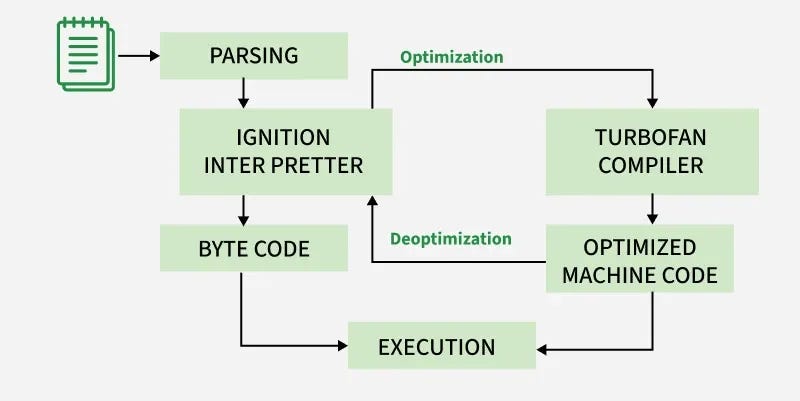
STEP 1: PARSING JAVASCRIPT
When JavaScript enters V8, the parser converts source code into an Abstract Syntax Tree (AST).
function add(a, b) {
  return a + b;
}

add(2, 3);
The AST helps V8 understand code structure before execution begins.

STEP 2: IGNITION GENERATES BYTECODE
Ignition is V8’s bytecode interpreter.
Instead of compiling directly into machine code, V8 first converts JavaScript into bytecode for quick startup execution.
// file.js

function square(x) {
  return x * x;
}

square(5);
node --print-bytecode file.js

STEP 3: HOT FUNCTION DETECTION
When functions are executed repeatedly, V8 marks them as “hot.”
// file.js

function add(a, b) {
  return a + b;
}

for (let i = 0; i < 1000000; i++) {
  add(i, i);
}
Repeated invocation signals optimisation opportunity.
STEP 4: TURBOFAN OPTIMISATION
TurboFan is V8’s optimising compiler.
Once code becomes hot, TurboFan recompiles it into efficient machine code.
node --trace-opt file.js
STEP 5: DE-OPTIMISATION
TurboFan makes assumptions about stable data types.
If assumptions fail, V8 deoptimises.
example:
// file.js

function multiply(a, b) {
  return a * b;
}

for (let i = 0; i < 100000; i++) {
  multiply(i, 2);
}

multiply("hello", 5);
node --trace-deopt file.js
KEY OPTIMISATION TECHNIQUES
TurboFan uses several advanced optimisation strategies:
Hidden Classes
Improves object property access speed.
Inline Caching
Caches repeated property lookup patterns.
Speculative Optimisation
Optimises based on observed runtime types.
Dead Code Elimination
Removes unnecessary instructions.
Escape Analysis
Avoids unnecessary memory allocations.
PERFORMANCE BENCHMARK
Benchmark test:
// file.js

console.time("test");

function add(a, b) {
  return a + b;
}

for (let i = 0; i < 10000000; i++) {
  add(i, i);
}

console.timeEnd("test");
time node app.js
WHY JIT MATTERS
JIT directly impacts:
- Faster browser rendering
- Better Node.js throughput
- Faster React applications
- Improved real-time performance
Without JIT, modern JavaScript ecosystems would be significantly slower.
CHALLENGES OF JIT
Despite its benefits, JIT introduces trade-offs:
- Warm-up latency
- Higher memory usage
- Deoptimisation penalties
- Runtime unpredictability in dynamic code
CONCLUSION
V8’s JIT architecture is one of the primary reasons JavaScript performs at near-native speed today.
By combining Ignition for fast startup and TurboFan for deep optimisation, V8 balances flexibility with high execution efficiency.
This design is what makes JavaScript viable for modern large-scale applications.
REFERENCES & DOCUMENTATIONS
V8 Official Site:
Ignition Interpreter:
TurboFan Compiler Docs: *https://v8.dev/docs/turbofan*
Node.js CLI Flags:
V8 GitHub Repository: *https://github.com/v8/v8*
Chrome DevTools Performance Docs: *https://developer.chrome.com/docs/devtools/*
메타데이터
- post_id
- 82784434d1e7
- slug
- inside-v8-how-jit-compilation-makes-javascript-fast-82784434d1e7
- url
- https://medium.com/@timmyojha/inside-v8-how-jit-compilation-makes-javascript-fast-82784434d1e7
- canonical_url
- https://medium.com/@timmyojha/inside-v8-how-jit-compilation-makes-javascript-fast-82784434d1e7
- author_url
- https://medium.com/@timmyojha
- status
- ok
- fetched_at
- 2026-06-17 08:20:12




