Training at the Fudoji Temple
Memories of Daito-ryu training at the Fudoji temple
Training at the Fudoji Temple

Source: https://www.visitgunma.jp/en/sightseeing/detail.php?sightseeing_id=149
Location and history
Located in Gunma prefecture, Kurotaki mountain's Fudoji temple (or 黒滝山不動寺) is a small Buddhist temple dedicated to Fudo Myoo. Legend has it the temple is over 1300 years old and is a location where Budoka of various traditions from across Japan would gather and practice.
An old tradition
For decades, Daito-Ryu practitioners would gather up on this mountain for a special training session.

Kondo Masayuki sensei, leading a column on a mountain climb (source: Daito-ryu Aikibudo All-Tokyo branch 20th-anniversary book).
The location, in many ways, is perfect for ascetic training; a training hall is available, along with a meditation hall, lodging, the Kurotaki waterfall (which was of course used for training), and mountain trails which could be treaded to enjoy beautiful scenic views.
Deep in the mountain, the temple’s location was not easy to access, however; in the early iteration of the special training, I’ve been told that tatami would be carried uphill by zipline because there were no roads for vehicles. The story is rather believable; even today, the climb by vehicle is so steep that I doubt a truck carrying piles of mats would safely be able to make the climb.
This probably explains why the practice was eventually discontinued altogether. At least, by the time I participated, training would simply be held on hard wooden floors instead.

Kondo Masayuki sensei, still leading the way decades late. Kondo Katsuyuki sensei was only able to pass by for the day on that occasion (source: personal archives).
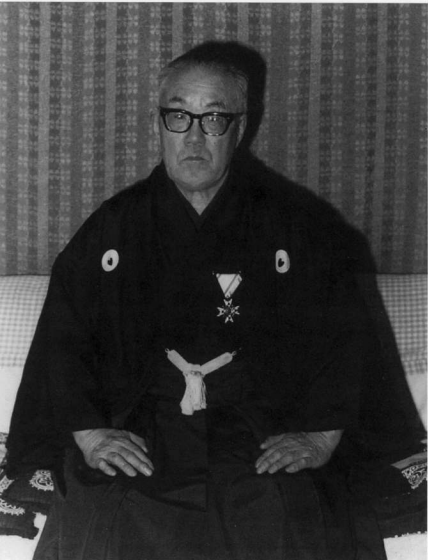
I only had the chance to go for training about two times, in the early 2010s. Since then, the head priest has passed away (seen in the picture above), and it appears that nobody has taken his place — an increasingly frequent issue, unfortunately.

Source: https://www.daitohryu.com/gallery
Most of the day was spent training or exercising in one way or another. We’d start very early — if my memory is correct, we’d be up and out by 5 AM — and would generally start with light exercises. It was probably the best time of the day; the misty mountain surroundings would glow bright with the rising sun. We’d have breakfast soon after, and then out again for training; we would generally be alternating between zazen and koryu training (both Ono-ha Itto ryu and Daito-ryu). Since I was not an Itto ryu practitioner, I had to try and catch up with most of the other people there, but this was nothing compared to the zazen. I believe we would do hour-long meditations, and by the 10th minute, my legs would already be in pain. Focusing on breathing helped a lot, but I can’t say it was easy.
The rest of the time was peppered with meditations under the waterfall and walks in the mountain.
Asceticism, religion, and Budo
Ascetic training is not new, but I think its purpose — in the context of Budo, at least — is only partially understood. In my understanding, the purpose of combining the two is:
- Provide some “time off” between each Budo training sessions, and provide some time for each training’s experience to sink in;
- Provide ample time and a variety of exercises to focus on the development of a clear and unencumbered mind;
- Strengthen the body by using nature to its fullest (weather, obstacles, etc);
It is important to emphasize that for most Budoka the practice of zazen (and potentially other religious rituals) will be exoteric — meaning that it will greatly differ from the practice, say, a devoted practitioner would engage in. Not unlike koryu, it appears most religious practices have secrets of their own. And not everyone can be, say, Omori Sogen.
This doesn’t mean the practice is meaningless, or that it cannot provide benefits. But it’s important, I believe, to remember that you are a guest in such practices. As in all things, humility goes a long way.
In both religious and ascetic practices, it’s important to be guided. You’ll need someone to admonish you when you do things wrong, but most importantly, you’ll need to learn how to safely practice. Going under a waterfall alone to meditate seems like a good idea until you slip on a polished stone as water keeps on pouring heavily on your near-drowning body. Keeping full-body control while you are shattering your teeth from being cold — all the while trying to garner enough focus to recite mantras—is no small task.
Besides, would you really want to go freeze under pouring icy water only to be doing it all wrong unknowingly?
Practical application and pragmatism
Note that in the above-stated purposes, there is no “magical strength”, or enlightenment.
Obviously, the first one is just silly, but the second one can make a lot of sense if you practice Budo to extend your religious practice. Unfortunately, I am ill-equipped to discuss such a way of practicing, as I am unfamiliar with most esoteric practices.
However, it’s worth pointing out that the concept of spiritual purity is far from being detached from any pragmatic purposes. One cannot expect to maintain peace with a troubled mind, after all. Obviously, most of us practitioners are not required to do so professionally, but it doesn’t mean we cannot put the developed skills to good, practical use within our own communities.
Conclusion
It’s often easy to look at those practices and be engulfed by the spirituality of it all. I’ll be the first to admit that each time I went to train at the Fudoji, I felt a connection of sort, something intangible which I would struggle to describe still today. However, I wanted to take the opportunity to point out that spirituality is really just one thin layer of a much thicker piece of lacquerware. Especially for serious practitioners, these practices have concrete, practical benefits — as long as they are done correctly.
메타데이터
- post_id
- 828d7a6dffe4
- slug
- training-at-the-fudoji-temple-828d7a6dffe4
- url
- https://daito-ryu.blog/training-at-the-fudoji-temple-828d7a6dffe4
- canonical_url
- https://daito-ryu.blog/training-at-the-fudoji-temple-828d7a6dffe4
- author_url
- https://medium.com/@marc.trudelbelisle
- status
- ok
- fetched_at
- 2026-06-23 06:34:20