Introduction: The Imperial Production of the Ungrievable
The Japanese military “comfort women” system constitutes one of the most extensive yet persistently unresolved regimes of wartime sexual…
Introduction: The Imperial Production of the Ungrievable
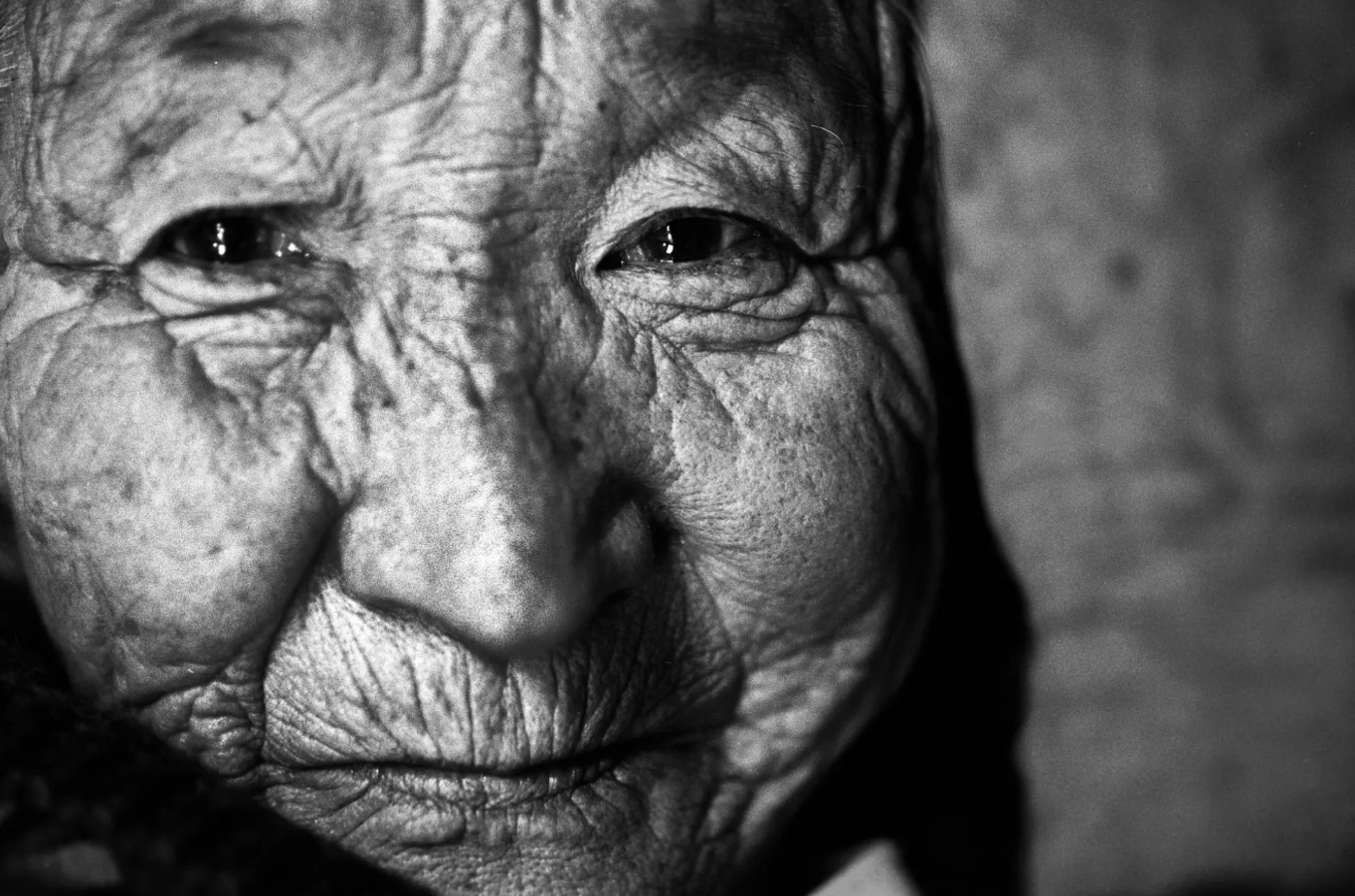
Park Ok-ryeon, 77, deceived with promises of factory work before being forcibly conscripted into the Japanese military regime of wartime sexual enslavement. Photographed in Seoul by Yunghi Kim, 1996.
The Japanese military “comfort women” system constitutes one of the most extensive yet persistently unresolved regimes of wartime sexual violence in modern history. From the early 1930s until the collapse of the Japanese Empire in 1945, an estimated 20,000 to 200,000 women and girls across occupied Asia were coerced, trafficked, deceived, abducted, or forcibly conscripted into military sexual slavery for the Imperial Japanese Army. The breadth of this estimate testifies to a violence that exceeded the conditions of historical legibility.
The term “comfort women” functions as a euphemism that sanitizes a regime of serial rape, torture, imprisonment, forced abortion, STIs, and death. The majority of those subjected to the system were Korean women under Japanese imperial occupation, though women across territories subsumed within the Japanese Empire were likewise brutalized.
The Imperial Production of the Violable
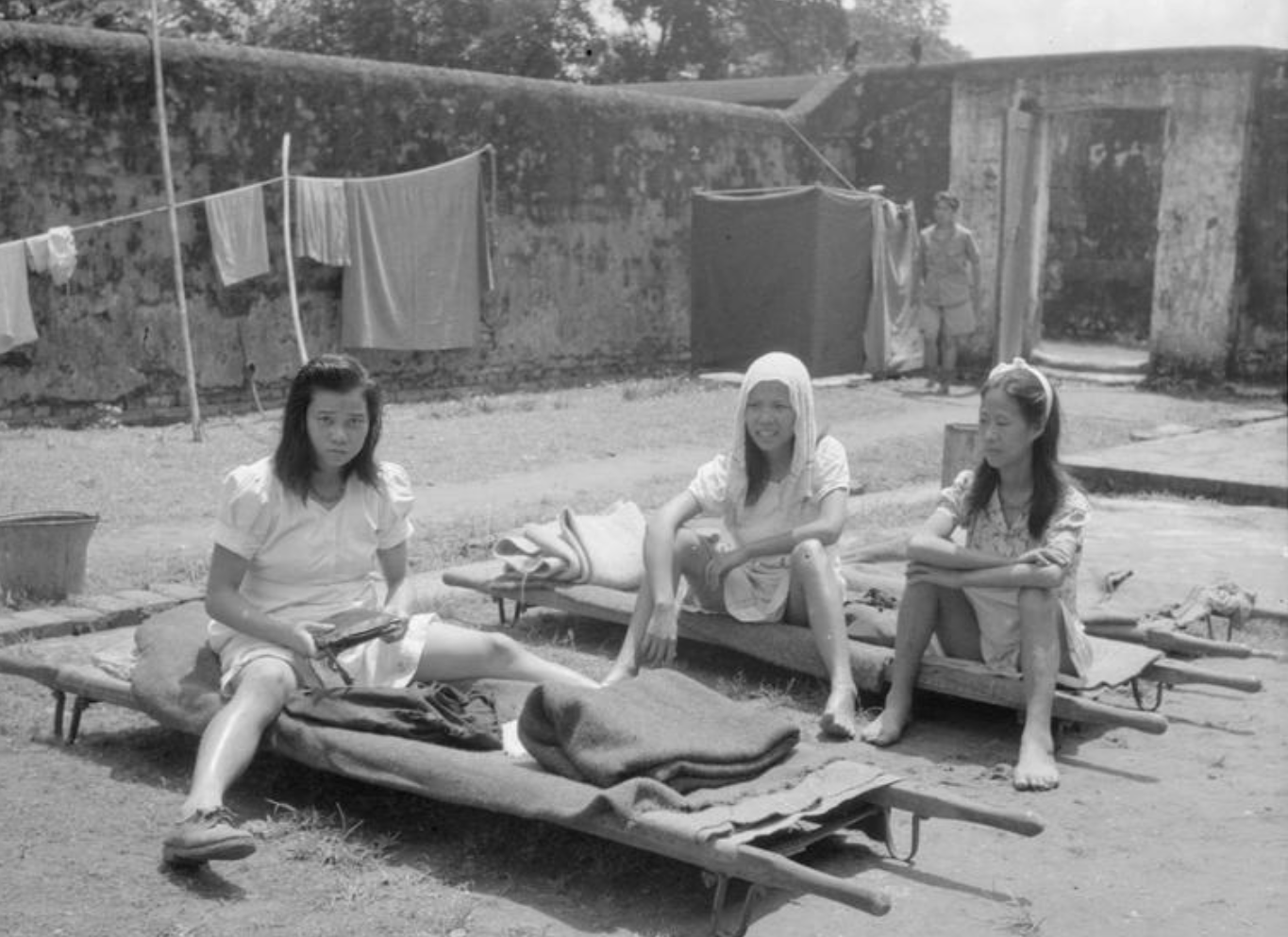
Three young women subjected to wartime sexual enslavement under the Japanese military “comfort women” system during the Second World War.
The origins of the system are inseparable from Japanese imperial expansion following the 1910 annexation of Korea, which produced racialized hierarchies that rendered Koreans politically subordinate and economically exploitable. As Japanese militarism intensified throughout the 1930s, the Imperial Japanese Army consolidated a militarized infrastructure of sexual enslavement across occupied Asia. The system was administered through the converging apparatuses of imperial bureaucracy, military command, civilian brokers, and police surveillance.
Sexual violence was thus bureaucratically systematized into a militarized regime of captivity, torture, and serial rape sustained through the trafficking of predominantly poor rural girls. The system emerged as an imperial machine of extraction structured through the interlocking violences of empire, patriarchy, racialization, and class dispossession, rendering colonized women structurally violable and administratively disposable.
This violence transpired despite Japan’s formal incorporation into international legal regimes ostensibly designed to prohibit trafficking and forced labor. In 1925, Japan ratified the International Convention for the Suppression of the Traffic in Women and Children, yet deliberately excluded imperial Korea from the treaty’s territorial application. Imperial rule thus consigned Korean women to a juridical void that outlived empire. This disjunction intensified following Japan’s ratification of ILO Convention №29 in 1932, which expressly prohibited forced labor. Yet even as coercion was formally proscribed, the Japanese military continued institutionalizing a vast regime of sexual servitude in direct violation of its international obligations. Consequently, in the decades after the war, their suffering became historically intelligible while the reparative obligations inscribed by that injury remained suspended within the postwar legal order.
The rapid proliferation of the “comfort women” system followed the 1937 Nanjing Massacre, during which Japanese soldiers raped, tortured, mutilated, and murdered an estimated 20,000 to 80,000 Chinese women over six weeks. International reports documenting the atrocities provoked mounting global condemnation and exposed the unrestrained brutality of Japanese imperial conquest. In response, Japan expanded a transnational network of so-called “comfort stations” across occupied Asia. The system sought to suppress public scrutiny and preserve the international legitimacy of its empire while regulating soldiers’ sexual access and controlling STIs within military ranks. While contemporary narratives often center Korean women as the primary victims of the system, the network rapidly metastasized across occupied Asia, drawing Chinese, Filipina, Indonesian, Taiwanese, Dutch, Burmese, Timorese, Papuan, and other colonized women into the machinery of sexual enslavement.
Inside military “comfort stations,” women and girls were subjected to relentless torture. Survivors testified to being raped by ten to fifty soldiers per day until their bodies gave way to hemorrhage, infection, starvation, and collapse. Forced abortion, sterilization, untreated STIs, invasive medical examinations, beatings, and sustained psychological terror formed part of the system’s ordinary machinery. One survivor recalled being treated not as a human being but as expendable military infrastructure, describing herself and the other women as being reduced to “female ammunition,” “public toilets,” and disposable provisions.
The Postwar Distribution of Grief
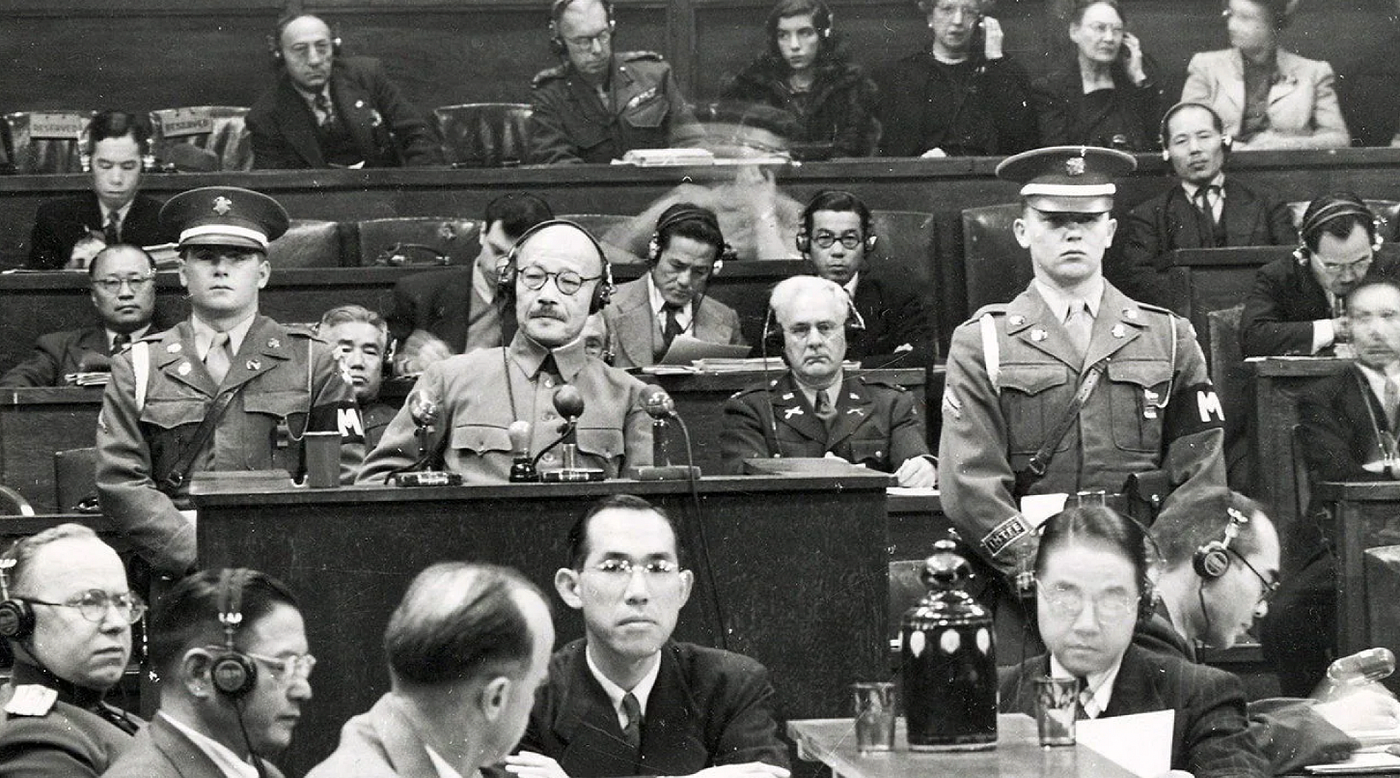
Former Japanese Prime Minister and General Hideki Tojo during the Tokyo War Crimes Tribunal in 1946. / VCG
This violence did not end in 1945. It mutated into a postwar legal order that institutionalized a racialized hierarchy of grief, which converted European suffering into prosecutable injury while abandoning Asian women to the margins of historical and juridical memory.
At the 1946 Tokyo War Crimes Tribunal, violence inflicted upon Allied nationals was codified as prosecutable, while the industrialized rape of thousands of Korean and other Asian women remained largely unprosecuted. Dutch military tribunals aggressively prosecuted Japanese officers responsible for coercing colonial Dutch survivors into sexual slavery in Indonesia. Equivalent crimes committed against Asian women, however, receded into the administrative silence of postwar legality; Indonesian survivors remained largely excluded from juridical recognizability.
The postwar international order thus reconstructed a hierarchy of grievability through which some injuries became legible as history while others were consigned to juridical and archival neglect. The mass rape of Asian women remained visible enough to scar public memory, yet insufficiently legible within the juridical order to compel substantive legal reckoning.
Cold War Reconstruction and the Geopolitical Rehabilitation of Empire
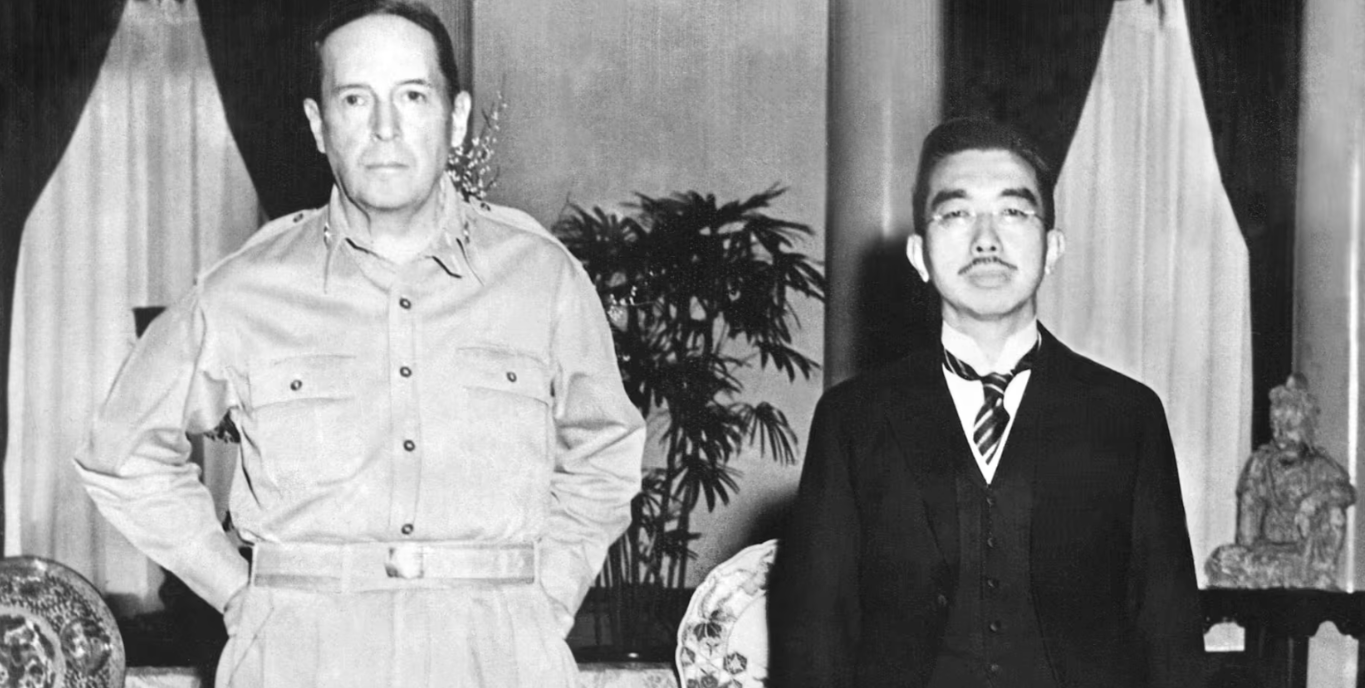
General Douglas MacArthur and Emperor Hirohito at Allied General Headquarters in Tokyo, September 17, 1945. Photograph by Pictures from History / Universal Images Group via Getty Images.
Cold War geopolitics further entrenched this failure of justice. Following Japan’s defeat, the United States increasingly prioritized reconstructing Japan as a liberal-democratic bulwark against communism in East Asia. Accountability for imperial atrocities was subordinated to the strategic imperatives of geopolitical stability. Responsibility for Japanese war crimes was consequently individualized within a narrow cohort of prosecuted defendants. The juridical, political, and administrative structures that authorized and organized imperial violence remained largely insulated from accountability.
Although select imperial officials were prosecuted, much of Japan’s wartime elite was ultimately rehabilitated as Cold War imperatives eclipsed meaningful accountability. Scrutiny of atrocities committed against colonized Asian populations gradually receded from the center of postwar legal discourse. Japan, in turn, increasingly reconstructed national memory through narratives of collective victimization surrounding the atomic bombings of Hiroshima and Nagasaki. Simultaneously, the mass sexual violation of Asian women was displaced into archival marginality, historical disavowal, and juridical silence.
Japan’s postwar response unfolded through denial, minimization, and juridical evasion. Survivors were repeatedly recast as “voluntary prostitutes” despite overwhelming documentary and testimonial evidence establishing their coercive recruitment, trafficking, confinement, and subjection to military authority.
The 1993 Kōno Statement constituted a partial acknowledgment of Japanese state involvement in the “comfort women” system and recognized the coercive conditions under which many women had been recruited. Yet the acknowledgment remained juridically constrained, preserving historical recognition while maintaining that reparative obligations had been extinguished through postwar settlements.
Among these was the 1965 Treaty on Basic Relations between Japan and the Republic of Korea, which normalized bilateral relations while formally declaring outstanding claims between the two states settled. Recognition was thereby preserved only in a disembodied juridical form severed from material redress. The violence became historically legible while remaining structurally unresolved within the international legal order.
This distinction between moral regret and legal liability became central to the ongoing injustice survivors confronted. In 1995, Japan established the Asian Women’s Fund, which distributed compensation to select survivors through privately donated funds. Many survivors rejected the fund; compensation severed from legal accountability risked recasting imperial sexual enslavement as an object of humanitarian charity rather than state violence. The state could thus perform remorse while remaining formally unimplicated in the structures of violence it had institutionalized.
The fund’s quasi-nongovernmental structure was deliberately designed to compensate survivors while absolving the Japanese state of formal legal liability. Survivors repeatedly insisted that imperial sexual enslavement could not be reduced to a compensable injury; their struggle concerned juridical recognition, historical legibility, and the formal assumption of state responsibility. At stake was whether recognition would culminate in accountability or become the juridical alibi for the continued disavowal of Japan’s historical crimes. As one survivor observed, even a nominal payment accompanied by the formal acknowledgment of state responsibility carried greater significance than substantial restitution absent legal liability.
Archival Erasure and the Afterlife of Empire
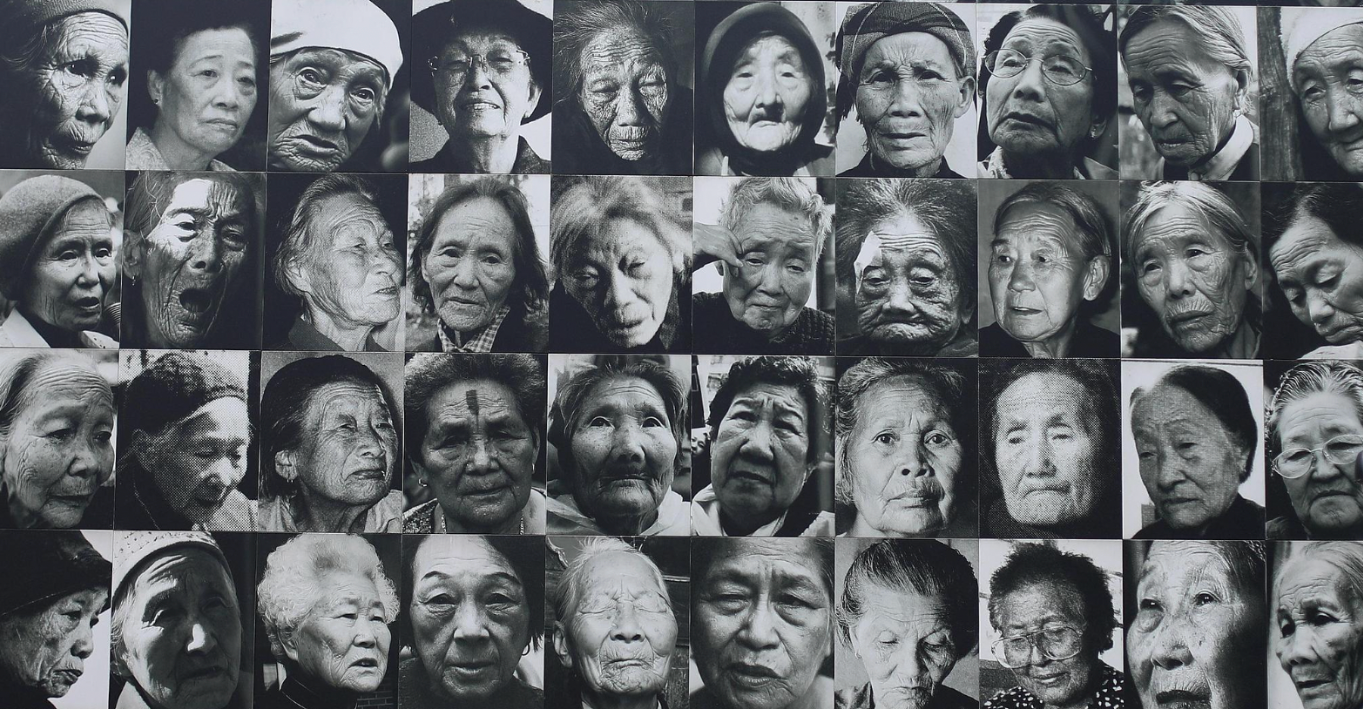
Portraits of Chinese survivors of wartime sexual enslavement line the memorial wall at the former site of a Japanese military “comfort station” in Liji Lane, Nanjing. Jiangsu Province, China, August 14, 2018. / CFP
The failure of international law to adequately redress survivors’ claims became increasingly evident as women sought legal remedies through postwar institutions that historically privileged sovereign states as primary juridical actors. Survivors, therefore, remained structurally dependent upon governments such as South Korea to pursue accountability on their behalf even as diplomatic normalization and economic cooperation were repeatedly prioritized over survivor-centered litigation. Because the jurisdiction of the International Court of Justice remained contingent upon state consent, Japan could refuse adjudication outright, thereby insulating wartime atrocities from international scrutiny and foreclosing survivors’ access to legal redress. Meanwhile, the International Criminal Court’s charter precludes prosecution for crimes committed prior to its establishment in 2002. International law thus reproduced, and continues to reproduce, a juridical order in which survivors could testify to mass sexual violence while remaining barred from the very mechanisms ostensibly constituted to remedy it.
These injustices persist into the present because the epistemic conditions through which survivors become intelligible as grievable subjects remain constitutively unstable. Japanese officials systematically destroyed substantial portions of the wartime archives at the end of the Second World War. The eradication of evidence was subsequently reinscribed into the evidentiary regimes governing legal recognition.
Positivist juridical frameworks continue to privilege state archives over oral testimony, rendering survivor narratives perpetually precarious in the face of revisionist denial. The evidentiary absence produced through archival destruction has been subsequently mobilized against survivors, such that women are denied juridical recognizability precisely because the material traces of violence were systematically eradicated by the regime that inflicted it.
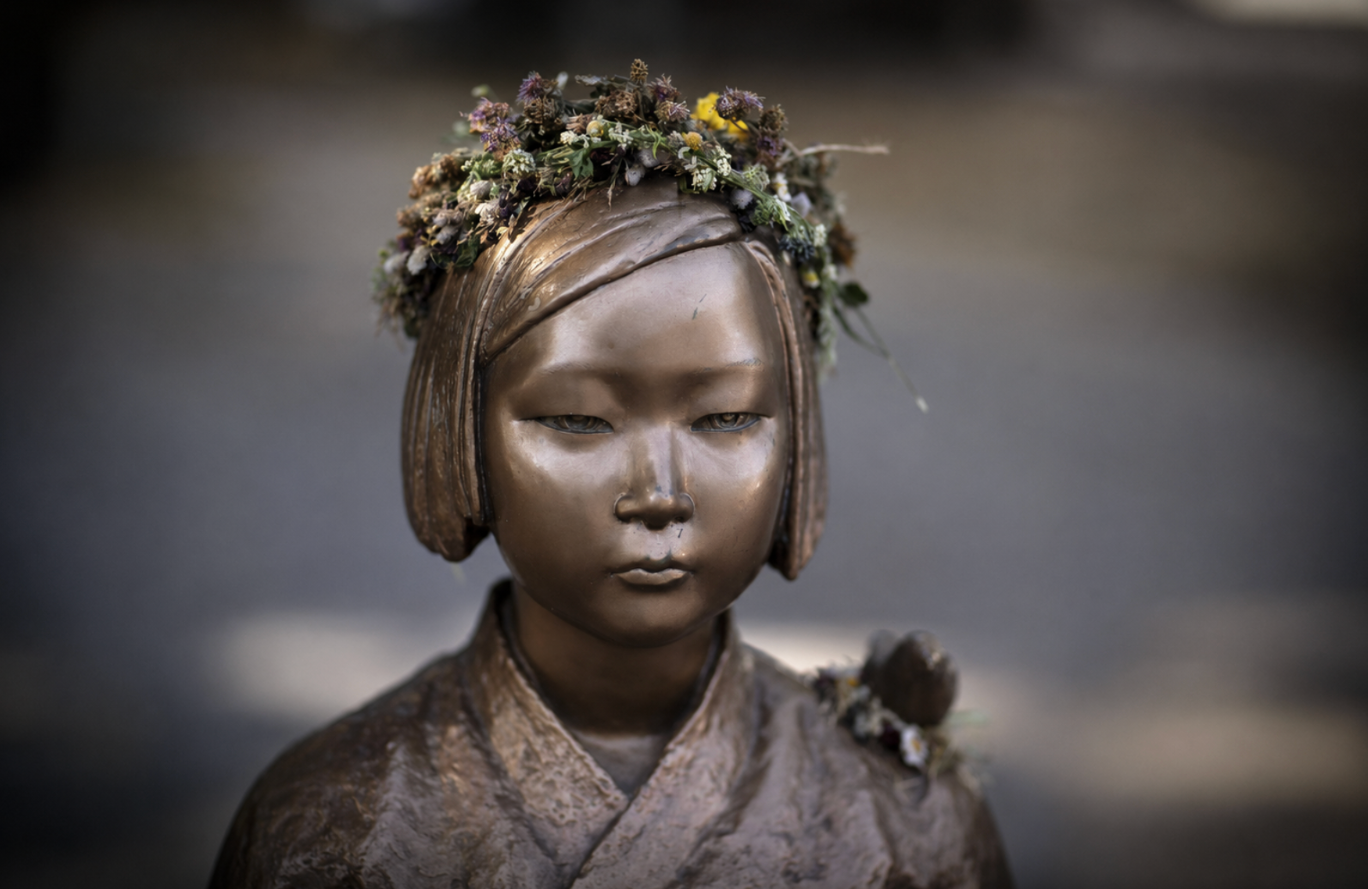
“Ari,” a Peace Statue installed in Berlin in 2020, commemorates survivors of the Japanese military’s wartime regime of sexual enslavement. Subject to sustained Japanese diplomatic pressure for its removal, the monument became a contested site of historical legibility. / Shutterstock
This evidentiary hierarchy continues to animate contemporary nationalist revisionism, as Japanese political actors repeatedly recast survivor testimony as exaggerated, inconsistent, or politically motivated while contesting textbooks, memorialization projects, and public commemoration across East and Southeast Asia. Statues commemorating survivors, such as “Ari,” have become geopolitical flashpoints precisely because they threaten official narratives of historical closure.
Today, more than eighty years after the collapse of the Japanese Empire, the overwhelming majority of survivors have died without receiving formal legal reparations. In South Korea, only five officially registered survivors remained as of March 2026. Yet the Wednesday Demonstrations, weekly demonstrations held outside the Japanese embassy in Seoul, demanding formal acknowledgment and legal reparations, continue. These demonstrations persist against the fiction that imperial violence recedes into history, even as its injuries continue to hemorrhage through the unresolved juridical afterlife of empire.
The “comfort women” case, therefore, exceeds the confines of historical atrocity. It exposes the constitutive limits of international law: a juridical order capable of rhetorically acknowledging violence while withholding enforceable reparations. It reveals an evidentiary regime that privileges state archives over subaltern testimony and a postwar order in which imperial subjects remain differentially grievable. The continued absence of comprehensive reparations thus marks the juridical afterlife of imperial hierarchy embedded within legal, archival, and geopolitical structures that continue to delimit whose suffering becomes historically intelligible and whose suffering remains perpetually contestable.
This is only the beginning of the Counterarchives Project. Future posts will excavate the histories, testimonies, and juridical afterlives of women victimized by the Imperial Japanese regime of sexual enslavement, and contextualize these histories within the normative and juridical frameworks through which imperial injury becomes historically legible while accountability remains persistently deferred. In centering these testimonies, the project seeks to restore historical intelligibility to forms of suffering repeatedly displaced into archival erasure, nationalist revisionism, and juridical silence.
메타데이터
- post_id
- 8298f91a2aad
- slug
- introduction-the-imperial-production-of-the-ungrievable-8298f91a2aad
- url
- https://medium.com/@TheCounterarchivesProject/introduction-the-imperial-production-of-the-ungrievable-8298f91a2aad
- canonical_url
- https://medium.com/@TheCounterarchivesProject/introduction-the-imperial-production-of-the-ungrievable-8298f91a2aad
- author_url
- https://medium.com/@TheCounterarchivesProject
- status
- ok
- fetched_at
- 2026-08-01 14:40:44