Column LED Screens: What They Are, How They Work, and Where They’re Used
You’ve seen them in shopping malls and airport terminals — those glowing pillars that display video from every angle. That’s a column LED…
Column LED Screens: What They Are, How They Work, and Where They’re Used
You’ve seen them in shopping malls and airport terminals — those glowing pillars that display video from every angle. That’s a column LED screen, and it’s one of the more practical display formats available for high-traffic commercial spaces. Here’s what they actually are, how the specs work, and where they make sense.
Column LED Screens
What Is a Column LED Screen?
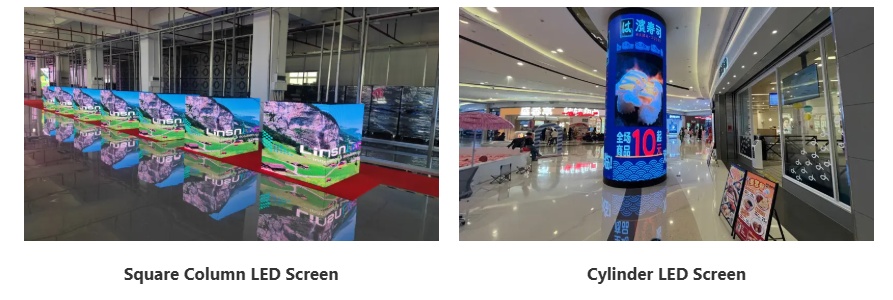
A column LED screen wraps around a structural building pillar — square, round, or rectangular — turning it into a 360-degree display surface. Unlike a flat wall-mounted screen, it broadcasts content in all directions simultaneously. No blind spots, no single viewing angle. The system consists of LED panels attached to a steel mounting frame that goes around the existing column. No structural modifications are needed. Most installations complete in one to three days.
The Two Main Types
Flexible column LED screens use soft PCB modules that physically bend around curved surfaces. They’re the right choice for round or cylindrical pillars where a seamless finish matters. Rigid modular systems use flat panels arranged in a polygon — four panels on a square column, for example. They cost less and install faster. For most square-column applications, rigid is the practical choice.
Key Specs to Understand
Pixel pitch is the gap between LED pixels in millimeters. Smaller = sharper = more expensive. For close-range viewing (under 3 meters), P2 to P3 is appropriate. For viewing distances of 5 meters or more, P4 to P6 delivers the same visual quality at a lower cost. Brightness is measured in nits. Indoor column screens typically run 1,000–2,000 nits, which is enough to compete with ambient lighting. Outdoor installations need 4,000–6,000 nits to stay visible in direct sunlight. IP rating determines weatherproofing. IP43 is the minimum for indoor spaces. IP65 is required outdoors, or anywhere near open air — covered walkways, transit platforms, atrium lobbies. Refresh rate affects how the screen looks when photographed. For general display use, 1,920 Hz works fine. For environments where phones and cameras are frequently pointed at the screen — retail, events, broadcast — 3,840 Hz or higher avoids flicker bands in captured images.
Where They’re Used
Shopping malls were the first to adopt pillar LED displays at scale. A column positioned in the center of a walkway reaches foot traffic from every direction — which typically outperforms a wall display several times its size. Hotels and lobbies use them for brand content, event schedules, and ambient visual installations. The column format adds to the architecture rather than interrupting it. Airports and transit hubs combine advertising, flight information, and wayfinding on a single pillar surface. Dwell time is high and audiences are captive. Stadiums use them in concourses and concession areas, where viewers are constantly moving and no single screen angle works for everyone. Corporate offices increasingly use them in reception areas and campus lobbies for internal communications and visitor-facing brand content.
What to Check Before Buying
Measure your column first — shape, face width, height, and any physical obstructions. Without these numbers, no supplier can quote you accurately. Match pixel pitch to your actual viewing distance, not the sharpest option available. Ask whether the system supports front-access module replacement — on a column installation, rear access is often impossible after the screen goes up. Ask for completed column-specific project references, not just general LED display work. Column installations require tighter tolerances than flat panels, and the difference shows immediately on a lit screen.
For full specifications, pricing ranges, installation steps, and a complete buyer’s guide: 👉 Column LED Screen: Types, Specs, & Applications Explained
메타데이터
- post_id
- 82c36d70d95f
- slug
- column-led-screens-what-they-are-how-they-work-and-where-theyre-used-82c36d70d95f
- url
- https://medium.com/@linsnled/column-led-screens-what-they-are-how-they-work-and-where-theyre-used-82c36d70d95f
- canonical_url
- https://medium.com/@linsnled/column-led-screens-what-they-are-how-they-work-and-where-theyre-used-82c36d70d95f
- author_url
- https://medium.com/@linsnled
- status
- ok
- fetched_at
- 2026-06-09 15:37:30