Bargains Made Without Us
Why Legitimacy Is Always Paid for in Arrears
Bargains Made Without Us
Why Legitimacy Is Always Paid for in Arrears
June 20, 1789. The Third Estate arrives at their meeting hall at Versailles to find the doors locked. No explanation. No notice. Just soldiers standing guard outside.
They have been gathering for six weeks to draft a constitution for France. For six weeks, the king’s government has been stalling, delaying, managing. Now the locks speak more plainly than any royal communiqué: you are not needed here. The decisions will be made without you.
So the Third Estate does what excluded people eventually do. They find another room — a nearby tennis court — and swear an oath not to disperse until France has a constitutional settlement. Three weeks later, a fortress falls. Three years after that, a king loses his head. A decade after that, the guillotine has processed forty thousand people, the country is at war with most of Europe, and a Corsican artillery officer is rewriting the continent.
All of it — from the Tennis Court Oath to Waterloo — can be read through a question nobody in Versailles was willing to answer honestly: who was at the table when the terms were set?

Le Serment du Jeu de paume by Jacques-Louis David (c. 1791), depicting the Tennis Court Oath
This is not primarily a question about the French Revolution. It is a structural question about how civilizational bargains gain legitimacy — and what happens when they don’t. The answer, across eight centuries of evidence, is consistent. Bargains made without the consent of those they govern accumulate a debt. The debt compounds silently. And eventually, one way or another, it is paid.
This is not an argument that all renegotiations are equally violent — one case in this essay shows they need not be. It is not cultural relativism — some of the bargains described here were deeply unjust, and the essay says so. It is not historical fatalism — human agency shapes these outcomes, even when the structural pressures are immense. It is a structural argument about how legitimacy actually works, visible only when you take the long view.
Three Terms That Get Confused
Political philosophy has given us three related concepts that most people use interchangeably, and shouldn’t.
The **social contract** is the philosopher’s device. Hobbes, Locke, Rousseau all used it — an imagined agreement among individuals to surrender some freedom in exchange for the order that makes everything else possible. Nobody signs it. It is a theoretical reconstruction of why authority might be legitimate. Useful for philosophy seminars. Less useful for understanding why France guillotined its king.
The social compact is closer to the lived reality. It is the practical, ongoing agreement among members of a society about how to treat each other. Unwritten, culturally transmitted, maintained through daily civic life. The social compact is what you feel when a stranger holds a door, when a driver yields at a junction, when a clerk follows the rule even when breaking it would be easier. It is civic culture rather than formal framework.
The **civilizational bargain** is different from both. It is the specific terms a civilization has negotiated — usually under existential pressure — about who holds authority, over what, on whose behalf, at what cost to whom. Historical. Specific. Improvised under duress. Every civilization has one. Most were made in crisis. None were made by everyone they affect.
This essay is about the civilizational bargain. And specifically about one feature that determines everything else about its durability: **provenance**. Who negotiated it. Under what conditions. With whose consent.
The most just bargain in the world, imposed without consent, accumulates a legitimacy debt. The most imperfect bargain, genuinely negotiated, generates ownership. Content matters morally. But provenance determines durability.
This is the key that unlocks eight centuries of political violence. And of the rarer moments when that violence was avoided.
How Bargains Are Actually Made
Forget the image of philosophers in a room, debating first principles until they reach an optimal constitutional settlement. That is not how civilizational bargains are made.
They are made at Runnymede, where King John — cornered by barons who had run out of patience — signed a document he immediately petitioned the Pope to annul. The Magna Carta was not a constitutional philosophy. It was a hostage situation. The barons wanted specific protections for specific grievances. They got a king’s signature under duress on a June afternoon in 1215.
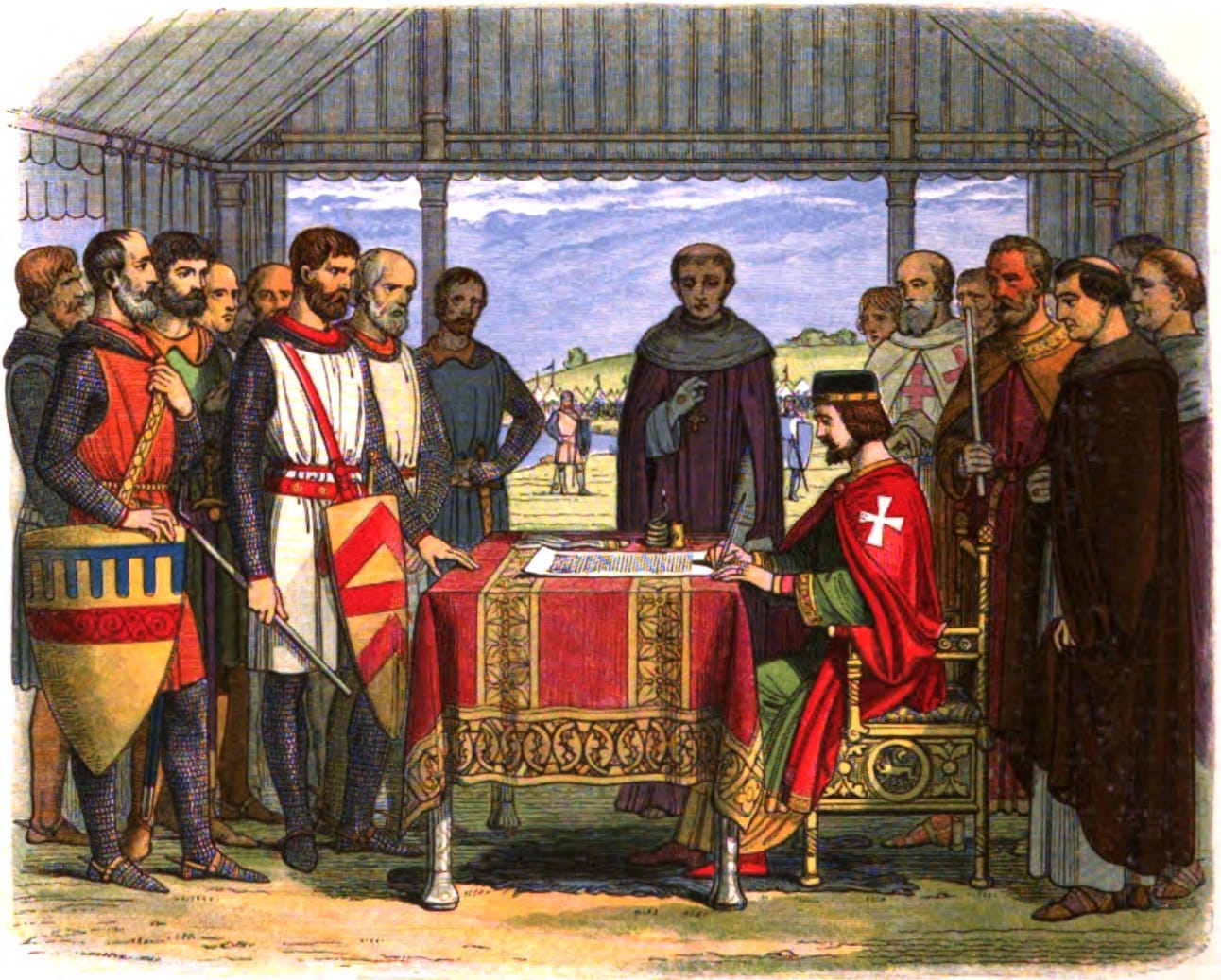
A romanticised 19th-century recreation of King John signing Magna Carta. Rather than signing in writing, the document would have been authenticated with the Great Seal and applied by officials rather than John himself.
The document matters, eventually, for something the barons never anticipated: it establishes the precedent that even a king can be made to acknowledge his power has limits. But ninety-eight percent of England was not at Runnymede. The peasants who ploughed the barons’ fields were not at Runnymede. The women of England were not at Runnymede. The document that would launch a thousand constitutional claims excluded virtually everyone it would eventually be used to protect.
This is how bargains work. Improvised by those who happen to be powerful in the moment of crisis, solving the problem of that moment. The downstream effects — who inherits the terms, who is bound by provisions they never agreed to, whose interests were traded away as the price of someone else’s security — belong to history.
The Peace of Westphalia (1648) is the most expensive example. After the Thirty Years War had killed between five and eight million people — perhaps twenty percent of Germany’s population — exhausted diplomats gathered in Osnabrück and Münster to write a settlement. The war had begun over a question that felt, in 1618, like the most important question in the world: who has the authority to define religious truth? Catholic or Protestant? Empire or principality? Pope or prince?
The settlement reached in 1648 did not answer that question. It quarantined it. Cuius regio, eius religio: whose realm, his religion. No one would agree on theology. They would agree on jurisdiction. The ruler of a territory determines its official faith. Citizens who cannot live under those terms may leave for a territory whose ruler believes otherwise.
This was Tiebout before Tiebout — the insight that people sort toward the jurisdictions that fit their preferences, and that this sorting can be made to function if exit is possible. What the diplomats of Westphalia discovered through exhaustion, the economist Charles Tiebout formalised in a 1956 paper. The resolution of a civilizational bargain about religious authority was, at bottom, an early proof of a sorting mechanism that economists would not name for three more centuries.
The five to eight million bodies between the opening shot and the treaty are the price of that discovery.
Bargains are made this way everywhere — not through philosophical consensus but through exhaustion, crisis, and the art of the survivable. Indonesia’s founding fathers removed seven words from the Jakarta Charter overnight in August 1945 to prevent the Christian eastern islands from breaking away. Singapore’s independence was negotiated in 25 days, so secretly that senior ministers who hadn’t been told signed the documents while “eating and drinking till past midnight.” Both were improvised under duress. Both solved the immediate crisis. Both created downstream problems still compounding today.
The improvisation is not a flaw. It is a feature of how humans make consequential agreements under pressure. The question is never whether bargains will be imperfect. They will. The question is always: who was excluded when they were made?
The Legitimacy Debt
When people are excluded from the bargain that governs them, a debt accumulates. It compounds silently — sometimes for decades, sometimes for centuries — while the bargain is maintained by force, institutional inertia, or the founding generation’s memory of why the terms were necessary. The debt is invisible to those it benefits. It remains invisible to almost everyone until the moment it becomes unavoidable.
Three cases, three debt structures.
The clearest case.
The United States founding bargain explicitly encoded slavery. Not by accident or oversight — by design, in documented negotiations. The three-fifths compromise. The fugitive slave clause. The twenty-year protection of the international slave trade. These provisions were made with zero consent from the four million people whose lives they governed most directly. The debt was not subtle. It was written into the founding documents.
For seventy-five years, the debt was managed, argued over, geographically contained, and periodically renegotiated in Congress. None of those renegotiations were sufficient because none addressed the foundational problem: the bargain excluded those most affected from its terms. When the debt came due, it required the bloodiest war in American history — 620,000 to 750,000 dead — to begin resolving. And even then: the renegotiation was incomplete. The Reconstruction bargain that followed was itself imposed without full consent — sharecropping, Black Codes, convict leasing. The unfinished renegotiation is still paying interest today.
The principle: the more complete the original exclusion, the larger the legitimacy debt, and the more violent the eventual collection.
The invisible case.
The Catholic Church’s monopoly on religious interpretation in Western Europe was not a bargain anyone had explicitly agreed to. It accumulated over centuries through institutional power, conversion by conquest, and the systematic suppression of dissent. By 1500, most Europeans would not have experienced it as a bargain at all. It was simply the world. The legitimacy debt was invisible to almost everyone, including those who bore it.
Luther’s 95 Theses in 1517 were not primarily a theological innovation. They were a legitimacy challenge: by what right does a single institution claim interpretive authority over every Christian’s relationship with God? The challenge resonated across Europe not because the theology was universally persuasive but because the grievance was universally felt. The debt had been accumulating for a long time.
What followed was 130 years of war, ending with Westphalia in 1648. The resolution was jurisdictional, not doctrinal. Nobody agreed that Lutheranism and Catholicism were equally true. They agreed that neither could impose on the other’s territory. The minimum viable renegotiation: not agreement on substance, but agreement on who has authority over what.
The principle: bargains that feel natural, ancient, and self-evidently legitimate can carry enormous legitimacy debt invisible to those who benefit from them. The debt becomes visible only when the challenge is made.
The exceptional case.
South Africa’s apartheid bargain was made without Black South African consent — obviously, explicitly, by design. The legitimacy debt was total. By the calculus of the previous two cases, the renegotiation should have been maximally violent.
It was not — relatively. The Truth and Reconciliation Commission chose acknowledged truth over maximalist justice: confess publicly, receive amnesty. Nelson Mandela and F.W. de Klerk made deliberately non-maximalist choices, accepting less than their constituencies wanted in the interest of a viable transition. The violence was real but contained.
This case breaks the pattern’s apparent determinism. The debt was enormous. The violence was not inevitable. But the conditions were specific: extraordinary leadership on both sides making simultaneously non-maximalist choices, at a moment when sustained resistance and international pressure made de Klerk’s calculation of unsustainability plausible. These conditions were fragile, unrepeatable, and extraordinary.
But they existed. South Africa happened. The thesis is therefore not great legitimacy debt always produces great violence. It is: great legitimacy debt creates great pressure toward violence, which requires specific and extraordinary conditions to deflect. Understanding those conditions is more useful than assuming the worst.
How Renegotiations Happen
Three paths. Not a taxonomy — a recognition that different conditions produce different outcomes.
Violent rupture.
The French Revolution is the master case, and the most instructive precisely because it went wrong.
The French case involved not one illegitimate bargain but three simultaneously: divine right monarchy, noble privilege, and Church authority. Each had its own legitimacy debt. Each debt had its own creditors. When the system broke in 1789, all three renegotiations began at once.

ine émigrés are executed by guillotine, 1793
The concurrent collapse was the catastrophe. Any single renegotiation might have been manageable. All three at once produced the Terror — forty thousand guillotined, hundreds of thousands dead in the Revolutionary Wars. Then Robespierre himself consumed by the revolution he architected. Then Napoleon imposing order by replacing contested authority with authoritarian clarity.
The revolution proclaimed liberty, equality, fraternity. It used the guillotine to enforce conformity. The new bargain was proclaimed loudly and held with as little consent as the old one. Which is why France has had five republics, two empires, and a commune since 1789 — each renegotiation of the previous renegotiation’s failures.
Here the Haitian Revolution offers a clarifying parallel, often omitted from European-centric histories. In 1791, enslaved people in what is now Haiti — then Saint-Domingue, France’s most profitable colony — began the only successful slave revolution in recorded history. The French bargain had no provision for the consent of 500,000 enslaved people producing the sugar that funded Versailles itself. The renegotiation was total. By 1804, Haiti was independent. The debt had been called in full, and France — still insisting on its own revolutionary ideals — refused to recognise Haiti for decades.
The principle: concurrent renegotiation of multiple civilizational bargains is maximally destabilising. And the debt will be paid by those who held it, whether or not the collectors have polite methods available to them.
Negotiated separation.
When two parties within the same bargain hold incompatible visions and both are capable of exit, separation is sometimes the cleanest resolution.
Malaysia’s founding bargain in 1957 encoded ethnic primacy — Malay political supremacy in exchange for economic space for Chinese and Indian communities. Singapore’s PAP leadership insisted on multiracial meritocracy. These were not merely different preferences. They were mutually exclusive constitutional logics. You cannot have Malay primacy and meritocracy as simultaneous organising principles in the same polity.
The 25-day covert operation that produced Singapore’s independence in 1965 was the sorting mechanism working at the civilizational level. Both parties found the merger more expensive than the separation. Both pursued their own bargain. Both eventually thrived on incompatible terms in adjacent territories.
Separation is not failure. It is what happens when two incompatible bargains share a territory and both parties are honest enough to acknowledge the incompatibility before the violence begins.
Transformation.
The rarest path. Two cases show its possibilities and its limits.
*Meiji Japan (1868).* The feudal settlement — shogunal authority, samurai class, deliberate isolation from the world — was renegotiated by reformers using the Emperor as legitimating cover. Japan went from feudal to industrial in approximately thirty years. The Satsuma Rebellion — the last armed resistance of the samurai class — was crushed within a year because the reformers had genuine internal authority and worked within the cultural logic of Japanese society rather than against it. They renegotiated the political and economic bargain while preserving cultural identity. The bargain changed; the civilizational continuity held.
South Africa’s TRC (1996–1998). Already named above as the exceptional case. The TRC was not merely a political settlement — it was a novel institutional mechanism invented for the specific terms of South Africa’s legitimacy debt, not borrowed from someone else’s context. Acknowledged truth in exchange for amnesty, as an alternative to the prosecution-and-punishment cycle that might have shattered the fragile transition. It worked partly because it was designed rather than inherited.
The cautionary contrast is *Atatürk’s Turkey.* Top-down internal renegotiation that exceeded its mandate. Atatürk renegotiated not just the political and economic bargain but the cultural identity itself — abolishing the Caliphate, replacing Arabic script with Latin, banning religious dress — without sufficient internal consent for that deeper revision. Turkey’s century of tension between Kemalism and Islamism is the ongoing cost. Even internal actors can create legitimacy debt. The question is always: who consented to the specific terms being changed?
What External Actors Cannot Do — And What They Can
When a civilizational bargain loses legitimacy from within, external actors face a specific and recurring temptation: to impose the correct values from outside, at scale, with speed. The temptation is understandable. The results are predictable.
The colonial record is the comprehensive empirical test. Dutch colonial architecture in Indonesia was an optimisation for resource extraction: concentrate population, railways, and administration on Java; rule the outer islands cheaply through indirect authority. It solved the Dutch problem of governing a vast archipelago at low cost. It created an Indonesian inheritance — extreme population concentration on a small island, a centralised bureaucracy designed for control rather than consent — that no independence declaration could erase. Systems don’t forget whose problems they were optimised for.
The British approach in Malaya was surgical and equally consequential. Malays to land and administration. Chinese to commerce. Indians to plantations. Each segmentation encoded in administrative law, immigration policy, and educational access. What looked like divide-and-rule was actually something more durable: the hardening of what might have been fluid social categories into structural facts. Malaysia’s ethnic politics today are not a failure of national will. They are the direct inheritance of a colonial bargain made without the consent of those it structured.
The deepest case is the one that eventually reformed itself: Christian missions.
For centuries, the gospel travelled alongside gunboats. The Treaty of Nanking (1842) that opened China to missionary work was the same treaty that forced China to pay 21 million silver dollars in reparations and ceded Hong Kong. In Canada, approximately 150,000 Indigenous children were placed in mission-run residential schools between the 1880s and 1990s. The Truth and Reconciliation Commission identified over 4,100 who died while enrolled. The medicine was real. The delivery system was catastrophically compromised.
The reckoning came through the Lausanne Movement of 1974, when evangelical leaders from around the world gathered to ask an uncomfortable question: had missions confused the gospel with Western cultural preferences? The answer was yes. The response was structural: contextualization, indigenous leadership, humility, the willingness to step back. Missionaries redefined their role from governors to trainers, from permanent fixtures to temporary catalysts.
The statistical result is the strongest empirical case in this essay for what accompaniment can achieve. In 1900, there were approximately 9 million Christians in Africa. By 2020, there were over 685 million. Christianity grew fastest on the African continent not when Western missionaries imposed it, but when Africans were allowed to own it as their own. South Korean missionaries now serve in the Middle East. Brazilian evangelists work across the least-reached regions of the world. African pastors preach in European cathedrals.
The lesson is: value systems spread faster when they stop being externally imposed. The external actor’s legitimate role is accompaniment, not imposition. Catalysis, not governance. Equipping internal reformers without capturing them. Enabling exit without demanding compliance. Making the internal renegotiation possible without determining its terms.
This is harder to sustain than imposition. It requires more patience, more humility, and a willingness to accept that the outcome of the renegotiation may not match the external actor’s preferences. But it produces change that lasts, because it is owned.
The Renegotiations Now in Progress
Three renegotiations are visible in the present, illuminated differently by the historical arc.
Iran.
The Islamic Republic superimposed a theocratic bargain on a civilisation with a deep pre-Islamic tradition of managed pluralism. The Cyrus Cylinder — issued when the Persian king conquered Babylon in the sixth century BCE and permitted its populations to maintain their own religious practices — predates the Islamic Republic by 2,500 years. The 1979 revolution was not the culmination of Persian civilizational history. It was a rupture: the hardening of one interpretive tradition into constitutional supremacy, imposed during revolutionary momentum on a society with a much older and more pluralist institutional memory.
The current protests are not primarily about economic hardship. They are contesting the foundational claim: can religious interpretation serve as constitutional authority? This is the 1517 question, asked 500 years later. If the uprising succeeds from within — without foreign invasion, without external imposition — it will not simply change a government. It will discredit a model. It will demonstrate that theocratic constitutionalism cannot maintain legitimacy even in a society of deep religious faith, once the population becomes educated enough to question monopoly interpretation. That lesson would reverberate far beyond Iran’s borders — into every society still navigating the relationship between faith and governance.
The most important thing external actors can do for this renegotiation is precisely what Lausanne learned: support the internal reformers without making the reform look like a Western project. The moment the Iranian uprising is successfully characterised as Western-sponsored, its domestic legitimacy is compromised. The renegotiation must be owned by Iranians to be durable.
Japan.
Japan’s civilizational bargain encoded cultural homogeneity as the load-bearing wall of social coordination. A dense, resource-poor island nation needed extraordinary coordination, and cultural uniformity was its most efficient mechanism. The bargain worked spectacularly — from the Meiji industrialisation through postwar reconstruction to economic superpower status.
But the bargain contained a hidden assumption: that the Japanese population would sustain itself biologically. That assumption is now empirically failing. Total fertility rate around 1.2. Population peaked in 2008 and is declining. Projections suggest below 88 million by 2065. The pension system is structurally strained. The labour shortage is already acute.
Here is the internal contradiction the next Japanese generation will be forced to name: the bargain was designed to preserve Japanese civilisation. If it is not renegotiated, it may instead accomplish Japanese civilisation’s demographic extinction. You cannot preserve a culture if there is no one left to carry it.
This renegotiation cannot be imposed from outside. The question will be asked by Japanese people themselves — probably the generation now in their 20s and 30s, who will inherit both the cultural identity and the fiscal consequences — when the arithmetic becomes undeniable. The question is genuinely hard: which is more essential to Japanese identity — the population that carries the culture, or the cultural purity the population was meant to protect? The Muslim burial case, the mosque protests, the permit refusals — these are small skirmishes in the early stages of a much larger renegotiation that has not yet been named. It will be.
The Islamic Reformation.
Multiple Muslim-majority societies are navigating — at different speeds, through different mechanisms — the equivalent of Christianity’s 16th and 17th century crisis: whether religious authority can claim constitutional supremacy, and if not, what should replace it. The reformists — legal scholars like Abdullahi An-Na’im, public intellectuals like Maajid Nawaz, philosophers like Abdolkarim Soroush, the Iranian protesters, the Tunisian constitutional moment before its reversal — are doing the hard theological work of arguing that no single interpretation of Islam should govern civic life.
This work is slow, dangerous, and poorly supported. Reformers face hostility from traditionalists who experience reform as betrayal, and weaponisation by outside critics who absorb their arguments into anti-Islam narratives. They are doing exactly what Lausanne called for: internal, contextualised, owned renegotiation of their own civilizational bargain. They need support, not absorption. Space, not direction. The worst thing external observers can do is make the Islamic Reformation look like a Western civilizational victory.
Christianity’s renegotiation took from 1517 to 1648, a 131 years of conflict, then a settlement. Islam’s equivalent is happening now, in a more compressed timeframe, under worse conditions: globalisation, mass migration, digital media, and live geopolitical conflict simultaneously, with the entire world watching and judging every move. Whether it takes 131 years or finds a faster path depends substantially on whether the internal reformers are supported or abandoned.
The Durable Bargain
Eight centuries of evidence produce a pattern too consistent to dismiss.

Bargains gain legitimacy through provenance, not content. A just bargain imposed without consent generates resistance. An imperfect bargain genuinely negotiated generates ownership. The moral quality of the terms matters enormously for what the bargain produces. But the durability of the bargain — how long before the legitimacy debt is called — depends on who was at the table when the terms were set.
The most expensive bargains in history were not the ones with the worst content. They were the ones that excluded the most people from their making. The French Revolution’s violence was not proportional to the badness of the ancien régime. It was proportional to how many people — 97% of the French population — had never been consulted about any of it. The American Civil War’s cost was not proportional to slavery’s economic importance. It was proportional to four million people written out of the founding documents entirely.
The most durable bargains are not those with the best content. They are those that built in the capacity for their own revision.
The Magna Carta’s specific provisions were largely obsolete within a generation. What endured was the precedent: authority has limits; those limits can be renegotiated; the mechanism for renegotiation can itself be institutionalised. The United States Constitution is flawed in ways its drafters knew and acknowledged. What has made it relatively durable — 237 years, 27 amendments — is the amendment process itself: the provision for internal revision built into the original bargain.
This is the hard lesson that civilizations keep learning expensively: the earlier a bargain acknowledges its own legitimacy gaps and builds mechanisms for internal renewal, the less violent its renegotiation will be.
The ones that resist acknowledgment — that insist their terms are settled, that suppress internal challenge, that treat renegotiation as existential threat rather than natural process — are the ones that eventually pay compound interest. They pay it in the currency history has always preferred for these transactions: blood, time, and the destruction of what the bargain was originally designed to protect.
We are living inside several such renegotiations right now. Iran’s internal rejection of theocratic constitutionalism. Japan’s approaching confrontation with demographic arithmetic. The Islamic Reformation navigating the space between tradition and modernity under global scrutiny. Western liberal democracies contesting the terms of their own post-war settlement. Each one following the same structural logic, each one shaped by the specific conditions and specific choices of those who live inside it.
The question is not whether these bargains will be renegotiated. They will. It is only who will be at the table when the new terms are set — and how much the delay will cost.
The real issue was never simply which civilization made better bargains. It was whether any civilization had the wisdom to build the renegotiation into the original terms.
Most didn’t. The ones that did are still standing.
메타데이터
- post_id
- 82da6817e5ad
- slug
- bargains-made-without-us-82da6817e5ad
- url
- https://medium.com/@darwingosal/bargains-made-without-us-82da6817e5ad
- canonical_url
- https://medium.com/@darwingosal/bargains-made-without-us-82da6817e5ad
- author_url
- https://medium.com/@darwingosal
- status
- ok
- fetched_at
- 2026-06-10 21:21:38