Earthlight vs Earthshine
People get earthshine confused for Earthlight but not Leonardo da Vinci or Dr. Sian Proctor
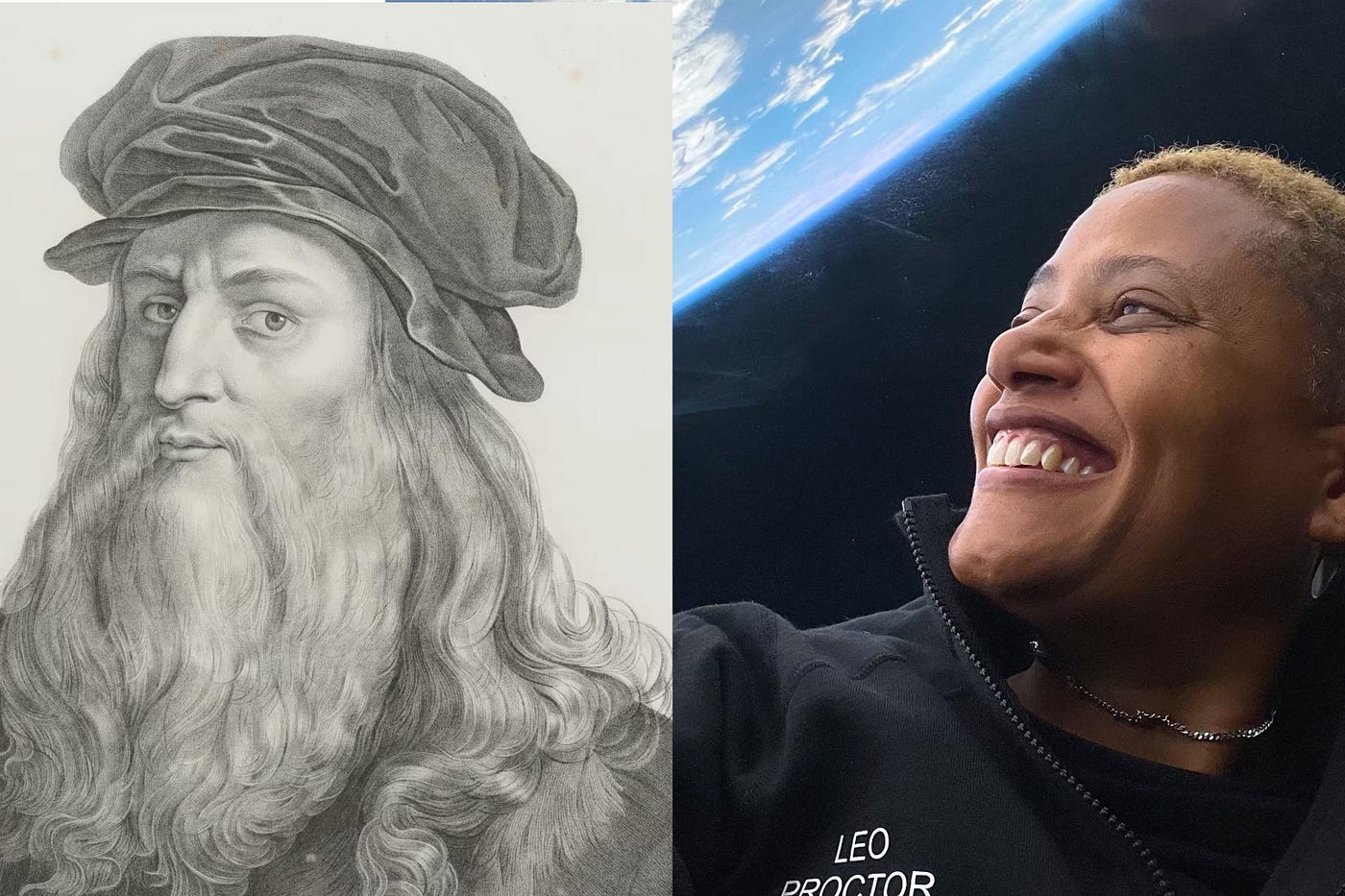
Earthlight polymaths: Leonardo da Vinci and Dr. Sian “Leo” Proctor
Earthlight vs Earthshine
People get earthshine confused for Earthlight but not Leonardo da Vinci or Dr. Sian Proctor
There is a word people reach for when they first hear about Earthlight. They say, “Oh, you mean earthshine.” They mean well. They are also wrong, and the difference between the two words is the difference between looking at a thing and understanding what the thing is.
Let me draw the line clearly, because the line matters.
What Earthshine Is
Earthshine aka “the Da Vinci Glow” is the faint glow you can see on the dark portion of a crescent Moon. The bright sliver is direct sunlight. But look closely at the shadowed part, the part that should be black, and you will see it dimly lit, a ghostly gray disk cradled inside the lit crescent. Poets have called it “the old Moon in the new Moon’s arms.”

Leonardo da Vinci on earthshine, Codex Leicester
The mechanism is simple once you see it. Sunlight strikes Earth. Earth reflects a portion of that light out into space. Some of that reflected light lands on the Moon’s night side, and some of that bounces back to your eye. Earthshine is sunlight that has made a round trip: Sun to Earth to Moon to you.
Roughly five hundred years ago, Leonardo da Vinci figured this out. In the Codex Leicester, compiled in the first decade of the 1500s, he sketched the crescent Moon and worked out that the ashen glow on its dark side was not the Moon producing its own light but Earth’s light reflected onto it. He described planetshine a full century before Kepler proved it, and he did it by looking carefully and reasoning honestly. He even guessed, wrongly on the details but rightly in spirit, that Earth’s oceans were doing much of the reflecting. Modern instruments later showed clouds do most of the work, but Leonardo had the shape of the truth.
So earthshine is a geometry problem. It is about where light goes. It is one of the loveliest facts in naked-eye astronomy, and it is entirely about reflection and angle.
What Earthlight is
Earthlight is not about where the light goes. It is about what the light is.
Dr. Sian “Leo” Proctor named Earthlight aboard the SpaceX Inspiration4 mission in 2021, when she found herself bathed in the light coming off our planet and understood, viscerally, that she was not simply seeing reflected sunlight. She was inside the signal of a living world.

Dr. Sian “Leo” Proctor and the art she created while in orbit and bathed in Earthlight
Here is the distinction. The sunlight that arrives at Earth is generic starlight, the same light that falls on Mars or the Moon or an empty stretch of vacuum. But the light that leaves Earth is not generic anymore. It has been transformed. Three billion years of living systems have processed this planet’s surface and atmosphere. Photosynthesis filled the air with oxygen. Oceans, forests, phytoplankton, weather, the whole vast machinery of the biosphere has altered the chemistry of what reflects and what absorbs. So the light that departs Earth carries a spectral signature, a fingerprint that says: a living planet made this.
That is Earthlight. It is sunlight remade by life into the outgoing signal of a living world. It is measurable. It is singular. It is essential. And astronomers looking for life on distant exoplanets are searching for precisely this kind of biosignature in the light of other worlds. When they find it, they will be finding another planet’s Earthlight.
Earthlight or Earthshine? The confusion is understandable (and why it still matters)
You can see how the words collapse into each other. Both involve light coming off Earth. Both involve reflection. If you squint, they look like the same phenomenon described twice.
But earthshine describes a path and Earthlight describes a substance. Earthshine answers “how does Earth’s light reach the Moon?” Earthlight answers “what is Earth’s light carrying?” One is optics. The other is biology written into photons.
And here is the part worth sitting with. Leonardo did not confuse them, because Leonardo was doing the harder thing. He was not content to see the pretty glow and name it. He asked what it actually was, and followed the reasoning until he understood the mechanism underneath the appearance. Dr. Proctor did the same thing, in the same spirit, five centuries later and from orbit. She was not content to say “how beautiful, Earth reflects light.” She asked what that light was, and understood it as the living signal of a living planet. Beyond this, Dr. Proctor proposes, Earthlight is not something Earthlings can sustainably live without.

Earthlight World
That is the through-line between a Renaissance polymath with a notebook and a twenty-first-century astronaut in low Earth orbit. Neither one stopped at the surface of the phenomenon. Both insisted on knowing the thing itself.
Earthlight Is The One You Can Feel
There is a final difference, and it is the one that reframes everything.
Earthshine you observe. You stand in a field, you look up at the crescent Moon, and you notice the dim ghost of the full disk. It is out there, at a distance, a fact about the sky.
Earthlight you are inside of. It is inside you. You are not observing Earthlight from a distance. You are standing in it right now. It is the light your planet is broadcasting into the universe as its living signal, and you are one of the countless living things whose breathing and growing and metabolizing helps compose it. When Dr. Proctor encountered Earthlight in orbit, what she understood was not a fact about the sky. It was a fact about belonging. You don’t have to go to space to be part of that light. You already are.
Earthshine is something Earth does to the Moon.
Earthlight is something life does to light, and something we all are made of.
Get the two confused if you like. You will be in good company with a lot of well-meaning people. Just know that Leonardo would have corrected you, gently, and so would Dr. Proctor, and both for the same reason: the phenomenon is more astonishing than the confusion allows.
Mike Mongo is a commercial astronaut, Astronaut Teacher, and author. With Dr. Sian “Leo” Proctor he is co-author of the upcoming Earthlight World, and story writer of the fulldome show Earthlight World: An Astronaut’s Journey, now showing at the Charles Hayden Planetarium at the Museum of Science, Boston.

PR HORSE. We Do Everything For Attention.
메타데이터
- post_id
- 82df6d6bdb71
- slug
- earthlight-vs-earthshine-82df6d6bdb71
- url
- https://medium.com/@PRHORSE/earthlight-vs-earthshine-82df6d6bdb71
- canonical_url
- https://medium.com/@PRHORSE/earthlight-vs-earthshine-82df6d6bdb71
- author_url
- https://medium.com/@PRHORSE
- status
- ok
- fetched_at
- 2026-07-13 06:23:13


