Dina-Perla Portnaar: Dutch politics will remain trapped
between empty pragmatism, moral absolutism, and dangers of collapsing
Dina-Perla Portnaar: Dutch politics will remain trapped
Between empty pragmatism, moral absolutism, and dangers of collapsing

I’ve never hidden where I stand politically. In contemporary Dutch politics, uncertainty is often performed as nuance, while in reality it functions as self preservation. It allows people to drift along the edges of responsibility, commenting without committing, and analyzing without consequence.
My ideas are liberal in the classical sense, not as a marketing term we have known all too well for a long time, but as a demanding ethical position. In fact, my philosophy humanecy is the next phase. Liberalism, when taken seriously, isn’t permissive, soft, or just about freedom.
It assumes moral adulthood when others cannot bring themselves to show any. It rests on the idea that individuals are free, but therefore accountable, that pluralism is a strength, but therefore fragile, and that the role of the state isn’t to moralize life, but to make coexistence possible (special message for the mayor of Amsterdam). Yet, all of this isn’t enough for the world we live in, but that’s for another article.
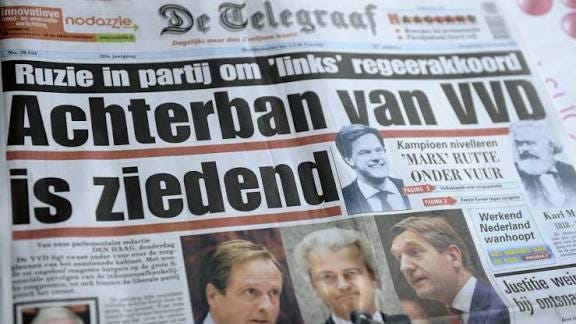
In the Netherlands today, that position has no solid political home. On the right, what exists isn’t a coherent party but a landscape of fragments. Parties that define themselves reactively, whose identity is shaped less by a vision of society than by resentment towards enemies — sometimes, rightly so. In other words, reactive politics.
The desire for a serious, classically liberal right wing party is widespread, yet unmet. What fills the gap instead is a politics of irritation, suspicion, and nostalgia, none of which translate enough into sustainable governance.
Now, this is the first time I will express my thoughts on Forum voor Democratie, part of that fragmentation on the right. The party stepped into the right with remarkable theatrical and commercial skill. Now, it presents itself as intellectually superior, and as a movement that thinks in long lines while others manage decline. But what it offers is staging.
Its relationship to philosophy is ornamental. Ideas are invoked as symbols of depth, not as disciplines that impose limits. There’s an almost adolescent fascination with grand narratives, civilizational decay, and heroic resistance. What’s missing is the healthy, adult work of political ethics.
That absence matters. When politics becomes an aesthetic project with fascism in its ‘umfelt’, responsibility dissolves. Its tolerance — possibly love — for authoritarian impulses, proximity to extremist figures, and erosion of trust in democratic institutions aren’t deviations from its identity. They’re expressions of it. If politics is treated as a cultural rebellion rather than a civic practice, then destabilization becomes a key feature. This doesn’t absolve the rest of the political spectrum.
The Dutch left is in deep trouble, because it increasingly confuses moral intensity with political clarity. What presents itself as progressiveness often relies on rigid identity frameworks, on a vocabulary that flattens complexity into dogma, and that is fed by new types of fascism with deep roots in religion and ideology.
Disagreement is moralized and dissent pathologized. In that climate, antisemitism thrives. This type of fascism with even a crusade consciousness isn’t something we’ve seen for centuries. And there is no condemnation at all! It’s all ‘allowed’. The horrors of our time.
I was raised in a Jewish family. In another era, that might’ve been a biographical footnote in my case. Today, it isn’t. The hostility is everywhere. Extremism on the right and extremism on the left don’t merely coexist. They sustain each other.
Each side offers the other justification, proof that restraint is obsolete, and that liberal hesitation is weakness. In that feedback loop, liberalism appears outdated and insufficiently dramatic. But its refusal to offer certainty is precisely what makes it necessary. Freedom without absolutism is harder to sell, but easier to live with.
This is the context in which Rob Jetten steps into the role of prime minister. He isn’t a savior, and framing him as one would be a mistake. As a person, he represents decency. He’s visibly human, socially open, and for many within the gay community, symbolically meaningful. That matters in a society where visibility still carries risk. But symbolism doesn’t govern countries.
D66, as a party, is ill equipped for the fractures we’re dealing with. Its instincts lean towards technocratic optimism and moral pedagogy, both of which falter when social cohesion is already strained, and when civilians have been gaslighted for so long when they spoke up about the problems in society. In other times, D66 could work well, but in current (geo)political climate? I don’t think so.
Rob Jetten’s real challenge won’t be just policy detail, it’ll be trust. Holding together a society that has massive dangers on both ends of the political spectrum requires more than good intentions. It demands restraint, seriousness, and the willingness to disappoint one’s own supporters with massive, concrete, and matching action. If he manages that, it’ll be more than impressive. It’ll be so rare, that I don’t see it happen.
Over the past few years, I’ve made a deliberate choice not to retreat into ideological comfort. I haven’t confined myself to media spaces that mirror my worldview. I’ve gone where the friction is, where the conversations are uncomfortable, and where the costs of speaking are real. I did that because withdrawal felt like complicity in losing social coherence even more. Liberalism, if it’s to mean anything at all, requires presence where it’s least convenient. Thus, where the dehumanization happens.
The Dutch political crisis isn’t primarily about disagreement. It’s about infantilization. A collective refusal to accept that freedom is demanding, that pluralism requires effort, and that democratic life is sustained by restraint. Forum voor Democratie didn’t create this condition, but it exploits it with precision for something that is extremely dangerous. The rest of the political field, oscillating between fear and moral exhibitionism, shouldn’t enable it.
At my core, politically speaking, I’m exactly the same person the public has known for the past twenty one years, yet slighty more to the right because of the geopolitical necessity. That isn’t going to change. It means I’m not far left. I don’t belong to outlets like BNNVARA, Joop in the Netherlands, but I go where I’m needed. I’m not far right either, which means I don’t belong to platforms like De Dagelijkse Standaard, but same story.
This is a strategic choice. I’ve published where I can make a difference and engage with people I might actually be able to reach. Indeed, practicing what I preach with my philosophy humanecy, until it is a no go. I’ve invested an enormous amount of time and energy into it.
I even decided to create a TikTok account. The goal was to connect, engage with some of the more extreme, often young people, to preserve a sense of humanity, and to work towards social cohesion. All I can offer there is myself and my intellect. It’s incredibly draining because of the content I’m exposed to. Ideas I find deeply repulsive. It takes me days to recover. And it’s inherently vulnerable. I’m not sure how long I’ll continue with that.
This hasn’t been a gut feeling (nothing ever is when I do something) but a strategic assessment that’s backed by data. Far left extremism, including religious and ideological variants, has been a serious danger for years now. The numbers don’t lie, not in 2020, and not in 2024 - 2025. The likelihood of action emerging from that form of fascism is significant. Some of the subcategories we’re seeing now are unprecedented in modern times, and in certain respects haven’t appeared for centuries, albeit in different forms.
Far right extremism operates differently. In 2020, the risk of concrete action was effectively zero. By 2024 - 2025, that risk has grown dramatically, partly due to online dynamics such as TikTok Live, where people — lots of people from the umfelt of Forum voor Democratie — amplify one another’s hatred and incite each other. This form of fascism is more familiar from recent history, which gives me some hope that intervention can still make a difference. I’ve already had multiple conversations where individuals genuinely shifted their mindset entirely.
Overall, what’s missing is maturity and realism, instead of fantasizing about collapse, or ignoring the problems. Until that returns, Dutch politics will remain trapped between empty pragmatism, moral absolutism, and dangers of collapsing. Whether that would be anarchy on the right or left, that doesn’t matter in terms of outcomes.
I sure hope I can finish what I need to finish to get the hell out of this place as soon as possible. That’s not fear driven at all but a sense of disgust I haven’t felt this intense ever in my entire life, including toward a mayor I never chose and would never choose. Not for one moment in my entire life. That doesn’t include a lot of people who do great things in this country. But for me, it’s not good enough, not even close. I’ve already completely checked out…
메타데이터
- post_id
- 82ec11f67e48
- slug
- dina-perla-portnaar-82ec11f67e48
- url
- https://medium.com/@Dina-Perla/dina-perla-portnaar-82ec11f67e48
- canonical_url
- https://medium.com/@Dina-Perla/dina-perla-portnaar-82ec11f67e48
- author_url
- https://medium.com/@Dina-Perla
- status
- ok
- fetched_at
- 2026-08-03 05:05:57