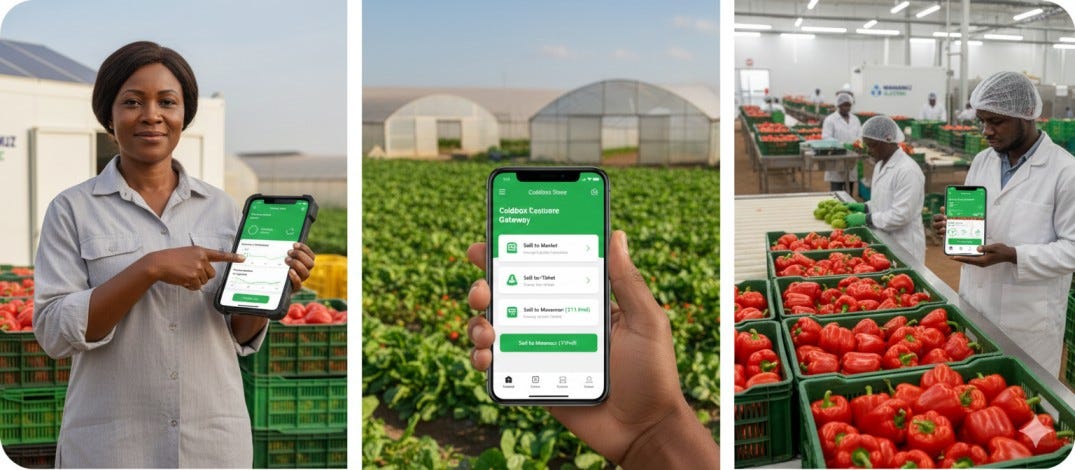
Distribution, Market and Cold Chain Technology
In Nigeria, agriculture is often viewed through the lens of “planting and harvesting.” However, the real problem arises after the harvest…
Distribution, Market and Cold Chain Technology

In Nigeria, agriculture is often viewed through the lens of “planting and harvesting.” However, the real problem arises after the harvest and continues till the products get to the final consumer. These problem are collectively categorized as post-harvest loss.
Statistically, Nigeria loses roughly 40–50% of its perishable produce (tomatoes, peppers, fruits) before it reaches the consumer. This is due to high ambient temperatures, poor handling and a lack of specialized storage facilities in the country.
This opens up a market and research gap for young and enthusiastic individuals to bring their skill sets to help curb the effect of post harvest losses to the nation’s economy. The agricultural market is no longer about selling more, it’s about losing less.
This is why we at Manamuz are building greenhouses; a place where the temperature and humidity of an out of season plant to ensure even distribution of this plant produce all year round. This ensures that these products are fresh and of high quality before distribution.
Cold-Rooms the Innovation bolstering Agricultural preservation in Nigeria
Perishable farm products like tomato, pepper, vegetables, and fruits to name a few, are susceptible to experiencing damage, getting rotten or becoming inviable during the process of distribution and marketing. This is due to the fact that once harvested, these crops keep on carrying out respiration and deteriorating due to age (senescence), and this time the energy to do this is no longer provided to it cause it has been harvested.
Preservation of these farm products require that they are cooled down to suitable temperature range (0–4 degree Celsius for vegetables, 10–12 degree Celsius for pepper and tomato) and the humidity to be maintained at 85–95%. This is achieved in the cold room a box structure as shown in the figure below, fitted with a refrigeration systems that cools the content within it and keeps the humidity to the required value. This reduces the rate of deterioration and respiration of the harvested farm produce significantly. Therefore allowing significant portion of these farm products to reach the final consumer, reducing the effect of post harvest losses to farmers and to the nation as a whole.
This cold room also known as Coldbox is powered by solar energy in order to help eliminate the problem of low distribution in some areas and to ensure energy efficiency with effective costing. Distribution is a race against time. The “Cold Chain (multiple cold-room)” is a series of temperature-controlled environments that is sustaining food security in the nation.

Marketing of Farm Produce
After all this, we now have to ensure that these carefully nursed, harvested and stored farm produce must reach the consumer market safely. These products thrive in the market due to this special care given to them and ensure that they are of higher quality than market counterparts and are more sought for therefore giving these farmers a competitive advantage in the market. Hotels, Restaurants, shopping malls, to name but a few.

The Economics: Why it Matters
- Price Stability: By using Cold Rooms, farmers don’t have to “panic sell” at the end of the day for a low price. They can store the produce for 2 weeks and wait for a better market price.
- Job Creation: This sector needs more than farmers; it needs Refrigeration Engineers, Data Analysts, Supply Chain Managers, and Tech Writers.
This is the convergence of months of preparation, hard work, nursery preparation, transplanting, irrigation, harvesting, and post-harvest operations. Distribution/marketing is what determine if the farmer has been successful or not, therefore it must be carried out judiciously to ensure maximum output.
Nigeria doesn’t have a production problem, we grow enough food. We have a preservation problem. But here’s what changes when we solve it: farmers store instead of panic-sell. Prices stabilize. Supermarkets stock local produce year-round. Engineering graduates build careers in agri-tech, not just oil and gas.
The cold chain isn’t just about refrigeration. It’s about rewriting the economics of Nigerian agriculture one degree Celsius at a time.
메타데이터
- post_id
- 82f5e87f50b7
- slug
- distribution-market-and-cold-chain-technology-82f5e87f50b7
- url
- https://medium.com/@sammyogv/distribution-market-and-cold-chain-technology-82f5e87f50b7
- canonical_url
- https://medium.com/@sammyogv/distribution-market-and-cold-chain-technology-82f5e87f50b7
- author_url
- https://medium.com/@sammyogv
- status
- ok
- fetched_at
- 2026-06-27 23:56:40