Why Businesses Don’t Have a Document Problem — They Have a Records Intelligence Problem
Every organization creates documents. The real challenge isn’t creating them — it’s finding, securing, governing, and using them…
Why Businesses Don’t Have a Document Problem — They Have a Records Intelligence Problem
Every organization creates documents. The real challenge isn’t creating them — it’s finding, securing, governing, and using them effectively.
In today’s digital-first world, businesses generate more information than ever before. Contracts, invoices, employee files, customer records, engineering drawings, compliance reports, emails, scanned documents, and handwritten notes accumulate every day. Most organizations have invested in cloud storage or document management tools to keep this information organized.
Yet many still face the same questions:
- Where is the latest version of the contract?
- Which employee has access to this confidential file?
- How long should these records be retained?
- Can we retrieve documents quickly during an audit?
- What happened to our physical files after digitization?
- How can we search thousands of scanned documents without opening them one by one?
These aren’t document storage problems.
They’re records intelligence problems.
The organizations that recognize this distinction are moving beyond basic document repositories and adopting a more intelligent approach to managing information across its entire lifecycle.
The Difference Between Documents and Records
The terms document and record are often used interchangeably, but they serve different purposes.
A document is any piece of information that can be edited, updated, or shared. Examples include proposals, drafts, presentations, reports, and spreadsheets.
A record, however, is information that serves as evidence of business activity. Signed contracts, financial statements, employee records, medical files, compliance reports, tax documents, and legal agreements are all records that must be retained, secured, and managed according to organizational policies and regulatory requirements.
Simply storing these files in folders or cloud drives doesn’t make them easy to manage. As organizations grow, the volume of records increases rapidly, making governance, retrieval, and compliance significantly more challenging.
This is where Records Intelligence becomes essential.
What Is Records Intelligence?
Records Intelligence combines document management, records governance, artificial intelligence, digitization, and lifecycle management into a unified strategy.
Instead of asking, “Where is my file?” organizations begin asking more valuable questions:
- Can I instantly locate any record across millions of files?
- Can AI understand what’s inside scanned documents?
- Can access be controlled based on user roles?
- Can document history be tracked automatically?
- Can physical and digital records be managed together?
- Can retention and disposal policies be enforced consistently?
Records Intelligence transforms static files into structured, searchable, secure business assets.
Why Traditional Document Storage Falls Short
Many businesses still rely on shared drives, email attachments, or basic cloud storage to manage critical information. While these tools are useful for collaboration, they weren’t designed to manage enterprise records throughout their lifecycle.
Common challenges include:
Information Is Scattered
Important records are spread across email inboxes, local computers, cloud folders, filing cabinets, and archived storage boxes. Employees often spend valuable time searching instead of working.
Version Confusion
Without proper version control, multiple copies of the same document circulate within the organization. Teams struggle to identify which version is current, increasing the risk of errors.
Limited Search Capabilities
Traditional storage systems rely heavily on filenames and folder structures. If users don’t remember where a file was saved, finding it becomes difficult — especially when dealing with scanned PDFs or handwritten documents.
Compliance Risks
Organizations in regulated industries must demonstrate how records are stored, accessed, retained, and disposed of. Without audit trails and retention policies, compliance becomes a manual and time-consuming process.
Physical Records Remain Isolated
Even after digitization projects, many organizations continue to maintain large archives of physical files. Without proper indexing and mapping, locating these records remains difficult.
The Five Pillars of Records Intelligence
A modern Records Intelligence platform goes far beyond digital storage. It manages information from creation to disposal.
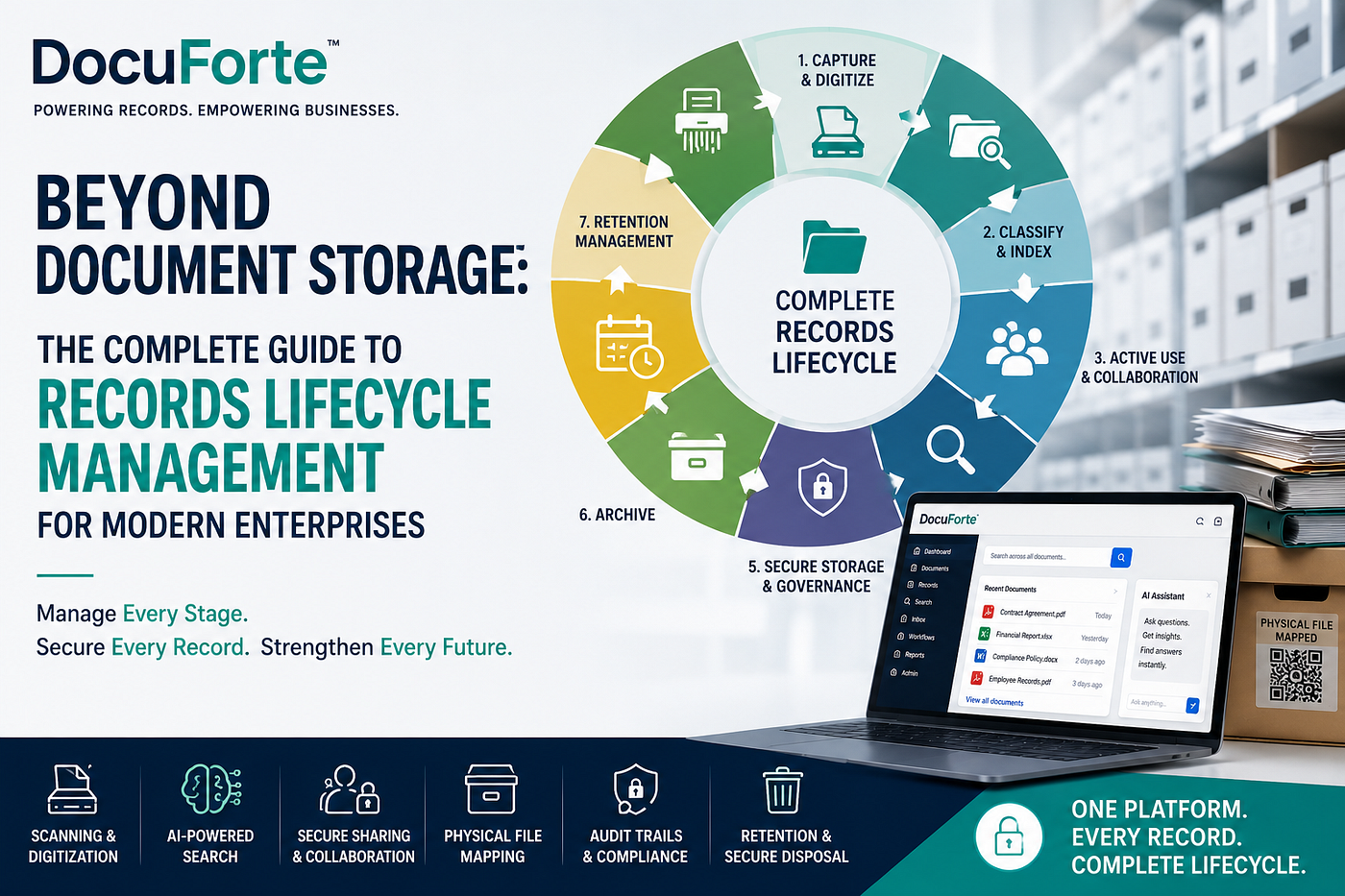
1. Capture and Digitization
Every records journey begins with capturing information.
This includes:
- Paper documents
- Scanned images
- Email attachments
- Office documents
- Historical archives
- Engineering drawings
- Handwritten files
High-quality scanning combined with Optical Character Recognition (OCR) converts physical documents into searchable digital assets while preserving their original content.
2. Intelligent Organization
Managing thousands — or even millions — of files manually isn’t sustainable.
Intelligent organization uses metadata, document classification, indexing, and automated categorization to ensure every record can be located quickly without depending on complex folder structures.
Instead of searching for filenames, users search for information.
3. AI-Powered Discovery
One of the most significant advances in enterprise information management is AI-driven search.
Modern platforms can search inside scanned documents, recognize printed and handwritten text, summarize lengthy reports, and answer questions directly from document content.
Rather than opening dozens of files, employees can ask simple questions such as:
- Show contracts expiring this quarter.
- Find invoices above a specific value.
- Summarize this policy document.
- Locate employee records created in 2024.
This dramatically reduces the time spent searching for information.
4. Governance and Security
Information is only valuable if it remains secure.
A Records Intelligence platform should provide:
- Role-based permissions
- Audit trails
- Version history
- Secure document sharing
- Activity monitoring
- Controlled collaboration
- Records retention policies
These capabilities help organizations maintain compliance while protecting sensitive business information.
5. Lifecycle Management
Records shouldn’t remain in storage forever.
Every organization needs clear policies for:
- Creation
- Review
- Active use
- Archiving
- Retention
- Secure disposal
Managing this lifecycle consistently reduces storage costs, minimizes compliance risks, and improves operational efficiency.
Why Physical Records Still Matter
Despite ongoing digital transformation, many organizations continue to maintain extensive physical archives.
Industries such as healthcare, banking, manufacturing, legal services, education, and government often store decades of paper records due to legal or operational requirements.
Digitization alone doesn’t solve this challenge.
Organizations also need to know:
- Where physical files are stored.
- Which box contains a specific record.
- Whether a document has been digitized.
- Who accessed the file.
- When the record can be archived or securely destroyed.
An integrated approach to managing both physical and digital records provides greater visibility across the entire information ecosystem.
Industries Leading the Shift Toward Records Intelligence
The need for intelligent records management extends across industries.
Financial institutions must secure customer records while meeting strict regulatory requirements.
Healthcare providers depend on fast access to patient information without compromising privacy.
Government departments manage large volumes of public records that require long-term preservation and controlled access.
Legal firms need reliable version histories, secure collaboration, and rapid retrieval of case files.
Manufacturing organizations handle engineering drawings, quality documentation, vendor records, and compliance certificates across multiple locations.
Although each industry has unique requirements, they all face the same challenge: turning growing volumes of information into accessible, governed, and trusted records.
Building a Future-Ready Information Strategy
Organizations often begin their digital transformation by scanning documents or adopting cloud storage.
These are important steps — but they represent only part of the journey.
A future-ready information strategy should unify:
- Document management
- Records governance
- AI-powered search
- Physical records management
- Secure collaboration
- Compliance
- Lifecycle automation
When these capabilities work together, information becomes easier to locate, safer to manage, and more valuable to the business.
Where DocuForte Fits In
Managing enterprise records isn’t just about storing files — it’s about creating a connected system that supports every stage of the records lifecycle.
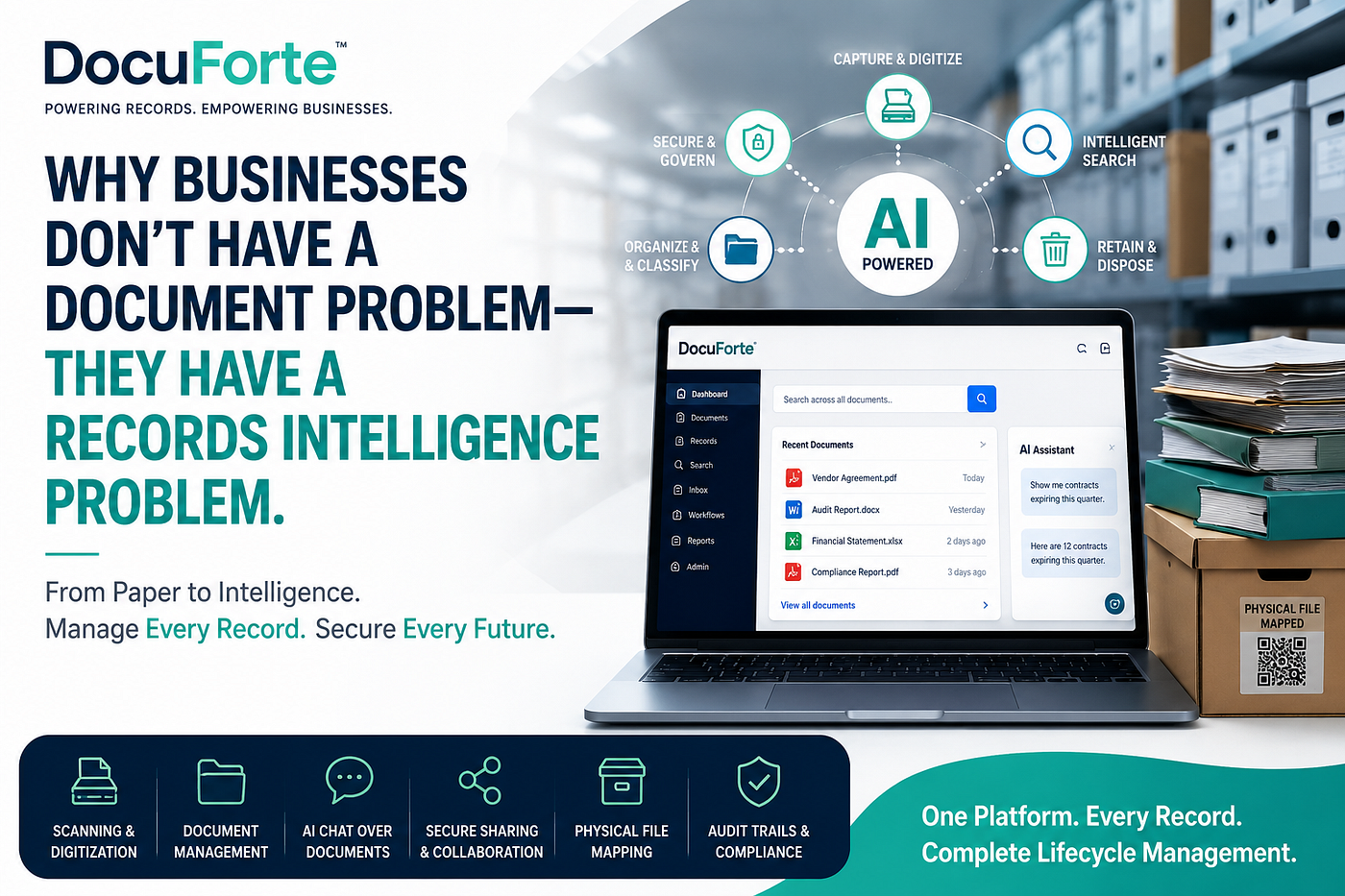
DocuForte brings together document management, AI-powered search, enterprise records management, scanning and digitization services, physical file mapping, secure collaboration, audit trails, version control, online editing, and lifecycle governance in a single platform. By connecting physical archives with digital repositories, organizations gain faster access to information, stronger compliance, and greater operational efficiency without relying on disconnected tools.
Final Thoughts
The future of enterprise information management isn’t about creating more folders or buying larger storage systems.
It’s about making information intelligent.
Organizations that embrace Records Intelligence spend less time searching for documents, reduce compliance risks, improve collaboration, and make faster, more informed decisions.
As businesses continue to generate increasing volumes of information, success will depend not on how many documents they store, but on how effectively they can understand, govern, and use those records throughout their entire lifecycle.
The next generation of competitive organizations won’t simply manage documents.
They’ll build intelligence around them.
메타데이터
- post_id
- 830706fae35d
- slug
- why-businesses-dont-have-a-document-problem-they-have-a-records-intelligence-problem-830706fae35d
- url
- https://medium.com/@DocuForte/why-businesses-dont-have-a-document-problem-they-have-a-records-intelligence-problem-830706fae35d
- canonical_url
- https://medium.com/@DocuForte/why-businesses-dont-have-a-document-problem-they-have-a-records-intelligence-problem-830706fae35d
- author_url
- https://medium.com/@DocuForte
- status
- ok
- fetched_at
- 2026-07-13 06:23:13