Best Advice When Flying? Keep Your Seatbelt Fastened
Their effectiveness is proven once again
Best Advice When Flying? Keep Your Seatbelt Fastened
Their effectiveness is proven once again

An Unsplash + Image
Like many other folks who woke up to the news on Monday morning that an Air Canada Jazz flight had collided with a firetruck on the runway at LaGuardia airport late Sunday night, I felt sick to my stomach.
The plane originated from Montréal, where I live. It was a little too close for comfort, just like the recent incident in Toronto when a Delta flight landed hard and flipped over, bursting into flames. ¹
Sadly, the two young pilots commanding the Air Canada flight died. They landed, then plowed into a firetruck that was cleared to cross the runway to attend to another incident, shearing the nose off the regional jet on impact.
Although 22 people were injured in the Delta flight, no one died.
I’m not here to speculate who messed up on either incident. Rather, I want to highlight why seatbelts should be kept fastened throughout a flight as they can prevent both injury and death.
Ever since I was a kid, I was fascinated by how planes could get off the ground, let alone stay up there. Our house was on the flightpath for the airport and every time I heard one approaching, I’d race to the kitchen window to marvel at the beast in the sky.
My former husband was an air traffic controller. I’ll admit that I loved our discussions about aviation and how the system worked. I had no idea that the person sitting in the tower of a busy airport was only responsible for arrivals and departures. Another was assigned to handle ground traffic: firetrucks, buses moving passengers from remote gates to the main halls of an airport, along with catering, baggage and fuel vehicles.
Flights between countries are assigned to another set of controllers, ensuring safe passage over foreign lands. Each one communicates periodically, keeping planes apart with recommended, standard altitudes and directional pathways.
I was fortunate to go up to the Tower at Hong Kong’s old airport years ago, and also saw the action at Auckland airport firsthand. Dare I mention there were buckets collecting water dripping from the ceiling in Hong Kong? I was horrified! But that was just before the new airport opened…
Although I’m sure the system has become more modern, back then, each flight’s details were on a piece of paper enclosed in a metal strip that they’d place strategically into the console in front of them while watching the radar screen. Each controller on duty had a role to play, and communication between each of them and the pilot was — and still is — critical to maintain safety.
I distinctly recall our first flight together. He insisted that I always keep my seatbelt on. Before being ‘in the know,’ I’d been the first person to detach that hindrance as soon as the plane had reached cruising altitude and the overhead lights went off, stipulating it wasn’t mandatory.
In truth, turbulence is not always seen ahead of time. We’ve all read the news reports of passengers and crew being injured when a flight hit clear air turbulence, and the aircraft was thrown into an unexpected frenzy.
It is heartbreaking to see any plane crash, but when it’s bearing a maple leaf, the emblem of my adopted country, it’s sobering. The mangled nose of the aircraft on most online news hubs accentuated the force of impact. The chilling audio recordings highlight the realization and panic of an error, seconds before the fire truck and plane collided.
I’m incredulous of how a split second saved the two fire-truck operators’ lives and how passengers took command to exit the aircraft quickly and safely without direction from the crew. Why the firetruck crew didn’t respond to the repeated calls to stop mere seconds before the impact will be part of the National Transportation Safety Board (NTSB) investigation, as will the fact that the truck didn’t have a transponder on board.
If anything, this accident proves that seatbelts are key to survival. An air hostess was found metres away from the aircraft, alive and still strapped into her seat, and although several passengers were seriously injured, the death toll has not risen.
In truth, many aviation disasters occur because of a series of events. The finger should never be initially pointed at one person, because there are always several other factors at play.
The Tenerife air disaster is a classic example of a series of events…
The plane had been diverted to Tenerife because a bomb had closed Las Palmas, the airport they were supposed to go to. The aprons were clogged with diverted aircraft, so the runway was used to taxi aircraft to the threshold for take-off.
There were communication glitches between the controller and pilot due to static, and the ground-surface radar was out of order. To boot, fog descended, clouding views.
Although the pilot was ultimately blamed for taking off without authorization, hundreds of passengers and crew on both aircraft perished that day because of a series of events.
In this latest Jazz incident, the plane departed late from Montréal, another plane had just aborted takeoff because of a cabin issue, and the firetruck was responding to that when the collision occurred. The NTSB investigation will look at every aspect of the accident, including the number of controllers in the tower, their assigned roles, fatigue levels and experience.
The NTSB has already warned people not to jump to conclusions and allow them to do a thorough investigation to identify the causative factors and prevent another such incident from happening again.
While we do our best to install earthquake warning systems to detect the potential for deadly tsunamis, have researchers monitoring dormant volcanoes for activity and have intelligence scouring the web for possible breaches of security and terrorism threats, there is only one certain thing:
We never know when our time is up.
We all hang onto the illusion that bad things happen to other people. That we are invincible. If we do our best, everything will be okay. In truth, any one of us could be in the wrong place at the wrong time.
The reality that two firemen in the truck that was hit by the plane on Sunday are still alive is a testament to this notion. Had the plane hit them a second or two earlier, they would not be nursing only broken bones and shattered minds. They would be dead.
Most of us have flown at least once in our lives. In doing so, we put our lives into the hands of individuals monitoring the airspace and controlling the aircraft. They are trained professionals who are well aware of the laws and regulations in place to ensure passenger safety.
In truth, you’re more likely to die en route to the airport than in an aircraft accident.² Simply observing the volume of air traffic on applications like FlightAware is mind-boggling. Airspace is akin to a busy, eight-lane highway in a huge metropolis.
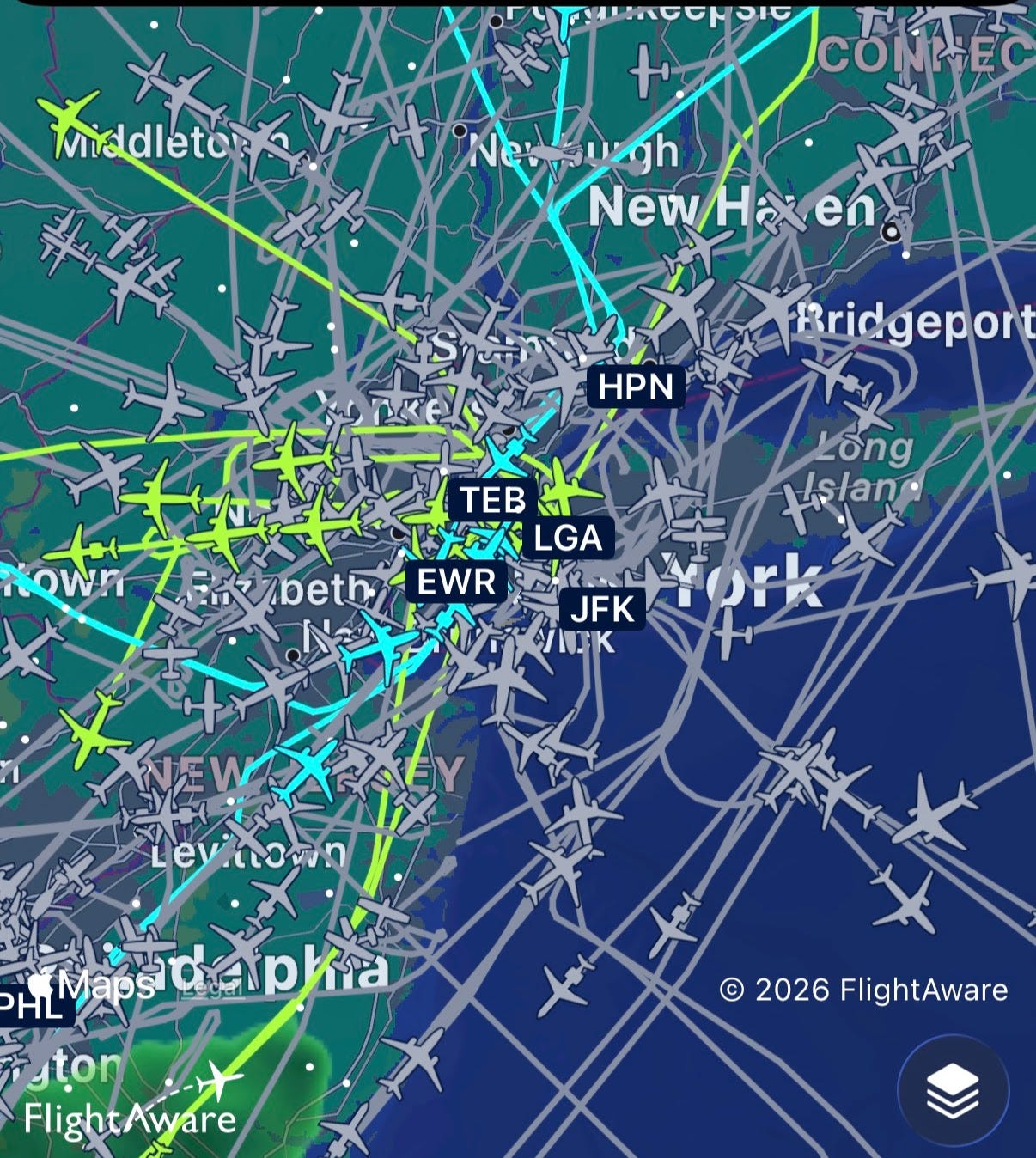
LaGuardia airspace at 1920, March 27th. Screenshot by Author
If anything, this accident proves that seatbelts are key to survival. Had the air hostess not been securely strapped into her seat, she would not have survived being flung metres away from the plane. Although passengers were violently thrown into the seat in front of them, had they not been strapped in, there would have been more deaths.
No, they won’t protect you in a midair collision or a sudden nose-dive to earth, but they can be the difference between life and death in turbulence and unexpected runway incursions like the Delta and Jazz flight.
Listen to the crew instructions pre-departure and landing. Watch the safety briefings, even if you’ve been on a gazillion flights and keep your seatbelt fastened.
¹ The Delta crash investigation ² Flying is safer than driving
메타데이터
- post_id
- 8307892bd3bf
- slug
- best-advice-when-flying-keep-your-seatbelt-fastened-8307892bd3bf
- url
- https://medium.com/the-springboard/best-advice-when-flying-keep-your-seatbelt-fastened-8307892bd3bf
- canonical_url
- https://medium.com/the-springboard/best-advice-when-flying-keep-your-seatbelt-fastened-8307892bd3bf
- author_url
- https://medium.com/@barbdalton-21201
- status
- ok
- fetched_at
- 2026-07-11 06:12:03