The Ottoman Architectural Influence on the Balkans
The Balkan Peninsula is a geographic area in Southeast Europe, comprised of countries that have their entire or partial territories in the…
The Ottoman Architectural Influence on the Balkans

Blue Mosque Interior, Istanbul
The Balkan Peninsula is a geographic area in Southeast Europe, comprised of countries that have their entire or partial territories in the area. The historical formation of the region is often related to the long term invasion of the Ottomans and the influence they had on it. Their impact on the region was so profound that even its name comes from the Turkish word “Balkan” which means a mountain range (Hartmuth 689). The Muslims’ conquest over the peninsula shaped its political, economic, cultural, and social life, leaving its mark even in 21 century. One of the traces from the Ottoman reign on the Balkans that has survived even today is the Ottoman buildings and architecture. The Ottoman architecture which still remains captures the spirit of the two main architectural periods in the empire — Bursa and Edirne periods. What’s more, these buildings remain unique among the others in the area, despite the growing social tensions against them. That is why the architectural heritage of the Ottoman period in the Balkans is timely. As a result of many wars, revolutions, and constant changes the empire was hanging by thread before it fell apart. However, the empire which at its end was only a dark shadow to its past glory left a strong legacy that every country in the Balkans keeps to this day in some form. This paper will focus on architecture as a style during the Ottoman period and what is left of it today in our territories. Not only that the Ottoman legacy is represented in the architectural beauty in the Balkans, but its other aspects such as religion were major reasons why only a small amount of it is preserved today. Since religion will be a major factor in both situations, mosques are going to be the center of discussion with a presentation of where the idea came from, and how they manage to still amaze us today. Public baths, bridges as monuments of other types of buildings brought in the Balkans by the Ottomans will be only briefly discussed.
Ottoman architects developed the interiors of buildings by using the same structural solutions from the Byzantines but created very different space conception because of their Middle East influence as well. Ottomans mastered the technique of achieving the perfect harmony between in and outer spaces. During the leadership of Sultan Suleiman, the Magnificent were some of the greatest expansions. At this time Mimar Sinan is one example of a true architect, who is the creator of over 300 classical Ottoman structures and known as the master of geometry. Süleymaniye Mosque is well worth mentioning, simply because of its geometric synchronization, star patterns and miniature details starting from the giant to the smallest windows. It is astonishing because it is done in a way so it is bright by natural light, even if it is situated in gloomy Istanbul. The mosque stands today as a testament to greatness and power at the time. Sinan got materials from all over the empire; some of the stones were from Egypt and some from Lebanon, so the final piece represents the whole empire. He designed the monuments in Balkans as well, but they're usually only local materials were used. Dr. Elizabeth Macaulay-Lewis and Dr. Steven Zucker elaborate on the plan of the mosque and compare it to Hagia Sophia which was considered as its inspiration, to create a better version of it with strong Ottoman style. It is not only the mosques that strongly represent Ottoman culture; it is visible in preserved prayer rooms, dervish lodges, inns, baths, bazaars, and markets as well. Therefore, the legacy goes on from one version to the next representing greatness. The Ottoman Empire was influenced by Western Europe, which leads to the modernization of the Ottoman architecture in the 18th century further.
One of the beautiful things about architecture is that it matures in time, and its style gradually changes as it is adapting to the new trends. The Ottoman architects lived long enough to implement multiple styles over the years and give astonishing masterpieces as a result. For the sake of simplicity, the ongoing debate about the uniqueness of the Ottoman architectural style will not be covered. Now, in order to fully examine the significance of these architectural feats, we need to understand the building process itself. After the Ottomans stepped on the peninsula in the 1350s, they slowly began their conquest on the Balkans (İnalcık 10–15). Soon after they were in control of the majority of the region, they started to change the landscape by building traditional Muslim mosques and houses. The empire’s plan was to build as many centers of Islam and as many mosques as possible. The Sultan had numerous skilled architects at hand, which he sent all over the Balkans to begin with the building process. For the building process itself, local craftsmen and skillful labor was hired which were given orders directly by the architect himself (Hartmuth 701–703). This way, the process was optimized and many sites could be built simultaneously. With this being said, it’s time to examine some of the biggest architectural achievements of the Ottomans on the Balkans.
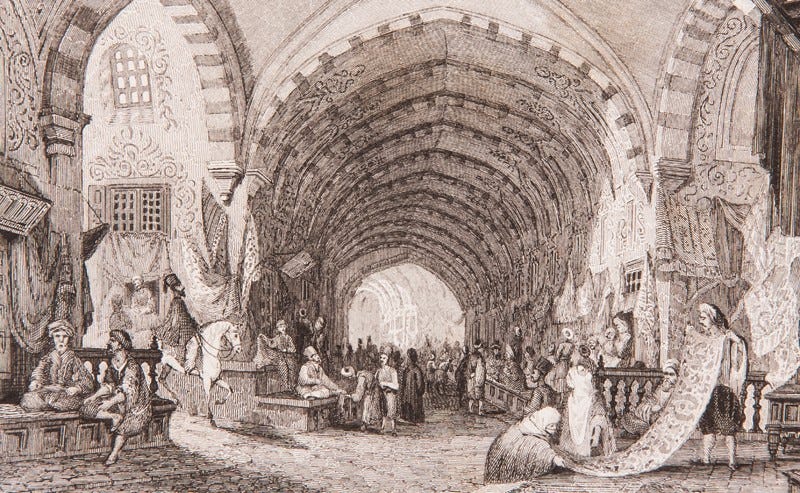
Let’s begin by examining the mosques in the region. Mosques play a central role in the culture and architecture influence the empire has had on the region. Not only they were the most widely built Ottoman structures, but also they are the ones that have remained even in today’s times (Furat 197). The first one to explore is the Hadum Mosque in Gjakova. Located in the town of Gjakova, Kosovo, this cathedral is accepted to be the first one built in the country by Suleiman Efendi, a military commander in Istanbul. The building dates back to 1595 and it’s a medium-size mosque. It’s doomed-shape and tall minaret suggest that it represents the late Bursa style architecture with some Baroque influence (Hartmuth 110–111). However, what makes this mosque that impressive is what is hidden inside. The embellishments inside and the paintings of floral motives on the walls and ceilings dated back to the 18th century when such designs became popular (Hartmuth 110).When talking about the Ottoman architectural heritage on the Balkans, we can’t fail to cover the first country which fell in the empire’s hands — Bulgaria. The fact that Bulgaria was the closest Balkan country to Constantinople gave a lot of opportunities to the invaders for architectural development. Without a doubt, mosques have been the most apparent example of Ottoman influence in the country. According to Stephen Lewis, in 1992 in Bulgaria there were more than 1,500 active and functioning mosques (2). An example of a mosque that is active even today is Muradiye mosque, also known as the Dzhumaya mosque, located in Filibe (today’s Plovdiv). This is one of the biggest mosques located on the Balkans and it was built under Murad II’s agenda for constructing “large imperial mosques” in the rural areas of the Empire (Boykov, 77). The structure impresses with its big size and is covered with three huge domes, hanging over the prime part of the building, which was used for prayers and gatherings. Not only, was the whole structure maintained by massive pedestals, each having three vaults on the sides (Boykov, 77). The mosque also featured an outside part, called a portico, which resembles a Greek architectural style of building. Unfortunately, this edition of the mosque crumpled sometime in the eighteenth century and was substituted by a wooden composition (Boykov, 77). According to Grigor Boykov, a Bulgarian academic, the building of such a grandiose mosque in Filibe shows the Ottoman’s ambition for a long-lasting control of the area (Boykov, 77).
In the capital city, Sofia, there is currently only one functioning mosque — Banyabaşı. The structure was built in 1576, a period during which the Ottomans were in control of the city (Trankova). The monument is built above the ruins of Roman Serdica and above active mineral springs (Trankova). What’s impressive about the mosque is that the architect who designed the building is Mimar Sinan, as already mentioned perceived one of the greatest architects in Empire. The building consists of four domes and a tall minaret, located in the middle of the construction (Sofia Guide). Inside the stone building, one can observe the sky-looking dome, a universal way of expressing the closeness of the visitors to God. Just like the Hadum Mosque in Gjakova, the interior of Banyabasi is rich in floral motives and Quran inscriptions. What’s more, the mosque can fit more than 700 people inside (Sofia Guide). The significance of Ottoman architecture is that strong that one of the oldest mosques in Sofia — the Great Mosque, completed in the 15th century is currently transformed into the Bulgarian National Museum of Archeology (Trankova).
When talking about Sofia, other historical and cultural forces also helped shape this city. Sofia has a very high number of mineral springs which helped public baths or hammams to be introduced along with the Ottoman tradition and religion that realized the importance of hygiene. Their significance lies in that they were mostly a social phenomenon, places for people to gather and discuss. The standards in the period led to the religious and gender separation between each building. There was a focus in the public baths when describing Ottoman Sofia. (Gharipiur and Ozlu) The geographic location of Sofia and its thermal waters allowed the Ottomans to build more public baths that are buildings that represent the image of the city. Some of them are located in the Ovcha Kupel District, Bakya District, and Gorna Banya. It is stated in the Daily Life in the Ottoman Empire: “A city was not considered to be a proper city by Muslim travelers in the pre-modern period unless it had a mosque, a market, and a bathhouse.” (Kia, 89) There were public baths in every conquered territory in the Balkans. Some of the baths were part of the bazaar. They were usually built in an octagon shape with a central hall surrounded by fountains and cabinets. (Kia, 90) There was notable building and designing skill needed for the construction, in order for the design and décor to be Ottoman building marks. They could have a reception room and bath chamber rooms. In many of them, the walls were painted with warming colors and specific design. The water system was built in a way to provide cold and hot water.
Few famous bridges still stay as an Ottoman monument. The bridge of Drina in Visegrad in Bosnia should be mentioned as an example. It was built in the 16th century by Mimar Sinan as well, on the orders of Mehmed Pasa Sokolovic. (UNESCO) It was included in the list as a World Heritage by UNESCO in 2007. This recognition was partly due to its architectural style and good proportions. It spans for 179 meters and it was built in an L shape in order to resist flooding, which happened a lot at the time it was built. It has 11 masonry arches that span 11 m to 15 m. It has strong structures holding it positioned at right angles on the left side of the river. (UNESCO) Another bigger reason for the recognition is about what the bridge represents aside from the Ottoman constructive beauty, which is its symbolic role throughout the history of cultural exchange. Its geographic position makes it a place for exchange between the Ottoman Empire, Mediterranean side and Balkans. The novel “The Bridge on the Drina” was written by the Nobel Prize-winning author Ivo Andric. In it, he describes the lives of people with different religions such as Christians, Muslims, and Jews. The novel represents mixed societies and is set around this bridge. It helps to understand the citizen’s view of the Ottoman Empire and their differences. Unfortunately, the bridge was later a testament to a major tragedy in the 1990s. Thousands of Muslim citizens were killed and thrown into the river off it. It has been repaired since the wars because like many other Ottoman monuments it suffered damages during the conflicts that took place in the 20th century. Even today as it stands as a reminder of past tragedies, it represents its cultural value on national, cultural and religious aspects. Another example of a historical bridge that stands as a symbol of coexistence is the old bridge in Mostar in Bosnia it was designed by Mimar Hajruddinand and built in the 16th century. After its destruction in 1990, over religious dispute, it was restored and later also protected by UNESCO. As a masterpiece of Ottoman times, it also has symbolic meaning between different ethnic and religious communities.
It is important to present the second point of the reason for the preservation of a small number of architectural designs from the Ottoman Empire in the Balkans. This can show how the architecture changed trough time and portrays how outside involvement may change the style. During this time there were periods of the strength of the empire, there were times of development of something beautiful and clearly memorable, but also times of the destruction of what was beautiful before. Despite the high architectural value and the beauty of all these Ottoman establishments, in recent decades they have been the reason for many social tensions. The reason is simple — they reminded the population about the painful past. In his piece De/constructing a ‘Legacy in Stone’, Maximilian Hartmuth states that soon after the Bulgarian nation gained its independence, the country started eradicating all the Ottoman buildings which were located in the country (701). According to him, this was still a part of the process of “de-Ottomanization” aiming to get rid of every structure related to the Muslims’ conquest. The destruction could be seen as an attempt to erase and not deal with the complex cultural legacy of the Ottoman Empire. The deliberate actions aimed at restarting the country’s development without the hold of the past (Hartmuth 701). Similar movements were organized in all the other Balkan countries upon their independence. Starting in the 1990s, the former Republic of Yugoslavia undertook a cleansing process, again for the sake of “reshaping the historical memory” (Hartmuth 701). Ottoman monuments, main mosques, were being destroyed overnight as a part of the country’s division into different states (Hartmuth 701). During the war in Serbia in the early 1990s, the military began a destruction conquest during which various types of Ottoman buildings such as towers, clock towers, cemeteries, and mosques were completely demolished (Hajdarpasic 715). The Christian population on the Balkans perceived every Ottoman establishment as a reminder of the atrocious past and the violence with which the Ottomans were controlling the region. Evidence for that is the case of Banja Luka when in 1998 a reconstruction of the Ferhadija mosque was proposed. The mayor of the city came out, warning the political elite that such action “would be perceived by the Serbian people as the blackest humiliation” (Hajdarpasic 715) In the Balkans, many people still refer to the Ottoman period as “slavery” or “the yoke” specifically for Bulgaria (Lewis, 2) Therefore, as the folk and literature with some exaggerations raised more the hostility to the past, these destructions continued into the post-Communist period. Among the lost architectural projects were the demolition one of the oldest hammams in Bulgaria, the one in Hasovo and some of the largest hans in Skopje, Nish, and Belgrade. (Lewis)
Despite the destruction, the remaining architecture shows the economic and cultural history in each territory, it also shows the genesis and evolution of the Ottoman style. Other historical buildings, baths, bridges have been protected and restored, as a part of a project by the Turkish Cooperation and Coordination Agency (TIKA) The history of the Balkan Peninsula has not been easy. The region was marked by the constant political, social, and ethnic division exacerbated by the long-lasting conflicts between the neighboring countries (Crampton and Danforth). However, after the Ottoman Empire appeared on the map of the peninsula, all nations seem to have united against the common enemy. Years of domination and occupation have inevitably left its imprint even on today’s look of the Balkan countries. One of the most long-lasting and arguably significant traits that we can see nowadays is the architecture which has remained from the Ottoman Empire. Ranging from many beautiful and massive mosques to public baths and bridges, these conserved old structures continue to shape the landscape of the Balkan countries. The style, details, and craftsmanship of these constructions fascinate even modern engineers. Some of these old buildings were designed by the most famous and renowned architects in the world. However, these same years of slavery have left its mark also on the mentality of the Balkan population. Decades after the states have gained their independence; massive destruction of these monuments began. The people of the Balkan countries wanted a new beginning, without the memory of their oppressors reminding them of the past. But how can a country move forward if it doesn’t appreciate its past?
Bibliography:
CHWB “Centres and peripheries in Ottoman architecture: Rediscovering a Balkan Heritage” no.9, 2010 http://chwb.org/bih/wp-content/uploads/sites/5/2015/02/Centres-and-peripheries-in-Ottoman-architecture-Rediscovering-a-Balkan-heritage.pdf. Accessed 15.10.2017
İnalcık, Halil, 1916–2016. The Ottoman Empire; The Classical Age, 1300–1600. London :Weidenfeld & Nicolson, 1973. Print.
Furat Zisan Ayse, et al. Balkans and Islam: Encounter, Transformation, Discontinuity, Continuity. Cambridge: Cambridge Scholars Publishing. 2012. Print
Boykov, Grigor. “Architecture as a Symbol of Power: Some Thoughts on the Ottoman Architectural Heritage of Plovdiv (Filibe).” in Maria Baramova, Plamen Mitev, Ivan Parvev, Vania Racheva (Eds.), Power and Influence in Southeastern Europe, 16th-19th c. (Berlin: LIT Verlag, 2013), 67–85. | Grigor Boykov — Academia.Edu.
Trankova, Dimana. Ottoman Bulgaria. Vagabond, October 2014, pp1- 15. Vagabond. Access: https://www.vagabond.bg/travel/high-beam/item/2858-ottoman-bulgaria.html
Gharipour, Mohammad, and Nilay Ozlu. City in the Muslim world: depictions by Western travel writers. Routledge, 2015.
“Banya Bashi Mosque” Sofia Guide, 24 July.2017,
Centre, UNESCO World Heritage. “Mehmed Paša Sokolović Bridge in Višegrad.” UNESCO World Heritage Centre, whc.unesco.org/en/list/1260.
Hartmuth, Maximilian. “De/Constructing a ‘Legacy in Stone’: Of Interpretative and Historiographical Problems Concerning the Ottoman Cultural Heritage in the Balkans.” Middle Eastern Studies, vol. 44, no. 5, 2008, pp. 695–713. JSTOR, JSTOR, www.jstor.org/stable/40262611.
Lewis, Stephen,’The Ottoman Arhitectural Patrimony of Bulgaria’, EJOS, IV(2001) (=M.Kiel, N.Landman & H. Theunissen (eds.) Proceedings of the 11th National Congress of Turkish Art, Utrecht- The Netherlands, August 23–28,1999) №30,1–25.
Hajdarpasic, Edin. “Out of the Ruins of the Ottoman Empire: Reflections on the Ottoman Legacy in South-Eastern Europe.” Middle Eastern Studies, vol. 44, no. 5, 2008, pp. 715–734. JSTOR, JSTOR, www.jstor.org/stable/40262612.
Crampton, Richard J., and Loring Danforth. “Balkans.” Encyclopædia Britannica, Encyclopædia Britannica, inc., 15 Jan. 2017, www.britannica.com/place/Balkans.
Cerasi, Maurice. “Late-Ottoman Architects and Master Builders.” Muqarnas, vol. 5, 1988, pp. 87–102. JSTOR, JSTOR, www.jstor.org/stable/1523112.
Kia, Mehrdad. Daily life in the Ottoman Empire. Greenwood, 2011.
Andrić, Ivo. Na Drini ćuprija. Prosveta, 1945.
메타데이터
- post_id
- 8308a42e4f92
- slug
- the-ottoman-architectural-influence-on-the-balkans-8308a42e4f92
- url
- https://medium.com/@valerijakoneska/the-ottoman-architectural-influence-on-the-balkans-8308a42e4f92
- canonical_url
- https://medium.com/@valerijakoneska/the-ottoman-architectural-influence-on-the-balkans-8308a42e4f92
- author_url
- https://medium.com/@valerijakoneska
- status
- ok
- fetched_at
- 2026-08-02 02:32:02




