How to Organize Evidence for a U.S. Immigration Strategy
Why documents, structure, and strategy matter before starting an immigration process
How to Organize Evidence for a U.S. Immigration Strategy
Why documents, structure, and strategy matter before starting an immigration process
By Osmany Perez, JD, LL.M. Founder, Osmany Perez LLC
A strong U.S. immigration strategy is not built only on forms. It is built on evidence.
Many professionals, entrepreneurs, families, and employers begin an immigration process with an important goal: to live, work, invest, reunite with family, or build a future in the United States. But one of the most common mistakes is starting the process without organizing the evidence first.
Documents tell the story. They show who the person is, what they have done, what they are qualified to do, what they plan to do, and why their case deserves serious review.
Whether a person is exploring EB-2 NIW, EB-3, family-based immigration, adjustment of status, a waiver, or another immigration strategy, evidence organization can make the difference between a clear case and a confusing one.
Immigration Strategy Starts Before Filing
Many people think the immigration process begins when the application or petition is filed.
In reality, the strategy should begin much earlier. Before filing anything, the person should understand:
- What immigration option is being evaluated?
- What legal standard applies?
- What facts are strong?
- What facts are weak?
- What documents are available?
- What documents are missing?
- What evidence needs to be translated?
- What evidence needs to be explained?
- What story does the evidence tell?
A case should not feel like a random collection of documents. It should feel like an organized presentation of facts, qualifications, eligibility, and strategy.
Why Evidence Matters
Immigration agencies review documents. They do not simply review intentions.
A person may have a strong professional background, but if the documents are incomplete, disorganized, inconsistent, or unclear, the strength of the profile may not be obvious.
- A professional may have a degree, but not provide transcripts.
- An entrepreneur may own a business, but not provide business records.
- A worker may have years of experience, but not provide employment letters.
- A family member may have a real relationship, but not provide enough evidence of the relationship.
- A person may have achievements, but not explain how those achievements connect to the immigration strategy.
This is why evidence must be organized with purpose. The goal is not only to collect documents. The goal is to connect the documents to the strategy.
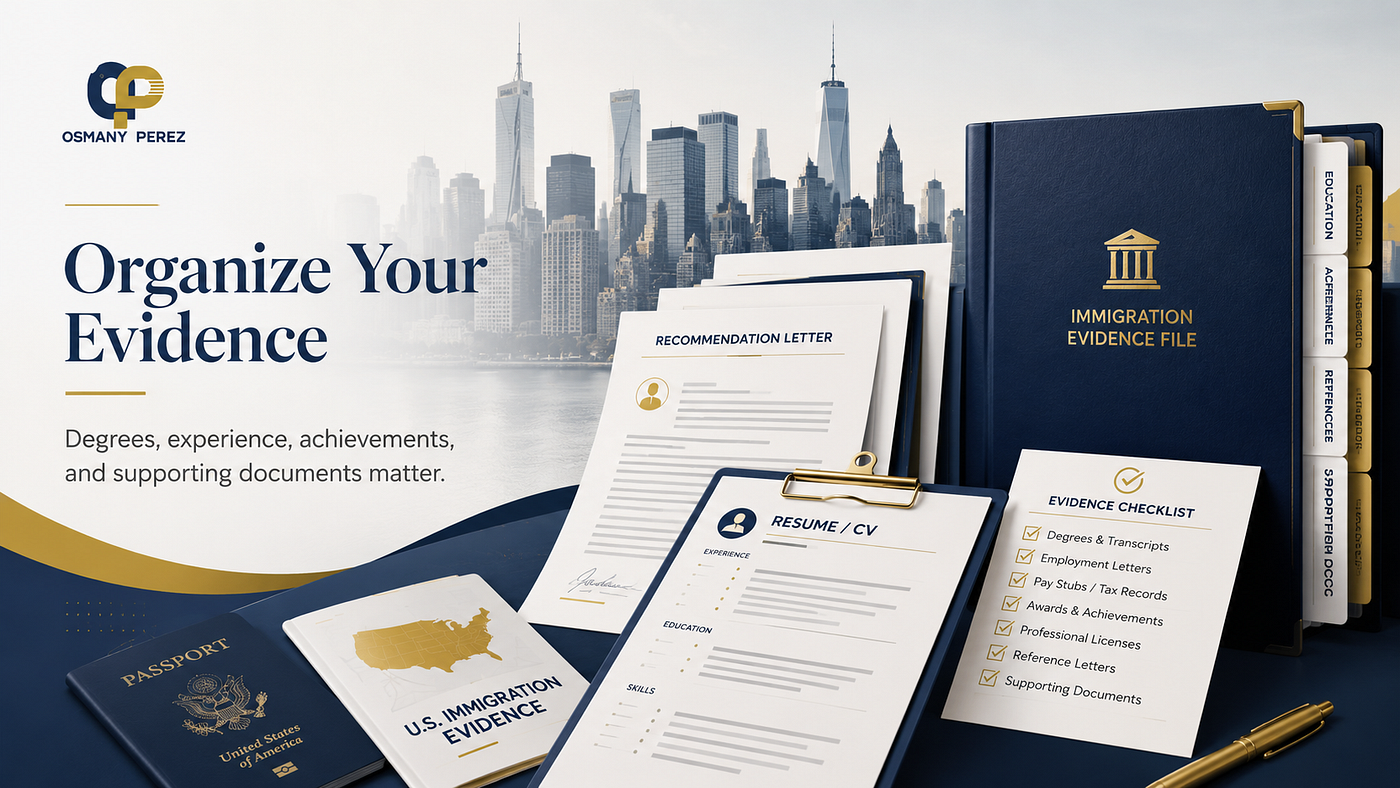
Step 1: Identify the Immigration Category
Before organizing evidence, the first step is to identify the immigration category being evaluated. Different immigration strategies require different types of evidence.
For example, an EB-2 NIW strategy may require evidence of education, exceptional ability, professional achievements, a proposed endeavor, national importance, and the person’s ability to advance the proposed work.
An EB-3 strategy may focus more on the employer, job offer, labor certification, wage requirements, job duties, the worker’s qualifications, and the employer’s ability to sponsor.
A family-based case may focus on the relationship, identity documents, financial sponsorship, immigration history, and admissibility.
A waiver may focus on hardship, family ties, medical issues, financial circumstances, country conditions, rehabilitation, discretion, and other factors depending on the waiver.
The evidence should match the strategy.
Step 2: Create a Master Evidence Folder
One of the best ways to begin is to create a master digital folder.
The folder should be organized clearly so that every document can be found quickly.
A simple structure may look like this:
- Identity Documents
- Immigration History
- Education
- Employment Experience
- Professional Licenses and Certifications
- Achievements and Awards
- Publications and Media
- Business Records
- Financial Records
- Recommendation Letters
- Family Documents
- Court or Police Records
- Translations
- Drafts and Strategy Notes
- Final Filing Version
This structure can be adjusted depending on the type of case, but the key is consistency. Do not leave documents scattered across WhatsApp, email, phone photos, Google Drive, Dropbox, and screenshots without labels.
A strong case starts with a clean file system.
Step 3: Use Clear File Names
File names matter.
A file named “IMG_3948” does not help anyone understand what the document is.
A file named “Diploma_Bachelor_Industrial_Engineering_2015.pdf” is much more useful.
Use file names that identify:
- Document type
- Person’s name
- Institution or employer
- Date or year
- Purpose of the document
Examples:
Passport_Osmany_Perez_2026.pdf
Resume_Osmany_Perez_Updated_2026.pdf
Diploma_Juris_Doctor_Osmany_Perez.pdf
LLM_Degree_University_of_Miami_Osmany_Perez.pdf
Employment_Letter_ABC_Company_2018_2022.pdf
Recommendation_Letter_Dr_Smith_EB2_NIW.pdf
Business_Registration_Osmany_Perez_LLC.pdf
Good file names save time, reduce confusion, and help the case remain organized from beginning to end.
Step 4: Separate Evidence by Purpose
Not every document serves the same purpose.
- Some documents prove identity.
- Some prove education.
- Some prove work experience.
- Some prove business activity.
- Some prove family relationships.
- Some prove financial ability.
- Some prove professional impact.
- Some explain hardship.
- Some support discretion.
When organizing evidence, ask:
- What does this document prove?
- Why is it important?
- Which requirement does it support?
- Does it need translation?
- Does it need explanation?
- Is it complete?
- Is it current?
- Is it consistent with the rest of the evidence?
This helps prevent unnecessary documents from distracting from the core strategy.
Step 5: Build a Timeline
A timeline is one of the most useful tools in immigration strategy. A timeline helps organize the person’s life, immigration history, education, work experience, family events, entries and exits, status changes, court history, employment history, business history, and key achievements.
A professional immigration timeline may include:
- Date of birth
- Education history
- Employment history
- Business ownership
- Professional licenses
- Major projects
- Awards
- Publications
- Travel history
- U.S. entries and exits
- Visa history
- Immigration filings
- Court dates
- Family events
- Major hardship events
- Current immigration goals
A timeline allows the strategy to identify inconsistencies before the government does. It also helps connect facts to documents.
Step 6: Review Consistency Across Documents
Consistency is critical. Before filing, review whether the documents match each other.
Check:
- Names
- Dates of birth
- Passport numbers
- Addresses
- Job titles
- Employment dates
- School names
- Degree names
- Business names
- Marital status
- Children’s names
- Entry dates
- Exit dates
- Case numbers
Small inconsistencies can create big questions if they are not explained. For example, if a resume says employment started in 2018 but the employment letter says 2019, that difference should be reviewed.
If a passport has a different spelling of a name than a birth certificate, that should be addressed.
If a business document uses one company name and tax documents use another, the relationship should be clarified.
Evidence should not create confusion. It should create clarity.
Step 7: Translate Foreign-Language Documents
Many immigration cases involve documents in Spanish or another language.
If a document is not in English, it generally needs a complete and accurate English translation with a certification from the translator.
This may include:
Birth certificates, Marriage certificates, Divorce decrees, Degrees, Transcripts, Employment letters, Court records, Police certificates, Business records, Tax records, Awards, Professional licenses
Translations should be clear, complete, and consistent.
Do not summarize documents that require full translation. Do not translate only the parts that seem important.
If the document is part of the evidence, the translation should accurately reflect the document.
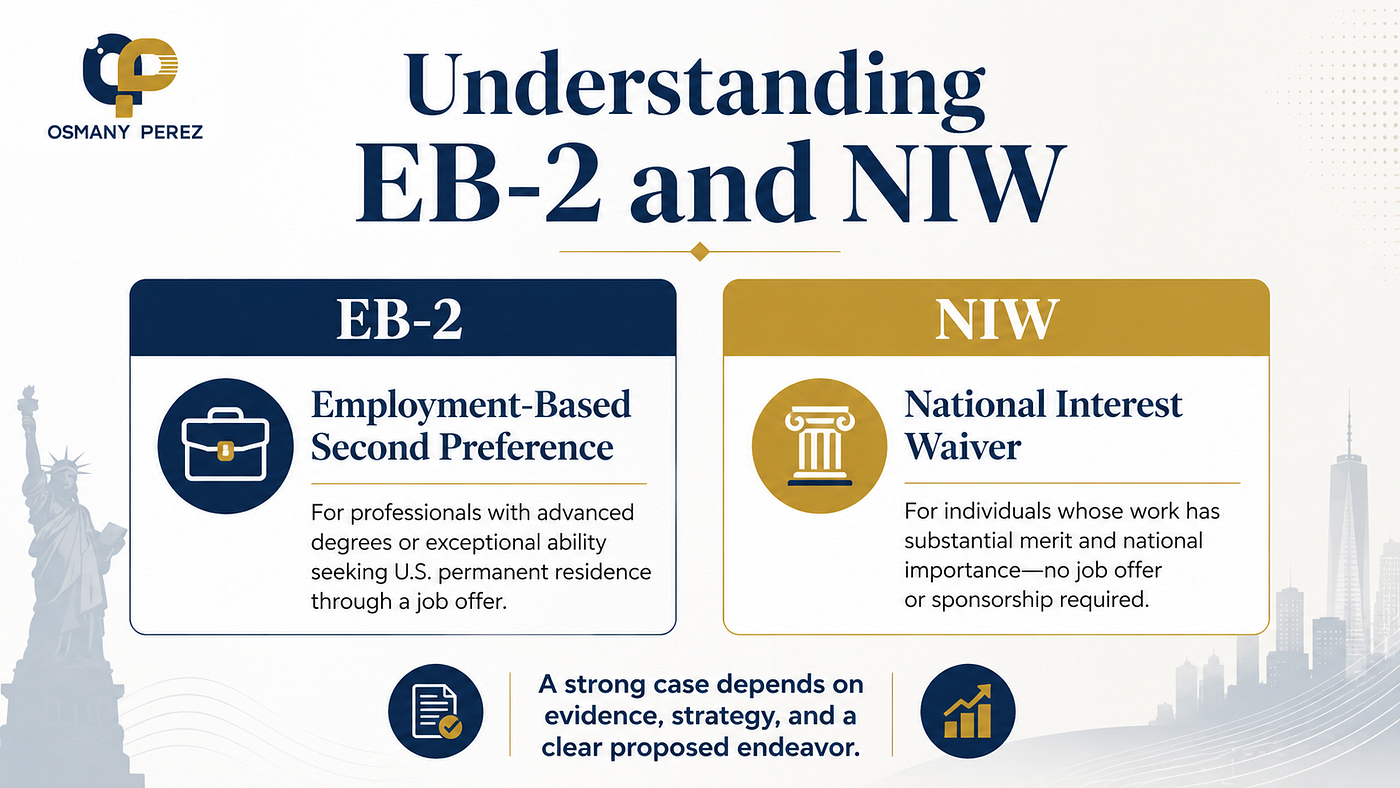
Step 8: Organize EB-2 NIW Evidence Strategically
For EB-2 NIW, evidence organization is especially important. According to USCIS, a person seeking a National Interest Waiver must first show eligibility for the underlying EB-2 classification, such as advanced degree or exceptional ability, University degree, years of experience and then show that the waiver of the job offer and labor certification requirement is in the national interest.
That means the evidence should usually be organized around both the EB-2 requirement and the NIW strategy.
A strong EB-2 NIW evidence file may include:
-
Degrees and transcripts
-
Credential evaluations, if needed
-
Resume or curriculum vitae
-
Employment letters
-
Professional licenses
-
Certifications
-
Awards and recognitions
-
Publications
-
Media mentions
-
Conference participation
-
Recommendation letters
-
Business ownership records
-
Business plan or proposed endeavor plan
-
Evidence of impact in the field
-
Evidence of future work in the United States
-
Evidence showing why the proposed work matters
-
Evidence showing why the person is well positioned
-
The evidence should answer three central questions:
- What is the proposed endeavor?
- Why does it matter?
- Why is this person qualified to advance it?
Step 9: Organize Employment-Based Evidence
For employment-based cases, the evidence may involve both the foreign worker and the U.S. employer.
The worker’s evidence may include:
- Passport
- Immigration history
- Resume
- Degrees
- Transcripts
- Licenses
- Certifications
- Employment letters
- Experience evidence
- Professional qualifications
- The employer’s evidence may include:
- Business registration
- Tax records
- Financial statements
- Job offer
- Job description
- Wage information
- Recruitment documents
- Ability-to-pay evidence
- Organizational chart
- Business need explanation
For employer-sponsored cases, the employer’s role is central. The evidence must show not only that the worker qualifies, but also that the employer is real, organized, and able to support the immigration process.
Step 10: Organize Family-Based Evidence
For family-based immigration, the evidence should prove the qualifying relationship and the eligibility of the petitioner and beneficiary.
Depending on the case, evidence may include:
- Birth certificates
- Marriage certificate
- Divorce decrees
- Proof of U.S. citizenship or lawful permanent residence
- Passport biographic pages
- Photos
- Joint bills
- Joint leases
- Joint bank statements
- Children’s birth certificates
- Affidavits
- Financial sponsorship documents
- Tax returns
- Proof of lawful entry, if adjustment of status is involved
- Immigration history documents
In marriage-based cases, the evidence should show that the marriage is real and not entered into only for immigration benefits. The evidence should be organized by category, date, and purpose.
Step 11: Organize Waiver Evidence
Waiver cases often require detailed and emotional evidence. Depending on the type of waiver, the evidence may focus on hardship, discretion, rehabilitation, family unity, medical issues, financial hardship, psychological hardship, country conditions, community ties, or other relevant factors.
Waiver evidence may include:
- Personal statement
- Family statements
- Medical records
- Psychological evaluations
- Financial records
- School records
- Country condition evidence
- Proof of family ties
- Proof of community ties
- Employment history
- Tax records
- Rehabilitation evidence
- Court records
- Police clearances
- Evidence of responsibility and good moral character
Waiver evidence should not be disorganized or overly emotional without structure. The best approach is to combine human facts with documentary proof.
Step 12: Use an Evidence Index
An evidence index is a table that lists the documents included in the case.
It may include:
- Tab number
- Document name
- Date
- Category
- Purpose
- Notes
Example:
Tab A — Passport biographic page — Identity
Tab B — Birth certificate with translation — Identity
Tab C — Master’s degree diploma — Education
Tab D — Employment verification letter — Work experience
Tab E — Recommendation letter — Professional qualifications
Tab F — Business plan — Proposed endeavor
Tab G — Tax records — Financial/business evidence
An evidence index makes the case easier to review and helps the person preparing the case stay organized.
Step 13: Avoid Submitting Unnecessary Evidence
More evidence is not always better.
Relevant evidence is better. A large number of documents can become a problem if they are disorganized, repetitive, irrelevant, or confusing.
Before including a document, ask:
- Does this document support the legal strategy?
- Does it prove something important?
- Is it clear?
- Is it complete?
- Is it consistent?
- Does it need translation?
- Is there a better document that proves the same point?
Evidence should strengthen the case, not distract from it.
Step 14: Prepare a Strong Resume or CV
For professional and employment-based cases, the resume or CV is often one of the most important documents.
A strong immigration-focused resume should be accurate, complete, and consistent with the rest of the evidence.
It should include:
- Education
- Professional experience
- Job titles
- Dates
- Employers
- Skills
- Certifications
- Licenses
- Publications
- Awards
- Speaking engagements
- Projects
- Business ownership
- Professional memberships
- Relevant achievements
For EB-2 NIW, the resume should support the proposed endeavor and show why the person is well positioned to advance the work.
Step 15: Prepare Recommendation Letters Carefully
Recommendation letters can be helpful, but they should be meaningful.
A weak recommendation letter says general things like:
“He is a good professional.”
“She is responsible.”
“He has many years of experience.”
A stronger recommendation letter explains:
- Who the recommender is
- How the recommender knows the person
- What the person accomplished
- Why the work matters
- What specialized skills the person has
- What impact the person has had
- Why the person is well positioned
- How the proposed work may benefit the United States
The best letters are specific, credible, and connected to the strategy.
Step 16: Connect Evidence to the Story
The final step is to make sure the evidence tells a coherent story.
The story should be clear:
- This is who the person is.
- This is what the person has accomplished.
- This is what the person plans to do.
- This is why the person qualifies.
- This is why the evidence supports the strategy.
- This is why the case should be considered favorably.
Immigration evidence should not be treated as paperwork only. It should be treated as the foundation of the strategy.
Common Mistakes to Avoid
Avoid these common mistakes:
- Submitting blurry photos of documents
- Submitting incomplete records
- Using inconsistent names or dates
- Failing to translate foreign-language documents
- Submitting documents without explaining their relevance
- Sending too many irrelevant documents
- Not organizing evidence by category
- Not reviewing immigration history
- Not checking court or police records
- Using generic recommendation letters
- Relying only on a resume
- Starting the process without a strategy
A strong case begins with preparation.
Final Thoughts
Organizing evidence is one of the most important steps in building a U.S. immigration strategy. The documents should not be random. They should be organized, labeled, translated when necessary, reviewed for consistency and connected to the legal and factual strategy.
Whether a person is exploring EB-2 NIW, EB-3, family-based immigration, adjustment of status, waivers, or another immigration pathway, evidence organization helps create clarity.
At Osmany Perez LLC, we help professionals, entrepreneurs, families, and employers evaluate their immigration options, organize their evidence, and prepare a strategy before starting the process.
For consultations and resources, visit: osmanyperez.com
You can also follow on Instagram: @dr.osmanyperez
Osmany Perez, JD, LL.M. Founder, Osmany Perez LLC
Disclaimer: This article is for general educational purposes only, Immigration cases depend on individual facts, evidence, current law, policy, visa availability, and government review.
메타데이터
- post_id
- 831689e0b7cd
- slug
- how-to-organize-evidence-for-a-u-s-immigration-strategy-831689e0b7cd
- url
- https://medium.com/@osmanyperez/how-to-organize-evidence-for-a-u-s-immigration-strategy-831689e0b7cd
- canonical_url
- https://medium.com/@osmanyperez/how-to-organize-evidence-for-a-u-s-immigration-strategy-831689e0b7cd
- author_url
- https://medium.com/@osmanyperez
- status
- ok
- fetched_at
- 2026-07-08 19:15:55