Lets Investigate The Hype Around Facebook’s Big Comeback With Muse Spark 1.1, Fact or Fiction
Meta put Muse Spark 1.1 into public preview on July 9. The part I care about is not the usual claim that a new model can plan, code and use…
Lets Investigate The Hype Around Facebook’s Big Comeback With Muse Spark 1.1, Fact or Fiction
Meta put Muse Spark 1.1 into public preview on July 9. The part I care about is not the usual claim that a new model can plan, code and use tools. It is the economics of giving a multimodal worker a real job inside an agent loop: $1.25 per million input tokens, $4.25 per million output tokens, 118.1 output tokens per second, and a 1M-token context window, according to Artificial Analysis.
That combination makes the model worth routing into bounded work now. Screenshot triage, browser-and-tool tasks, scoped bug fixes, long-document extraction and repeatable verifier loops all become cheaper to run. Meta is calling the model a step toward personal superintelligence. I would keep the claim smaller: Muse Spark 1.1 looks like a serious worker model before it looks like a proven long-horizon main agent.
I am Caspar Bannink, and I build AI products and agent workflows. HomeScout, my AI rental-search product for Dublin renters and expats, has no connection to Meta or Muse Spark. I write the practical routing notes here on CasparAI and on LinkedIn.
The independent receipt is better than the launch wording
Artificial Analysis currently gives the xhigh reasoning configuration an Intelligence Index score of 51, ranking it #17 of 188 models. Its summary also lists 118.1 output tokens per second, a 1M-token context window, $1.25 input and $4.25 output per million tokens, plus a $0.15 cache-hit input price.
Metric                                  Muse Spark 1.1 xhigh
--------------------------------------  --------------------
Artificial Analysis Intelligence Index  51
Rank                                    #17 of 188
Output speed                            118.1 tokens/s
Input price                             $1.25 / 1M tokens
Output price                            $4.25 / 1M tokens
Cache-hit input                         $0.15 / 1M tokens
Context window                          1M tokens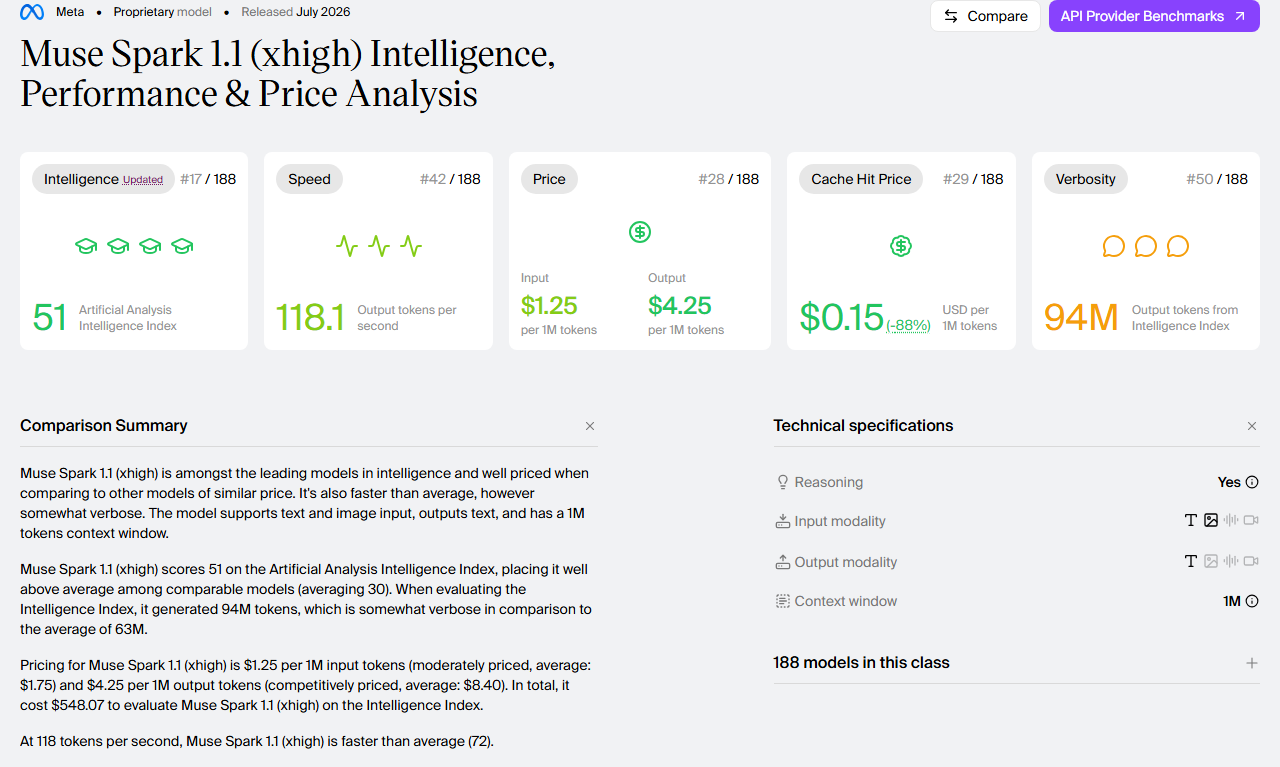
Artificial Analysis: Index 51, 118.1 tokens/s, $1.25/$4.25 per 1M tokens and 1M context. Source: .
Those figures are enough to make a concrete builder decision. The model is not cheap because it costs nothing. It is cheap because the price and speed change how often I can afford to let an agent inspect a screenshot, retry a tool call, read a large context or hand a narrow task to a second model.
Artificial Analysis adds an important caveat: it describes Muse as somewhat verbose. Its Intelligence Index run used 94M output tokens, against a 63M average. For one-shot chat this is a footnote. For agent loops that keep generating reasoning and tool traces, it belongs in the budget.
What Meta actually shipped
Meta describes Muse Spark 1.1 as a multimodal reasoning model for agentic tasks. It is available through the public-preview Meta Model API and in Thinking mode in Meta AI and on meta.ai. The product page says the model accepts text and image input, then returns text.
The technical shape is more interesting than a generic coding claim. Meta says Muse can work with native tools, MCP servers and custom skills; manage 1M tokens of context; plan and delegate across parallel subagents; and decide when a script is faster than clicking through an interface.
Meta also shows an OpenCode debugging demo. The model builds a chat application, takes automated screenshots, identifies a visible failure, traces the relevant code, implements a fix and validates the result. That is the right kind of demo to show for a multimodal coding model because it combines visual inspection, tool use and a clear acceptance check.
It remains a Meta demo. I count it as product evidence, not a universal benchmark result.
Why I would start with worker jobs
The launch video makes the usual frontier-model case: build a macOS clone, make a game, generate a visual and keep adding features. Those are useful demonstrations of range, but they do not tell me where a model belongs inside a real system.
The higher-value starting point is smaller and more operational:
Role in an agent system        Why Muse is a plausible fit today
-----------------------------  -----------------------------------------------------------------------
Screenshot or UI issue triage  Image input, high speed and a low enough price for retries
Scoped coding task             A clear bug, acceptance test and tool permissions keep the loop bounded
Long-document extraction       1M context makes large reading passes less awkward
Subagent                       A main agent can delegate a narrow job and verify the returned artifact
Main agent on a long project   Needs independent proof before I would trust it by default
This is where the comparison to DeepSeek V4 is useful, but only as a routing analogy. The appeal is similar: a model can be surprisingly good at resolving concrete issues for its cost without becoming the automatic choice for every long, messy project. That does not mean Muse and DeepSeek V4 have the same scores, the same failure pattern or the same model design. It means builder economics can reward a strong worker before the long-horizon evidence is settled.
For an agentic coding stack, I would put Muse behind fixed acceptance criteria. Give it a bug report, repository scope, test command, screenshot or UI spec, and a limit on tool permissions. Then ask a stronger or more proven orchestrator to decide whether the resulting patch is ready. That design gives Muse the tasks where speed, image understanding and cost can compound while the system keeps accountability above it.
A 1M-token window does not settle the long-horizon question
Meta says Muse actively manages context, retrieves old details and compacts the critical steps needed later. That is a meaningful implementation claim. A large context window alone does not prove that a model can maintain a correct plan through many changing dependencies, recover from a bad assumption or know when an earlier subagent has quietly failed.
The current Artificial Analysis page makes the distinction visible. Its APEX-Agents-AA long-horizon panel shows leading rows for Gemini 3.5 Flash at 47%, GPT-5.5 xhigh at 38%, GLM-5.2 max at 34%, Gemini 3.1 Pro Preview at 32% and DeepSeek V4 Pro max at 24%. Muse Spark 1.1 is not among those visible leading rows.
I will not fabricate a negative Muse score from that absence. The honest conclusion is narrower: the independent evidence is already strong on aggregate intelligence, price and speed. It is not yet equally strong for long-horizon agent reliability.
That is why the original video feels directionally right when it calls the release underrated, but too broad when it turns selected demo and benchmark claims into a frontier-wide victory lap. Muse does not need to beat every expensive model to be a valuable release. It needs to lower the cost of useful, verifiable work.
The routing rule I would use now
I would test Muse Spark 1.1 where the task has a visible finish line:
- a UI failure that can be inspected in a screenshot
- a bug with a test suite or reproduction path
- a document extraction job with a schema
- a browser-and-tool workflow with a final check
- a delegated coding task with a reviewer model or human approval
I would not make it the default owner of a long project merely because the context window is 1M tokens or the vendor says it can delegate subagents. The first independent comparison I want is a fixed-tool, fixed-budget, end-to-end run against a known main-agent setup, with the same task list and acceptance criteria.
That is the benchmark that decides whether Muse has crossed from excellent worker to reliable conductor.
Meta has already shipped enough to justify testing. The model has a public API, multimodal input, strong independent aggregate numbers, high output speed and pricing that makes retries practical. The launch becomes more useful when it is treated as a routing opportunity rather than a declaration that Meta has won the agent race.
Sources
- Meta, Introducing Muse Spark 1.1
- Artificial Analysis, Muse Spark 1.1
- Simon Willison, Introducing Muse Spark 1.1
About the author
I am Caspar Bannink, founder of HomeScout, an AI-powered rental search and application workflow product for Dublin.
HomeScout: homescout.io
Personal LinkedIn: linkedin.com/in/caspar-bannink-719440217
HomeScout LinkedIn: linkedin.com/company/homescout-io
메타데이터
- post_id
- 8317fdf51af9
- slug
- lets-investigate-the-hype-around-facebooks-big-comeback-with-muse-spark-1-1-fact-or-fiction-8317fdf51af9
- url
- https://pub.towardsai.net/lets-investigate-the-hype-around-facebooks-big-comeback-with-muse-spark-1-1-fact-or-fiction-8317fdf51af9
- canonical_url
- https://pub.towardsai.net/lets-investigate-the-hype-around-facebooks-big-comeback-with-muse-spark-1-1-fact-or-fiction-8317fdf51af9
- author_url
- https://medium.com/@CasparAI
- status
- ok
- fetched_at
- 2026-07-17 08:43:13