Award Certificate Generator: Recognition Is a Frequency Problem, Not a Design One
It’s 6:47 PM on a Friday. Someone in HR is still hunched over a Canva tab, copy-pasting 412 names from a spreadsheet, exporting each one as…
Award Certificate Generator: Recognition Is a Frequency Problem, Not a Design One

It’s 6:47 PM on a Friday. Someone in HR is still hunched over a Canva tab, copy-pasting 412 names from a spreadsheet, exporting each one as a PDF, and renaming the files one by one. By the time the certificates hit inboxes on Monday, the achievement they were meant to celebrate has aged three days. The dopamine is gone. The recipient opens it, says “oh nice,” and moves on.
This is the quiet tragedy of modern recognition. We know it works. We just don’t deliver it on time.
Gallup and Workhuman’s two-year study found that employees who receive high-quality recognition are 45% less likely to leave within two years. (Source)
Companies with strategic recognition programmes are 48% more likely to report high retention. (Source)
Recognition isn’t fluff. It’s a measurable lever on a multi-trillion-dollar problem. Gallup estimates voluntary turnover costs the global economy roughly $1 trillion a year. (Source)
And yet… most of us are still making certificates by hand.
The real bottleneck isn’t design, it’s delivery
Let’s name the problem honestly. The issue isn’t that nobody knows how to make a certificate look good. 50,000 free templates are floating around the internet. The issue is the gap between “template exists” and “412 personalised PDFs land in 412 inboxes.” That gap is filled with one of two things: a junior employee’s evening, or nothing at all.
The numbers behind this are uglier than people admit.
76% of office workers spend up to three hours per day on manual data entry. (Source)
Manual document processing carries a 1–4% error rate, with each error costing $15 to $90 to remediate. (Source)
Knowledge workers spend 30–40% of the workday managing, searching for, and re-creating documents.
Now picture the misspelt-name version of this. “Anushka” instead of “Anushkaa.” A wrong date. A logo from last quarter’s branding. Recognition that was supposed to make someone feel seen makes them feel insulted instead. That one bad PDF eats more goodwill than ten good ones generate.
Why this hurts most at scale
If you’re handing out 12 employee-of-the-month certificates a year, manual work. Annoying, but works.
The numbers stop working when you cross certain thresholds:
Online learning: Over 220 million learners were enrolled in MOOCs globally by late 2024 (Source). 5.4 million people completed paid certificate courses in 2023 alone (Source). Now imagine running Coursera and your team designing each cert by hand.
Webinars and events: 57% of marketers host up to 50 webinars a year (Source). The global events industry hit roughly $1.48 trillion in 2025 (Source).
Corporate training: About 45% of large corporations now use MOOCs for employee training (Source). Multiply that across cohorts, modules, and quarters.
At those volumes, a person with a Canva account isn’t a workflow. It’s a single point of failure with a Gmail address.
The shape of a better workflow
The right answer is boring on purpose: design the certificate once, then let the data fill it in.
This is what CraftMyPDF does. You build a single template in a drag-and-drop editor, background, fonts, logo, signature, the lot. Wherever a name, date, course title, or score should appear, you drop a placeholder. From that point on, you stop touching the design.
The data flows in from wherever your data already lives:
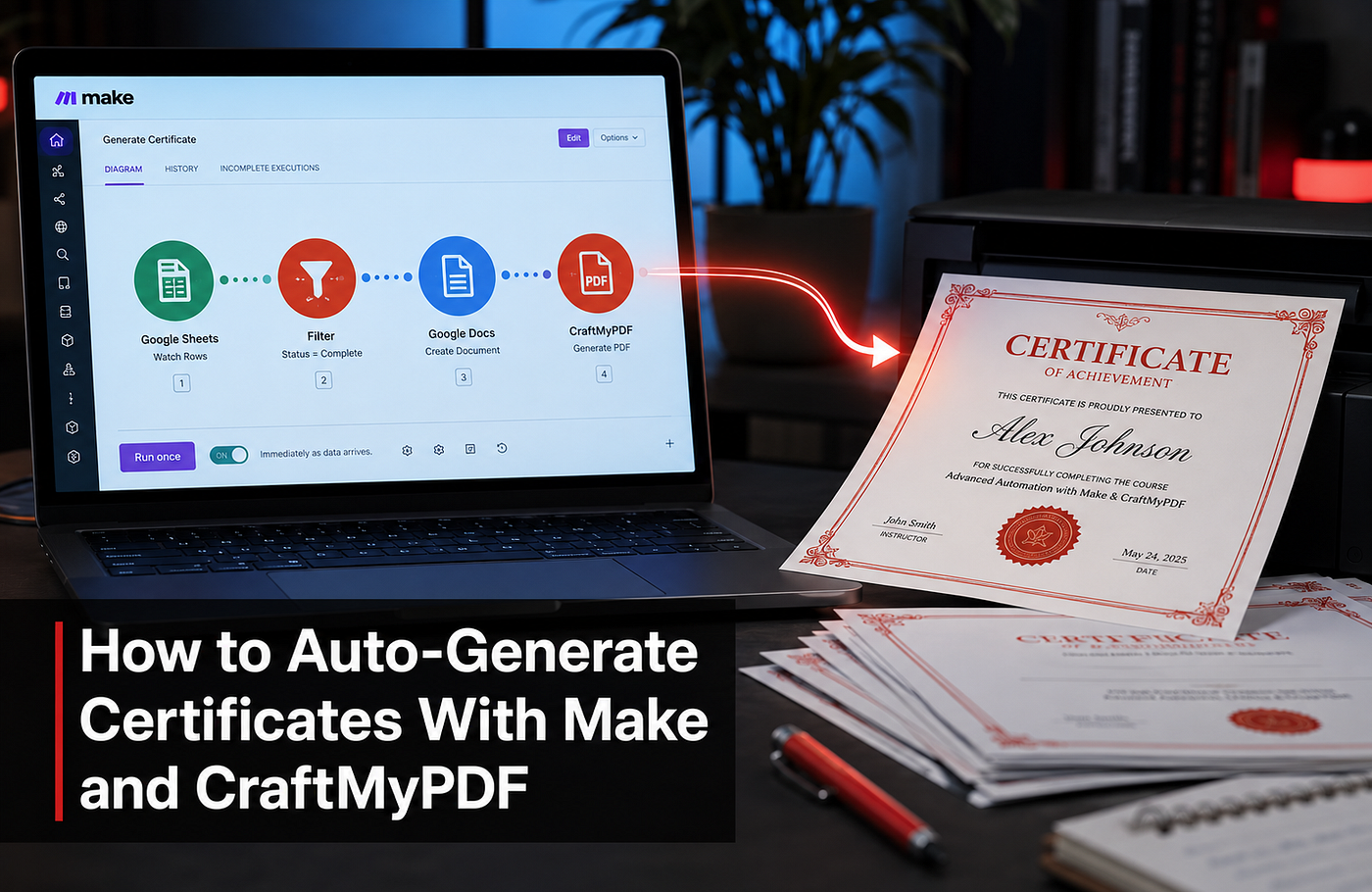
A row gets added to a Google Sheet of course completions: certificate generated and emailed automatically.
A Typeform fills up after a webinar: 800 attendees get personalised attendance certificates within minutes.
Your LMS fires a webhook on course completion: the API spins up a certificate, drops it in S3, and emails the learner before they’ve closed the browser tab.
The mechanics underneath are not complicated. Send a JSON payload with the recipient’s details to CraftMyPDF’s API, point it at your template, and you get a clean PDF back. If code isn’t your thing, the same workflow runs through Zapier, Make, n8n, or Bubble, no engineering required.
The same workflow can go beyond certificates too. Here are **10 creative ways to use the CraftMyPDF Image Generation API** for automating branded visuals across events, marketing, and day-to-day operations.
What changes when the bottleneck disappears
Here’s the part the productivity charts usually skip. When recognition stops being a chore, you start sending it more often. That matters because frequency is doing the heavy lifting here.
According to the Employee Recognition Statistics in the US 2024–2025 report, employees who receive recognition daily, weekly, or monthly report feeling valued at rates of 98%, 94%, and 88%, respectively. Only 37% feel valued when recognition arrives just once a year. (Source)
In other words, the difference between a certificate landing next Tuesday versus next quarter is the difference between an employee who stays and an employee who has already updated their LinkedIn headline.
Automated generation also opens up moments nobody bothers to recognise today because the friction is too high:
- A learner finishes module 3 of 8: a micro-certificate to keep them moving. MOOC completion rates sit between 10% and 15% (Source). Anything that keeps people in the game is gold.
- A customer’s product anniversary lands: a “1 year with us” certificate that doubles as marketing.
- A sales rep crosses a pipeline milestone: instant recognition without waiting for the quarterly all-hands.
- A hackathon ends at midnight: all 600 participants get their proof-of-participation before they go to bed.
None of those happens in a manual world. All of them happen when the generation cost drops to roughly nothing.
A quick word on what “at scale” really means
“Scale” gets thrown around too loosely. It’s not just volume. It’s also:
Variance: Different courses, different signatories, different visual themes, one template engine, multiple variants. Personalisation: QR codes that link to a verification page. Dynamic completion dates. Custom messages. Scores rendered as charts. Distribution: PDF for download, PNG for LinkedIn, JPG for embedding in a profile, all from the same template.
A certificate that gets shared on LinkedIn is recognition that compounds. It reaches the recipient, their network, and your brand in one shot. Hard to pull that off when the file is buried in a shared drive nobody opens.
Try CraftMyPDF’s Online Certificate Maker, a Free tool.
Where to start
Pick the single most painful certificate workflow in your business right now. The one that eats on a Friday. The one where names get misspelt. The one who arrives late.
Build it once in CraftMyPDF. Connect it to wherever the data lives. Walk away.
Then count the hours you didn’t spend, the names you didn’t misspell, and the people who stayed because something thoughtful arrived on a Tuesday morning instead of three weeks later.
That’s what automation at scale actually buys you, not faster certificates but Better recognition.
메타데이터
- post_id
- 83250f58d7ea
- slug
- award-certificate-generator-recognition-is-a-frequency-problem-not-a-design-one-83250f58d7ea
- url
- https://medium.com/@JackyKiatTan/award-certificate-generator-recognition-is-a-frequency-problem-not-a-design-one-83250f58d7ea
- canonical_url
- https://medium.com/@JackyKiatTan/award-certificate-generator-recognition-is-a-frequency-problem-not-a-design-one-83250f58d7ea
- author_url
- https://medium.com/@JackyKiatTan
- status
- ok
- fetched_at
- 2026-06-26 03:39:16