YC’s Company Brain RFS: What Hyper, GBrain, and the Competition Got Right (and Wrong)
Tom Blomfield’s YC Summer 2026 RFS formally launched the “Company Brain” category. Hyper, GBrain, Cerenovus, and Savant are racing to own…
YC’s Company Brain RFS: What Hyper, GBrain, and the Competition Got Right (and Wrong)
Tom Blomfield’s YC Summer 2026 RFS formally launched the “Company Brain” category. Hyper, GBrain, Cerenovus, and Savant are racing to own it. But here’s what nobody says out loud: they’re solving 40% of the problem. The other 60% is metric consistency, governance, and compliance. That’s where the real value lives.
YC’s Company Brain RFS: What the Market Got Right — and What It Still Misses
When Y Combinator highlights “Company Brain” as a startup category, it signals something important: enterprise AI is moving beyond chatbots and copilots.
The market now understands that agents need company-specific context. They need to know how the business works, where knowledge lives, and how decisions are made.
That insight is correct.
But many company brain approaches still solve only part of the problem.
They focus heavily on memory and retrieval, while underestimating the execution layer needed for reliable enterprise data work.
What the category gets right
The company brain framing gets one thing exactly right: the bottleneck is not only model intelligence.
Modern models are already capable enough to reason, plan, and interact with tools. The blocker is domain knowledge. Enterprise workflows depend on definitions, systems, processes, exceptions, permissions, and history that are not inside the model.
A company brain should make that knowledge available to agents.
It should pull context from documents, systems, conversations, and workflows. It should stay current. It should help AI understand the company as it actually operates.
That is the right starting point.
What retrieval-first approaches miss
The risk is treating the company brain as a better search engine.
Search and retrieval help an agent find information. They do not guarantee that the agent can safely execute a business query.
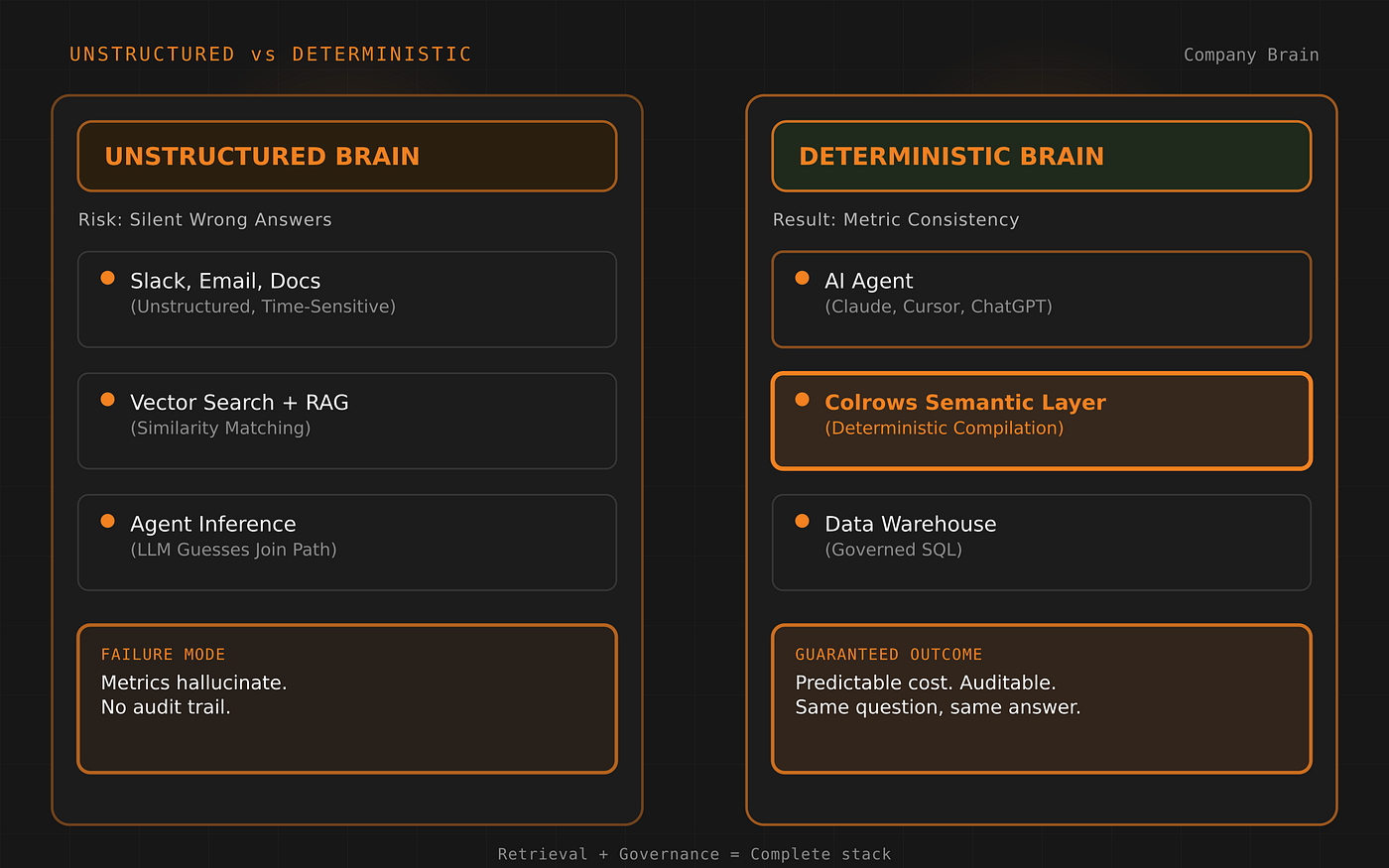
For example, an agent may retrieve a document explaining revenue. But when it needs to answer a question from live data, it still has to know which tables to use, which join path is approved, which grain applies, which filters are required, and whether the user is allowed to access the result.
If the model decides those things at runtime, the system is still probabilistic.
For enterprise analytics and operations, that is not enough.
The missing 60%: governed semantic execution
A full company brain needs a semantic execution layer.
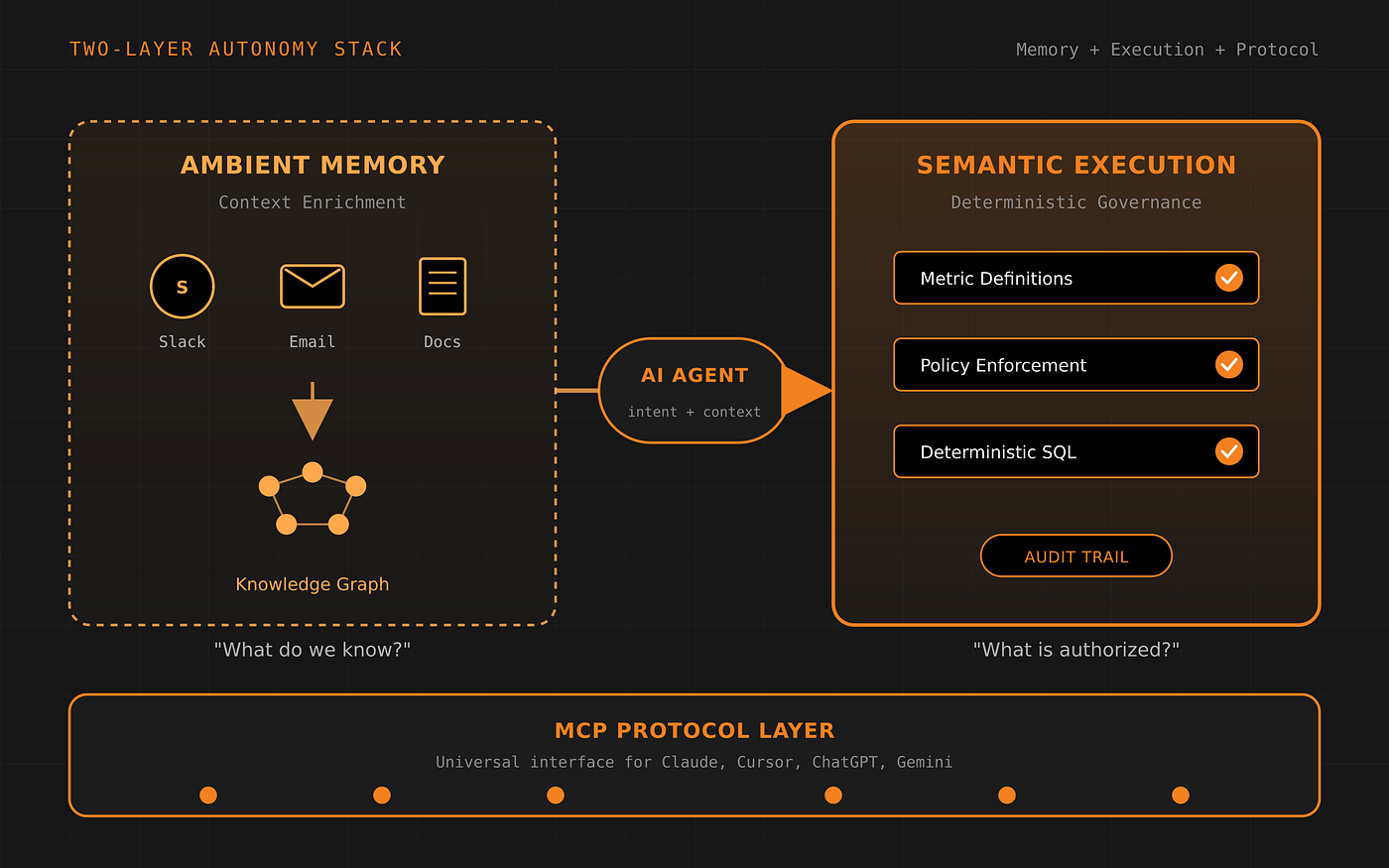
This layer defines business entities, metrics, relationships, policies, and valid query paths. It converts intent into deterministic SQL or executable plans. It enforces access rules before the data is touched. It creates an audit trail that shows exactly how a result was produced.
This is the difference between remembering knowledge and operationalizing knowledge.
Memory helps an agent answer, “What do we know?”
Semantic execution helps an agent answer, “What is the correct governed action?”
Why this matters for AI-native companies
As agents move from assistance to autonomy, the cost of wrong context increases.
A copilot that drafts a paragraph can be corrected by a human. An agent that runs pricing analysis, reconciles revenue, routes a compliance case, or triggers a customer workflow needs stronger guarantees.
It must not hallucinate metrics.
It must not invent join paths.
It must not bypass access controls.
It must not silently use stale definitions.
That is why the company brain cannot be only an ambient memory layer. It must also be a deterministic control plane for business meaning.
What founders and enterprise leaders should build
The best company brain products will combine three capabilities.
First, ambient memory: capture and retrieve company knowledge from documents, chats, tickets, and systems.
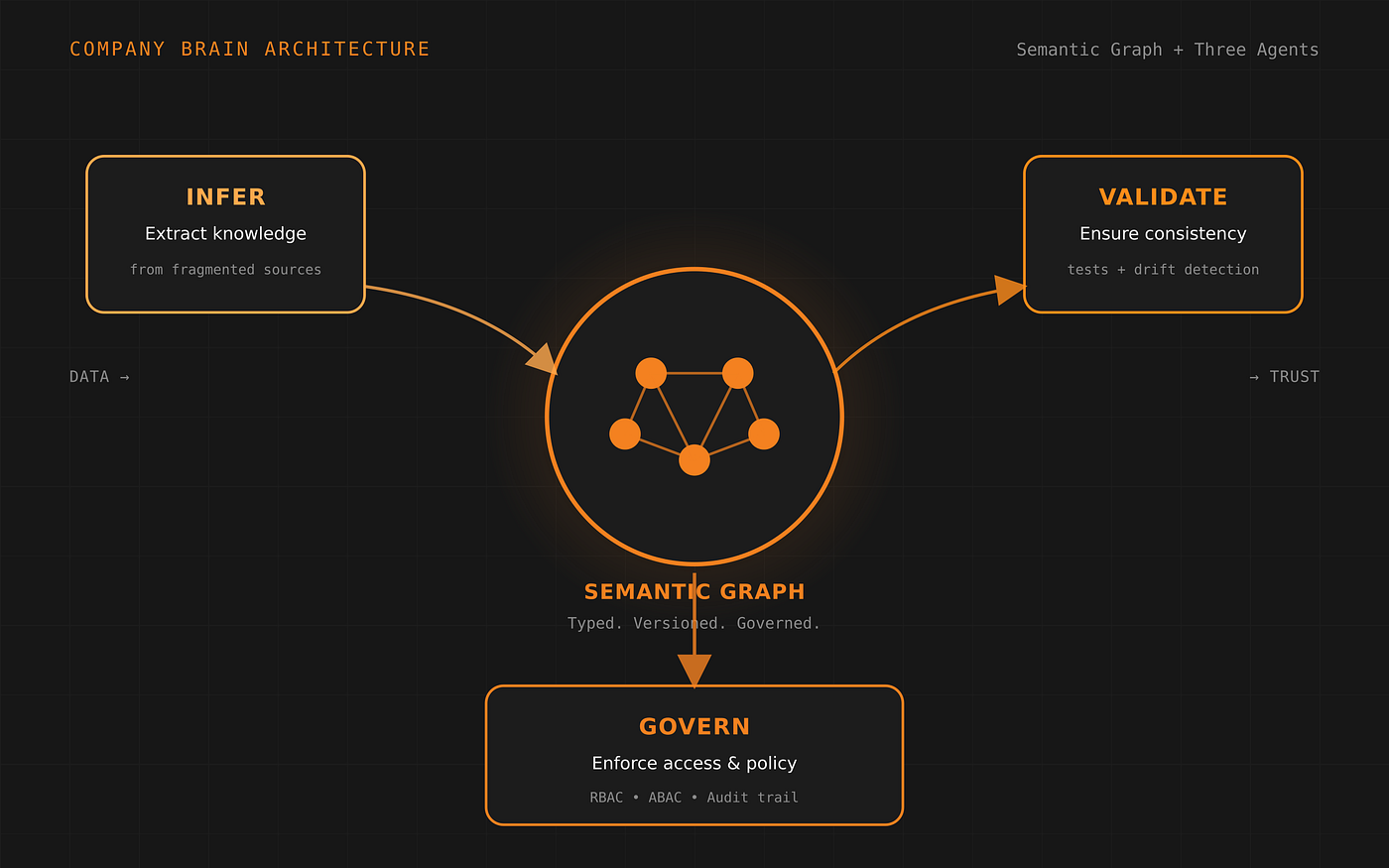
Second, semantic graph: structure business entities, relationships, metrics, definitions, and policies.
Third, semantic compiler: turn agent intent into governed execution paths that are reproducible, auditable, and safe.
The companies that combine all three will own the infrastructure layer beneath enterprise agents.
The bottom line
YC is right that every company will need a brain.
But the winning company brain will not be just memory. It will be the layer where memory, semantics, governance, and execution meet.
Retrieval gives agents context. Semantic compilation gives them correctness.
Enterprise AI needs both.
Read the full version on Colrows: https://colrows.com/blogs/yc-company-brain-rfs/
Explore the Company Brain series: https://colrows.com/blogs/topics/company-brain/
메타데이터
- post_id
- 8329bddca018
- slug
- ycs-company-brain-rfs-what-hyper-gbrain-and-the-competition-got-right-and-wrong-8329bddca018
- url
- https://medium.com/@mayank.mudgal/ycs-company-brain-rfs-what-hyper-gbrain-and-the-competition-got-right-and-wrong-8329bddca018
- canonical_url
- https://medium.com/@mayank.mudgal/ycs-company-brain-rfs-what-hyper-gbrain-and-the-competition-got-right-and-wrong-8329bddca018
- author_url
- https://medium.com/@mayank.mudgal
- status
- ok
- fetched_at
- 2026-07-16 12:13:25