Thirty Minutes to Merge a Country
How a single inland station in Haifa could unify Israel’s talent market — and why the Technion should plan for a bigger map
Thirty Minutes to Merge a Country
How a single inland station in Haifa could unify Israel’s talent market — and why the Technion should plan for a bigger map
Thesis: Minutes Make Markets
High-speed rail promises technology; what it actually delivers is time. Set a reliable 30-minute rhythm between Tel Aviv and Haifa, and a different Israel appears: students commute across regions, labs and clinics work in daily sync, and employers hire from a geography that used to be a weekend trip. This follow-up paper looks past alignments and tunneling to the human network effects — how a central Haifa deep station under the Grand Canyon district (not on the coast) would expand the Technion’s catchment, stitch the North into the country’s innovation belt, and change where companies choose to grow.
The Decision That Decides Everything
Two versions of the future are on the table:
- Coastal detour (status quo plan): a high-speed tunnel to an underground station at Hof HaCarmel, preserving the bay-side bend and entangling expresses with urban shoreline constraints.
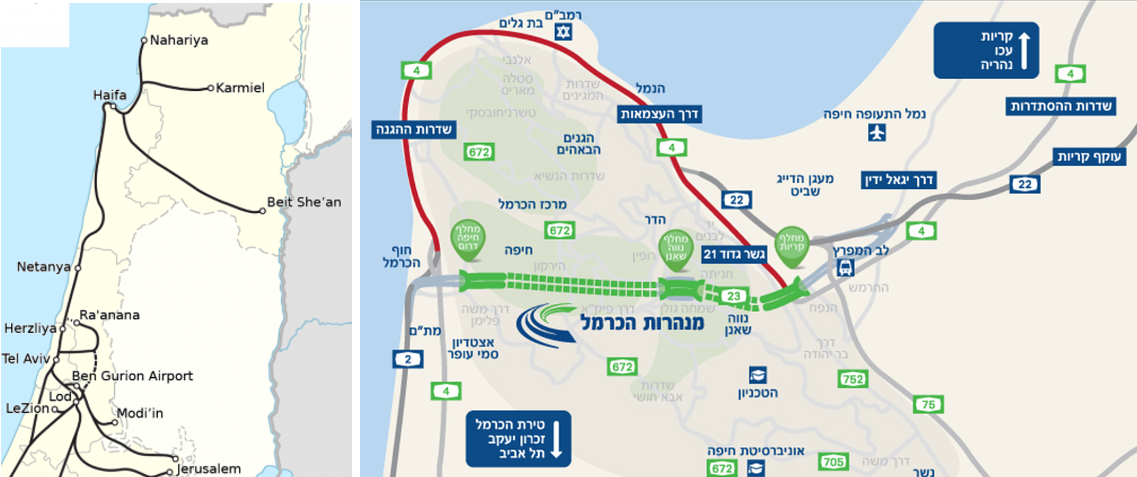
- Carmel chord (proposed): a straight through-tunnel under Mount Carmel with one pass-through station in central Haifa (Grand Canyon/Ruppin), stacked with an underground bus hall and a five-minute reserved shuttle to the Technion (plus a connector to the University of Haifa).
Both cost billions. Only one changes the map of daily life.
The New Catchment of the Technion
With the inland hub and five-minute shuttle, practical door-to-door times tighten to:
- Tel Aviv ↔ Technion: ≈ 35 minutes (express via inland hub + 5-min shuttle).
- Nahariya ↔ Technion: ≈ 15–17 minutes (one intermediate stop at most).
- Afula ↔ Technion: ≈ 16–19 minutes (zero to one stop).
That turns the Technion from a Haifa-area university into a national daily campus. Undergraduates can live in Afula or Tel Aviv without sacrificing hours; doctoral students split days between lab and startup; adjunct faculty from the Center teach mornings in Haifa and make afternoon design reviews back in Tel Aviv. The result is a step-change in applicant quality and diversity — more choices of housing, more family configurations that work, more second-career engineers who can teach without moving.
The Labor Market Multiplier
Minutes shape matching. Reduce friction, and more of the “right person, right team, right week” matches occur:
- R&D hiring: Tel Aviv companies that “love Technion people” can run same-day interviews, hybrid roles, and one-day-a-week teaching appointments. The North is no longer a recruiting exception; it’s part of the pipeline.
- Clinical–engineering teams: With the hospital embedded in the hub (Rambam-Carmel) and the Technion five minutes away, mixed teams form and persist — surgical robotics, imaging physics, nano-delivery — because collaboration becomes a habit, not a grant milestone.
- Firm formation: Founders no longer must choose between lab access in Haifa and investor gravity in Tel Aviv. A company can keep prototyping above the Haifa concourse and meet funders downtown by lunch.
Agglomeration economics favors places where unexpected meetings are cheap. An inland hub makes those meetings default.
A North That Works Like a Metro
Put the station where the tunnels meet and the minutes end, and the North behaves like a larger, slower-moving metro:
- Nahariya–Haifa–Afula triad: fifteen-to-twenty minutes between anchors turns internships, clinical rotations, and dual-campus degrees from exceptions into patterns.
- The eastern fork: The clean post-platform split toward Karmiel and the Valley Line means “east” is not an afterthought. The Jezreel becomes commuter-close to both the coast and the labs.
- Freed waterfront: By moving acute care uphill and taking expresses inland, Haifa returns its shoreline to living — rehab, prevention, promenades — while the working center consolidates under Carmel.
This isn’t only mobility; it’s regional dignity. The North’s choices widen without uprooting families.
Education at the Speed of Trust
When travel time falls under 40 minutes, institutional trust changes:
- Shared faculty: Joint appointments between Technion and Tel Aviv schools stop being paperwork and become Tuesday/Thursday routines.
- Stacked degrees: Engineers add clinical or policy minors at the University of Haifa because the “extra campus” is one shuttle from the platform.
- Industry classrooms: Companies teach on campus because the commute is trivial and the recruiting return is immediate.
The more programs rely on face-time, the larger the benefit. Online can scale content; fast rail scales relationships.
What Companies Will Do
Firms follow frictions. Expect three moves:
- Satellite labs above the hall: Biomed, robotics, imaging, and data science teams co-locate within a five-minute field of the hospital and Technion.
- Dual-home startups: Found in Haifa for prototyping; fund in Tel Aviv; operate across both. The inland hub makes “two-address” companies sane.
- Second-wave clustering: Accounting, legal, regulatory, and design studios drift toward the hub as client density rises — creating a genuine CBD under the ridge.
The coastal station can’t do this; it’s a cul-de-sac. The inland hub is a market.
Security and Reliability — The Quiet Premise
Depth is not theater. A hardened hospital core and a deep concourse are a civic hardpoint: quiet on ordinary days, layered and redundant on bad ones. A chord under Carmel gives the network a backup route if the shore is compromised. Commuters feel it as punctuality; planners count it as resilience.
What to Decide — Now
Every network has one hinge where a single alignment choice multiplies or mutes the rest of the plan. For Israel’s North, this is Haifa’s stop. To unlock the education-and-labor dividend:
- Move the high-speed stop inland. Commit the Haifa HSR station to the Grand Canyon hub, not Hof HaCarmel.
- Build a four-track pass-through hall. Two straight mains for expresses; two platform tracks for regionals and overtakes.
- Stack the bus terminal on the hub. Replace the north and south bus stations with housing/labs/civic uses.
- Hard-wire the university links. Five-minute Technion shuttle, plus a connector to the University of Haifa, embedded in the station’s fabric — not added from the curb.
- Stage the hospital move. Stand up Rambam-Carmel’s underground acute block early; specialize the coast for rehab and prevention.
How to Measure If It’s Working
Don’t wait for ribbon-cuttings; watch behavioral metrics:
- Share of Technion students/faculty commuting daily from Tel Aviv, Afula, Nahariya.
- Number of joint appointments and co-taught courses across campuses.
- Volume of same-day clinical–engineering sessions (robotics, imaging, trials).
- Count of firms with two-address operations (Haifa prototyping, Tel Aviv market).
- Waterfront footfall and rehab capacity after acute care moves uphill.
- On-time performance through Haifa during works or disruptions on the coast.
If those curves bend up, the chord is doing what chords do: turning distance into possibility.
The Country That Got Bigger Without Moving
Israel cannot sprawl its way to opportunity; it has to shorten to grow. A central Haifa station under the mountain is not a prize for one city. It is a choice to make the best minds commute in minutes, to let families keep roots while trading ideas at national scale, to let the North work like a metro and the Center breathe.
We can build a beautiful coastal cul-de-sac — or a national hinge. Choose the chord. Put the station where the tunnels meet and the minutes end. The rest — students, startups, clinics, careers — will follow on the very next timetable.
=
=
=
Почему одна железнодорожная станция в центре Хайфы важнее десятков программ развития Севера
Высокоскоростная железная дорога — это не столько про скорость, сколько про структуру повседневной жизни. Она меняет не расстояния на карте, а то, что люди считают допустимым в обычный рабочий день. Если дорога между двумя городами укладывается в полчаса и работает надежно, эти города начинают жить как части одного пространства — даже если формально остаются разными регионами.
В этом смысле проект скоростного сообщения между Тель-Авивом и Хайфой — не просто транспортная стройка. Это редкий шанс изменить устройство страны. Но эффект зависит от одного, на первый взгляд технического, решения: где именно в Хайфе будет находиться ключевая станция.
Минуты важнее километров
Экономисты и градостроители давно знают: рынки труда, образования и знаний формируются не по географии, а по доступности. Человек может жить в сорока километрах от места учебы или работы — и чувствовать себя ближе, чем тот, кто живет в десяти, но вынужден тратить на дорогу полтора часа с пересадками.
Существует негласный психологический порог: если дорога «дверь-в-дверь» занимает около 35–40 минут и при этом предсказуема, она перестает восприниматься как отдельное событие. Она становится частью дня — вроде поездки из одного района города в другой. Ниже этого порога связи начинают множиться, выше — редеть.
Именно поэтому вопрос о скоростной линии между Тель-Авивом и Хайфой нельзя сводить к цифрам максимальной скорости. Важнее другое: где именно заканчиваются эти минуты.
Два сценария для Хайфы
Сегодня обсуждаются разные варианты прохождения скоростной линии через Хайфу. Упрощая, можно выделить два принципиально разных подхода.
Первый — инерционный. Скоростной поезд приходит в прибрежную зону, в район существующей станции Хоф ха-Кармель. Формально цель достигнута: время в пути сокращено, линия вписана в существующий коридор. Но дальше пассажир снова сталкивается с городом — пересадками, объездами, сложной логистикой.
Второй — городской. Он предполагает сквозной тоннель под Кармелем и центральную станцию внутри Хайфы, в зоне, откуда за считаные минуты можно добраться до Техниона, университетских кампусов, больниц и делового ядра города. Такая станция работает не как конечная точка, а как узел — место, где сходятся потоки.
С инженерной точки зрения оба решения сложны и дороги. Но с точки зрения последствий для страны разница между ними принципиальна.
Что дает центральная станция
Главное преимущество станции в центре города — резкое сокращение «последней мили». Именно она чаще всего съедает выгоды от быстрой магистрали. Если эту проблему удается решить архитектурно — встроив автобусный терминал, короткие городские линии, прямые связки с университетами, — дорога превращается в привычный маршрут.
Для Техниона это означает качественный сдвиг. Университет перестает быть локальным учреждением Севера и начинает работать как национальный научно-образовательный центр ежедневной доступности. Студенты получают возможность выбирать жилье не по транспортной необходимости, а по жизненным обстоятельствам. Преподаватели и исследователи из центра страны могут участвовать в учебном процессе регулярно, а не эпизодически. Совместные курсы и программы перестают быть формальностью.
Похожий эффект возникает и в медицине. Современная клиническая практика всё чаще развивается на стыке дисциплин: инженерии, физики, анализа данных. Такие команды требуют частых личных контактов. Когда университет и больницы оказываются в нескольких минутах друг от друга и в получасе от Тель-Авива, сотрудничество становится не проектом «по гранту», а рабочей рутиной.
Рынок труда и эффект совпадений
Рынок труда — это, по сути, система совпадений: нужный человек, нужная задача, нужный момент. Чем выше трение, тем меньше таких совпадений. Центральный транспортный узел в Хайфе резко снижает это трение.
Компании из Тель-Авива начинают воспринимать Север не как удаленную периферию, а как часть общего пространства. Появляются гибридные позиции, регулярные собеседования, совместные проекты. Стартапы получают возможность распределять функции: лабораторную и инженерную часть — в Хайфе, ближе к университету и клиникам; встречи с инвесторами и партнерами — в центре страны. Это перестает быть организационным подвигом и становится рациональной моделью.
Со временем вокруг такого узла формируется полноценная экосистема: юридические и регуляторные услуги, дизайн, бухгалтерия, сервисы для науки и медицины. Так возникают устойчивые городские кластеры — не по указу, а по логике удобства.
Север без переселения
Важно подчеркнуть: речь не идет о «перетягивании» людей в центр страны. Напротив, ценность подобного решения в том, что оно расширяет возможности без переселения. Север и восточные районы от Хайфы начинают работать как части единого пространства, сохраняя при этом свои социальные и семейные связи.
Когда Нагария, Афула и Хайфа оказываются связанными устойчивыми 15–20-минутными маршрутами, образовательные и профессиональные траектории становятся гибче. Люди могут учиться, работать и развиваться, не разрывая привычную жизнь. Это редкий случай, когда инфраструктура напрямую влияет на качество человеческого выбора.
Решение, которое нельзя отложить
У больших инфраструктурных проектов всегда есть одно-два решения, от которых зависит всё остальное. Для Севера Израиля таким решением является расположение скоростной станции в Хайфе.
Если она останется на побережье, страна получит быструю, но ограниченную линию. Если же будет создан полноценный городской узел в центре Хайфы, Израиль фактически «сожмется» во времени — и от этого станет больше.
Это не вопрос престижа и не вопрос архитектурных амбиций. Это вопрос того, будут ли университеты, больницы и рынки труда работать как разрозненные острова или как единая система. Иногда, чтобы изменить страну, достаточно правильно поставить одну станцию.
메타데이터
- post_id
- 833252fae4bf
- slug
- thirty-minutes-to-merge-a-country-833252fae4bf
- url
- https://medium.com/@michaelzibulevsky/thirty-minutes-to-merge-a-country-833252fae4bf
- canonical_url
- https://medium.com/@michaelzibulevsky/thirty-minutes-to-merge-a-country-833252fae4bf
- author_url
- https://medium.com/@michaelzibulevsky
- status
- ok
- fetched_at
- 2026-06-24 23:31:39