Did the Extinction That Launched the Dinosaurs Start Millions of Years Earlier?
New evidence suggests the oceans were already changing long before the end-Triassic mass extinction.
FOSSILS ET AL.
Did the Extinction That Launched the Dinosaurs Start Millions of Years Earlier?
New evidence suggests the oceans were already changing long before the end-Triassic mass extinction.
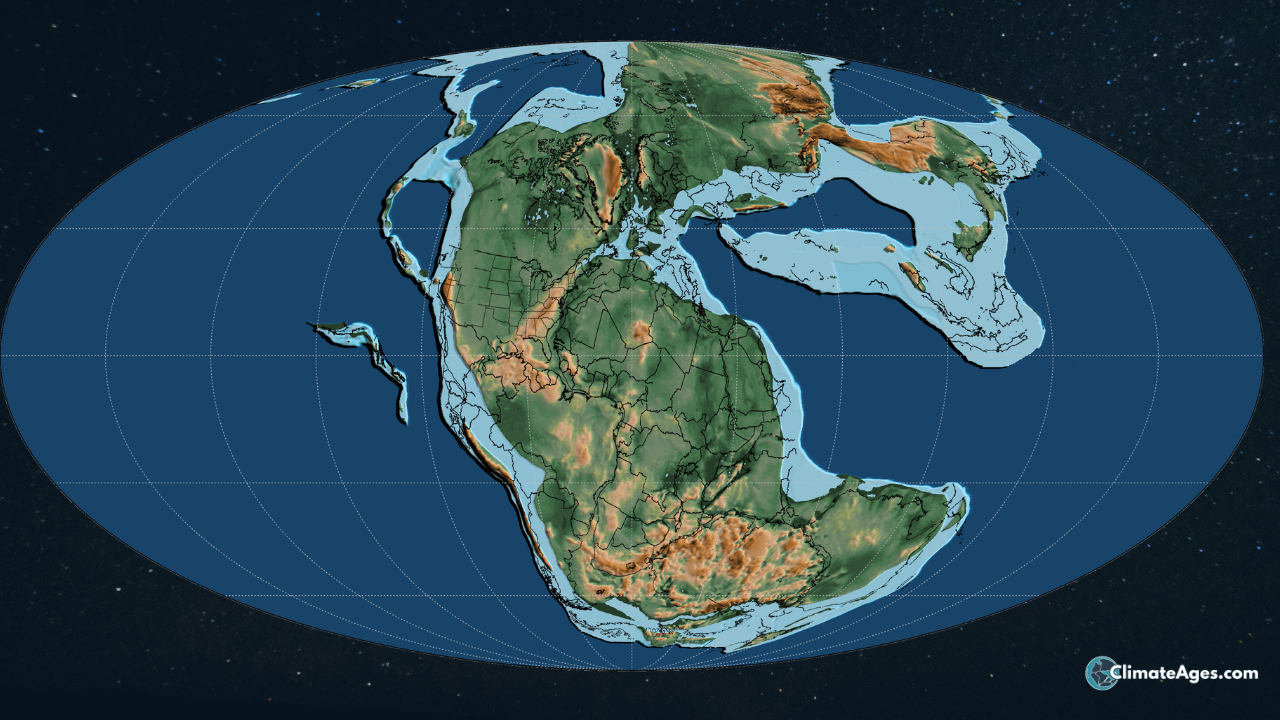
Imaged based on: By Scotese, Christopher R.; Vérard, Christian; Burgener, Landon; Elling, Reece P.; Kocsis, Ádám T. — “Phanerozoic-scope supplementary material to “The Cretaceous World: Plate Tectonics, Paleogeography, and Paleoclimate (doi:10.1144/sp544–2024–28)” from the PALEOMAP project”. doi:10.5281/zenodo.10659112 https://zenodo.org/records/10659112, CC BY 4.0, https://commons.wikimedia.org/w/index.php?curid=155112434
For years, paleontologists thought they understood the broad outline of the end-Triassic mass extinction, the event that marked the beginning of the Age of Dinosaurs as we know it.
Around 201 million years ago, enormous volcanic eruptions associated with the formation of the Atlantic Ocean released vast amounts of carbon dioxide into the atmosphere. The climate changed rapidly, oceans warmed, many species disappeared, and ecosystems were reorganized. By the end of the crisis, roughly half of Earth’s species were gone, and dinosaurs emerged from one group among many to become the dominant large vertebrates on land.
The story seemed straightforward enough, but some researchers began noticing something that did not quite fit.
The extinction itself, as well as the volcanic eruptions, were well documented. But when they looked closely at the fossil record, signs of trouble appeared earlier than expected. Some groups were already declining, and certain environmental signals seemed to be changing before the main extinction event. The deeper scientists looked, the more one question refused to go away.
What if the crisis had started long before the extinction became obvious? That question has been quietly growing for years.

Reptile extinction at the end of the Triassic is poorly understood, but phytosaurs (such as this Redondasaurus) went from abundant to extinct by the end of the Rhaetian — By Daderot — Own work, Public Domain, https://commons.wikimedia.org/w/index.php?curid=8557845
I remember first learning about the end-Triassic extinction as one of several major turning points in Earth’s history. Like many extinction events, it was often presented as a relatively sudden catastrophe: Something happens, ecosystems collapse, and species disappear.
But real ecosystems are rarely that simple.
When ecologists study modern environmental change, they often find that populations show signs of stress long before they disappear. Growth slows, reproduction declines, and communities begin to change. The final collapse may happen quickly, but the warning signs can appear years or even decades beforehand.
The same idea may apply to mass extinctions. But to understand why, we need to talk about oxygen.
Most animals in the ocean depend on dissolved oxygen in the water, just as we depend on oxygen in the air. When oxygen levels fall, life becomes more difficult. While some species can tolerate low oxygen conditions better than others, some need to move elsewhere, and yet others struggle to survive.
Today, scientists pay close attention to regions known as oxygen minimum zones. These are parts of the ocean where oxygen concentrations are naturally lower than those in the surrounding waters. Such zones have existed throughout much of Earth’s history. The problem begins when they expand.
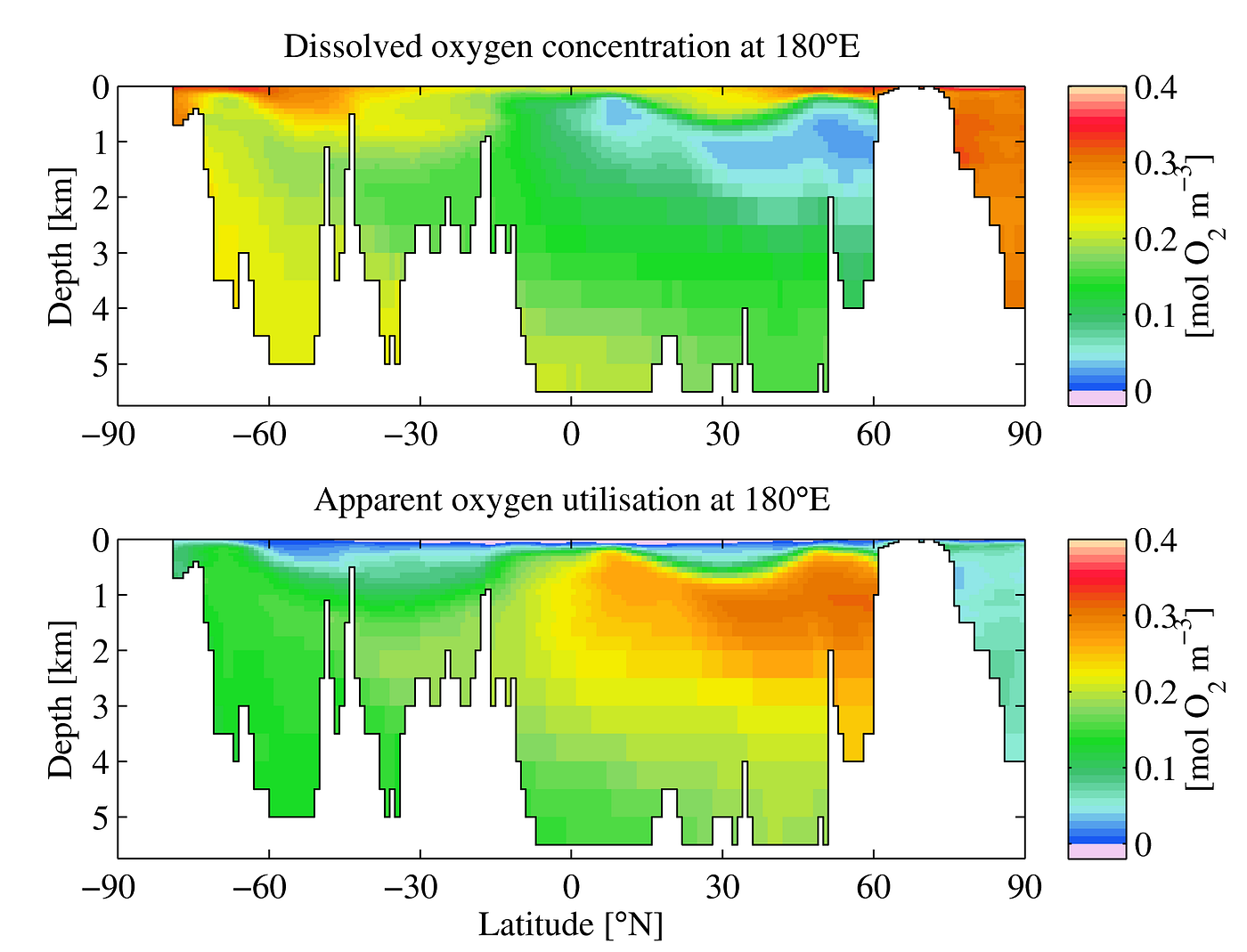
Annual mean dissolved oxygen (upper panel) and apparent oxygen utilisation (lower panel) from the World Ocean Atlas — By Plumbago — Own work, CC BY-SA 3.0, https://commons.wikimedia.org/w/index.php?curid=23016369
As oxygen-poor waters spread into areas that were previously well oxygenated, they reduce the amount of suitable habitat available to marine organisms. Even if conditions do not become completely oxygen-free, many species experience increasing stress.
Importantly, though, this is not an all-or-nothing process.
Imagine a crowded room where someone gradually lowers the amount of fresh air entering. People do not suddenly collapse the moment oxygen decreases. Instead, conditions become progressively less comfortable. Some people may leave, others may struggle, but the room surely becomes harder to occupy long before it becomes uninhabitable.
Marine ecosystems can respond in similar ways.
Over the last two decades, researchers studying rocks from the Late Triassic began finding hints that oxygen conditions were changing before the extinction itself. Evidence emerged from Europe, Canada, Japan, and other locations. Some studies suggested oxygen-poor waters were expanding. Others identified changes in nutrient cycling that often accompany declining oxygen levels.
Still, there was a problem. Most of these records covered only the extinction interval itself or came from relatively restricted marine environments. Scientists lacked a long record from the vast open ocean that dominated the planet at the time.
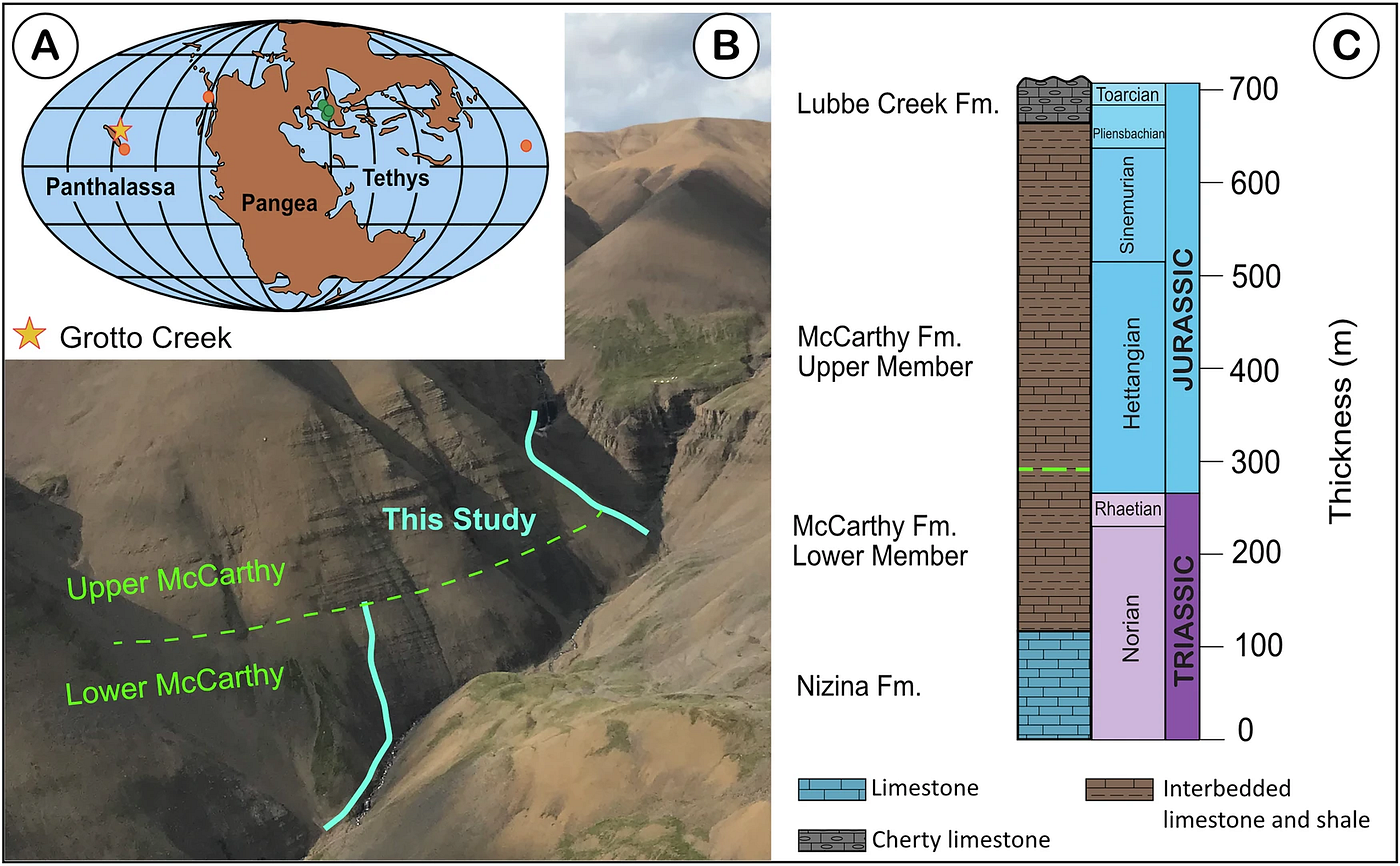
Paleogeography of the Late Triassic and stratigraphic setting of the Grotto Creek Section. A Late Triassic global paleogeographic reconstruction displaying the depositional location of the McCarthy Formation27 (gold star) on the Wrangellia terranes and other known nitrogen isotope records during the ETME (green and orange circles). B Aerial photo taken of the Grotto Creek Section with the boundary between the upper and lower McCarthy Formations denoted with the dashed line and the studied sections denoted with the solid blue line. The white dots on the green meadow above the cliff on the middle right of the photo are tents that are 1 meter tall for scale. C General stratigraphy of the Grotto Creek Section showing the relevant study interval in blue — McCabe et al., 2026
That gap is what motivated a new study published this year in *Communications Earth & Environment*.
The researchers examined sediments deposited in the equatorial Panthalassan Ocean, the enormous ocean that surrounded the supercontinent Pangaea. Today, those rocks are exposed in Alaska. By analyzing chemical signatures preserved within them, the team reconstructed changes in ocean oxygen levels across millions of years leading up to the extinction.
Their results suggest that oxygen-poor conditions began expanding roughly eight million years before the end-Triassic mass extinction.
That finding does not overturn what scientists know about the extinction itself. The enormous volcanic eruptions associated with the Central Atlantic Magmatic Province remain the leading explanation for the environmental disruptions that accompanied the extinction.
Instead, the new evidence adds another layer to the story. The results suggest marine ecosystems may have been experiencing environmental stress for millions of years before the final crisis. Oxygen minimum zones appear to have expanded gradually: nutrient cycles changed, and conditions became increasingly challenging for marine life.
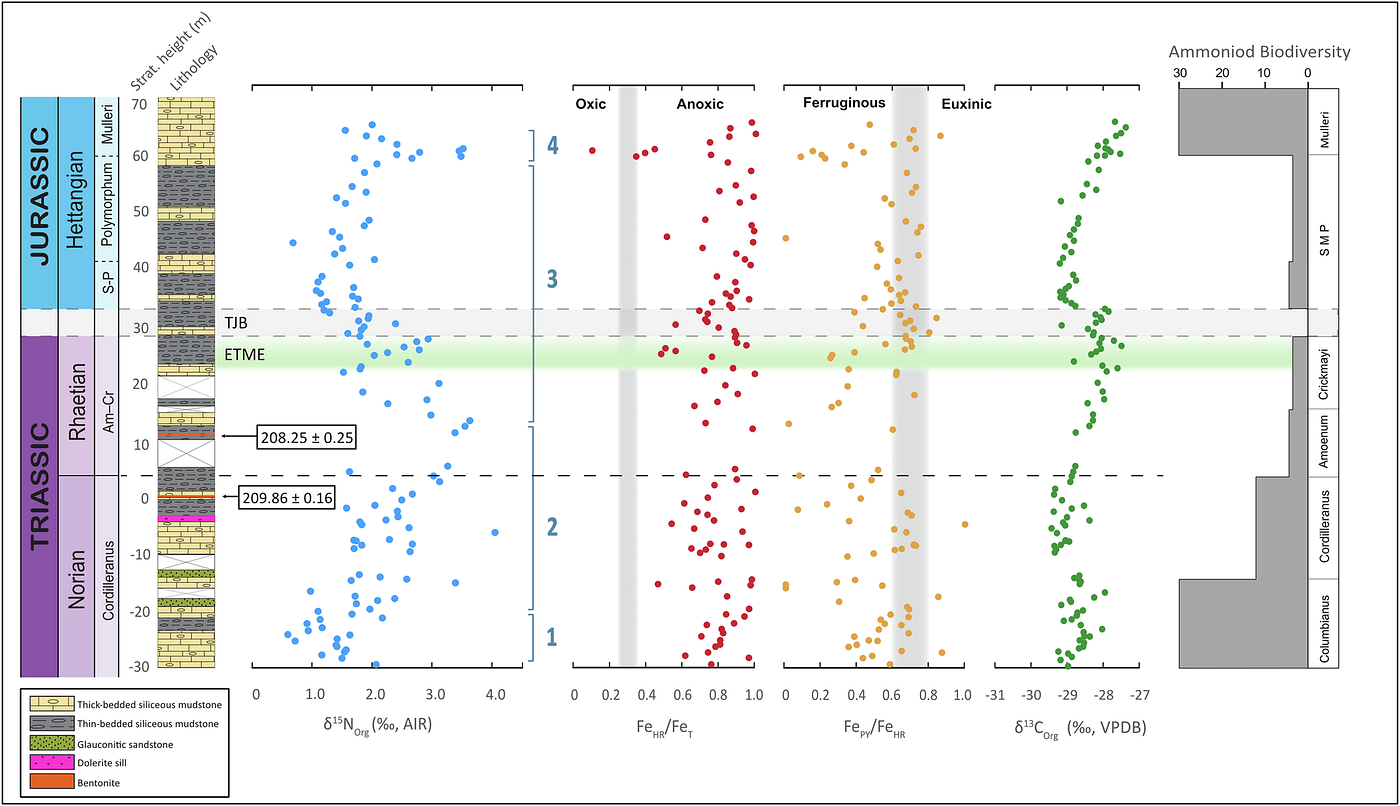
Geochemical data spanning the Norian-Rhaetian and End-Triassic Mass Extinction at Grotto Creek, Alaska, USA. Stratigraphic plots of nitrogen isotope and iron speciation proxy data from Grotto Creek displayed with the previously established biostratigraphic, geochronologic, and lithologic framework along with the generic ammonoid biodiversity curve from eastern Panthalassa sites. Nitrogen isotopes are depicted in blue, FeHR/FeT in red, FePY/FeHR in yellow, and organic carbon isotopes in green. Thresholds for Fe speciation are displayed as vertical dashed lines in both the FeHR/FeT (oxic <0.38 <anoxic) and FePY/FeHR (ferruginous <0.6, 0.8 <euxinic) plots. Ash bed dates are shown next to the corresponding stratigraphic height of the sampled bentonite — McCabe et al., 2026
At the same time, other studies have documented declines in certain marine groups during this earlier interval. The researchers are careful not to claim that deoxygenation alone caused the extinction. The exact drivers of these earlier environmental changes remain uncertain. What the study shows is that the oceans were already changing long before the final extinction pulse arrived.
In other words, the extinction may have had a long prelude.
That possibility feels familiar. One of the lessons that repeatedly emerges from both ecology and paleontology is that environmental change often begins quietly. Ecosystems frequently show signs of stress before they reach a breaking point. The challenge is recognizing those signals while there is still time to understand them.
Fortunately, modern ocean deoxygenation is something scientists can measure directly. Many regions of today’s oceans have experienced declining oxygen levels over recent decades. Researchers continue to study the causes, the pace of change, and the consequences for marine ecosystems. Unlike paleontologists studying ancient oceans, we do not have to reconstruct these trends from rocks hundreds of millions of years old. We can observe them as they happen.

Reconstructed history of the equatorial Panthalassan oxygen minimum zone (OMZ) from the Late Triassic to Earliest Jurassic. Nitrogen cycle process indicated are the thought to control the isotope composition of organic nitrogen during each time interval. Pink star indicates the location of Grotto Creek. I). Late Norian: Deep oxygen minimum zone (OMZ). Core of OMZ was mostly ferruginous and occasional euxinic. Nitrate is abundant. II.) Latest Norian-middle Rhaetian: Expansion of the OMZ. Denitrification starts to deplete the local nitrate pool. Core of OMZ continues to be ferruginous and euxinic. III.) Middle Rhaetian-to earliest Hettangian including the ETME: Continued expansion of the OMZ including the into the photic zone. Depletion of the local nitrate pool. Core of OMZ becomes more frequently euxinic. IV.) Early Hettangian: OMZ temporarily contracts. Increased nitrate availability. Core of the OMZ returns to being mostly ferruginous and occasional euxinic — McCabe et al., 2026
That does not mean modern oceans are destined to follow the same path as the Late Triassic. Earth’s systems are complex, and every environmental change unfolds under different circumstances.
But deep-time studies like this one provide an important reminder. Low oxygen conditions do not need to become catastrophic before they matter. Ecosystems can respond to relatively modest changes, just as species can experience stress long before extinctions occur. Understanding those early warning signs gives scientists, policymakers, and communities more opportunities to find solutions.
Sometimes the most valuable lesson from the fossil record is not how ecosystems collapsed. It is how early the signals of change first appeared, and how much we can learn when we pay attention to them.
Do you want to read more stories like this? You can now subscribe to my newsletter and join a community of over 12,000 Earth lovers!
Published in Fossils et al. **Follow **to learn more about Paleontology.
메타데이터
- post_id
- 834053b6bc27
- slug
- did-the-extinction-that-launched-the-dinosaurs-start-millions-of-years-earlier-834053b6bc27
- url
- https://medium.com/fossils-et-al/did-the-extinction-that-launched-the-dinosaurs-start-millions-of-years-earlier-834053b6bc27
- canonical_url
- https://medium.com/fossils-et-al/did-the-extinction-that-launched-the-dinosaurs-start-millions-of-years-earlier-834053b6bc27
- author_url
- https://medium.com/@silvia-pineda-munoz-phd
- status
- ok
- fetched_at
- 2026-06-12 07:40:50