The Lazy Eye That Patching Cannot Fix
You have done everything the doctor told you. Every morning, you carefully stick the adhesive patch over your child’s stronger eye. Your…
The Lazy Eye That Patching Cannot Fix
You have done everything the doctor told you. Every morning, you carefully stick the adhesive patch over your child’s stronger eye. Your child cries, pulls at it, begs you to stop. But you persist because you were told this is the only way to fix a lazy eye. Weeks turn into months. Then the follow‑up appointment arrives, and the vision in the weak eye has barely moved. The chart shows the same numbers as before. You feel like you have failed. The truth is, you haven’t. The failure is in the assumption that patching works the same way for every child.
WHY PATCHING SOMETIMES STOPS WORKING?
Patching is the oldest and most widely used treatment for amblyopia. The idea is simple. By covering the strong eye, you force the brain to use the weak eye. With enough forced practice, the brain strengthens its connection to that eye and vision improves. The American Academy of Ophthalmology acknowledges that patching is effective for many children, particularly when started before the age of seven. But effectiveness does not mean universal success. When patching stalls or fails, it is usually because of one or more of these reasons:
· The child removes the patch when no one is watching. Even a few minutes of peeking with the strong eye can undo hours of effort.
· The underlying refractive error has not been fully corrected. If the weak eye still sees a blurry image even with glasses, the brain has no clear signal to work with.
· Strabismus is present but has not been addressed. If the eyes are misaligned, the brain receives two different images and continues to suppress the turned eye, patch or no patch.
· The amblyopia is severe and the brain has deeply suppressed the weak eye for years. Brief daily patching may not be enough to break through that suppression.
· The child has passed the critical period of visual development. The AAO notes that while treatment can still be effective in older children, the response is often slower and less complete.
THE LIMITS OF A BLUNT TOOL
Patching treats the symptom, not the cause. It forces the weak eye to work, but it does not teach the two eyes how to work together. When the patch comes off, the brain often slips back into its old habit of ignoring the weaker eye. This is why some children show improvement during patching but regress soon after treatment stops. A lazy eye is fundamentally a binocular problem. The brain has learned to suppress one eye to avoid double vision, and patching alone may not unlearn that suppression.
THE NEXT LINE OF TREATMENT
If patching is failing, parents need to know that there are other options. Amblyopia treatment has advanced significantly in the past decade, and a child who does not respond to patching is not out of options. The following approaches are supported by clinical evidence and recommended in various scenarios by the AAO Preferred Practice Pattern on Amblyopia.
· Atropine penalisation. Instead of covering the strong eye, a drop of atropine is placed in it once a day. The drop temporarily blurs the vision in the strong eye, forcing the brain to rely on the weak eye, just as a patch does. The advantage is that once the drop is in, the child cannot cheat. The AAO recognises atropine as an effective alternative, particularly for mild to moderate amblyopia. It is sometimes better tolerated by children who find a patch uncomfortable or embarrassing.
· Binocular therapy. This is a newer class of treatments that directly target the brain’s suppression. In dichoptic training, the child plays a video game or watches a show through special goggles or a tablet screen that presents a different image to each eye. The strong eye sees a reduced‑contrast version, while the weak eye sees a full‑contrast version. To succeed at the game, the brain must combine information from both eyes. Over time, this reduces suppression and improves stereoacuity as well as visual acuity. The AAO has highlighted emerging evidence that binocular approaches may produce better and more stable outcomes than patching alone for some children.
· Vision therapy. Conducted in a specialist’s office and supplemented with home exercises, vision therapy trains the entire visual system. It includes activities that improve eye teaming, focusing, tracking, and depth perception. For children with both amblyopia and convergence insufficiency or strabismus, vision therapy can address the underlying binocular dysfunction that patching ignores.
Glasses alone. In some cases, particularly in refractive amblyopia where the only problem is a significant difference in prescription between the two eyes, wearing the correct glasses full‑time can improve vision in the weak eye without any patching or drops. The AAO notes that optical correction alone can resolve amblyopia in a substantial minority of children, and that a period of glasses wear should usually precede other treatments.
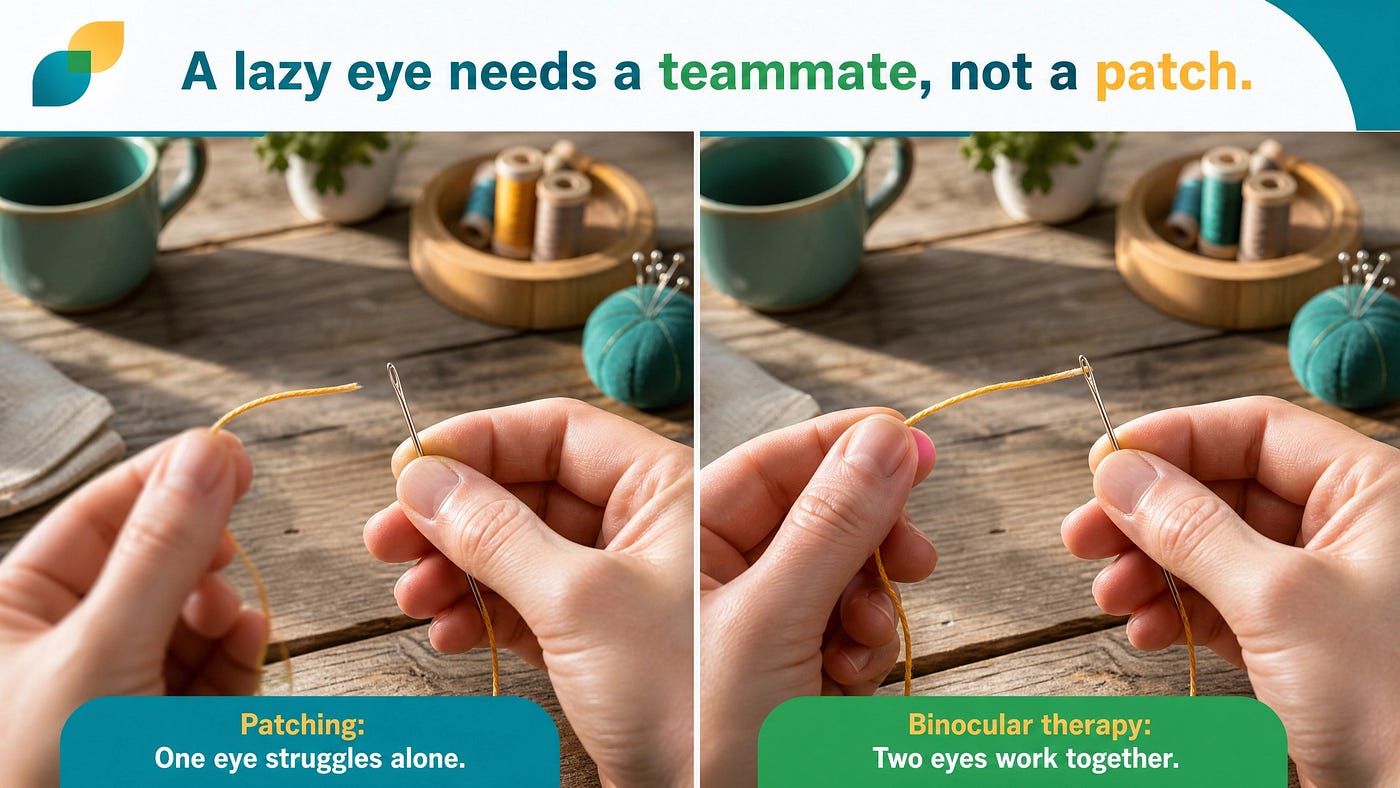
One eye struggles. Two eyes succeed.
WHAT INDIAN RESEARCH TELLS US
The All India Ophthalmological Society and the Vitreoretinal Society of India have both emphasised that compliance is the single biggest barrier to successful treatment. A 2023 study from a tertiary eye care centre in Western India, published in the Indian Journal of Ophthalmology, found that non‑compliance with patching was the leading cause of treatment failure in children with amblyopia. Parents often stopped treatment early because they did not see immediate results, or because the child resisted so strongly that the household became a battleground. The study recommended structured counselling for parents before treatment begins, so they understand that improvement is measured in months, not days.
THE PARENT’S ROLE IN TURNING THINGS AROUND
When patching is not working, the worst thing a parent can do is give up quietly. Instead, the first step is to return to the ophthalmologist with honest information. Admit how often the patch was actually worn. Bring the glasses your child has been using, because a scratched lens or an outdated prescription could be sabotaging progress. Ask for a cycloplegic refraction to confirm the prescription is still correct. Ask whether atropine penalisation or binocular therapy might be suitable. Ask for a binocular vision assessment, not just a check of how many letters each eye can read.
Small practical changes can also make a difference. Patching can be turned into a game with reward charts. It can be done during a favourite half‑hour television show rather than during homework, when frustration levels are already high. If the child is old enough, explain why the patch matters in simple, honest terms. A lazy eye does not announce itself as an emergency, but every month of delay tightens the window for easy treatment.
KNOWING WHEN TO ESCALATE
If patching has been tried diligently for six months with no measurable improvement, it is time to escalate. This may mean moving to atropine, enrolling in a vision therapy programme, or seeking an opinion from a paediatric ophthalmologist who specialises in binocular vision. In rare cases, what looks like a lazy eye is actually a misdiagnosed retinal or optic nerve condition, and a dilated fundus examination can rule out structural causes. The AAO recommends that any child who fails to respond to standard amblyopia treatment should undergo a thorough re‑evaluation to ensure the diagnosis is correct.
THE PATH FORWARD
Patching is not the only tool, and a stalled eye chart is not the end of the road. The brain remains capable of change well beyond the early childhood years, and modern amblyopia treatment offers multiple paths to improvement. What matters most is that the parent and the doctor work together, track progress honestly, and pivot when one approach stops working.
If your child is patching faithfully but still cannot see clearly from the weak eye, book a comprehensive paediatric eye evaluation at Infigo Eyecare Hospital or a trusted centre near you.
메타데이터
- post_id
- 835e9ce8dcfb
- slug
- the-lazy-eye-that-patching-cannot-fix-835e9ce8dcfb
- url
- https://medium.com/@aniketmmclayinc/the-lazy-eye-that-patching-cannot-fix-835e9ce8dcfb
- canonical_url
- https://medium.com/@aniketmmclayinc/the-lazy-eye-that-patching-cannot-fix-835e9ce8dcfb
- author_url
- https://medium.com/@aniketmmclayinc
- status
- ok
- fetched_at
- 2026-08-15 10:56:09