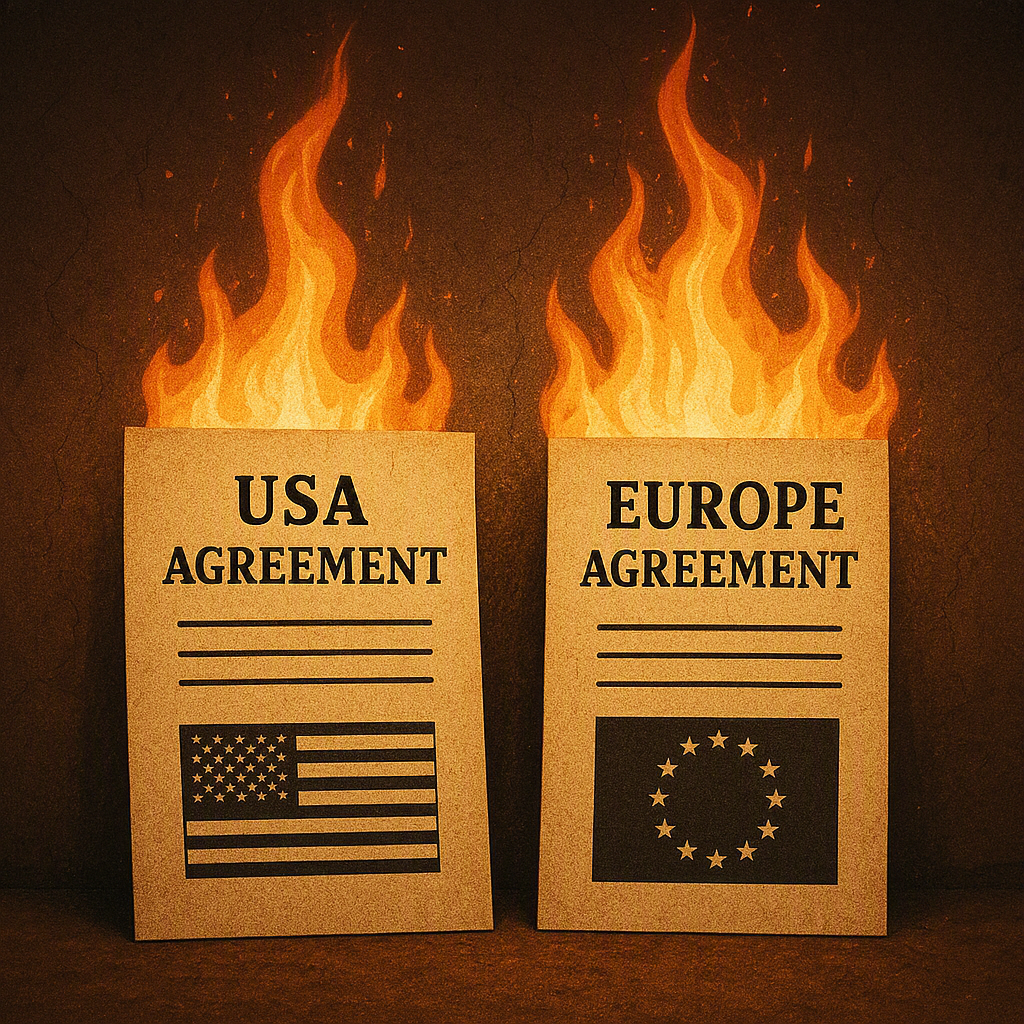
The Strait of Hormuz Peace Deal Fails to Meet Expectations
Sign up for [The Long Game Brief] newsletter to learn more about long game scenarios around the world
The Strait of Hormuz Peace Deal Fails to Meet Expectations
Sign up for [The Long Game Brief] newsletter to learn more about long game scenarios around the world
Photo by Tom Crew on Unsplash
What’s the Status on Strait of Hormuz Shipping?
It doesn’t sound good at this point in time. Both the U.S. and Iranian governments are throwing words or war around in their respective media spaces. Ships were already fired on by the Iranian military in the Strait of Hormuz over the weekend, which reinforced Iran’s renewed aggressive posture following the breakdown of the U.S.-Iran MoU signed in June.
In his story about the economic risks for the both the U.S. and the rest of the world, David Reavill uploaded some of the photos from the worldwide web to underscore **the tense situation in the Strait of Hormuz**.
David also bluntly illustrated the aftermath of this destruction:
“Apparently, ending the brief halt in the kinetic conflict. It’s an unfortunate turn of events that will inevitably result in further killing and destruction. Much will be reported on the specific destruction of military bases and civilian infrastructure. US Central Command has already begun announcing the specific targets it has ordered destroyed.”
So here we are again, back to more maritime shipping disasters in the Strait of Hormuz, unless this time more missiles will be fired at land-based targets of Iran, and putting more emphasis on the fighting between Iran and other U.S. military assets throughout the Persian Gulf region. One thing is clear, all of the Persian Gulf countries will not surrender to Iran, and they are definitely in the cross-fire — literally!
David explained the topic of the Petrodollar in his story, and why Saudi Arabia has taken a different direction than what the Trump Administration had hoped during this war with Iran:
“The world began to see a schism between the US and its chief Middle East ally, Saudi Arabia, in May 2026. It was then that the Saudis denied the US forces access to the Prince Sultan Airbase in its attacks on Iran. President Trump had launched ‘Operation Freedom’ in his continuing battle with Iran.”
I responded to his comments about the Petrodollar. I said:
“I don’t think Saudi Arabia will allow China or any other country to dictate terms in OPEC. In the end, all of the OPEC countries prefer the US Dollar to any other currency. So this obvious brings to mind other financial assets other than currencies, like gold. If OPEC and OPEC+ start buying and selling gold, then we could refresh the conversation about the decline of the US’s influence via Petrodollar.”
On the points about global crude oil markets, it is should be noted that oil prices have already declined significantly since the U.S.-Iran MOU was signed last month.
At the time of this publication, oil prices have been rising on the news.
Crude oil prices haven’t went down to the price levels of USD $60 per barrel that we have been accustomed to before the U.S. invaded Iran’s territorial waters in the Persian Gulf. Unfortunately, oil prices will not be going back down to that level for the foreseeable future.
On the issue of who controls the Strait of Hormuz, **Dorsey pointed out that Oman has the same amount of leverage** as Iran for shipping:
“The fact of the matter is that the Strait of Hormuz is part Iranian territorial waters, part Omani territorial waters, and Oman has sovereignty over its territorial waters. Iran legally cannot impinge on that, and that’s the point where Iran may be overplaying its hand because it’s not going to find a lot of international sympathy, including among those NATO countries with which the United States at the moment has strained relations over Iran. They’re not going to support the Iranian position.”
In a previous interview with CNBC, James Dorsey gave his opinions on how the Trump Administration wants to shape the narrative:
“I think we’re used to President Trump creating his own world. Underlying what he said in the CNBC interview…is the notion that Iran is militarily defeated and it’s on its knees and willing to compromise and do whatever takes to end the war. I think if we look at the facts on the ground, that’s not quite correct.”
On the points about U.S. agriculture exports to Iran, this really got my attention because Iran’s market hasn’t previously been known as one that trades in agriculture with the U.S. In fact, this is very foretelling about U.S. agriculture, because the U.S. has struggled to get market access with China in recent years. China has already heavily **switched over to both Brazil and Argentina for soybeans**, for example.
Here’s what Dorsey said about the Iranian funds being used for U.S. agriculture imports:
“I don’t see how Iran could agree to a release of some funds of Iran that then the use of which is dictated by the United States, and then can only be used for purchases in the United States; that in Iran’s perception would be a violation of its sovereignty.”
I totally agree with Dorsey. The U.S. agriculture exports to Iran would be more expensive than all of the other imports options, notably Brazil, Argentina, Russia, Ukraine, Romania, Bulgaria and Australia.
There seems to be this misperception of the Trump Administration that the U.S. is holds a stick to other countries when it comes to U.S. agriculture exports. China has already given a big middle finger to the U.S. government and agribusiness sector in this regard. To think that the Iranian government will simply use the funds to purchase expensive agricultural commodities, all in a favor to a country that it was just at war with, is utterly preposterous.
Photo by Saifee Art on Unsplash
How is the war in Iran affecting the Palestinian issue?
Khaled Elgindy, senior research fellow in the Middle East program at the Quincy Institute for Responsible Statecraft, said Iran’s support for Palestine has long served both political and ideological purposes.
The relationship emerged during a period of significant regional change. Iran’s revolution took place the same year Egypt signed a peace treaty with Israel, marking the beginning of a new regional order. As traditional forms of Arab nationalism lost influence, Tehran increasingly sought to establish itself as a supporter of the Palestinian cause.
That relationship has never been without limits. Iran and Hamas, for example, come from different political and religious traditions. Their partnership has often reflected shared interests rather than shared ideology.
The political value of that relationship appears to have grown since the war in Gaza began following the October 7 attack.
Arab citizens continue to view Iran’s nuclear ambitions with concern while simultaneously expressing support for Tehran’s position on Palestine. The findings point to a distinction that appears throughout the region; attitudes toward Iran itself often differ from attitudes toward its role in the Palestinian issue.
Michael Robbins, Project Director and Co-Principal Investigator of Arab Barometer and senior research specialist at Princeton University, **told Atlas Broadcasting** that public perceptions of regional threats remain closely connected to the Palestinian question.
Robbins said Arab Barometer researchers observed significant changes while conducting surveys in Tunisia during the opening weeks of the Gaza war. Support for the United States fell sharply during that period. Attitudes toward Iran followed a different trajectory:
“We didn’t ask about Iran itself “We asked about the foreign policies of Ali Khamenei, the former supreme leader. Day by day, you could trace it, and one day it jumps by about 10 points. We looked back, and that was the day after he asserted that there was a genocide taking place in Gaza.”
For the first time in the organization’s data, Khamenei received as much support among Tunisian respondents than Saudi Crown Prince Mohammed bin Salman and more than UAE President Mohammed bin Zayed in a Sunni-majority country.
Robbins attributed the shift to the central place the Palestinian issue occupies in regional public opinion:
“At a level, my enemy’s enemy is my friend. If Israel is the biggest enemy and Iran is fighting Israel, then Iran is your friend because they’re fighting your enemy.”
The Palestinian issue has become intertwined with Iran’s regional standing, particularly as rival diplomatic frameworks have struggled to gain traction.
The Abraham Accords, signed in 2020 between Israel and several Arab states, sought to deepen regional cooperation while reducing the centrality of the Palestinian issue in diplomatic negotiations.
Analysts remain divided on their long-term impact, though many argue the Gaza war altered the political environment that made the agreements possible.
“The Abraham Accords were designed to circumvent and basically permanently put the Palestinian issue in formaldehyde, if not just make it disappear. The fact that this also strengthened Iran’s claim to be the champion of the Palestinian issue was a side product. I don’t think it was the goal.”
In closing, **the rising prices of food, fertilizers and energy** provide the foundation for another series of global instability, from which the COVID-19 Pandemic had already sowed the seeds of chaos in various countries from the African continent to North America and beyond.
October 7 accelerated massive change in the regional security envrionment of the Middle East region. At the same time, support for Palestinian statehood has gained ground internationally, and among a different kind of Gen Z population.
European Union member states have formally recognized Palestine, while public opinion surveys in the United States show narrowing gaps between sympathy for Israelis and Palestinians. This doesn’t mean that those new international political gains will translate into stronger Palestinian institutions in international or multilateral organizations in the future.
I publish a newsletter covering current affairs topics and global commodities markets in [**The Long Game Brief**] every week.
Subscribe to the newsletter to learn more about long game scenarios, as they evolve in real time and disrupt future trends, around the world.
메타데이터
- post_id
- 837cfc4b4e95
- slug
- the-strait-of-hormuz-peace-deal-fails-to-meet-expectations-837cfc4b4e95
- url
- https://medium.com/areas-producers/the-strait-of-hormuz-peace-deal-fails-to-meet-expectations-837cfc4b4e95
- canonical_url
- https://medium.com/areas-producers/the-strait-of-hormuz-peace-deal-fails-to-meet-expectations-837cfc4b4e95
- author_url
- https://medium.com/@Monroe4PEACE
- status
- ok
- fetched_at
- 2026-07-16 05:28:21