Financial Astrology and Risk-Reward Planning: How Traders Structure Better Trades
Financial astrology and risk-reward planning can work together when traders use astrology as a timing tool and risk management as the…
Financial Astrology and Risk-Reward Planning: How Traders Structure Better Trades
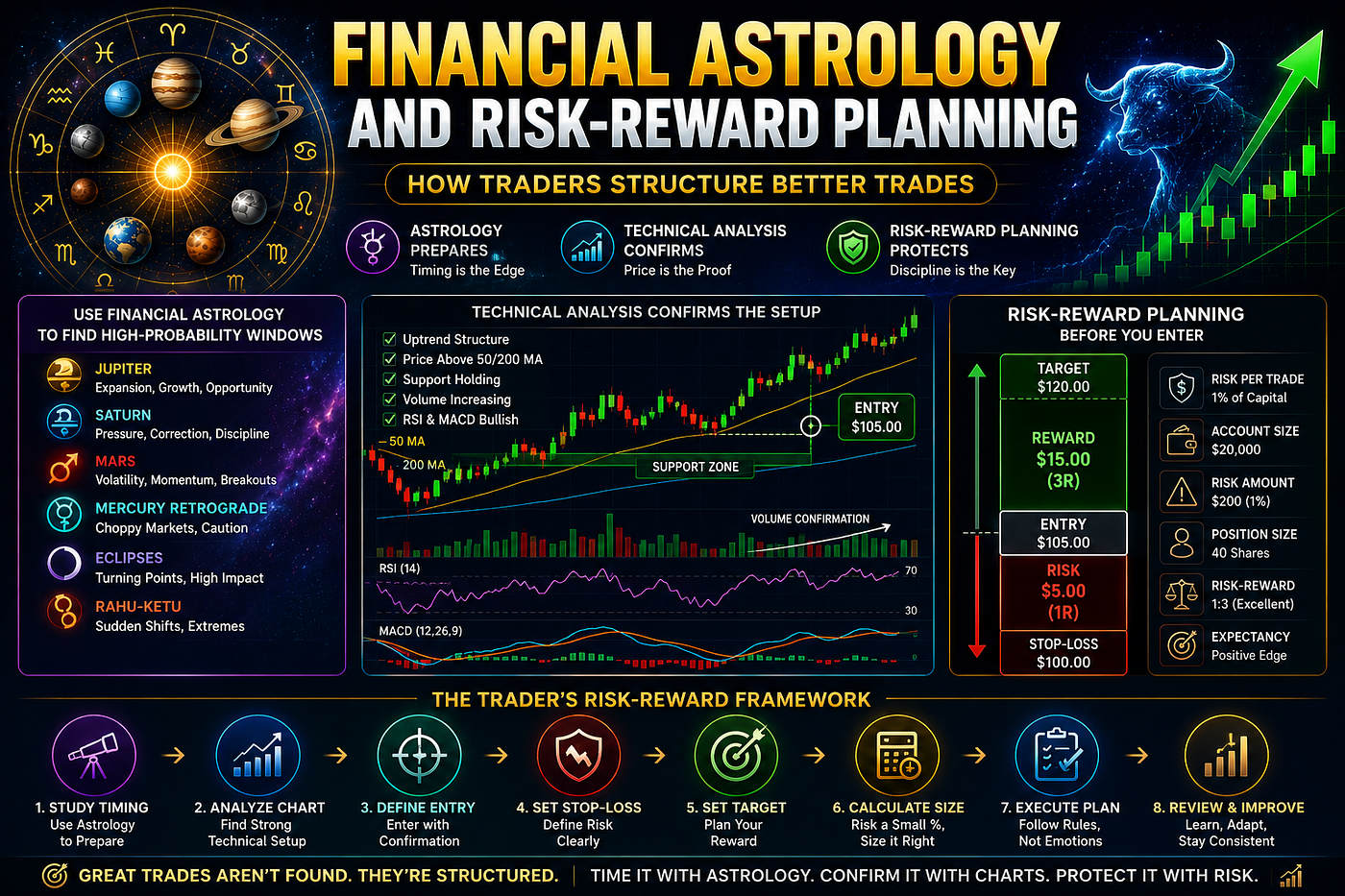
Financial astrology and risk-reward planning can work together when traders use astrology as a timing tool and risk management as the foundation of every trade. Financial astrology may help traders study market cycles, planetary timing windows, sentiment shifts, volatility phases, and possible turning points. However, no timing method should ever replace a structured trade plan. A trader still needs a clear entry, stop-loss, target, position size, and risk-reward ratio before taking any position.
Risk-reward planning is what turns a market view into a practical trade. A trader may believe that gold is entering a bullish phase, Nifty may bounce from support, Bitcoin may become volatile, or crude oil may react during a planetary timing window. But belief is not enough. The trader must know where the trade becomes invalid, how much capital is at risk, where profit may be booked, and whether the potential reward justifies the risk.
Financial astrology can help traders prepare for timing windows. Technical analysis helps them confirm price behavior. Risk-reward planning helps them decide whether the trade is worth taking. When these three elements align, the trader has a more complete process.
The key rule is simple: financial astrology prepares, technical analysis confirms, and risk-reward planning protects.
This article explains how traders can combine financial astrology with risk-reward planning. It covers entry selection, stop-loss placement, target setting, position sizing, volatility windows, planetary timing cycles, support and resistance, moving averages, RSI, MACD, volume, and trade discipline. It also explains how the Financial Astrology Terminal at https://finance.rajeevprakash.com/ can support traders by bringing market data, charts, watchlists, global stocks, indices, commodities, and financial astrology-based timing insights into one platform.
What Is Risk-Reward Planning?
Risk-reward planning means comparing the amount a trader may lose with the amount they may gain before entering a trade. It is one of the most important parts of trading discipline.
For example, suppose a trader enters a stock at $100 with a stop-loss at $95 and a target at $110. The risk is $5 per share, and the potential reward is $10 per share. That gives a risk-reward ratio of 1:2. The trader is risking one unit to potentially make two units.
If the target is only $103 while the stop-loss is $95, the trader risks $5 to make $3. That is poor risk-reward. Even if the trader is right more often, poor trade structure can damage long-term results.
Risk-reward planning forces traders to think before entering. It prevents emotional buying, random exits, and oversized positions. It also helps traders accept losses because they know the risk in advance.
A good trader does not ask only, “Will this market rise?” They ask, “If I am wrong, how much will I lose? If I am right, how much can I make? Is this trade worth the risk?”
Why Financial Astrology Needs Risk-Reward Planning
Financial astrology can create strong conviction. A trader may see a planetary transit, lunar phase, eclipse window, Mars volatility period, Saturn pressure cycle, or Jupiter expansion phase and feel that the market is ready to move. That conviction can be useful for preparation, but it can also become dangerous if the trader ignores risk.
No planetary cycle guarantees a profitable trade. Markets are influenced by many factors, including interest rates, inflation, earnings, liquidity, geopolitical events, institutional flows, sector rotation, economic data, and trader psychology. A timing window may suggest that volatility could rise, but price may move in either direction. A bullish timing window may fail if the chart breaks support. A risk window may not lead to a decline if buyers remain strong.
This is why risk-reward planning is essential. It keeps astrology practical. It prevents the trader from entering blindly. It converts timing awareness into a structured trade.
A trader using financial astrology should never say, “This transit is bullish, so I will buy.” A better approach is, “This transit suggests a possible bullish window. Now I will wait for price confirmation near support or breakout, define my stop-loss, set a target, and check whether the risk-reward is favorable.”
The Role of Technical Analysis in Risk-Reward Planning
Technical analysis gives the levels needed for risk-reward planning. Financial astrology may suggest timing, but charts provide entry, stop-loss, and target zones.
Support and resistance are the most important tools. Support helps identify where buyers may appear. Resistance helps identify where sellers may appear. A trader may enter near support and place a stop below it. The target may be the next resistance zone. This gives a clear risk-reward structure.
Moving averages help identify trend direction and dynamic support. RSI and MACD help confirm momentum. Volume confirms participation. Candlestick patterns show short-term market psychology. Fibonacci levels can help estimate correction zones and targets.
For example, suppose silver is near a major support zone during a favorable financial astrology timing window. The trader waits for a bullish candle and improving volume. If entry is near support and the stop-loss is just below support, the risk may be controlled. The target may be the previous resistance level. If the potential reward is at least twice the risk, the trade may be worth considering.
Without technical analysis, risk-reward becomes vague. With technical levels, the trade becomes measurable.
The Basic Risk-Reward Formula
The basic risk-reward formula is simple.
Risk per unit equals entry price minus stop-loss price for a long trade.
Reward per unit equals target price minus entry price for a long trade.
Risk-reward ratio equals reward divided by risk.
For example, if a trader buys at $50, places a stop-loss at $47, and sets a target at $59, the risk is $3 and the reward is $9. The risk-reward ratio is 1:3.
For a short trade, the formula is reversed. If a trader shorts at $100, places a stop-loss at $105, and sets a target at $88, the risk is $5 and the reward is $12. The risk-reward ratio is 1:2.4.
Many traders prefer trades with at least 1:2 risk-reward. Some trend followers may seek 1:3 or higher. Scalpers may accept lower ratios if their win rate is high, but beginners should avoid poor reward-to-risk setups.
A financial astrology timing window does not justify a bad risk-reward trade. If the stop-loss is too far and the target is too close, the trade should be skipped.
Entry Planning With Financial Astrology
Entry planning should begin with the chart, not the planet. Financial astrology can tell traders when to watch, but technical analysis tells them where to act.
A good entry often appears near support, after a breakout, during a pullback, or after a retest. A trader may use astrology to prepare for these moments. For example, if a Jupiter-related expansion window is approaching, the trader may scan for stocks forming bullish bases. If a Saturn-related pressure window is active, the trader may watch whether weak assets break support.
A bullish entry may require price to hold support, reclaim a moving average, break resistance, form bullish divergence, or close above a consolidation pattern. A bearish entry may require price to reject resistance, break support, lose a moving average, or confirm a lower high.
The entry should be planned in advance. Traders should avoid chasing large candles simply because a timing cycle looks active. If the price has already moved too far from the planned entry, the risk-reward may become poor.
Good entry planning improves the entire trade.
Stop-Loss Placement With Financial Astrology
A stop-loss defines where the trade idea becomes invalid. It is not a random number. It should be based on market structure.
For a long trade, the stop-loss may go below support, below a swing low, below a moving average zone, or below the breakout level. For a short trade, the stop-loss may go above resistance, above a swing high, or above the failed breakout zone.
Financial astrology can help traders become more alert around risk windows, but it should not move the stop-loss farther away. If the trade fails technically, the trader should exit. A planetary cycle should not become an excuse to hold a losing trade.
For example, if a trader buys gold near support during a favorable timing window and gold later breaks below support with volume, the stop-loss should be respected. The trader can always re-enter if a new setup appears.
The stop-loss protects capital. It also protects the trader from hope.
Target Planning With Financial Astrology
Targets should be based on technical levels and realistic price structure. Common target areas include previous resistance, measured moves, Fibonacci extensions, prior highs, range projections, or risk-reward multiples.
For example, if a stock breaks out from a range between $90 and $100, the measured move target may be around $110. If the entry is $101 and the stop is $96, the risk is $5 and the potential reward to $110 is $9. That is slightly less than 1:2. The trader may decide whether the setup is strong enough or wait for a better entry.
Financial astrology can help traders decide when to watch for acceleration or caution, but it should not create unrealistic targets. A Jupiter expansion window does not mean price will rise endlessly. A Mars volatility window does not mean the target should be widened emotionally.
Targets must be tied to chart structure. If price reaches a major resistance zone during a risk window, taking partial profits or tightening stops may be sensible.
Position Sizing: The Real Risk Control Tool
Position sizing is the practical heart of risk management. Even a good trade can become dangerous if the position is too large.
A trader should first decide how much capital they are willing to risk on the trade. Many disciplined traders risk a small percentage of their account, such as 0.5 percent, 1 percent, or 2 percent, depending on experience and strategy. Then they calculate position size based on stop-loss distance.
For example, suppose a trader has a $20,000 account and wants to risk 1 percent. The maximum risk is $200. If the trade risk is $4 per share, the trader can buy 50 shares. If the trade risk is $10 per share, the trader can buy 20 shares.
This method keeps risk consistent. It prevents the trader from taking oversized positions simply because an astrology signal looks powerful.
Financial astrology may increase alertness, but it should not increase reckless position size. Strong conviction still needs controlled exposure.
Risk-Reward and Win Rate
Risk-reward planning is connected to win rate. A trader does not need to win every trade if the average winner is larger than the average loser.
If a trader uses a 1:2 risk-reward ratio, they can be wrong more often and still survive if they manage losses properly. For example, if the trader risks $100 to make $200, even a 40 percent win rate can be profitable before costs if execution is disciplined.
If a trader uses poor risk-reward, they need a very high win rate to succeed. This is difficult, especially in volatile markets.
Financial astrology traders should understand this clearly. A timing method may improve awareness, but it does not remove losing trades. Risk-reward ensures that losses remain manageable and winners have room to matter.
The goal is not perfection. The goal is positive expectancy.
Using Planetary Timing Windows to Filter Trades
Financial astrology can be useful as a trade filter. Instead of trading every chart pattern, traders can focus on setups that appear near important timing windows.
For example, if a Mars-related volatility window is approaching, traders may focus on assets near breakout or breakdown levels. If a Saturn pressure period is active, traders may avoid weak charts and reduce leverage. If a Jupiter expansion window aligns with strong market breadth, traders may look for trend continuation setups. If Mercury retrograde creates choppy conditions, traders may trade less and demand stronger confirmation.
This does not mean traders should force trades during every transit. Sometimes the best trade is no trade. A timing window is useful only when price is near a meaningful technical level.
The strongest setups appear when timing, price, volume, and risk-reward align.
Jupiter Cycles and Reward Expansion
Jupiter is often associated with expansion, confidence, optimism, growth, liquidity, and opportunity. In a risk-reward framework, Jupiter-related timing windows may help traders watch for trades with larger upside potential.
If a market is breaking resistance, volume is expanding, RSI is strong, and broader conditions support risk-taking, a Jupiter-type window may support trend continuation. Traders may look for setups where reward is significantly larger than risk.
However, Jupiter can also create overconfidence. Traders may widen targets too much, ignore stops, or chase late moves. This is dangerous. Expansion is useful only when the chart supports it.
During Jupiter cycles, traders should still ask: is the entry near a logical level? Is the stop-loss clear? Is the target realistic? Is the risk-reward favorable?
Optimism must be structured.
Saturn Cycles and Risk Discipline
Saturn is associated with discipline, restriction, pressure, correction, debt, delay, and structure. In risk-reward planning, Saturn-related periods can remind traders to protect capital.
During Saturn-type timing windows, traders may reduce leverage, avoid weak setups, tighten risk controls, and respect stop-losses. If price is breaking support, losing moving averages, and volume is heavy, Saturn timing may confirm caution.
However, Saturn does not mean traders must avoid all opportunities. Sometimes Saturn periods create disciplined bases, strong support zones, and high-quality setups after excessive speculation has been removed.
The practical lesson is clear: during Saturn periods, risk comes first. A trade must have clean structure. If risk-reward is poor, skip it.
Mars Cycles and Volatility Risk
Mars is associated with action, aggression, speed, conflict, and volatility. Mars-related timing windows may coincide with fast price movement, sharp breakouts, breakdowns, or whipsaws.
In risk-reward planning, Mars requires special attention to stop-loss distance and position size. If volatility expands, stops may need to be wider. Wider stops require smaller position sizes. Traders who ignore this may lose more than planned.
Mars windows can create opportunity, especially in commodities, indices, high-beta stocks, and crypto. But they can also create emotional trades. Traders should avoid chasing large candles. They should wait for a clear setup and calculate risk before entering.
Mars can increase movement. Risk planning decides whether the move is tradable.
Mercury Retrograde and Trade Confirmation
Mercury retrograde is often associated with confusion, revisions, miscommunication, delays, and false signals. In trading, this may show up as choppy price action, failed breakouts, sudden reversals, or unclear market behavior.
During Mercury retrograde periods, risk-reward planning becomes even more important. Traders may wait for candle closes, avoid low-volume breakouts, reduce position size, and demand stronger confirmation.
A setup that looks attractive intraday may fail by the close. A breakout may reverse quickly. A support break may become a false breakdown. Therefore, traders should avoid impulsive decisions.
Mercury retrograde does not mean trading must stop. It means traders should structure trades more carefully.
Rahu-Ketu and Speculative Risk
In Vedic astrology, Rahu and Ketu are associated with sudden shifts, extremes, illusion, speculation, detachment, and reversals. These cycles can be especially relevant when markets become crowded, euphoric, or unstable.
Rahu-type periods may encourage traders to chase hype. Risk-reward planning protects traders from entering late. If price is far above support and the stop-loss is too wide, the trade may not be worth taking.
Ketu-type periods may coincide with sudden reversals or breakdowns in crowded trades. Traders should watch support levels and avoid assuming that a trend will continue forever.
During Rahu-Ketu windows, traders should be extra careful with position sizing, stop-losses, and false breakouts. Speculative excitement must be filtered through risk.
Eclipses and Major Risk Windows
Eclipses are often watched as powerful timing windows in financial astrology. Some traders study them for turning points, volatility, or changes in market psychology.
In risk-reward planning, eclipse windows should be used as alert zones. If price is near resistance and risk-reward for new longs is poor, traders may avoid chasing. If price is near support and bullish confirmation appears, traders may consider a controlled entry. If price breaks a major level during an eclipse window, traders should respect the move.
The mistake is assuming that an eclipse must create a reversal. It may create volatility, but direction depends on price confirmation.
A trader should use eclipse windows to become more disciplined, not more emotional.
Risk-Reward Planning for Stocks
In stock trading, risk-reward planning should include company-specific and sector-specific context. A stock may have a good chart, but earnings, news, or sector weakness can affect the trade.
A strong stock trade usually has sector support, clear trend structure, a logical entry, defined stop-loss, and realistic target. Financial astrology may help identify timing windows, but stock-specific events must also be considered.
For example, a trader may find a stock near support during a favorable timing window. If earnings are due the next day, risk changes. The stock may gap beyond the stop-loss. The trader may reduce size or wait until after the event.
Risk-reward planning must account for event risk.
Risk-Reward Planning for Indices
Index trading often involves futures, ETFs, or options. Because many index products use leverage, risk-reward planning is critical.
For indices such as the S&P 500, Nasdaq, Dow Jones, Nifty, and Bank Nifty, traders should mark major support and resistance, moving averages, trendlines, and volatility zones. Market breadth and sector participation should also be checked.
Financial astrology timing windows can help traders prepare for volatility or trend shifts. But the trade should be based on price confirmation.
If Nifty is near support during a recovery window and Bank Nifty confirms strength, a long trade may be considered with a stop below support. If Nasdaq is near resistance during a risk window and breadth is weakening, traders may avoid new longs or tighten stops.
Index trades should always include position sizing because volatility can rise quickly.
Risk-Reward Planning for Commodities
Commodities such as gold, silver, and crude oil often move sharply. Risk-reward planning is especially important.
Gold may respect major support and resistance levels. Silver is more volatile and may require smaller position size. Crude oil can react suddenly to inventory data, OPEC decisions, or geopolitical events.
Financial astrology timing windows may be useful for commodities because these markets often move in cycles. However, technical confirmation remains essential.
For example, if silver breaks resistance during a favorable timing window, the trader still needs volume confirmation and a stop-loss. If crude oil breaks support during a Mars volatility window, the trader must account for wider price swings.
Commodities reward discipline and punish oversized trades.
Risk-Reward Planning for Crypto
Crypto markets are highly volatile. Bitcoin and other digital assets can move sharply in both directions. Financial astrology may help traders watch sentiment and volatility cycles, but risk control is non-negotiable.
Crypto traders should use wider stops, smaller position sizes, and clear levels. A 1:2 or 1:3 risk-reward setup may be attractive, but only if the stop-loss is realistic and not too tight.
Because crypto trades around the clock, gaps are less common than in stocks, but sudden liquidations and volatility spikes can happen. Traders should avoid overleveraging.
Astrology may help prepare for active windows, but crypto trades must be managed with strict risk.
How the Financial Astrology Terminal Supports Risk-Reward Planning
The Financial Astrology Terminal at https://finance.rajeevprakash.com/ can support traders who want to combine market timing with structured risk planning. It brings together market data, charts, watchlists, global stocks, indices, commodities, and financial astrology-based timing insights in one platform.
This kind of workflow helps traders avoid scattered decisions. A trader can review price action, check support and resistance, monitor global indices, compare commodities, study watchlists, and review timing cycles before entering a trade.
For example, a gold trader can study gold’s chart, compare silver, check broader commodity sentiment, and review timing windows. A Nifty trader can monitor Nifty, Bank Nifty, sector strength, and timing insights. A stock trader can track watchlists and wait for setups near important levels.
The terminal should be used as a decision-support tool. It does not remove the need for stop-losses, position sizing, or risk-reward checks. Its value is in helping traders combine price, timing, and market context more efficiently.
A Practical Risk-Reward Framework
A simple framework can help traders structure better trades.
First, identify the asset and the higher-timeframe trend. Second, mark support and resistance. Third, review financial astrology timing windows. Fourth, wait for technical confirmation through price action, volume, RSI, MACD, or moving averages. Fifth, define the entry. Sixth, place the stop-loss where the trade becomes invalid. Seventh, set the target based on technical structure. Eighth, calculate risk-reward. Ninth, calculate position size based on account risk. Tenth, execute only if the setup meets the rules.
This framework turns analysis into discipline. It also prevents traders from using astrology as a shortcut.
Common Mistakes to Avoid
One common mistake is entering a trade only because a planetary timing window looks favorable. Timing is not enough.
Another mistake is ignoring stop-losses. A trader may believe the cycle is strong and hold a losing trade too long. This can be costly.
A third mistake is chasing price after a large move. Even if astrology supports the trend, the risk-reward may be poor.
Many traders also set unrealistic targets. A target should come from chart structure, not wishful thinking.
Another mistake is using the same position size in every market. Volatile assets require smaller size.
The biggest mistake is confusing conviction with control. A strong view is not a risk plan. A trade is structured only when entry, stop, target, and position size are clear.
Conclusion
Financial astrology and risk-reward planning can create a more disciplined trading process when used correctly. Financial astrology helps traders study timing cycles, sentiment shifts, volatility windows, and possible market turning points. Technical analysis confirms whether price is actually responding. Risk-reward planning turns the idea into a structured trade.
A trader should never enter only because of astrology. They should wait for price confirmation. They should define a stop-loss before entry. They should set realistic targets. They should calculate position size based on risk. They should skip trades where the reward does not justify the risk.
The core rule remains clear: astrology prepares, technical analysis confirms, risk-reward planning protects.
For traders and investors who want a more complete workflow, the Financial Astrology Terminal at https://finance.rajeevprakash.com/ helps combine market data, charts, watchlists, global stocks, indices, commodities, and financial astrology-based timing insights in one platform.
Better trading is not only about better predictions. It is about better structure. A trader who controls risk can survive uncertainty. A trader who plans reward can focus on quality opportunities. A trader who combines timing, price confirmation, and disciplined risk management can approach markets with greater clarity and confidence.
메타데이터
- post_id
- 838671ee80ba
- slug
- financial-astrology-and-risk-reward-planning-how-traders-structure-better-trades-838671ee80ba
- url
- https://medium.com/@fintechastro/financial-astrology-and-risk-reward-planning-how-traders-structure-better-trades-838671ee80ba
- canonical_url
- https://medium.com/@fintechastro/financial-astrology-and-risk-reward-planning-how-traders-structure-better-trades-838671ee80ba
- author_url
- https://medium.com/@fintechastro
- status
- ok
- fetched_at
- 2026-06-09 15:37:30