Why You Keep Falling Into the Same Love Story — And What Consciousness Is Trying to Tell You
A philosophical meditation on love as evolution, not destination
Why You Keep Falling Into the Same Love Story — And What Consciousness Is Trying to Tell You
A philosophical meditation on love as evolution, not destination

There is a belief most of us carry without ever examining it. That one day, we will arrive. That we will find the right person, the right relationship, the right state in which love will finally be complete — stable, whole, asking nothing more of us. A love that fills the unnamed something we have been carrying for as long as we can remember.
The philosophy of The Inner Universe offers a different answer. And a more liberating one.
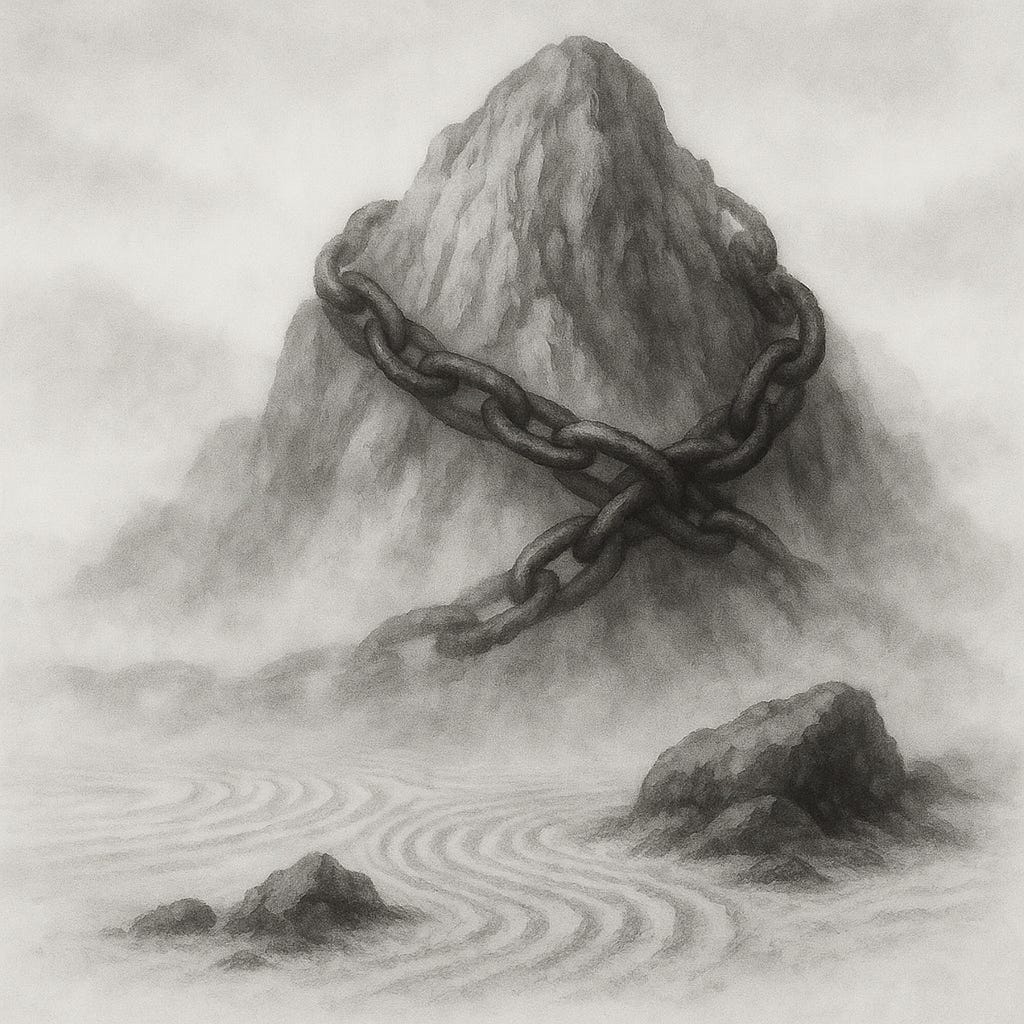
Infinite love does not exist as a final state.
It exists as a direction. A perpetual movement. A horizon that consciousness approaches without ever reaching — and it is precisely this impossibility of arrival that keeps consciousness awake, growing, alive.
Love is not the destination. It is the direction in which consciousness unfolds.
Consciousness learns through love
Every human being moves through successive forms of love — not because they fail, but because they learn.
It often begins with dependent love. The kind that needs the other in order to feel it exists. That confuses the other’s presence with its own worth. That asks, without knowing it, for an external person to fill an interior void that no one else can reach.
Think of a woman who finds herself, again and again, in relationships with emotionally unavailable men. Each time, she tells herself this one will be different. Each time — the same withdrawal. The same silence. The same ache of abandonment.
This is not bad luck. This is not fate.
It is a lesson that consciousness has not yet integrated — repeating itself, patiently, through different faces, different names, different cities, until it is finally understood from the inside.
As long as the wound is not looked at directly, it casts the actors. It writes the script. It stages the same play — again and again — until you recognize that you are both its author and its audience.
The confusion of intensity with love
Then comes passionate love. The kind that burns. The kind people call real — precisely because it hurts, because it consumes, because it occupies every waking thought.
Think of a man who has never loved as intensely as in this one impossible relationship. Two people who wound each other and cannot stay apart. Who confuse emotional turbulence with depth. Who mistake the storm for the sea.
Intensity is not love. It is sometimes love’s costume.
What this man is seeking in passion is not the other person. It is the sensation of being fully alive. Of existing completely. Of being pulled out of the anesthesia of ordinary life.
And as long as this is not understood — as long as consciousness does not realize it can find this aliveness within itself, without needing the turbulence — the attraction to this kind of relationship repeats.
It is not the other person you are missing. It is yourself — in your most alive form.
The attachment to absence
Perhaps the most subtle pattern of all: the attraction to what is unavailable.
Think of someone systematically drawn to impossible relationships. The person who is already committed. The one who lives across the world. The one who is emotionally closed. The one who will never be entirely present.
On the surface, this looks like bad luck. Underneath, it is a perfectly coherent architecture — built around a founding belief: a full, available love is not meant for me.
Absence has become familiar. And what is familiar is confused with what is true.
Until this belief is seen — not just intellectually understood, but genuinely felt and moved through — consciousness will continue to recreate the conditions of its own deprivation.
We do not attract what we desire. We attract what we believe we deserve.
The silent contracts of conditional love
More mature in appearance, but still carrying its own chains: conditional love.
I love you if you stay. If you change. If you fit the image I have of what our life should be. I love you — as long as you do not disappoint me too often.
This is the love of silent contracts. Of unspoken expectations. Of emotional ledgers kept in the shadows.
It represents a necessary stage — more conscious than dependent love, more stable than passion. But it still carries fear. The fear of losing. The fear of not being enough. The fear that if the other truly saw you, they would leave.
And as long as this fear is not examined — as long as it is mistaken for a truth rather than a construction — love remains conditional on terms the other can never entirely fulfill.
Toward a more conscious love
Consciousness evolves.
Not linearly. Not without setbacks. But it moves — toward something freer, more lucid, more open.
A love that does not need the other in order to exist — but that chooses the other freely, without dependency or fear. A love that does not require the other to be different in order for you to be at peace. A love that can hold difference, imperfection, the mystery of another person — without needing to reduce them to your own image.
This is not the absence of emotion. It is not the coldness of detachment.
It is a vaster presence. A capacity to love without needing love to belong to you.
Conscious love does not ask: what can I receive? It asks: what quality of presence can I bring?
What all of this reveals
Every relationship is a mirror. Every wound is an invitation. Every repetition is a lesson that consciousness has not yet fully integrated.
Not to make you feel guilty. But to remind you that you are not the victim of your love stories. You are their creator — often unconscious, always capable of becoming less so.
Infinite love is not a state you will one day reach. It is the direction in which your consciousness unfolds — through every relationship, every heartbreak, every opening.
And every stage — even the most painful — is necessary. Every form of love you move through brings you closer to something that words cannot entirely name.
Not a perfect love. A truer one.
A question to close
What is your last relationship — or the one you are in right now — trying to teach you?
Not about the other person.
About you.
Stéphane Lumin is the author of The Inner Universe: Phenomenology of the Creative Consciousness, available on Amazon Kindle. He has been exploring the nature of consciousness since a direct experience of ego dissolution in 1992.
메타데이터
- post_id
- 83a20c4f89e4
- slug
- why-you-keep-falling-into-the-same-love-story-and-what-consciousness-is-trying-to-tell-you-83a20c4f89e4
- url
- https://medium.com/@slumin3/why-you-keep-falling-into-the-same-love-story-and-what-consciousness-is-trying-to-tell-you-83a20c4f89e4
- canonical_url
- https://medium.com/@slumin3/why-you-keep-falling-into-the-same-love-story-and-what-consciousness-is-trying-to-tell-you-83a20c4f89e4
- author_url
- https://medium.com/@slumin3
- status
- ok
- fetched_at
- 2026-07-16 04:10:34