Is Cuba Embargo a Cold War Remnant or a Contemporary Humanitarian Error?
Natalia “Nana” Bonilla
Is Cuba Embargo a Cold War Remnant or a Contemporary Humanitarian Error?
Natalia “Nana” Bonilla
Sussex County Community College
American Government 105–01
April 22, 2026
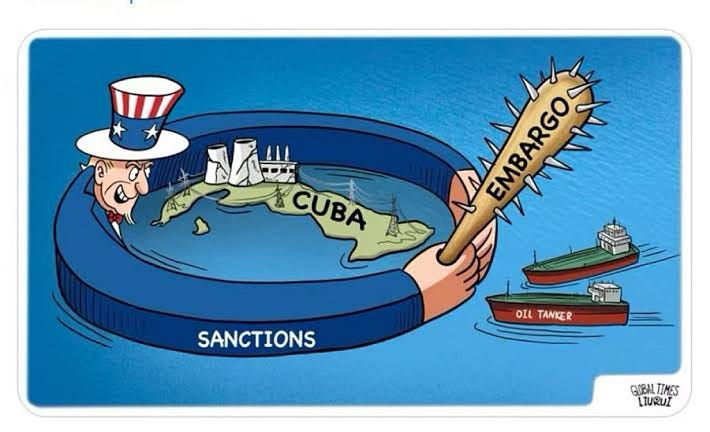
The political relations between the USA and Cuba have been based on numerous conflicts and tensions which have been accompanied by political, economic, and ideological differences over the years. The embargo imposed by the United States on Cuba was created as part of the Cold War strategy, however its implementation raises many ethical questions from the liberal perspective. Liberal policy implies democracy, freedom, and the promotion of human rights but the current embargo fails to correspond to liberal values since it continues after being in effect for sixty years without having provided any significant political results. Instead, it has brought about severe economic hardships and lack of opportunities for average Cubans. Although the initial intention behind the embargo on Cuba by the United States was to counter Cold War challenges, it has evolved into defying liberal values because it does not promote democratic and human rights. Instead, it harms ordinary Cuban citizens and diminishes their normal development.
Inequality was evident even before the Cold War. The Platt Amendment gave the U.S. right to use force whenever deemed necessary for Cuba. According to the document, the United States would use force “for the preservation of Cuban independence [and] the maintenance of a government adequate for the protection of life, property, and individual liberty” (National Archives). Although this might sound reasonable, what it implies is that Cuba is not sovereign. Instead, its independence depended on the U.S. willingness to recognize it as such. Early signs of inequality in the U.S. and Cuba relations were revealed of the future policies, such as the embargo. As far as liberalism is concerned, this approach contradicts it from the beginning.
The Batista regime made these issues even more evident. Fulgencio Batista had links with the United States and at the same time, his administration became authoritarian. According to Nations Online, his administration was characterized by “corruption, repression, and connections with U.S. business.” As a result, there was widespread discontent among Cubans with Batista’s regime. But Batista had the backing of some very influential American officials since he shared American interests. But then again, this poses a dilemma that is relevant to this situation. This alludes to the idea that the foreign policies of America are always in conflict with democracy. In simpler terms, liberalism did not influence certain decisions about Batista.
The revolution of 1959 was a pivotal point which changed the dynamics of their relationship. The new regime that took power in the country under the leadership of Fidel Castro, along with their allegiance to the Soviet Union, made Cuba into an adversary for the United States in the context of the Cold War era. As such, the imposition of an embargo on Cuba by the United States can be viewed as a measure that would help to isolate Cuba. The United States Department of State claims that the purpose of this policy is “to deny resources to the Cuban government… and encourage a transition to democracy” (U.S. Department of State).
The issue with the embargo is its place within liberal thinking. The ideology of liberalism focuses on fostering cooperation, conducting diplomacy, and ensuring that there is an observance of human rights. According to the United Nations, liberalism should be concerned about “the respect for human rights and fundamental freedoms.” (United Nations). We should be directing our attention to alleviating the suffering of people and increasing the wellbeing of all nations. An embargo cannot contribute to these goals because it fosters separation rather than collaboration and economic hardship rather than improvement in quality of life.
Alan Ryan’s On Politics helps explain why this contradiction matters. Ryan writes about how liberal states justify their existence not because of the sheer use of force, but because of their capacity to promote and maintain freedom as well as rule through voluntary agreement. According to him, politics deals with the question of “how we are to live together” (Ryan). With regards to the embargo on Cuba, this is one area where there appears to be a discrepancy between liberal theory and practice. The United States has failed to promote reform through diplomatic and economic engagement, using only forceful methods that have been applied for many years but have not resulted in much progress towards democracy. Ryan further emphasizes the importance of results when assessing the validity of political regimes, stating that politics involves “power, conflict, and compromise” (Ryan). When an action is considered legitimate based on its commitment to freedom but ultimately causes problems such as food shortages among regular citizens, its moral standing declines.
These problems have worsened in recent times instead of solved. According to 2025–2026 statistics, the US has maintained its “maximum pressure” towards Cuba, especially in light of President Trump’s return as a figure in foreign affairs policy. Trump has strengthened sanctions against Cuba, limited oil supplies, and enhanced the embargo on Cuba via a National Security Presidential Memorandum that is supposed to increase pressure on the Cuban government (White House). The point is that such measures are aimed at making political changes within the Cuban administration, but in practice they make the lives of ordinary Cuban people much harder.
As far as ethics are concerned, this is the part which makes such policies particularly hard to explain or defend. After all, if one wishes to promote democracy and human rights in the first place, then implementing policies which will result in shortages and pain seems entirely counter productive. It is difficult to argue against the notion that those who will feel these sanctions heavily are regular citizens rather than the governmental officials who make political decisions.
This brings us straight into the notion of structural violence. Structural violence happens whenever societies and economies victimize individual citizens by depriving them of the means of achieving basic needs. Sanctions fall clearly within this category, limiting the access of people to basic requirements for living and development. According to research, sanctions frequently lead to “severe suffering for civilian populations without succeeding in accomplishing the desired political results” (Fairfield University Digital Commons). In Cuba, this is exemplified through the lack of food, medicines, and energy supplies. Most recently, the energy crisis in the country has been worsened by limitations on importing oil. This has resulted in regular power cuts in Cuba, as well as general worsening of living standards.
Another result of long term embargos has to do with the level of development in the country. Many times, Cuba is referred to as being frozen in time, meaning that it did not develop for a number of years. And in essence, this is the true nature of the state. On this note, the key question that emerges is whether the decades long embargo should be regarded as a complete failure in view of the fact that very little has been achieved.
The situation has now reached a point where it is difficult to stop thinking that the people of Cuba are paying a heavy price for circumstances that were out of their hands. Though the United States insists that they intend to liberate the country, there seems to be no tangible change. There is a sense of stagnation and there is oppression. In this respect, the embargo cannot be regarded as a success story from a liberal point of view.
Those who support the policy of embargo have been advocating for its continuance due to the reason that it is essential for ensuring that the Cuban administration takes them seriously. This assertion is founded on the basis that without reforms following lifting of the embargo, there is every likelihood that the regime will become even more oppressive. As reasonable as their claim sounds, it fails to recognize the futility of the policy itself. If anything, the embargo has helped the regime by enabling them to shift blames to external factors for any problem they have.
In conclusion, the embargo on Cuba is one of the most significant paradoxes in the use of liberal foreign policy by the United States. Although the sanctions were introduced at the time when the Cold War existed, their present continuation does not correspond with liberalism, democracy, human rights, and cooperation. On the contrary, the introduction of tougher sanctions that are also referred to as maximum pressure, contradicts the goals of these sanctions which are meant to cause improvements. In other words, after more than six decades of sanctions it is possible to claim that the goal of bringing about reforms has not been achieved. Not only did sanctions fail to yield any positive results but also caused a lot of harm in terms of poverty, structural violence, and underdevelopment. If the United States stands firm in its liberal ideas, then they should change their approach towards development and cooperation.
References
Franklin, T. E. (2024, October 15). Cuba in pictures, frozen in time — NJ Spotlight News. NJ Spotlight News. https://www.njspotlightnews.org/special-report/thomas-e-franklin-havana-cuba-photo-essay-frozen-in-time-us-embargo/
Gordon, J. C. (2012). The U.S. Embargo Against Cuba and the Diplomatic Challenges to Extraterritoriality. World Affairs, 36(1), 63 — 79. https://digitalcommons.fairfield.edu/cgi/viewcontent.cgi?article=1019&context=philosophy-facultypubs
History of Cuba — Nations Online Project. (2019). Nationsonline.org. https://www.nationsonline.org/oneworld/History/Cuba-history.htm
Kennedy, J. F. (1962, February 3). Proclamation 3447 — Embargo on All Trade with Cuba | The American Presidency Project. Www.presidency.ucsb.edu. https://www.presidency.ucsb.edu/documents/proclamation-3447-embargo-all-trade-with-cuba
Lester KC, M., & O’Kane, M. (2023, November). Cuba | Global Sanctions. Global Sanctions. https://globalsanctions.com/region/cuba/
National Archives. (2022, February 8). Platt Amendment (1903). National Archives. https://www.archives.gov/milestone-documents/platt-amendment
Roy, D. (2026, March 31). Trump’s “Maximum Pressure” Campaign on Cuba, Explained. Cfr.org; Council on Foreign Relations. https://www.cfr.org/articles/trumps-maximum-pressure-campaign-on-cuba-explained
Ryan, A. (2012). On politics: A history of political thought from Herodotus to the present. W. W. Norton & Company.
The White House Washington. (2025, June 30). Fact Sheet: President Donald J. Trump Strengthens the Policy of the United States Toward Cuba. The White House. https://www.whitehouse.gov/fact-sheets/2025/06/fact-sheet-president-donald-j-trump-strengthens-the-policy-of-the-united-states-toward-cuba/
U.S. Department of State. (n.d.). Cuba Sanctions. United States Department of State. https://www.state.gov/cuba-sanctions
United Nations News. (2015, July 29). Sanctions on Iran and Cuba need phasing out, says expert. UN News. https://news.un.org/en/audio/2015/07/602872
메타데이터
- post_id
- 83b2e0d2cdbe
- slug
- is-cuba-embargo-a-cold-war-remnant-or-a-contemporary-humanitarian-error-83b2e0d2cdbe
- url
- https://medium.com/@nabandzz1/is-cuba-embargo-a-cold-war-remnant-or-a-contemporary-humanitarian-error-83b2e0d2cdbe
- canonical_url
- https://medium.com/@nabandzz1/is-cuba-embargo-a-cold-war-remnant-or-a-contemporary-humanitarian-error-83b2e0d2cdbe
- author_url
- https://medium.com/@nabandzz1
- status
- ok
- fetched_at
- 2026-07-13 12:30:36