SpaceX Has It Easy By Comparison
The Diagnostics of Despair and the Carrier Detect
SpaceX Has It Easy By Comparison
The diagnostics of despair and the dial-up carrier detect
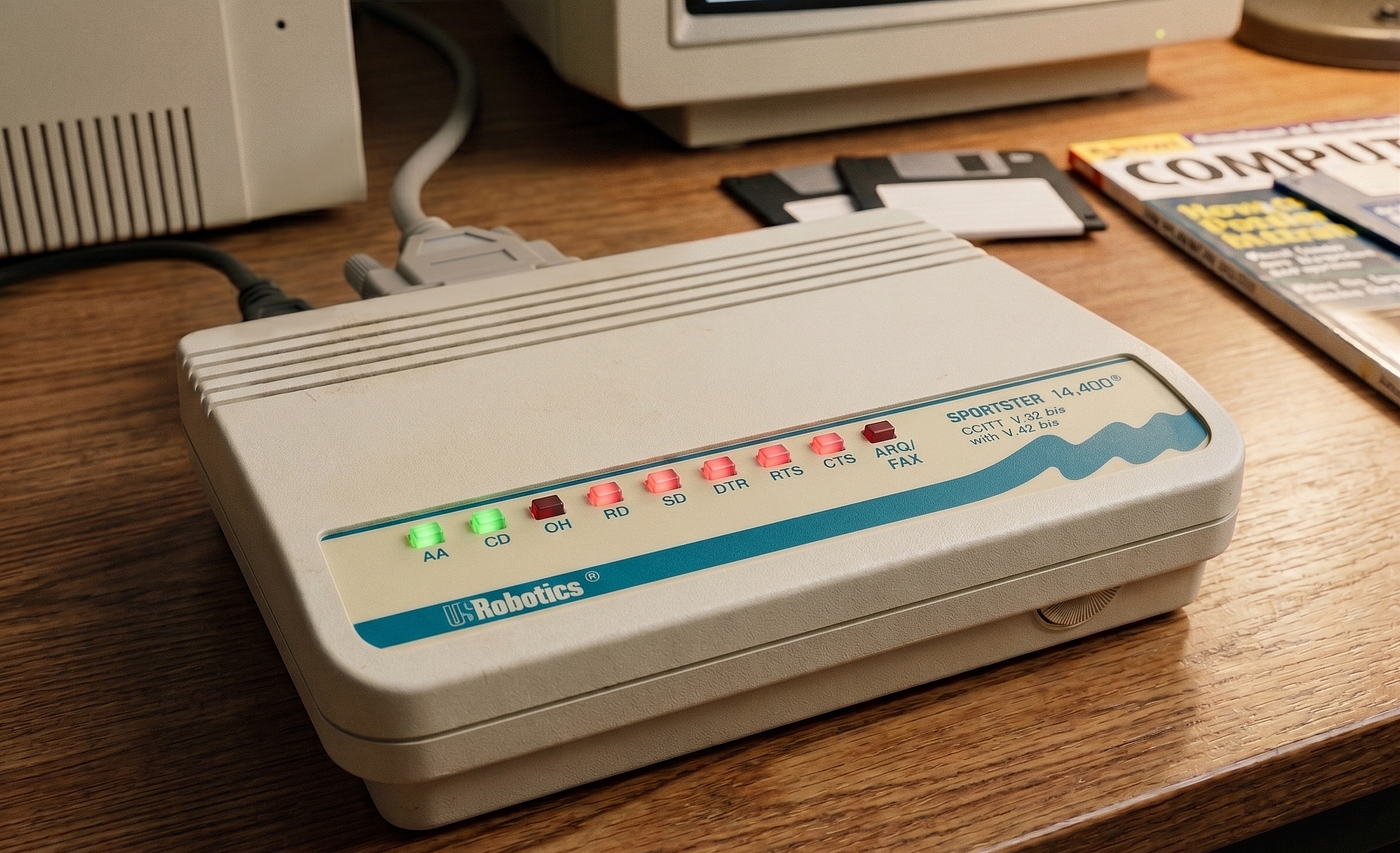
Author-generated and heavily Photoshopped representation based on museum photographs of a genuine USRobotics Sportster 14,400 modem.
The sheer, irrational emotional investment in a piece of mid-90s hardware — the humble dial-up modem — which was, by modern standards at least, completely useless, defies all sense of logical reasoning, but remains one of those recollections that brings a smile because it’s all we had available to use.
Launch Director: ‘Final roll call for launch. Prop?’ Propulsion: ‘Go.’ Launch Director: ‘Guidance, Navigation, and Control?’ *(GNC) *GNC: ‘Go.’ Launch Director: ‘Avionics?’ Avionics: ‘Go.’ Launch Director: ‘Tanks?’ Tanks: ‘Go.’ Launch Director: ‘Thermal?’ Thermal: ‘Go.’ Launch Director: ‘Safety?’ Safety: ‘Go.’ Launch Director: ‘Stage 1?’ S1: ‘Go.’ Launch Director: ‘Stage 2?’ S2: ‘Go.’ Launch Director: ‘SpaceX Launch Director is GO for launch.’
The words of those who, under the employment of a certain trillionaire with a penchant for populating the solar system, are spoken moments before giving the go-ahead to strike a match under the largest fireworks ever built.
But let’s consider the anxiety and stomach-churning nervousness encountered by those sat in a dark room, staring at that row of LED lights like a hospital monitor, in absolute terror of a single, millisecond-long blink of the CD light.
Did it actually blink, or did you imagine it?
The user would freeze, staring at that scuffed and discoloured plastic box, waiting to see if the data stream would recover or if they were about to hear that final, devastating click-hiss-silence of a dead line.
One might consider that the modern launch of a space rocket is no more, nor less, existential than the upload of a large 3MB file in 1996.
Should SpaceX, for future missions, ever decide to employ the use of a 14.4k dial-up modem, that launch sequence with a large gathering of LED bulb watchers may be a fraction more complicated and in tune with what a 90s user had to put up with:
User: ‘Final roll call for the three-megabyte digital payload. Comms?’ Comms: ‘Go. The copper wire to the local exchange is live and it’s not raining.’ User: ‘Carrier Detect Bulb?’ (CD) CD: ‘Go. Establishing the sacred handshake. The garbled squealing and screeching has commenced.’ User: ‘Auto Answer Bulb?’ (AA) AA: ‘Standing by in passive alignment, she’s dark.’ User: ‘Protocol?’ Protocol: ‘Go. ZMODEM parameters are locked. Crash recovery is entirely theoretical but highly optimistic.’ User: ‘Temporal Estimation?’ Temporal: ‘If the line remains stable and the household refrains from lifting the receiver, we should achieve full upload insertion in approximately… forty-seven minutes.’ User: ‘Line Noise Monitoring?’ Line Noise: ‘Acceptable clicks detected. No immediate meteorological interference reported.’ User: ‘Domestic Security?’ Domestic: ‘Perimeter secure. Granny has been explicitly commanded to step away from the hallway telephone extension for the duration.’ User: ‘Other indicator monitors that we don’t know what they mean?’ Off Hook Bulb Controller: ‘OH Go. Line seized. All Clear.’ Data Terminal Ready Bulb Controller: ‘DTR solid red. Is that good?’ High Speed Bulb Controller: ‘HS go. I think.’ Send Data Bulb Controller: ‘SD, she’s nae flashing yet, capt’n — I cannae change the laws of physics! You’ve gotta give me thirty minutes!’ TR Bulb Controller: ‘No idea. There’s no light for TR. I know it’s my job, but maybe I should be a DTR bulb monitor or RD blub?’ User: ‘Who’s watching the RTS and ARQ bulbs?’ ???: [Blank, confused silence] User: ‘Bugger it! Operation Upload is GO. May British Telecom have mercy on our quarterly bills. We’re live across all incandescent indicators. Initiate file transfer.’
The upload of a 3MB, heavily compressed MPEG-1 Audio Layer III (early MP3) Shockwave Audio (.swa) file in 1996 was, as far as one recalls, far more foreboding and a task filled with as much — if not more — vomit-inducing angst than any modern-day launch of a fancy firework.
The Master Lights
Users today don’t look at their routers; they are hidden behind television stands or on full display, with a pretty blue designer light incorporated into the room's furnishings and aesthetics. It glows pleasantly with a single calming hue, telling them everything is live and has been for the past year-and-a-half.
However, in the mid-90s, staring unblinking at that row of LED lights on that ugly, oatmeal-coloured, angry-looking abomination was enough to drive any sane person into a spiralling, unhinged tirade of verbal abuse that lacked any form of sound reasoning or moderation should that CD light falter.
If it stayed solid for the duration, the patient was breathing.
If it flickered, you held your breath and kept going.
Treating that 14.4kbps modem not as a piece of silicon but as an active, spiteful participant in your day elevated it to the position of an ‘Inanimate Saboteur’. If a hand were moved too fast near the serial cable or if the wind blew too hard against the window, a high-strung, irritable and irascible user — through no fault of their own — would swear it dropped the ‘Carrier Detect’ just to spite you.
It was the only era in human history where a civilised professional would spend twenty minutes staring, eyes streaming, heart racing and twitching restlessly as they focused on a two-millimetre light bulb and praying to a lump of porridge-coloured plastic.
So long as that light was glowing solid green (or red if you were from somewhere better than a converted attic in the Highlands of Scotland), the user’s modem was physically locked onto the remote ISP’s carrier signal. If this light blinked out for even a microsecond, the connection had flatlined, the line was dead, and the upload ruined.
It was the light that should never go out — at least until the task was complete; after all, that pence-per-minute connection was costing a fortune, and no user wanted to pay for a second, or third, or fourth attempt.
The Modern Router: An innocent, always-on, passive, relatively featureless piece of consumer plastic hidden away under a desk, behind a curtain or on full display as a piece of modern art. It handles gigabits of data silently, completely ignored by the household unless the broadband network drops entirely once that year.
The 14.4k Modem: An interactive desktop performance piece with the pretentious arrogance of a prima donna ham that sat directly next to your monitor, in full view, devouring more electricity than it deserved to assist with the user’s home heating. Demanding absolute concentration and continual eye contact.
It didn’t just transfer data — it explicitly visualised the mechanical struggle of the transaction through a row of convoluted, overelaborate and psychologically damaging binary lanterns.
But they were, at the same time, much loved.
Yours Mark I Monaghan
Researcher | Monitor | Disrupter | Digital Media Architect | Digital Arsonist | Writer & Satirist | Sound Engineer | Custodian of Ontological Truth
‘The driving force behind the magazine is 26-year-old Mark Monaghan, who produces it each Saturday from a converted stable in Strathpeffer.’ — Aberdeen Press & Journal, 1 February 1996
메타데이터
- post_id
- 83b7147dcbb1
- slug
- spacex-has-it-easy-by-comparison-83b7147dcbb1
- url
- https://medium.com/the-springboard/spacex-has-it-easy-by-comparison-83b7147dcbb1
- canonical_url
- https://medium.com/the-springboard/spacex-has-it-easy-by-comparison-83b7147dcbb1
- author_url
- https://medium.com/@monaghan03
- status
- ok
- fetched_at
- 2026-06-20 20:29:01