It Is Not Too Late to Be Truly Known
Why the deepest problem in a wounded marriage isn’t conflict — it’s the quiet grief of two people who stopped feeling known.
It Is Not Too Late to Be Truly Known
Why the deepest problem in a wounded marriage isn’t conflict — it’s the quiet grief of two people who stopped feeling known.
There’s a particular jolt that catches people off guard.
It usually happens when someone describes you — your inner world, the way you move through life, the specific shape of your fears — with a little too much accuracy. A friend, a book, a stranger says something out loud that you thought only lived inside your own head, and something in your chest goes still. How did they know that?
That jolt has a name. It’s the feeling of being seen.
And if you’ve felt starved of it lately — if being genuinely understood feels rarer than it used to — you’re not alone, and you’re not imagining it. For a great many people, the place that feeling has gone most quiet is the very place it should be loudest: their marriage.
The grief underneath the fighting
We’ve spent 16 years walking alongside couples through some of the hardest things a marriage can face — betrayal, broken trust, the slow disconnection of parallel lives, the particular devastation of infidelity. And if there’s one thing that work has taught us, it’s this: the thing tearing most couples apart is never the thing they’re arguing about.
Underneath the logistics and the resentment and the recycled fights, there is usually the same quiet grief. Two people who stopped feeling known by the one person who was supposed to know them best.
You can share a bed, a mortgage, a calendar, and a last name with someone, and still slowly become strangers. You can be deeply committed and deeply lonely at the same time. And when that distance sets in, most couples don’t recognise it for what it is. They think they have a communication problem, or a conflict problem, or a “we’ve grown apart” problem. What they actually have is a knowing problem. Somewhere along the way, they each stopped letting the other all the way in — and you cannot feel loved by someone who can no longer reach you.
Why people stop letting each other in
Here’s the thing almost no one tells you: that wall you put up isn’t a character flaw. It’s armour.
Every one of us learned, somewhere early, that being fully ourselves wasn’t entirely safe. So we each built a way of protecting the softest part of us.
One person learns to keep everything perfect, because flaws once meant criticism. Another learns to give and give until they’re empty, because love once felt like something to be earned. Another retreats behind a wall of calm, because their needs were once too much for the people around them. Another braces constantly for the worst, because they were once caught off guard by it. Another performs strength, because their tenderness was once used against them. Another keeps the peace at the cost of their own voice, because their voice once caused a storm.
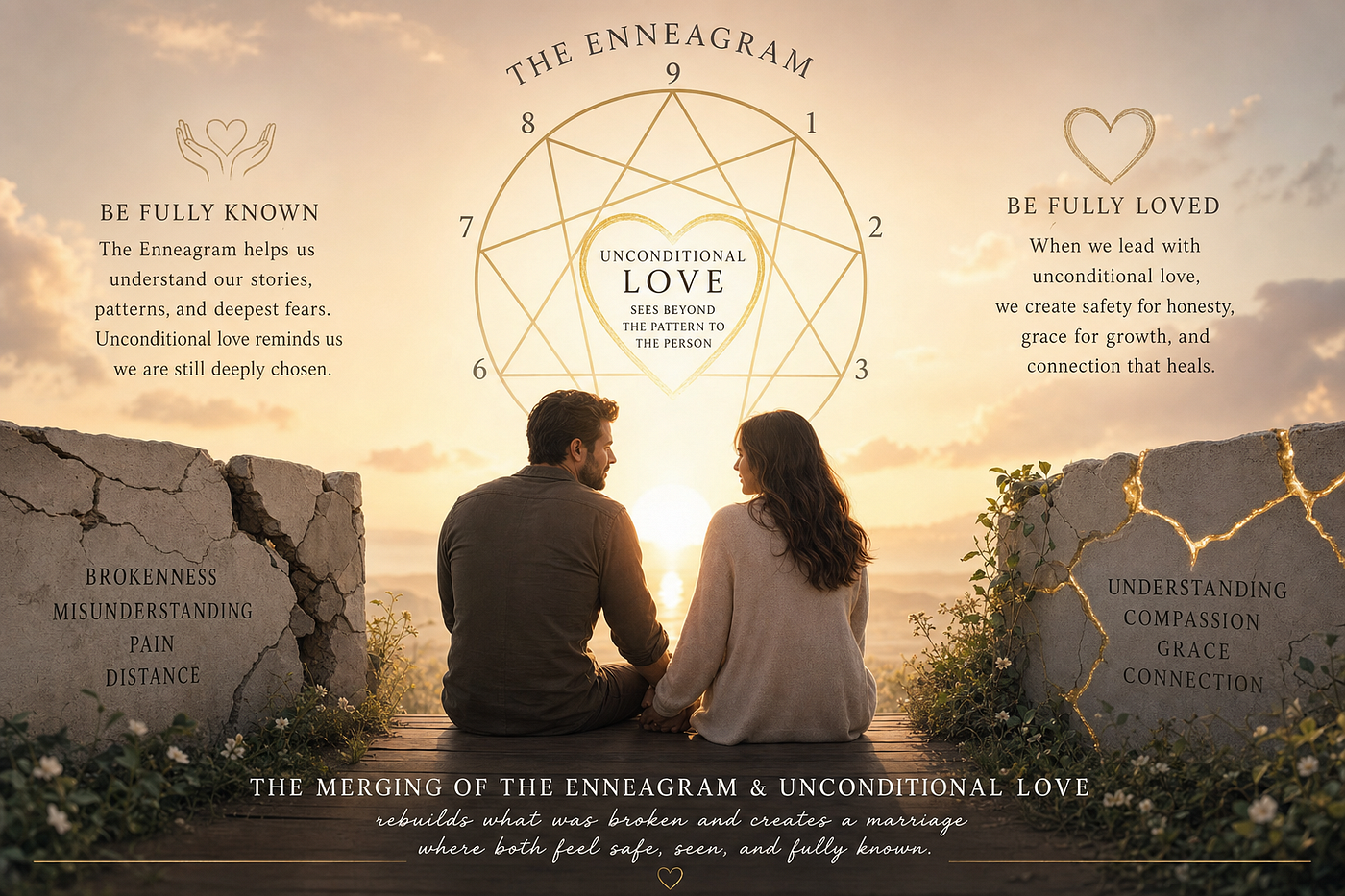
Nine deep patterns — nine ways the human heart learns to protect itself. We each carry one as our home base. And here is the quiet tragedy of marriage: you don’t marry a person, exactly. You marry a person and their armour. And over the years, it’s the armour that starts colliding. Two people, each defending an old wound, each certain the problem is the other — when really, neither has felt safe enough to be fully seen in a long, long time.
A marriage rarely falls apart because two people are too different. It falls apart because they’re each defending something tender, and from behind the armour, they simply can’t reach each other anymore.
Who we are, and why it matters to you
We want to tell you who we are, because it’s the whole reason we can say what comes next with confidence.
We’re not only marriage coaches. We are enneagram experts and marriage mentors who specialise in unconditional love. And it’s the joining of those two things — not either one alone — that changes everything.
Let us be honest about why that pairing matters, because each piece on its own falls short.
The enneagram - a personality typing system - on its own, is extraordinary at describing you. It can name your patterns, your fears, your defences with an accuracy that produces exactly that how-did-they-know-that jolt. But information has never healed a single marriage. You can understand your patterns perfectly and still feel utterly alone in them. Insight, by itself, just hands you a more detailed map of your own prison.
And love, on its own — even the unconditional kind — can feel beautiful but maddeningly vague. “Just love each other more” is true, and it is also useless to two exhausted people standing in the wreckage, because it never tells them how. It doesn’t show them what specifically keeps shutting the door between them, or why, or what to do about it tonight.
But put the two together, and something rare happens.
The enneagram shows us the exact shape of your armour — and your spouse’s. Precisely how each of you protects, hides, braces, and defends. It turns the fog of “we just don’t connect anymore” into something specific and namable and therefore changeable. And unconditional love gives us the one thing strong enough to make it safe to actually take that armour off — because no one lowers their defences for a diagnosis. People only lower them for love.
Deep insight, held inside deep love. That’s the combination almost no one offers, and it’s the whole of what we do.
What it looks like when emptiness becomes freedom
Let us show you, rather than just tell you.
There was a woman — we’ll protect her, so let’s call her the giver, because that was her pattern. She had spent more than twenty years pouring herself out for her husband and her children, certain that if she just gave enough, she’d finally be loved back. By the time she came to us after his affair, she was a husk. Resentful, exhausted, and quietly convinced that her only value lay in what she did for everyone else.
What the enneagram showed her was the armour: she didn’t give freely — she gave to earn. Love had always come with a price tag, and she’d been paying it her whole life. What unconditional love showed her was something she had never once let herself believe: that she was already, fully, completely loved before she lifted a finger. That she could be poured into, not only poured out.
The first time, she let her husband, simply hold her without rushing to be useful — without performing, without earning — she wept. Not from grief. From relief. Two decades of emptiness, and she’d finally found that the bottom of the well had a floor, and someone was standing on it with her.
That’s the difference between managing a marriage and freeing a soul.
What it looks like when fear becomes joy
There was a man — the one behind the wall. Cold, his wife called him. Checked-out. He’d learned somewhere long ago that the safest thing to do with a big feeling was to disappear behind it, to retreat, to give nothing away. His wife experienced years of his silence as rejection. He experienced his own silence as survival.
The enneagram named it gently: he wasn’t withholding to punish her. He was protecting a self he was terrified would be too much, or not enough, if he ever let it out. And held inside a love that didn’t demand he perform — coaching that refused to shame him — he slowly, for the first time in his adult life, let someone all the way in.
His wife told us later that the moment she’ll never forget wasn’t dramatic. It was him reaching for her hand across the table and saying, simply, “I’m scared. But I’m here.” Four words. From a man who’d hidden for thirty years. That’s what happens when the fear finally has somewhere safe to land.
How we actually walk this with you
Stories like those don’t happen by accident, and they don’t happen through insight alone. They happen because three things work together.
There’s a clear path — a structured way through, step by step, so you’re never wandering or guessing. It shows you exactly where the armour is, why it went up, and how, gently, it comes down. A real direction, with a real destination: a marriage where you are both fully known.
There’s a community that holds you while you heal. You will not do this alone, in secret, ashamed. You’ll be surrounded by others who understand the ache, who don’t flinch at your story, who hold you when the healing is tender and slow. This is unconditional love made tangible — not a concept, but actual people who refuse to let you carry it by yourself.
And there’s coaching that shines a light on you — where your gifts, your strengths, and yes, your armour, are seen with precision and met with warmth. Not labelled. Not boxed. Understood. You’ll often discover that the very thing you were ashamed of is the doorway to your greatest gift, and you’ll be led, gently, back toward who you were truly born to be.
Direction, safety, and yourself returned to you. Together they do what neither insight nor love could ever do alone.
You are more than one of nine
We described the nine patterns of the enneagram earlier, and they’re powerful. But we’ll be honest with you: those nine types are only scratching the surface.
A framework can describe a pattern. It can never hold the whole, unrepeatable, intricate truth of you — your specific story, your particular wounds, the exact way you learned to love and to brace for too long. You are so much more than one of nine. The patterns are a doorway, not a destination. And what waits on the other side of that door — being known not as a type but as a person, in your full specificity, and learning to know your spouse that way too — is deeper than any framework on a page could ever capture.
That’s the real work. That’s what changes a marriage.
If you’re tired, this is for you
Maybe you’re reading this exhausted. Maybe you’ve tried things before and they didn’t hold. Maybe a part of you wants to hope and another part is afraid to, because hope has cost you before.
That’s okay. You don’t have to feel strong to begin. You don’t have to have it figured out, or be sure it’ll work, or even fully believe it yet. After everything — even after betrayal, even in the rubble of trust that’s been broken — it is genuinely not too late to be truly known. We’ve watched it happen too many times to doubt it.
You were not made to spend your one marriage as two strangers in armour. You were made to be known — and to know another person — all the way to the soul. With the right insight, held in the right love, that is still possible for you. Even now.
Not sure what your next step is?
If your marriage is in the aftermath of betrayal, disconnection, secrecy, or repeated painful patterns, it can be hard to know what is actually going wrong. More information can help — but sometimes you need someone experienced to look at your specific situation and help you understand what is really happening.
Pete offers a private 90-minute Marriage Restoration Evaluation Call for individuals or couples who want clarity on:
— what has really fractured,
— why things are not improving,
— what each spouse may need,
— whether restoration is possible,
— and what kind of support would be the right next step.
This is a serious guidance session, not a casual chat. If you would like to explore whether this is right for you, email us with the word EVALUATION in the subject line and we’ll send you the information.
Pete & Nikki Uglow RestoringLove.com.
메타데이터
- post_id
- 83b829cbc8c9
- slug
- it-is-not-too-late-to-be-truly-known-83b829cbc8c9
- url
- https://medium.com/@restoringlove.com/it-is-not-too-late-to-be-truly-known-83b829cbc8c9
- canonical_url
- https://medium.com/@restoringlove.com/it-is-not-too-late-to-be-truly-known-83b829cbc8c9
- author_url
- https://medium.com/@restoringlove.com
- status
- ok
- fetched_at
- 2026-07-28 03:11:55