Rakuten × Anthropic: Building the Future of AI-Driven Product Development
Rakuten’s collaboration with Anthropic marks a significant shift in how modern software is built — moving from traditional engineering…
Rakuten × Anthropic: Building the Future of AI-Driven Product Development
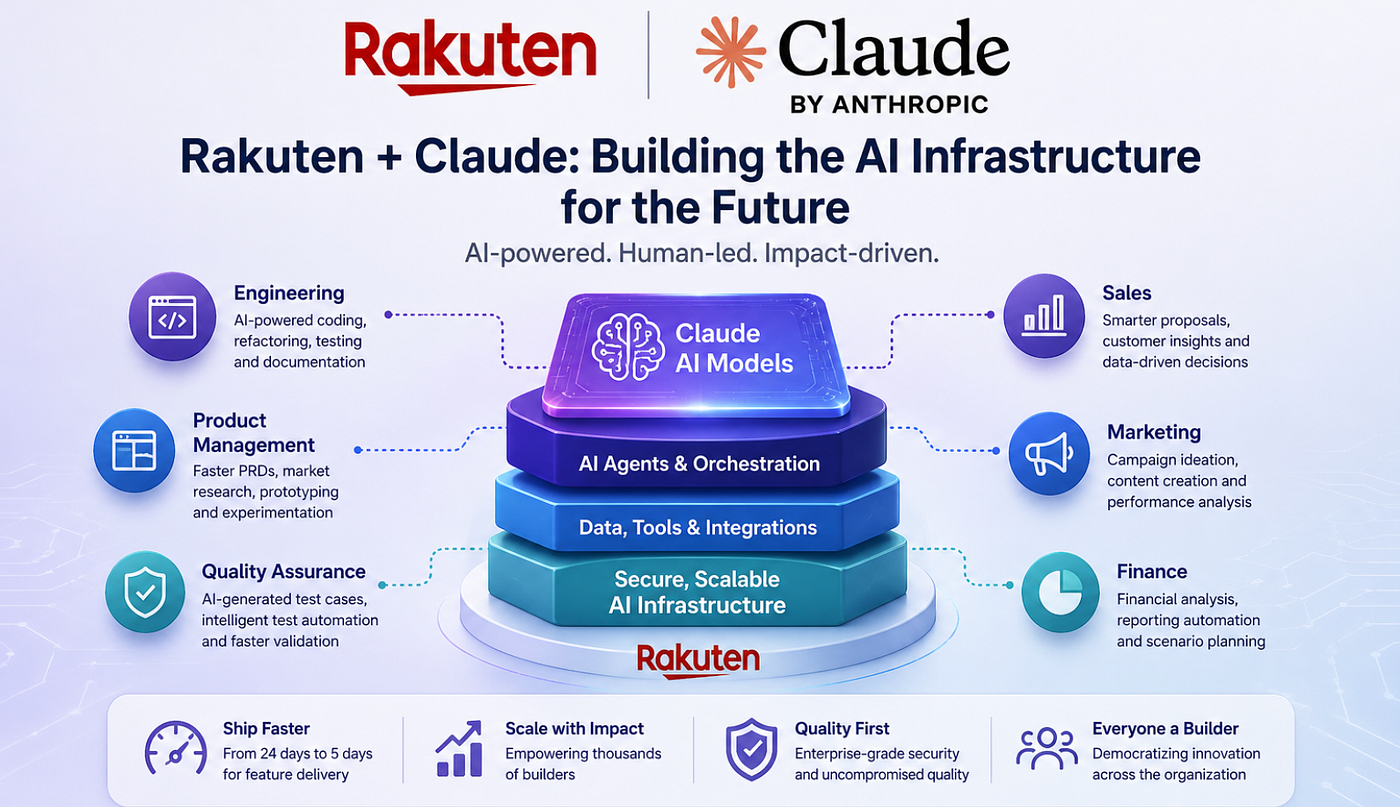
Rakuten and Claude code
Rakuten’s collaboration with Anthropic marks a significant shift in how modern software is built — moving from traditional engineering workflows to an AI-first, agent-driven development model.
At its core, the objective was clear:
- Ship faster
- Scale development across large engineering teams
- Maintain uncompromised quality
What has emerged is not just incremental improvement, but a fundamental transformation in how products are conceptualized, built, and delivered.
From Engineers Writing Code → AI Driving Development
One of the most notable shifts has been the transition from:
- Engineers writing most of the code manually to AI systems taking ownership of significant portions of coding tasks
This shift is complemented by another equally important change:
- Non-engineers can now:
- Generate applications
- Create dashboards
- Design workflows
This effectively transforms teams into orchestrators, while AI agents support workflows across:
- Product
- Sales
- Marketing
- Finance
Parallel Execution and AI as Infrastructure
Productivity gains are not just coming from automation — but from parallel AI-driven execution.
Instead of treating AI as a tool, organizations are increasingly treating it as core infrastructure — embedded deeply into workflows rather than layered on top.
A Transformation Happening in Real Time
The success story of Claude at Rakuten is still unfolding — and being part of this journey has been both exciting and insightful.
Initial pilots began last year, and today the outcomes are becoming increasingly visible:
- Increased productivity
- Faster delivery cycles
- No compromise on quality
This last point is particularly important.
As a Japanese organization, quality is not just a KPI — it is cultural DNA. The emphasis on strong processes and continuous improvement ensures that speed does not come at the cost of reliability.
Scaling AI Across a Complex Organization
Rakuten operates across multiple business domains globally, and in a rapidly evolving landscape, speed is no longer optional.
The growing adoption of AI across use cases reflects a broader shift toward embedding AI into everyday workflows. As a result, the impact on productivity and execution efficiency is becoming more evident.
A key mindset shift emerging from this transformation is:
Moving from being users of tools to becoming builders with AI
How Different Functions Are Leveraging AI
Product Management
Product Managers are leveraging AI across the lifecycle:
- Building prototypes and playgrounds for demos
- Showcasing feature capabilities
- Creating PRDs more efficiently
- Proofreading specifications using broader documentation context
- Conducting market research
- Refining experiments and exploring multiple scenarios
Engineering
Developers are using AI tools to:
- Accelerate code development
- Reduce turnaround time for feature delivery
Quality Assurance
QA teams are:
- Generating test cases
- Validating features more efficiently
All of this is happening at a significantly accelerated pace, while maintaining a strong focus on quality.
Why the 24 Days → 5 Days Shift Is Not Surprising
Reported improvements such as reducing feature delivery time from 24 days to 5 days reflect the cumulative impact of:
- Increased AI adoption
- Continuous experimentation
- Knowledge sharing across teams
- A strong focus on execution speed
As a Product Manager, one of the most valuable aspects has been observing how teams actively share use cases and learnings, enabling faster collective progress.
Culture + AI = Sustainable Speed
The use of AI aligns closely with 3 of Rakuten’s core principles:
- Speed, Speed, Speed
- Always Improve, Always Advance
- Maximize Customer Satisfaction
These principles are not applied in isolation — they work together to ensure:
- Speed with quality
- Continuous improvement
- Customer-centric outcomes
As a result, speed becomes a natural outcome of the ecosystem, not a forced metric.
Being Part of an Evolving AI Journey
It is encouraging to see how organizations are actively investing in AI adoption and experimentation.
Over the past year, the impact of AI on development velocity and productivity has become increasingly evident, with teams exploring new ways to integrate AI into their workflows and decision-making processes.
Final Thought
If organizations are not actively exploring how AI can improve productivity and delivery speed, there is a growing risk of falling behind.
I’d be curious to learn: How are you and your teams using AI to improve productivity and deliver better outcomes to customers?
👉 Read the full Rakuten × Claude collaboration story here: https://claude.com/customers/rakuten
메타데이터
- post_id
- 83bff2cf8a01
- slug
- rakuten-anthropic-building-the-future-of-ai-driven-product-development-83bff2cf8a01
- url
- https://medium.com/@deepakjatinchaudhary/rakuten-anthropic-building-the-future-of-ai-driven-product-development-83bff2cf8a01
- canonical_url
- https://medium.com/@deepakjatinchaudhary/rakuten-anthropic-building-the-future-of-ai-driven-product-development-83bff2cf8a01
- author_url
- https://medium.com/@deepakjatinchaudhary
- status
- ok
- fetched_at
- 2026-06-10 12:26:30




