In the AI age, timeless principles are designers’ best guide
As powerful generative AI tools are accelerating design work, the timeless principles of good design help designers stay on track.

In the AI age, timeless principles are designers’ best guide
As powerful generative AI tools are accelerating design work, the timeless principles of good design help designers stay on track.
There’s no doubt anymore: AI is woven into the very fabric of our design processes. Much of the time-consuming work that once defined our profession is now being accelerated, freeing us up to focus on a new set of challenges. At the same time, the roles around design are blurring as non-designer participation in design-centric tasks is increasing, and AI agents are paving the way for new UI, UX and CX paradigms that go beyond today’s graphical user interfaces, patterns and screens.
As our methods evolve, we might produce more, but are we becoming more effective? As we navigate this new landscape, how do we ensure we’re not just producing more, but producing better?
Technology changes fast, humans don’t
This is where classic design principles can help. As AI becomes more deeply embedded in products — and in how we build them — we need a compass to help point us in the right direction before we race off at top speed.
Design giant Dieter Rams’s ten principles for good design and his “less, but better” philosophy are a touchstone that I come back to often. For designers aiming for clarity, honesty and longevity in their work, these principles help us understand what good looks like, so that we can better create, edit and curate AI-assisted content and designs.

These core principles are rooted in fundamental aspects of human psychology, perception and needs— things that change very slowly, if at all.
10 timeless principles for good design

1. Good design is innovative.
An idea is just the starting line. Innovation is about turning a new idea into a tangible solution that creates real-world value, pushing the boundaries and moving into uncharted territories. It’s the hard work of designing, building and refining that transforms a clever thought into a finished product, a smarter service or a better way of working.

Onboarding for Zalando’s size and fit experience
In our context at Zalando, an example of this is our AI-driven size and fit experience, which allows customers to get size recommendations based on their own body measurements. Helping customers find the right size this way has already led to a 10% reduction in size-related returns for items purchased with this feature.

2. Good design makes a product useful.
“Solve problems that matter” has been a guiding principle at Zalando from day one, especially for creating generative AI products. This is what human centricity is essentially about: solving actual problems, not using technology to try to solve a problem that doesn’t really exist.
This principle is especially important when working with generative AI, because it’s easy to simply replicate existing concepts. AI excels at solving the problem of speed and efficiency, allowing organisations to produce vast amounts of text, images, and media quickly and affordably. Yet, true differentiation comes from the intent and understanding the context. It’s not just the how, but the why: the story, strategy and deeper meaning behind the design.

3. Good design is aesthetic.
Creating digital content that is considered aesthetic is dramatically easier now than ever before. Creating visuals that are distinctly human and avoid the common “AI look” involves leaning into qualities that AI, with its reliance on patterns, perfection and consistency, still struggles to replicate. Increasingly, we need to differentiate great from mediocre by deeply understanding the use case and wider context.

The product page aims to create a pleasing and engaging experience beyond pure utility. (Learn more about the Product Detail Page design principles)
Design leader Julie Zhuo argues that a designer’s most critical advantage is a highly developed “taste” — it’s what gives a designer a unique professional edge. Without this discerning eye, a designer risks being limited to whatever passable results AI can generate. Like Zhuo, I urge other designers to proactively cultivate their taste by studying the absolute best examples of craft and creativity — not just in their own field, but across disciplines. This strengthens the deep knowledge designers have, which provides the vast mental library and the understanding of principles needed to judge quality.

4. Good design makes a product understandable.
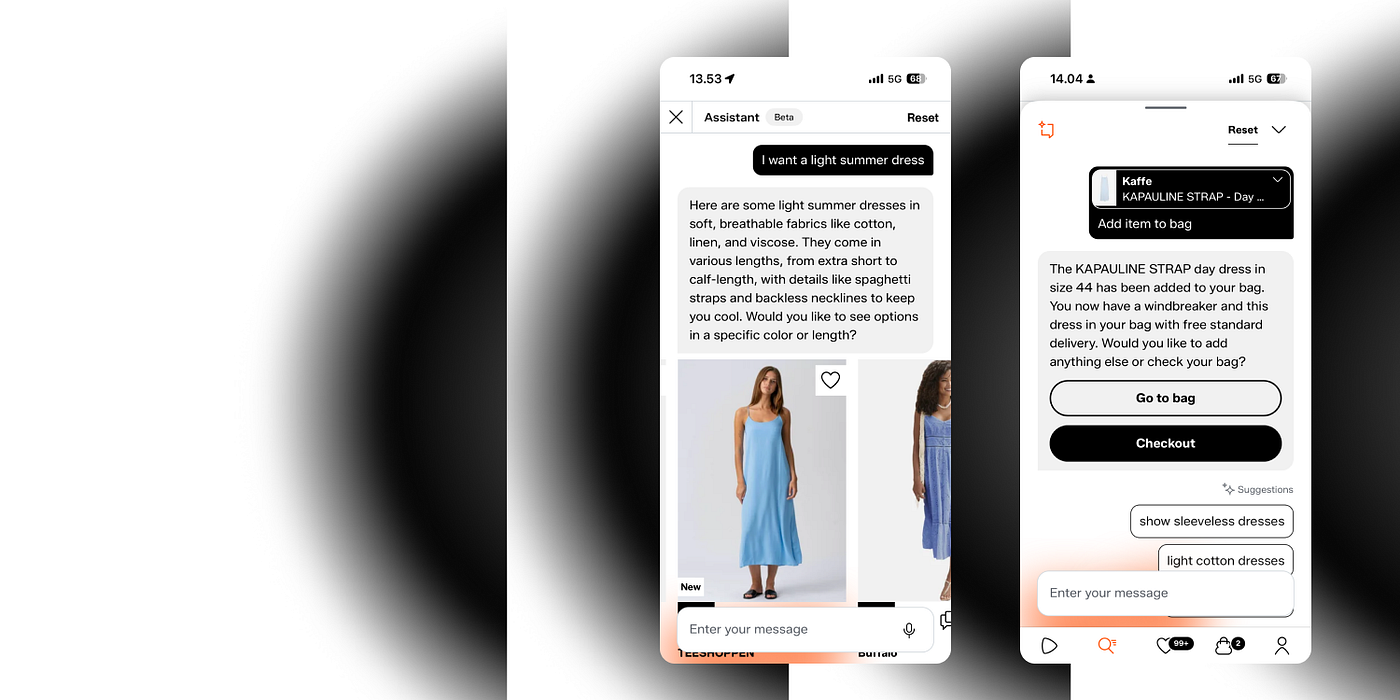
A product that’s well designed clearly communicates how it should be used. ‘Don’t just tell me, but show me: Customers need guidance to interact with generative AI, examples and active guidance.’ was one of our guiding principles for creating Zalando Assistant. In this case, the team recognised that customers didn’t know how to “talk” to the new assistant. To solve this, they provided conversation starters (such as “I want to get fashion advice”) to show what kinds of questions the assistant could answer. They also created a handy search function that actively showed customers how the generative AI was working differently, helping them understand and adapt to the new, more powerful capabilities.

5. Good design is unobtrusive.
Many design features are proactive — they anticipate users’ needs, add information or direct the user journey. While often useful, this proactivity still needs to fit seamlessly into the wider context. If we’re not careful, even a well-intentioned design feature — for example, asking customers to reconfirm all of their data during checkout, or introducing an overly enthusiastic AI agent — can become an unhelpful distraction.

At checkout, data entry should be as simple and seamless as possible. (Learn more about the checkout experience principles)
Unobtrusive design doesn’t demand your constant attention, but offers help when it’s contextually relevant.

6. Good design is honest.
The line between human and machine conversation is blurring. With each update, AI becomes a more convincing digital confidante, trusted daily by millions.
Therefore, this principle of honesty is even more urgent. In an era of misinformation and opaque algorithms, users want products and services they can trust. In the context of AI, honesty means more than just a physical product’s durability or function — it’s about transparency.

Prioritise advocacy and transparency: personalisation principles explicitly call for being clear about how personalisation works and what data is used.
We need honesty on multiple fronts: data, algorithms and outcomes. We need to ask: is the design honest about what data it collects and why? Is there algorithmic honesty, i.e. are we clear about the limitations of AI, or does it pretend to be human or all-knowing? Are we transparent about outcomes and how the user’s data will be used to influence their experience or the business’s bottom line?

7. Good design is long-lasting.
Design’s longevity is tied to its purpose, usefulness and applicability. Again, AI is incredibly powerful at executing the how: generating variations, applying styles and optimizing layouts. However, it doesn’t understand the strategic why.
Long-lasting design solves a fundamental problem or addresses a core human need. These needs change much more slowly than technology. A design that is deeply rooted in a clear and meaningful purpose will remain relevant even as the visual styles and underlying technology evolve. With a long-standing reputation for free delivery and easy returns, Zalando has created a customer expectation of a frictionless experience, which is also manifested in the design.

8. Good design is thorough down to the last detail.
In UI, nothing is left to chance. This principle is about care, precision and the respect shown to the user through meticulous attention to all aspects of the design. Designers make every choice for a reason: a specific line weight, a corner radius, or the timing of an animation is chosen to support the overall system and user experience. Edge cases have been covered: users should never bump into dead ends or be uninformed about what is going on or what to do.
AI can generate multiple UI options, much like it generates images or text, allowing designers to use them as part of their toolbox in discovering the most suitable solution. This expands the designer’s role to a curator and orchestrator of intelligent systems.

9. Good design is environmentally friendly.
In the face of climate change and digital waste, true design excellence is rooted in sustainability and respect for the environment. To combat one of the biggest drivers of returns, Zalando is actively using AI-powered sizing tools and virtual fitting rooms to reduce return rates, which has a direct environmental benefit by cutting down on transport emissions and packaging waste.
From a digital product perspective alone, the core environmental impact is related to energy consumption — from data centers, transmission networks and the user’s device. By advocating for eco-friendliness through tangible design decisions that reduce a product’s digital weight, designers can also champion sustainability.

10. Good design is as little design as possible.
Our digital environment is more saturated and noisy than ever. The principle of simplicity, or as Dieter Rams put it, “as little design as possible”, is a powerful antidote to this chaos. A clear, focused and uncluttered product respects the user’s time and cognitive limits: bringing clarity and focus removes barriers. The user’s intent is the key: why are they using the product?
An example of this is the Designer homepage — a curated space for storytelling and inspiration. The page is free of distractions, putting more emphasis on product imagery and the stories they have to tell.

Zalando’s Designer home page
The compass, the course and the changing role of designers
AI is a powerful, high-speed vehicle, but timeless design principles are our indispensable compass. While Dieter Rams spoke of static objects, his principles endure because they address unchanging human needs. In the age of AI, where generative tools can create an ocean of possibilities, the designer’s role expands from problem-solver to curator, strategist and ethicist. Our most critical task is no longer just generating solutions, but exercising the judgment, taste and critical thinking needed to provide a good solution.
Without principles like honesty, usefulness and simplicity as our compass, our high-speed vehicle will only get us to the wrong place faster. By staying rooted in these principles, we ensure that AI’s efficiency is transformed into meaningful, human-centred effectiveness.
메타데이터
- post_id
- 83cb6da5dd55
- slug
- timeless-design-principles-for-the-ai-age-83cb6da5dd55
- url
- https://medium.com/zalando-design/timeless-design-principles-for-the-ai-age-83cb6da5dd55
- canonical_url
- https://medium.com/zalando-design/timeless-design-principles-for-the-ai-age-83cb6da5dd55
- author_url
- https://medium.com/@hannelepiirainen
- status
- ok
- fetched_at
- 2026-06-12 18:20:59