Brand Impersonation Case Study : DHL
Executive Summary
Brand Impersonation Case Study : DHL
- Executive Summary
DHL group, one of the world’s leading logistics and parcel delivery operators, is consistently among the most impersonated brands in global phishing campaigns. This study examines the nature, scale, and mechanisms of DHL brand impersonation to inform brand protection strategies for enterprises and consumers alike.
Key reasons to choose DHL;
- DHL (#2) — Most imitated brand in 2020.
- DHL ranked #1, most impersonated brand globally in Q3 2022
- DHL ranked #3 most-impersonated brand by phishing email volume, with approximately 8.8 million spoofed emails sent in 2024 (Proofpoint).
- DHL re-entered the global top 10 most-impersonated brands in Q3 2025, ranking 10th after a multi-quarter absence (Check Point Research).
2. Objective
This study focuses on publicly documented brand impersonation threat activity targeting DHL in last 3 years (2022- 2025). They key objectives are
- Map the threat landscape for DHL brand impersonation across attack vectors.
- Analyse the visual and technical tactics used to deceive victims.
- Assess the impact on consumers and DHL’s brand reputation.
- Evaluate DHL’s existing brand protection posture and recommend enhancements.
3. Methodology
This report coordinate findings from publicly available information from threat intelligence feeds, including publications from Proofpoint, Check Point Research, ANY.RUN, Vade Secure, and the Anti-Phishing Working Group (APWG).
4. Attack Surface Analysis
Attackers exploit DHL’s brand through multiple channels, often combining vectors within a single strategy for amplified impact.
a. Phishing Emails
Email phishing is the primary attack vector. DHL-themed phishing emails typically follow one of several narrative templates: • Missed delivery notification: Victim is told a delivery attempt failed and must click to reschedule. • Customs fee required: Victim is informed a parcel is held at customs pending a small fee payment. • Account verification: Victim is prompted to confirm account details to release a shipment. • Fake invoice: Victim receives a fraudulent invoice PDF, which either contains malware or links to a credential-harvesting page.
b. Smishing (SMS Phishing)
SMS-based DHL impersonation has grown sharply alongside the rise of mobile parcel tracking. Key smishing characteristics include: • Shortened URLs (e.g., bit.ly links) to obscure malicious destinations. • Generic sender names such as ‘Delivery’ rather than a visible phone number. • Country code spoofing — messages sent from international prefixes inconsistent with the recipient’s region. • Requests for customs or redelivery fees via SMS, often directing to fake payment pages.
c. Typo squatting & Fake websites
Attackers register domains engineered to visually resemble the legitimate DHL website. Common patterns identified in threat intelligence research include: • dhl-tracking.com, dhl-shipment.net, dhldelivery.org (domain patterns, defanged for safety) • dhl-login-check.org — a specific fake login site identified by Check Point Research in Q3 2025, which replicated DHL’s login page design to harvest credentials, email addresses, phone numbers, and home addresses. • Subdomain spoofing: tracking.dhl-courier.com to create a believable URL structure.
d. Social Media Impersonation
Fraudulent DHL accounts appear across platforms including Facebook, Instagram, WhatsApp, and Telegram. These accounts typically: • Lack official verification badges. • Prompt users to move conversations to encrypted channels (WhatsApp, Telegram) to evade platform moderation. • Offer implausible incentives: free visa services, free flights, or investment doubling schemes. • Operate for only a few weeks before being reported and taken down, then re-emerge under new account names.
e. Supply chain attack
A more sophisticated vector involves using DHL impersonation not to target end-consumers, but to compromise DHL’s business partners and contractors. By impersonating DHL in emails directed at partner organizations, attackers can gain footholds in supply chains that eventually lead to the primary target.
5. Indicators of Impersonation
a. Brand Identity mimicry
DHL’s brand identity, a distinctive red and yellow colour scheme, the DHL logo and standardised typography is often closely replicated by attackers to build visual credibility. Common elements include:
- Logo -Official DHL watermark with low resolution or HTML recreation.
- Sender domain — Use free providers (@gmail) or lookalikes such as dhl-express.com
- Tracking links — Random string of characters or short URLs
- Tone & Language : Sound very urgent, time-limited and often contain grammatical errors.
b. Email Header red flags
- Sender address uses a free email provider (@gmail, @yahoo, @outlook), DHL explicitly states it never uses these.
- Reply-to address differs from the visible from address.
- Failed or absent DMARC/DKIM/SPF authentication
- Mismatched display name and actual sending domain.
c. Domain & URL patterns
Phishing URLs typically share several structural characteristics that distinguish them from legitimate DHL communications:
- Legitimate DHL domains: dhl.com, dpdhl.com, dhl.de, dhl.fr, dhl-news.com, and country-specific subdomains.
- Attacker domains: Insert ‘dhl’ into an otherwise unrelated domain, add hyphens and keywords (tracking, delivery, express, login, shipment), or register plausible-looking TLDs (.org, .net, .info).
- Shortened URLs: bit.ly, tinyurl, or other shorteners used to mask the true destination, especially in SMS campaigns.
6. Risk Assessment Matrix
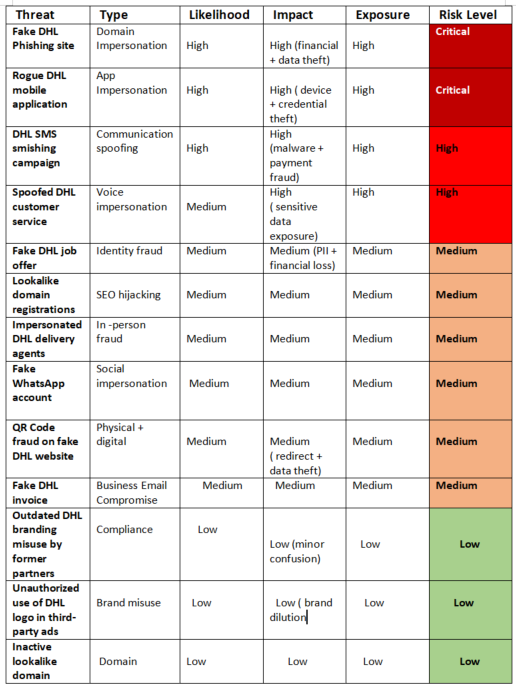
7. Impact Assessment
a. Impact on Consumers
Victims of DHL impersonation attacks face a range of harms depending on the attack type:

b. Impact on DHL
Brand impersonation erodes consumer trust even when the brand itself is a victim rather than a culprit.
Key reputational risks include:

8. Analysis of DHL’s existing brand protection measures
a. Consumer Fraud Awareness
DHL maintains a dedicated Fraud Awareness page across its global web properties, providing consumers with guidance on identifying and reporting suspected impersonation.
Key elements include:
- Users can report suspicious phishing emails, SMS scams and fraudulent social media accounts directly to phishing@dhl.com
- DHL publicly stated that all official communications originate from @dhl.com, @dpdhl.com, @dhl.de, @dhl.fr, @dhl-news.com, or country-specific domains and that free email providers are never used (gmail , yahoo).
- DHL clarifies that only custom duties and taxes may be requested via email or SMS, and that an OTP is only used as a safety measure for such legitimate requests.
- All DHL official communication channels ( WhatsApp, Telegram, X ) have blue badges and DHL brand logo, and the absence of it, signifies the illicit purpose of it.
- Every country has their own DHL shortcode for SMS communication, allowing consumers to verify sender authenticity.
b. Email Authentication
DHL employs industry-standard email authentication protocols to reduce spoofing of its own sending domains:
- DKIM (DomainKeys Identified Mail): Applies cryptographic signatures to legitimate DHL emails, allowing recipient mail servers to verify authenticity.
- Sender Policy Framework (SPF) : Authorizes specific mail servers to send on behalf of DHL domains.
- DMARC (Domain-based Message Authentication): Instructs recipient mail servers on how to handle emails that fail SPF/DKIM checks, and provides DHL with visibility into spoofing attempts.
c. Takedown & Monitoring
DHL has not publicly disclosed the internal metrics used to takedown fraudulent activities / behaviours but DHL’s fraud awareness infrastructure implies an ongoing takedown operation. The public Anti-Abuse Mailbox serves as a reporting pipeline that feeds into domain takedown requests coordinated with registrars, hosting providers, and platform operators. DHL’s global scale allows it to engage with law enforcement and cybersecurity agencies across jurisdictions to pursue takedowns.
9. Mitigation Recommendations
a. For DHL
- Consumer education campaigns: Invest in visible, ongoing consumer education, particularly during peak shipping seasons on how to identify legitimate DHL communications.
- Educate employees on supply chain attack risks , attackers may impersonate DHL when targeting an organization’s logistics partners.
- Implement BIMI (Brand Indicators for Message Identification) with a Verified Mark Certificate (VMC) to display the DHL logo in supported email clients, providing a visual trust signal for legitimate communications.
- Deploy automated monitoring of newly registered domains containing ‘DHL’ to enable faster takedown requests before campaigns launch.
- Require business partners to maintain minimum email authentication standards (DMARC with enforcement policy) to reduce supply chain attack surface.
b. For Consumers
- Always navigate directly to dhl.com to check your shipping status rather than clicking links in emails or SMS messages.
- Verify the sender’s identity ( email or SMS), look beyond the displayed email to see the actual sending address
- Be suspicious of urgency , legitimate carriers rarely impose pressure for clicking links.
- Enable MFA on any DHL account or email accounts associated with DHL tracking.
- Report suspected fraud to phishing@dhl.com
10. Conclusion
DHL group occupies a uniquely exposed position in the brand impersonation threat landscape. As a renowned global chain of logistics and shipping industry, the inherent psychology of using ‘parcel delivery’ tactic make it attractive target for cyber criminals. From holding #1 position and returning to top 10 in 2025, the threat has been persistent and is evolving in sophistication.
The emergence of AI assisted phishing toolkits, supply chain attack techniques, lack of awareness and multi-facilitated impersonation campaigns represents a huge cybersecurity challenge. However the combination of DHL’s proactive fraud awareness programs, email authentication deployment and the broader cybersecurity community’s vigilance provides a foundation for effective defence.
메타데이터
- post_id
- 83cd6b44ba23
- slug
- brand-impersonation-case-study-dhl-83cd6b44ba23
- url
- https://medium.com/@gresecure/brand-impersonation-case-study-dhl-83cd6b44ba23
- canonical_url
- https://medium.com/@gresecure/brand-impersonation-case-study-dhl-83cd6b44ba23
- author_url
- https://medium.com/@gresecure
- status
- ok
- fetched_at
- 2026-06-28 14:26:31