32 Illegal Refineries Destroyed, Thousands Remain: Nigeria’s Oil Theft Battle Continues at…
Military operations recover 175,000 litres while 32–64 million litres are stolen daily. OPEC+ increases production amid Gulf crisis…
32 Illegal Refineries Destroyed, Thousands Remain: Nigeria’s Oil Theft Battle Continues at Industrial Scale
Military operations recover 175,000 litres while 32–64 million litres are stolen daily. OPEC+ increases production amid Gulf crisis. Nigeria flares gas while power plants starve for supply. The contradictions defining Nigeria’s energy sector in one weekend.
Fuel Price Watch • March 3, 2026 • 8 min read
Weekend developments paint a comprehensive picture of Nigeria’s energy sector contradictions: tactical wins against oil theft without strategic resolution, global supply dynamics creating opportunities Nigeria may not be able to exploit, and a power crisis caused not by gas shortage but by infrastructure failure to deliver abundant gas to power plants.
Each story reveals the gap between Nigeria’s potential and reality.
32 Illegal Refineries Destroyed: Progress Without Resolution
Military operations over the weekend destroyed 32 illegal refining sites across the Niger Delta and recovered over 175,000 litres of stolen petroleum products.
On its face, this is positive news. Every illegal refinery destroyed is production recovered for legitimate use. Every litre recovered is revenue returned to government coffers instead of criminal enterprises.
But context transforms celebration into sobering reality.
The Scale of Oil Theft
Nigeria loses an estimated 200,000 to 400,000 barrels per day to oil theft. At typical refining yields, this translates to approximately 32 to 64 million litres of petroleum products daily.
The 175,000 litres recovered represents 0.27% to 0.55% of a single day’s stolen volumes.
32 illegal refineries destroyed sounds significant until you understand that thousands of illegal refining sites operate across the Niger Delta. Some are sophisticated operations with industrial-scale equipment. Others are artisanal refineries consisting of basic distillation apparatus in remote creeks and forests.
Tactical Wins, Strategic Stalemate
Military operations provide tactical wins. Destroying 32 sites disrupts specific criminal networks, recovers specific stolen volumes, and demonstrates enforcement commitment.
But tactical wins don’t constitute strategic resolution when the underlying dynamics remain unchanged:
Economic Incentives Persist: Stealing crude oil costs criminals nothing (they don’t pay for it). Refining illegally costs relatively little (equipment is basic, labor is cheap, environmental regulations are ignored). Selling products at market prices generates enormous profits (100% margin on stolen input).
As long as this economic equation holds, oil theft continues regardless of how many sites are destroyed. For every site shut down, another opens elsewhere.
Porous Security: Nigeria’s oil infrastructure spans thousands of kilometers across difficult terrain. Pipelines run through creeks, swamps, and forests. Monitoring every meter is impossible with available resources.
Thieves tap pipelines, steal crude, transport it to refining sites, and distribute products through informal networks. The infrastructure is extensive, the terrain is favorable to criminals, and enforcement capacity is limited.
Community Complicity: Many Niger Delta communities participate in or tolerate illegal refining because it provides income in regions with limited legal economic opportunities. Poverty, unemployment, and perceived marginalization create conditions where oil theft becomes economic activity rather than purely criminal enterprise.
Military operations that destroy refineries without addressing underlying economic grievances face community resistance and enable rapid reconstruction of destroyed sites.
Impunity for Sponsors: While military operations target physical refining sites and arrest low-level operatives, the financiers and sponsors of oil theft often operate with impunity. These are politically connected individuals who provide capital, logistics, and protection for theft operations while remaining insulated from prosecution.
Without addressing high-level sponsors, oil theft persists regardless of site destructions.
What Strategic Resolution Requires
Ending oil theft at scale requires:
Infrastructure Security: Technology (sensors, drones, surveillance) combined with rapid response capabilities can detect and address pipeline breaches quickly, reducing volumes stolen.
Economic Alternatives: Legal employment and economic opportunities in oil-producing communities reduce dependence on theft-related income. When communities benefit legitimately from oil production, they become stakeholders in protecting infrastructure rather than participants in theft.
Accountability: Prosecuting high-level sponsors and financiers, not just low-level operatives, demonstrates that oil theft carries consequences regardless of political connections.
Regulatory Reform: Modular refineries licensed and regulated could formalize some artisanal refining, bringing it into legal economy with taxation, environmental standards, and quality control.
Until these strategic elements are addressed, military operations will continue achieving tactical wins while oil theft persists at industrial scale.
OPEC+ Production Hike: Opportunity Nigeria May Not Exploit
The Organization of Petroleum Exporting Countries and allies (OPEC+) approved an oil production increase this weekend as the Gulf crisis escalates, responding to geopolitical supply risks with output expansion aimed at stabilizing global markets.
The Geopolitical Context
Escalating tensions in the Gulf region (involving Iran, regional conflicts, and shipping route vulnerabilities) threaten oil supply from one of the world’s most critical production zones. The Gulf produces approximately 20 million barrels per day, representing roughly 20% of global supply.
Any significant disruption creates supply shortages and price spikes. The 2019 attack on Saudi Aramco facilities briefly removed 5.7 million bpd from markets, causing immediate price increases.
Current crisis escalation raises similar concerns. If Gulf production is disrupted, global oil markets face supply deficits.
OPEC+ Response
OPEC+ approved production increases to preemptively address potential supply gaps. By increasing output now while Gulf production continues, OPEC+ builds supply cushion that can absorb disruptions without catastrophic price spikes.
This represents market management: using production flexibility to stabilize prices rather than maximize short-term revenue through supply constraints during crisis.
Opposing Price Pressures
Two forces now push oil prices in opposite directions:
Upward Pressure (Crisis Risk): Gulf crisis escalation creates supply risk. Markets price in potential disruptions, pushing prices higher in anticipation of future shortages.
Downward Pressure (Production Increase): OPEC+ production hike increases actual supply. More oil flowing to markets creates downward price pressure.
Net effect depends on crisis severity versus production increase magnitude. If crisis materializes and significantly disrupts Gulf supply, prices spike despite OPEC+ increases. If crisis remains contained, OPEC+ increases may push prices down.
Nigeria’s Opportunity and Constraint
For Nigeria, OPEC+ production increase potentially means higher production quota allocation. More barrels Nigeria can officially produce and export.
But Nigeria faces fundamental constraint: can we actually produce more?
Current Production: ~1.459 million bpd (as of recent reports)
Potential Production: Nigeria claims capacity around 2 million bpd
The Gap: 540,000 bpd difference between potential and actual
Why can’t Nigeria close this gap?
Oil Theft: 200,000 to 400,000 bpd stolen (as discussed above). This isn’t capacity constraint. It’s security failure preventing produced oil from reaching legitimate export.
Infrastructure Degradation: Decades of underinvestment mean production facilities, pipelines, and export terminals operate below optimal capacity. Maintenance backlogs and equipment failures reduce output.
Investment Deficit: International oil companies reduced Nigeria investments due to regulatory uncertainty, operational challenges, and better opportunities elsewhere. Without investment in new fields and production enhancement, output stagnates.
Even if OPEC+ grants Nigeria higher production quota, Nigeria may not be able to fill it without addressing theft, infrastructure, and investment challenges.
The Revenue Trade-Off
Higher oil prices benefit Nigeria through increased revenue per barrel exported. If prices rise from $70 to $90, Nigeria earns $20 more per barrel on 1.459 million bpd, generating approximately $29 million additional daily revenue ($10.6 billion annually).
But Nigeria also pays more for any petroleum products still imported. Despite Dangote producing 65 million litres daily, Nigeria may still import some diesel, jet fuel, or specialized products. Higher global prices increase import costs.
The net effect is generally positive (Nigeria exports far more than it imports), but the trade-off exists.
Gas Shortage Causing Power Crisis: Delivery Failure, Not Supply Shortage
The Nigerian Independent System Operator confirmed over the weekend that poor electricity supply across Nigeria results from gas shortage, with the national grid receiving only one-third of the gas supply needed to operate power plants at capacity.
This sounds straightforward: not enough gas, therefore not enough electricity.
But the reality is far more paradoxical and reveals deeper infrastructure dysfunction.
The Gas Abundance Paradox
Nigeria has 209 trillion cubic feet of proven natural gas reserves. This ranks Nigeria among the world’s top 10 countries by gas reserves.
Nigeria flared 203.9 billion standard cubic feet of gas in 2025. This gas was burned off at production sites instead of being captured for use.
So Nigeria has enormous gas reserves and burns gas annually that could power the entire country multiple times over, yet power plants starve for gas supply.
This isn’t a supply problem. It’s an infrastructure and priority problem.
The Infrastructure Failure
For decades, Nigeria prioritized crude oil exports over domestic gas utilization. Investment went into infrastructure connecting oil fields to export terminals, not infrastructure connecting gas fields to domestic power plants.
The result:
Pipelines exist connecting gas production sites to flare points where gas is burned.
Pipelines don’t exist (or are inadequate) connecting gas production sites to power plants where gas could generate electricity.
Gas that could power homes and businesses is burned because it’s cheaper and easier to flare it than to build infrastructure delivering it to users.
The Generation Gap
Nigeria currently generates approximately 5,000 megawatts of electricity. This serves a population of 200+ million people.
For comparison:
- South Africa (60 million people): 58,000 MW capacity
- Egypt (100 million people): 59,000 MW capacity
- Ghana (30 million people): 5,000 MW capacity
Nigeria’s installed power generation capacity exceeds 20,000 MW. The infrastructure exists to generate four times current output.
But capacity means nothing without fuel. Power plants can’t generate electricity without gas supply, regardless of how much capacity they have.
Why Grid Gets One-Third of Required Gas
Several factors prevent adequate gas supply to power plants:
Pipeline Constraints: Existing gas pipelines have limited capacity and suffer from vandalism, theft, and maintenance issues. Even when gas is available, pipelines can’t deliver sufficient volumes.
Contractual Issues: Gas producers prioritize export contracts (LNG, international buyers) over domestic supply because international contracts pay in hard currency at higher rates than domestic power generators can afford.
Payment Problems: Power distribution companies often don’t pay for electricity, creating cascading payment failures through the value chain. When generators don’t get paid for electricity, they can’t pay for gas. When gas producers don’t get paid, they reduce supply.
Infrastructure Sabotage: Pipeline vandalism and theft of gas (not just oil) disrupts supply even when contractual and payment issues are resolved.
The result: Power plants designed to generate 20,000+ MW receive gas sufficient for only 5,000 MW, so that’s all Nigeria generates.
The NNPC-AEDC Solution: Bilateral Agreements Bypass Broken Infrastructure
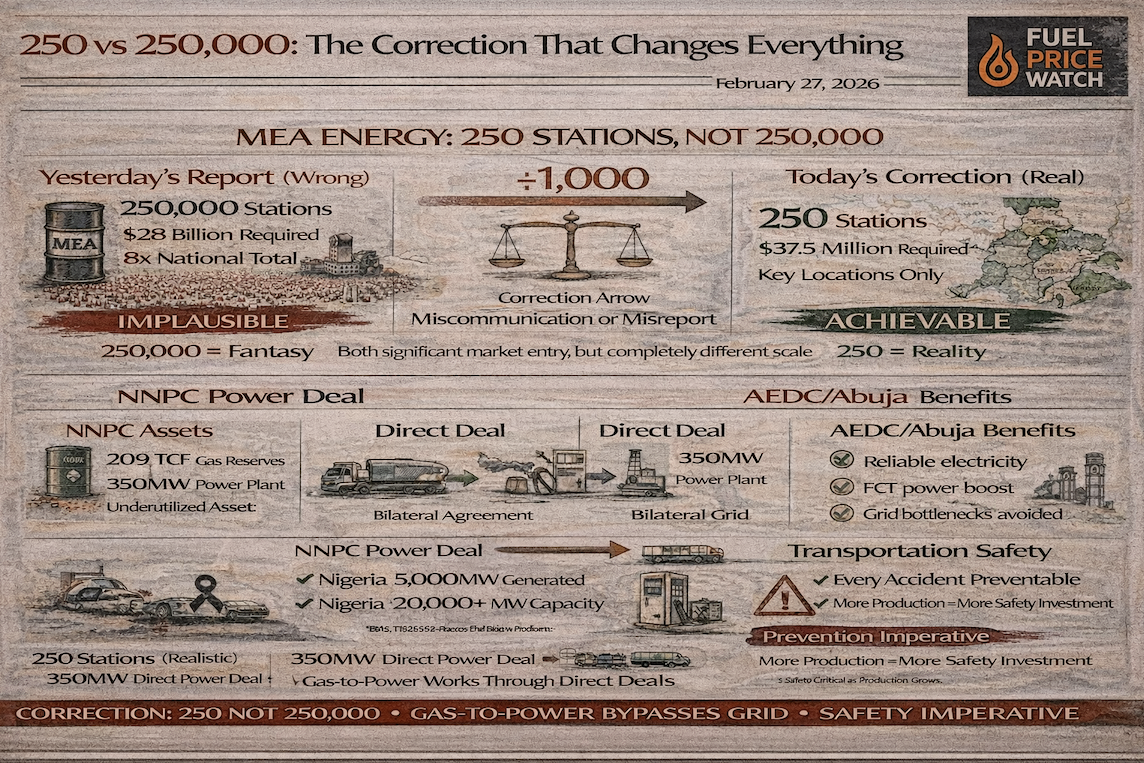
On February 27, we reported that Abuja Electricity Distribution Company signed a bilateral agreement with NNPC to source 350 MW directly from NNPC’s power plant.
This model bypasses the broken national infrastructure:
Traditional Model:
- Gas producer supplies gas to national grid
- National grid supplies gas to power plant
- Power plant generates electricity for national grid
- National grid supplies electricity to distribution company
- Distribution company delivers to consumers
Multiple points of failure, payment chain breaks, inefficiencies.
Bilateral Model:
- NNPC supplies gas to NNPC power plant (internal)
- NNPC power plant generates 350 MW
- NNPC supplies electricity directly to AEDC (bilateral agreement)
- AEDC distributes to Abuja consumers
Fewer intermediaries, direct accountability, clearer payment relationships.
If this bilateral model were replicated nationwide between gas producers with generation capacity and distribution companies, Nigeria’s gas-to-power problem could be substantially solved without fixing the broken national grid infrastructure.
The infrastructure exists. The gas exists. The generation capacity exists. What’s missing is the commercial and contractual framework connecting them efficiently.
Dangote’s Contrast: Private Sector Delivering What Government Couldn’t
Reports over the weekend highlighted Aliko Dangote living in a construction trailer at project sites, personally overseeing Nigeria’s industrialization rather than enjoying luxury lifestyle.
What Dangote has built:
- 650,000 bpd refinery (operational, producing 65 million litres petrol daily)
- $2.5 billion fertilizer plant (operational, monetizing previously flared gas)
- 1.4 million bpd refinery expansion ($400 million equipment deal signed)
What government built:
- Port Harcourt Refinery: $1.5 billion maintenance spent, essentially zero sustained production
- Warri Refinery: Similar maintenance spending, minimal output
- Kaduna Refinery: Same pattern
One private sector billionaire achieved industrial transformation federal government couldn’t deliver in 50 years.
The contrast isn’t just about money (government spent billions on refineries too). It’s about:
Accountability: Dangote’s money is at risk. If refinery fails, he loses billions. Government officials spending taxpayer money face limited personal consequences for failure.
Execution: Private sector execution discipline differs from government bureaucracy. Decisions are faster, accountability is clearer, performance matters.
Motivation: Dangote’s wealth grows if refineries succeed. Government officials’ careers aren’t directly tied to refinery performance.
This doesn’t mean privatization solves everything. But it demonstrates that Nigeria’s industrial challenges aren’t about capability or resources. They’re about governance, accountability, and execution.
What This Weekend Reveals
Tactical Wins Without Strategic Resolution
Nigeria celebrates destroying 32 illegal refineries while 200,000–400,000 bpd continues being stolen. Tactical enforcement operations without strategic solutions addressing economic incentives, community grievances, and high-level impunity achieve limited impact.
Opportunities Nigeria Can’t Exploit
OPEC+ offers higher production quotas Nigeria may not be able to fill due to theft, infrastructure degradation, and investment deficits. Global market opportunities exist. Nigeria’s ability to capitalize is constrained by domestic failures.
Infrastructure Failure, Not Resource Shortage
Nigeria has 209 TCF gas reserves, flares 203.9 billion scf annually, yet power plants receive one-third of required gas. The problem isn’t supply availability. It’s 50 years of infrastructure investment prioritizing exports over domestic utilization.
Private Sector Can Deliver
Dangote built operational refinery producing 65 million litres daily while government refineries consumed billions with zero output. The constraint isn’t Nigerian capability. It’s governance and accountability.
Nigeria’s energy sector challenges are solvable. The resources exist. The technical knowledge exists. What’s missing is governance quality, institutional accountability, and sustained execution focus that transforms potential into performance.
About Fuel Price Watch
Fuel Price Watch provides real-time, crowd-sourced fuel price data across Nigeria. Our mission is transparency in Nigeria’s fuel market. We report what’s happening without modification or spin.
Track fuel prices in your area and contribute updates at **app.fuelpricewatch.com**
Stay informed. Stay fueled.
Sources:
- Nigerian military oil theft operations, March 2, 2026
- OPEC+ production decision, March 2, 2026
- Nigerian Independent System Operator gas supply statement, March 1, 2026
- Dangote industrialization reports, March 1, 2026
메타데이터
- post_id
- 83d134cabcc6
- slug
- 32-illegal-refineries-destroyed-thousands-remain-nigerias-oil-theft-battle-continues-at-83d134cabcc6
- url
- https://medium.com/@fuelpricewatchteam/32-illegal-refineries-destroyed-thousands-remain-nigerias-oil-theft-battle-continues-at-83d134cabcc6
- canonical_url
- https://medium.com/@fuelpricewatchteam/32-illegal-refineries-destroyed-thousands-remain-nigerias-oil-theft-battle-continues-at-83d134cabcc6
- author_url
- https://medium.com/@fuelpricewatchteam
- status
- ok
- fetched_at
- 2026-06-20 20:29:01