Peer Review — Examining Mindset and Grit in Concurrent and Future Reading Comprehension: A Twin…
https://pmc.ncbi.nlm.nih.gov/articles/PMC9789528/
Peer Review — Examining Mindset and Grit in Concurrent and Future Reading Comprehension: A Twin Study
https://pmc.ncbi.nlm.nih.gov/articles/PMC9789528/
Examining Mindset and Grit in Concurrent and Future Reading Comprehension: A Twin Study
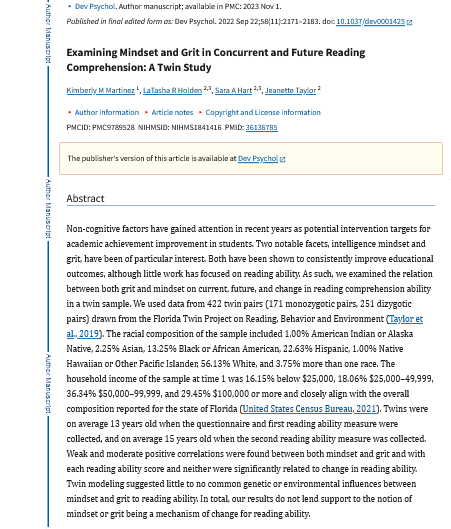
Non-cognitive factors have gained attention in recent years as potential intervention targets for academic achievement improvement in students. Two notable facets, intelligence mindset and grit, have been of particular interest. Both have been shown to consistently improve educational outcomes, although little work has focused on reading ability. As such, we examined the relation between both grit and mindset on current, future, and change in reading comprehension ability in a twin sample. We used data from 422 twin pairs (171 monozygotic pairs, 251 dizygotic pairs) drawn from the Florida Twin Project on Reading, Behavior and Environment (Taylor et al., 2019). The racial composition of the sample included 1.00% American Indian or Alaska Native, 2.25% Asian, 13.25% Black or African American, 22.63% Hispanic, 1.00% Native Hawaiian or Other Pacific Islander, 56.13% White, and 3.75% more than one race. The household income of the sample at time 1 was 16.15% below $25,000, 18.06% $25,000–49,999, 36.34% $50,000–99,999, and 29.45% $100,000 or more and closely align with the overall composition reported for the state of Florida (United States Census Bureau, 2021). Twins were on average 13 years old when the questionnaire and first reading ability measure were collected, and on average 15 years old when the second reading ability measure was collected. Weak and moderate positive correlations were found between both mindset and grit and with each reading ability score and neither were significantly related to change in reading ability. Twin modeling suggested little to no common genetic or environmental influences between mindset and grit to reading ability. In total, our results do not lend support to the notion of mindset or grit being a mechanism of change for reading ability.
— -
Grit and Growth Mindset: A Twin Study Says… Not So Fast
A Breakdown of Martinez, Holden, Hart & Taylor (2022)
Developmental Psychology
Link to paper: https://pmc.ncbi.nlm.nih.gov/articles/PMC9789528/
— -
The Big Question
We’ve all heard the hype: teach kids grit, and they’ll succeed. Tell them they have a growth mindset, and their grades will soar. Schools across the country have embraced these ideas. But do they actually work — specifically for reading?
A team of researchers led by Kimberly Martinez at Florida State University asked a deceptively simple question: Are grit and growth mindset actually related to how well kids read — now, or two years later?
Their answer? Not really.
And they had a secret weapon to find out: twins.
— -
Study at a Glance
| Element | Details |
| — — — — | — — — — |
| Sample | 422 twin pairs (171 identical, 251 fraternal) from Florida Twin Project on Reading |
| Age | ~13 years at Time 1, ~15 years at Time 2 |
| Demographics | 56% White, 23% Hispanic, 13% Black, 2% Asian; diverse income levels (29% above $100k, 16% below $25k) |
| Design | Longitudinal (2 years between waves) |
| Mindset Measure | Dweck’s Theory of Intelligence Scale (8 items) |
| Grit Measure | Short Grit Scale (Grit-S; 8 items) |
| Reading Measure | Gates-MacGinitie Reading Comprehension Test |
| Secret Sauce | Twin modeling to separate genetic from environmental influences |
— -
What They Found: Results in Tables
1. Are Grit and Growth Mindset Related to Each Other?
| Correlation | Strength |
| — — — — — — | — — — — -|
| Mindset–Grit | r = .19 (weak) |
Takeaway: Yes, they’re related — but barely. This suggests they’re tapping into different things. (Other studies have found correlations up to .41, so this is on the lower end.)
— -
2. Do Grit and Growth Mindset Predict Reading?
Concurrent Reading (same time point)
| Predictor | Correlation with Reading | Significant? |
| — — — — — | — — — — — — — — — — — — -| — — — — — — — |
| Mindset | r = .24 | ✓ Yes |
| Grit | r = .08 | ✓ Yes (but very weak) |
Future Reading (2 years later)
| Predictor | Correlation with Reading | Significant? |
| — — — — — | — — — — — — — — — — — — -| — — — — — — — |
| Mindset | r = .21 | ✓ Yes |
| Grit | r = .11 | ✓ Yes (but very weak) |
But here’s the kicker: When the researchers controlled for students’ previous reading scores (asking: does mindset or grit predict growth in reading?), neither was significant.
| Predictor | Predicts Change in Reading? |
| — — — — — | — — — — — — — — — — — — — -|
| Mindset | ✗ No |
| Grit | ✗ No |
The only thing that predicted how well a kid would read two years later was… how well they read two years earlier.
— -
3. What’s Actually Driving These (Weak) Relationships?
This is where the twin design shines. The researchers asked: Are the small correlations between mindset/grit and reading due to shared genes, shared environments (like home or school), or unique individual experiences?
Univariate Results (What influences each trait?)
| Trait | Genetic (A) | Shared Environment © | Nonshared Environment (E) |
| — — — -| — — — — — — | — — — — — — — — — — — | — — — — — — — — — — — — — |
| Mindset | 35% | 15% (not significant) | 50% |
| Grit | 42% | 3% (not significant) | 55% |
| Reading (Time 1) | 29% | 38% | 34% |
| Reading (Time 2) | 57% | 27% | 17% |
Interpretation:
-
Mindset and grit are about half genetic, half “nonshared environment” — things unique to each twin (different friends, different teachers, and also measurement error). Notably, no shared environment effects (family, school) for either.
-
Reading ability has substantial genetic and shared environmental influences, especially at the younger age.
Bivariate Results (What explains the overlap?)
When the researchers looked at whether mindset and grit share genetic or environmental influences with reading, the answer was mostly no. The tiny correlations that existed were driven by nonshared environmental factors — meaning individual-specific experiences, not genes or shared home/school environments.
In plain English: Whatever small link exists between mindset/grit and reading comes from unique, individual experiences — not from family background, not from genes, and not from things twins share.
— -
Summary Table: Key Findings
| Finding | Result |
| — — — — | — — — — |
| Mindset–grit correlation | r = .19 (weak) |
| Mindset–reading correlation | r = .21–.24 (weak to moderate) |
| Grit–reading correlation | r = .08–.11 (very weak) |
| Do mindset/grit predict change in reading? | No |
| Best predictor of future reading | Previous reading score |
| Genetic influence on mindset/grit | ~35–42% |
| Shared environment influence on mindset/grit | None (not significant) |
| Overlap between mindset/grit and reading | Mostly nonshared environment (individual-specific) |
— -
What This Means: Let’s Talk
The Hype vs. The Data
If you’ve been following education Twitter or reading popular press about “character education,” you might have gotten the impression that grit and growth mindset are silver bullets. This study suggests otherwise — at least for reading comprehension in middle schoolers.
Mindset had a weak-to-moderate correlation with reading. Grit barely registered. And neither predicted whether a student would improve in reading over two years.
This doesn’t mean mindset and grit are meaningless. But it does suggest they might not be the powerful levers for reading improvement that some have claimed.
— -
The Twin Design Tells Us Something Important
Why do some kids have growth mindsets and others don’t? This study found that mindset and grit are about 40% genetic and 50% “nonshared environment” — individual experiences.
Critically, there was no shared environmental influence. That means the things twins share — same parents, same school, same neighborhood — don’t seem to shape their mindset or grit. What matters are the different experiences they have.
This challenges the intuitive idea that “just teach growth mindset in schools” will uniformly shift kids’ beliefs. If shared environment doesn’t influence mindset, then a one-size-fits-all classroom intervention might not land the same way for everyone.
— -
The Reading Angle Matters
Most previous research on grit and mindset has used broad measures of achievement: GPA, standardized test composites, educational attainment. This study zoomed in on reading comprehension specifically.
Reading comprehension is a complex cognitive skill involving decoding, vocabulary, background knowledge, and executive function. It might be that grit and mindset matter more for things like turning in homework or persisting through a difficult semester — but less for the specific cognitive machinery of reading.
Or, as the authors note, kids might not see reading as a “long-term goal” worth being gritty about. The Grit Scale asks about finishing what you start and overcoming setbacks — but if reading isn’t framed as a goal, then the measure might not capture motivation specific to reading.
— -
What This Doesn’t Mean
It doesn’t mean growth mindset interventions are useless. Other studies (Yeager et al., 2019) have shown effects for certain subgroups (low-achieving students, specific school contexts). This study didn’t test an intervention — it tested whether naturally occurring mindset and grit correlate with reading.
It doesn’t mean grit is fake. Grit has shown predictive power for things like military retention, spelling bee performance, and college completion. But those are different outcomes than reading comprehension in early adolescence.
It doesn’t mean schools should stop caring about motivation. Motivation matters. But this study suggests that if you want to improve reading, focusing directly on reading instruction might be more effective than trying to change kids’ beliefs about intelligence or their “grittiness.”
— -
Peer Review: Behind the Scenes
This paper went through peer review at Developmental Psychology, one of the top journals in the field. Here’s what that process likely looked like.
— -
The Journal
Developmental Psychology is published by the American Psychological Association (APA). It’s a flagship journal with a rejection rate around 70–80%. Getting a paper here means it survived intense scrutiny.
— -
What Reviewers Probably Argued About
1. The small effects. The correlations between grit and reading were tiny (r = .08–.11). Reviewers likely pushed: “Are these effects meaningful, or are they just statistically significant due to sample size?” The authors don’t oversell — they’re upfront that the effects are small.
2. The grit measurement debate. There’s an ongoing controversy in the literature about whether grit should be measured as a single construct or as two subcomponents (perseverance and consistency of interest). Some argue that combining them is psychometrically problematic. The authors ran supplementary analyses with the subscales (in supplemental materials) and found no improvement — a good-faith effort to address this critique.
3. The age question. Grit was originally studied in adults. Reviewers might have asked: “Does grit even make sense for 13-year-olds? Do they have ‘long-term goals’ in the way Duckworth conceptualizes?” The authors acknowledge this limitation.
4. The non-significant finding for change. The fact that neither mindset nor grit predicted growth in reading (after controlling for baseline) is the paper’s most important finding. Reviewers would have scrutinized this analysis: Was it adequately powered? Were the controls appropriate? The authors ran sensitivity analyses and found consistent results.
— -
Strengths of the Paper
| Strength | Why It Matters |
| — — — — -| — — — — — — — -|
| Twin design | Allows separation of genetic, shared environment, and nonshared environment influences — something no correlational study can do |
| Longitudinal | Two-year follow-up allows examination of change, not just concurrent correlation |
| Large sample | 422 twin pairs = 844 individuals, well-powered for twin modeling |
| Transparent limitations | Authors openly discuss measurement issues, age appropriateness of constructs, and the grit debate |
| Subgroup sensitivity | Checked whether results held for lower-SES students (they did; see supplemental) |
— -
Limitations (From the Paper, Not Just Us)
| Limitation | Why It Matters |
| — — — — — -| — — — — — — — -|
| Self-report | Mindset and grit measured via questionnaires — subject to reference bias, social desirability |
| No Time 2 mindset/grit | Can’t tell if mindset or grit changed over the two years, and whether that change related to reading |
| Age range | 7–18 at Time 1 (yes, that wide). Results might differ for younger vs. older kids |
| Grit measurement debate | Field still divided on how to best measure grit; this paper used the Short Grit Scale, which has critics |
| Attrition | Some kids dropped out between waves; those who remained had slightly higher mindset scores (small effect, but worth noting) |
— -
So… What Should Educators Actually Do?
Based on this study, here’s the sober take:
1. Don’t expect mindset or grit interventions to magically improve reading comprehension. If the goal is reading growth, invest in reading instruction. Evidence-based reading interventions have much larger effect sizes than the correlations seen here.
2. If you do use mindset or grit interventions, target them carefully. Yeager et al. (2019) found that growth mindset interventions worked best for low-achieving students in schools with supportive peer norms. A blanket approach for everyone may not work.
3. Be skeptical of oversold claims. When you hear “grit predicts success” or “growth mindset changes everything,” ask: success at what? For whom? In which context? This study suggests reading comprehension might not be the outcome these constructs are best at predicting.
4. Consider the developmental fit. Grit was conceptualized for adults pursuing long-term career goals. A 13-year-old might not see reading as a “long-term goal.” If you’re working with younger students, constructs like motivation, self-efficacy, or engagement might be more relevant.
— -
The Bottom Line
Martinez and colleagues did something rare: they took two of the most hyped concepts in education — grit and growth mindset — and tested them rigorously in a large twin sample, with a two-year follow-up, specifically for reading comprehension.
The result: weak correlations, no prediction of reading growth, and little shared genetic or environmental overlap between these non-cognitive factors and reading ability.
This doesn’t mean mindset and grit are irrelevant. It means they might not be the reading intervention silver bullet they’ve been made out to be. For educators and researchers, the takeaway is clear: if you want to improve reading, focus on reading. If you want to build grit or growth mindset, do that too — but don’t assume one automatically leads to the other.
— -
References
- Aditomo, A. (2015). Students’ Response to Academic Setback: “Growth Mindset” as a Buffer Against Demotivation. International Journal of Educational Psychology, 4(2), 198–222.
- Alan, S., Boneva, T., & Ertac, S. (2016). Ever Failed, Try Again, Succeed Better: Results from a Randomized Educational Intervention on Grit. HCEO Working Paper. University of Chicago.
- Andersen, S. C., & Nielsen, H. S. (2016). Reading intervention with a growth mindset approach improves children’s skills. PNAS, 113(43), 12111–12113.
- Aronson, J., Fried, C. B., & Good, C. (2002). Reducing the Effect of Stereotype Threat on African American College Students by Shaping Theories of Intelligence. Journal of Experimental Social Psychology, 38(2), 113–125.
- Bashant, J. (2014). Developing Grit in Our Students: Why Grit Is Such a Desirable Trait, and Practical Strategies for Teachers and Schools. Journal for Leadership and Instruction, 13(2), 14–17.
- Bates, T. C., Neale, M. C., & Maes, H. H. (2019). umx: A library for Structural Equation and Twin Modelling in R. Twin Research and Human Genetics, 22, 27–41.
- Blackwell, L. S., Trzesniewski, K. H., & Dweck, C. S. (2007). Implicit Theories of Intelligence Predict Achievement Across an Adolescent Transition: A Longitudinal Study and an Intervention. Child Development, 78(1), 246–263.
- Borghans, L., Duckworth, A. L., Heckman, J. J., & Ter Weel, B. (2008). The economics and psychology of personality traits. Journal of Human Resources, 43(4), 972–1059.
- Bratko, D., Chamorro-Premuzic, T., & Saks, Z. (2006). Personality and school performance: Incremental validity of self-and peer-ratings over intelligence. Personality and Individual Differences, 41(1), 131–142.
- Browne, Y. (2017). Beyond IQ: The Role of Grit, Mindset, and Emotional Intelligence in Academic Achievement (Master’s thesis). Dublin Business School.
- Burt, S. A., Plaisance, K. S., & Hambrick, D. Z. (2019). Understanding “What Could Be”: a call for ‘experimental behavioral genetics’. Behavior Genetics, 49(2), 235–243.
- Chamorro-Premuzic, T., & Furnham, A. (2003). Personality Predicts Academic Performance: Evidence from two longitudinal university samples. Journal of Research in Personality, 37(4), 319–338.
- Claro, S., Paunesku, D., & Dweck, C. S. (2016). Growth mindset tempers the effects of poverty on academic achievement. PNAS, 113(31), 8664–8668.
- Cohen, G. L., Garcia, J., & Goyer, J. P. (2017). Turning point: Targeted, tailored, and timely psychological intervention. In A. J. Elliot, C. S. Dweck, & D. S. Yeager (Eds.), Handbook of competence and motivation: Theory and application (pp. 657–686). The Guilford Press.
- Cole, K. N., & Dale, P. S. (1986). Direct language instruction and interactive language instruction with language delayed preschool children: A comparison study. Journal of Speech, Language and Hearing Research, 29(2), 206–217.
- Connor, C. M., Morrison, F. J., Schatschneider, C., Toste, J., Lundblom, E., Crowe, E. C., & Fishman, B. (2011b). Effective classroom instruction: implications of child characteristics by reading instruction interactions on first graders’ word reading achievement. Journal of Research on Educational Effectiveness, 4(3), 173–207.
- Credé, M. (2018). What shall we do about grit? A critical review of what we know and what we don’t know. Educational Researcher, 47(9), 606–611.
- Credé, M. (2019). Total grit scale score does not represent perseverance. Proceedings of the National Academy of Sciences, 116(10), 3941–3941.
- Credé, M., Tynan, M. C., & Harms, P. D. (2017). Much ado about grit: A meta-analytic synthesis of the grit literature. Journal of Personality and Social Psychology, 113(3), 492–511.
- Daneman, M., & Carpenter, P. A. (1980). Individual differences in working memory and reading. Journal of Verbal Learning and Verbal Behavior, 19(4), 450–466.
- De Castella, K., & Byrne, D. (2015). My intelligence may be more malleable than yours: the revised implicit theories of intelligence (self-theory) scale is a better predictor of achievement, motivation, and student disengagement. European Journal of Psychology and Education, 30(3), 245–267.
- DeWalt, D. A., Berkman, N. D., Sheridan, S., Lohr, K. N., & Pignone, M. P. (2004). Literacy and health outcomes: a systematic review of the literature. Journal of General Internal Medicine, 19, 1228–1239.
- Duckworth, A. L., & Eskreis-Winkler, L. (2013). True Grit. The Observer, 26, 1–3.
- Duckworth, A. L., & Gross, J. J. (2014). Self-Control and Grit: Related but Separable Determinants of Success. Current Directions in Psychological Science, 23(5), 319–325.
- Duckworth, A. L., Peterson, C., Matthews, M. D., & Kelly, D. R. (2007). Grit: Perseverance and Passion for Long-Term Goals. Journal of Personality and Social Psychology, 92(6), 1087–1101.
- Duckworth, A. L., & Quinn, P. D. (2009). Development and Validation of the Short Grit Scale (Grit-S). Journal of Personality Assessment, 91(2), 166–174.
- Duckworth, A. L., Quinn, P. D., & Tsukayama, E. (2021). Revisiting the factor structure of grit: A commentary on Duckworth and Quinn (2009). Journal of Personality Assessment, 103(5), 573–575.
- Duckworth, A. L., & Seligman, M. E. P. (2017). The Science and Practice of Self-Control. Perspectives on Psychological Science, 12(5), 715–718.
- Dweck, C. S. (1999). Self-theories: Their role in motivation, personality, and development. Psychology Press.
- Dweck, C. S. (2007). Mindset: The New Psychology of Success. Random House Publishing Group.
- Dweck, C. S. (2008). Mindsets and Math/Science Achievement. Carnegie Corporation of New York, Institute for Advanced Study, Commission on Mathematics and Science Education.
- Dweck, C. S. (2010). Even geniuses work hard. Educational Leadership, 68(1), 16.
- Dynarski, S. M. (2017). For better learning in college lectures, lay down the laptop and pick up a pen. The Brookings Institution.
- Eskreis-Winkler, L., Shulman, E. P., Beal, S., & Duckworth, A. (2014). The grit effect: predicting retention in the military, the workplace, school and marriage. Frontiers in Psychology, 5, 36.
- Fergusson, D. M., & Lynskey, M. T. (1997). Early Reading Difficulties and Later Conduct Problems. Journal of Child Psychology and Psychiatry, 38(8), 899–907.
- Foliano, F., Rolfe, H., Buzzeo, J., Runge, J., & Wilkinson, D. (2019). Changing mindsets: Effectiveness trial. National Institute of Economic and Social Research.
- Francis, D. J., Shaywitz, S. E., Stuebing, K. K., Shaywitz, B. A., & Fletcher, J. M. (1996). Developmental lag versus deficit models of reading disability: A longitudinal, individual growth curves analysis. Journal of Educational Psychology, 88(1), 3–17.
- Gardner, R. C. (2000). Correlation, causation, motivation, and second language acquisition. Canadian Psychology/Psychologie Canadienne, 41(1), 10–24.
- Good, C., Aronson, J., & Inzlicht, M. (2003). Improving Adolescents’ Standardized Test Performance: an intervention to reduce the effects of stereotype threat. Applied Developmental Psychology, 24, 645–662.
- Hart, S. A. (2016). Precision education initiative: Moving toward personalized education. Mind, Brain, and Education, 10(4), 209–211.
- Hernandez, D. J. (2011, April). Double jeopardy: How third-grade reading skills and poverty influence high school graduation. Foundation for Child Development.
- Honicke, T., & Broadbent, J. (2016). The influence of academic self-efficacy on academic performance: A systematic review. Educational Research Review, 17, 63–84.
- Ivcevic, Z., & Brackett, M. (2014). Predicting school success: Comparing Conscientiousness, Grit, and Emotion Regulation Ability. Journal of Research in Personality, 52, 29–36.
- Jachimowicz, J. M., Wihler, A., Bailey, E. R., & Galinsky, A. D. (2018). Why grit requires perseverance and passion to positively predict performance. Proceedings of the National Academy of Sciences, 115(40), 9980–9985.
- Juel, C. (1988). Learning to read and write: A longitudinal study of 54 children from first through fourth grades. Journal of Educational Psychology, 80(4), 437–447.
- Kanfer, R., & Ackerman, P. L. (1989). Motivation and cognitive abilities: An integrative/aptitude-treatment interaction approach to skill acquisition. Journal of Applied Psychology, 74(4), 657–690.
- Kench, D., Hazelhurst, S., & Otulaja, F. (2016). Grit and Growth Mindset Among High School Students in a Computer Programming Project: A Mixed Methods Study. In S. Gruner (Ed.), ICT Education. SACLA 2016. Communications in Computer and Information Science (Vol. 642). Springer.
- Laidra, K., Pullman, H., & Allik, J. (2007). Personality and intelligence as predictors of academic achievement: A cross-sectional study from elementary to secondary school. Personality and Individual Differences, 42(3), 441–451.
- Lee, Y. S., & Jonson-Reid, M. (2016). The Role of Self-Efficacy in Reading Achievement of Young Children in Urban Schools. Child and Adolescent Social Work Journal, 33, 79–89.
- Lykken, D. T., Bouchard, T. J., McGue, M., & Tellegen, A. (1990). The Minnesota twin registry: some initial findings. Acta Geneticae Medicate at Gemellologiae: Twin Research, 39, 35–70.
- MacCann, C., & Roberts, R. D. (2010). Do time management, grit, and self-control relate to academic achievement independently of conscientiousness? In R. E. Hicks (Ed.), Personality and individual differences: Current directions (pp. 79–90). Australian Academic Press.
- MacGinitie, W., & MacGinitie, R. (2006). Gates-MacGinitie Reading Tests (4th ed.). Houghton Mifflin.
- Malanchini, M., Engelhardt, L. E., Grotzinger, A. D., Harden, K. P., & Tucker-Drob, E. M. (2019). “Same but different”: Associations between multiple aspects of self-regulation, cognition, and academic abilities. Journal of Personality and Social Psychology, 117(6), 1164.
- McCain, B. (2017). Effects of Teacher Grit on Student Grit and Reading Achievement: A Mixed-Methods Study. Indiana University of Pennsylvania.
- McCutchen, K. L., Jones, M. H., Carbonneau, K. J., & Mueller, C. E. (2016). Mindset and standardized testing over time. Learning and Individual Differences, 45, 208–213.
- McGue, M., & Bouchard, T. J. (1984). Adjustment of twin data for the effects of age and sex. Behavior Genetics, 14(4), 325–343.
- Miles, S. B., & Stipek, D. (2006). Contemporaneous and longitudinal associations between social behavior and literacy achievement in a sample of low-income elementary school children. Child Development, 77(1), 103–117.
- Moreau, D., Macnamara, B. N., & Hambrick, D. Z. (2019). Overstating the Role of Environmental Factors in Success: A Cautionary Note. Current Directions in Psychological Science, 28(1), 28–33.
- Morell, M., Yang, J. S., Gladstone, J. R., Faust, L. T., Ponnock, A. R., Lim, H. J., & Wigfield, A. (2021). Grit: The long and short of it. Journal of Educational Psychology.
- Muenks, K., Wigfield, A., Yang, J. S., & O’Neal, C. R. (2017). How True Is Grit? Assessing Its Relations to High School and College Students’ Personality Characteristics, Self-Regulation, Engagement, and Achievement. Journal of Educational Psychology, 109(5), 599–620.
- Neiderhiser, J. M., Reiss, D., & Hetherington, E. M. (2007). The Nonshared Environment in Adolescent Development (NEAD) Project: A longitudinal family study of twins and siblings from adolescence to young adulthood. Twin Research and Human Genetics, 10(1), 74–83.
- Noftle, E. E., & Robins, R. W. (2007). Personality predictors of academic outcomes: Big five correlates of GPA and SAT scores. Journal of Personality and Social Psychology, 93(1), 116–130.
- Norris, C. U., Shero, J. S. A., Haughbrook, R., Holden, L. R., van Dijk, W., Al Otaiba, S., & Hart, S. (2020). Socioeconomic status and response to a reading intervention: A quantile regression approach.
- Paunesku, D., Walton, G. M., Romero, C., Smith, E. N., Yeager, D. S., & Dweck, C. S. (2015). Mind-set interventions are a scalable treatment for academic underachievement. Psychological Science, 26(6), 784–793.
- Perkins-Gough, D. (2013). The Significance of Grit: A Conversation with Angela Lee Duckworth. Educational Leadership, 71(1), 14–20.
- Poropat, A. E. (2009). A meta-analysis of the five-factor model of personality and academic performance. Psychological Bulletin, 135(2), 322–338.
- Preckel, F., Holling, H., & Vock, M. (2006). Academic underachievement: Relationship with cognitive motivation, achievement motivation, and conscientiousness. Psychology in the Schools, 43, 401–411.
- Rattan, S., Savani, K., Chugh, D., & Dweck, C. S. (2015). Leveraging Mindsets to Promote Academic Achievement: Policy Recommendations. Perspectives on Psychological Science, 10(6), 721–726.
- Richardson, M., Abraham, C., & Bond, R. (2012). Psychological correlates of university students’ academic performance: A systematic review and meta-analysis. Psychological Bulletin, 138(2), 353–387.
- Rimfeld, K., Kovas, Y., Dale, P. S., & Plomin, R. (2016). True Grit and Genetics: Predicting Academic Achievement from Personality. Journal of Personality and Social Psychology, 111(5), 780–789.
- Scarborough, H. S. (2001). Connecting early language and literacy to later reading (dis)abilities: evidence, theory, and practice. In S. B. Neuman & D. K. Dickinson (Eds.), Handbook of Early Literature Research (pp. 97–110). Guilford Press.
- Schmidt, F. T. C., Nagy, G., Fleckenstein, J., Moller, J., & Retelsdorf, J. (2018). Same Same, but Different? Relations Between Facets of Conscientiousness and Grit. European Journal of Personality, 32(6), 705–720.
- Shaywitz, S. E., Fletcher, J. M., Holahan, J. M., Schneider, A. E., Marchione, K. E., Stuebing, K. K., Francis, D. J., Pugh, K. R., & Shaywitz, B. A. (1999). Persistence of dyslexia: The Connecticut longitudinal study at adolescence. Pediatrics, 104(6), 1351–1359.
- Sisk, V., Burgoyne, A., Sun, J., Butler, J., & Macnamara, B. N. (2018). To What Extent and Under Which Circumstances Are Growth Mindsets Important to Academic Achievement? Two Meta-analyses. Psychological Science, 29(4), 549–571.
- Slavin, R. E. (1986). Best-evidence synthesis: An alternative to meta-analytic and traditional reviews. Educational Researcher, 15(9), 5–11.
- Speece, D. L. (1990). Aptitude-treatment interactions bad rap or bad idea? The Journal of Special Education, 24(2), 139–149.
- Strayhorn, T. L. (2014). What Role Does Grit Play in the Academic Success of Black Male Collegians at Predominantly White Institutions? Journal of African American Studies, 18(1), 1–10.
- Taylor, J. E., Martinez, K., & Hart, S. A. (2019). The Florida State Twin Registry. Twin Research and Human Genetics, 22(6), 728–730.
- Torgesen, J. K., & Burgess, S. R. (1998). Consistency of reading related phonological processes throughout early childhood: Evidence from longitudinal, correlational, and instructional studies. In J. Metsala & L. Ehri (Eds.), Word recognition in beginning reading (pp. 161–188). Erlbaum.
- Tucker-Drob, E. M., Briley, D. A., Engelhardt, L. E., Mann, F. D., & Harden, K. P. (2016). Genetically-mediated associations between measures of childhood character and academic achievement. Journal of Personality and Social Psychology, 111(5), 790–815.
- Tucker-Drob, E. M., & Harden, K. P. (2017). A behavioral genetic perspective on noncognitive factors and academic achievement. In S. Bouregy, E. L. Grigorenko, S. R. Latham, & M. Tan (Eds.), Genetics, Ethics and Education (pp. 134–158).
- United States Census Bureau. (2021). QuickFacts: Florida.
- Wanzek, J., Otaiba, S. A., Petscher, Y., Lemons, C. J., Gesel, S. A., Fluhler, S., & Rivas, B. K. (2021). Comparing the effects of reading intervention versus reading and mindset intervention for upper elementary students with reading difficulties. Journal of Learning Disabilities, 54(3), 203–220.
- West, M. R., Kraft, M. A., Finn, A. S., Martin, R. E., Duckworth, A. L., Gabrieli, C. F. O., & Gabrieli, J. D. E. (2016). Promise and paradox: measuring students’ non-cognitive skills and the impact of schooling. Education Evaluation and Policy Analysis, 38(1), 148–170.
- Wigfield, A., & Eccles, J. S. (2000). Expectancy–value theory of achievement motivation. Contemporary Educational Psychology, 25, 68–81.
- Wigfield, A., & Guthrie, J. T. (1997). Relations of children’s motivation for reading to the amount and breadth or their reading. Journal of Educational Psychology, 89(3), 420–432.
- Wilson, C. (2016). A mixed-method case study of growth mindset, grit, and reading scores in a midwest public elementary school (Order №10240018). ProQuest Dissertations & Theses Global.
- Yeager, D. S., Hanselman, P., Walton, G. M., Murray, J. S., Crosnoe, R., Muller, C., & Paunesku, D. (2019). A national experiment reveals where a growth mindset improves achievement. Nature, 573(7774), 364–369.
- Yeager, D. S., & Walton, G. M. (2011). Social-psychological interventions in education: They’re not magic. Review of Educational Research, 81(2), 267–301.
메타데이터
- post_id
- 83d8fa1c9514
- slug
- peer-review-examining-mindset-and-grit-in-concurrent-and-future-reading-comprehension-a-twin-83d8fa1c9514
- url
- https://medium.com/@jolalf/peer-review-examining-mindset-and-grit-in-concurrent-and-future-reading-comprehension-a-twin-83d8fa1c9514
- canonical_url
- https://medium.com/@jolalf/peer-review-examining-mindset-and-grit-in-concurrent-and-future-reading-comprehension-a-twin-83d8fa1c9514
- author_url
- https://medium.com/@jolalf
- status
- ok
- fetched_at
- 2026-06-11 10:13:20