Simple Systems Create Consistent Results
Why readable systems outperform overloaded ones
Simple Systems Create Consistent Results
Why readable systems outperform overloaded ones
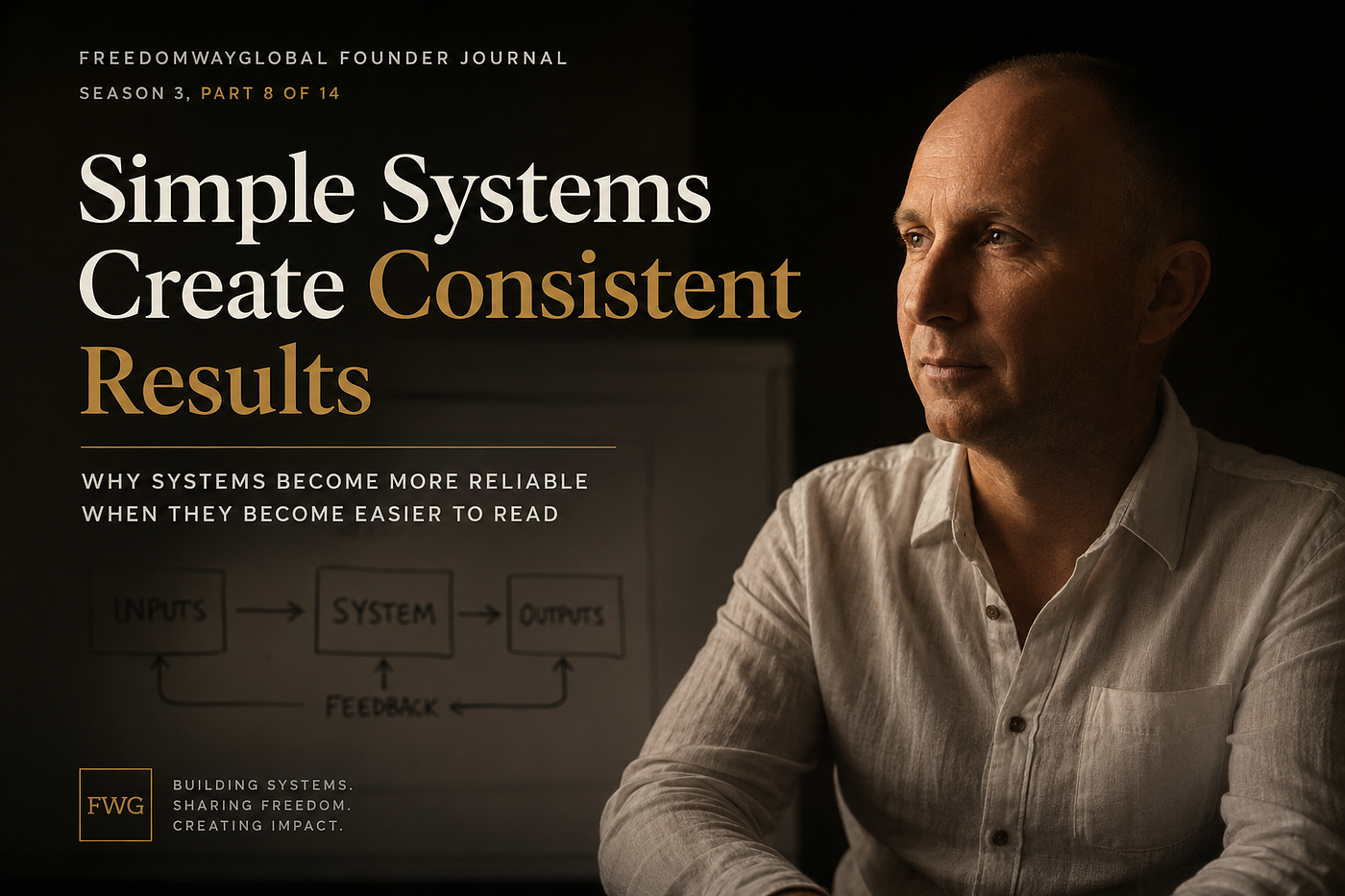
The goal is not to build a bigger system. The goal is to build one you can still understand under pressure.
Part 7 ended with a question worth sitting with.
If sustained activity can mask instability — if movement can substitute for signal — then what does a stable system actually look like?
Not a system that does more. Not a system built to handle every edge case before it arrives. Not a system that grows in complexity each time something goes wrong.
A system that is easy to read.
That distinction matters more than most people expect.
The assumption worth examining
Most people who build systems assume that strength comes from elaboration.
More rules. More contingencies. More layers of process that account for more variables. The thinking goes: a complex problem requires a complex solution. And if the system is not working, the answer must be to add more to it.
This assumption is understandable. It feels responsible. It looks like thoroughness.
But it produces a specific kind of failure — one that is difficult to diagnose precisely because the system is too dense to read clearly.
Complexity grows faster than understanding. And when a system becomes unreadable, it becomes unimprovable.
What readability means in a system
Readability is not simplicity for its own sake. It is not minimalism as an aesthetic preference. It is not doing less because less feels lighter.
Readability in a system means this: when something goes wrong, you can locate the problem. When something works, you can understand why. When you want to improve it, you know where to look.
A readable system is one where cause and effect remain visible.
In an unreadable system, they disappear into the complexity. You see output — or the absence of it — but the connection to specific inputs becomes unclear. You start guessing. You adjust things without certainty. You add more structure hoping something will shift.
That is not a system operating under control. That is a system operating under noise.
Why overloaded systems collapse gradually
The failure mode of complex systems is rarely sudden.
It is slow. It is incremental. Each addition to the system feels justified at the time — a new step, a new filter, a new dependency. Each one addresses something real.
But the total load accumulates.
Cognitive load increases. The cost of interpreting the system rises. Decision fatigue sets in not from making hard decisions, but from making too many small ones inside a system that requires constant re-orientation.
Eventually the person running the system spends more energy managing the system than executing through it.
The system is still technically functional. The outputs still arrive. But the friction has grown so embedded that the system no longer compounds — it drains.
This is the architecture of unsustainable execution. Not a dramatic collapse. A slow depletion, disguised as normal operation.
Fewer moving parts, clearer signal
The relationship between moving parts and signal visibility is structural.
Every additional element in a system introduces interpretation cost. Not always much. But every step that requires a decision, every dependency that requires monitoring, every handoff that requires verification — each one adds a small tax on clarity.
When those taxes accumulate, the signal-to-noise ratio drops.
The same output that would have been easy to evaluate in a simpler system becomes harder to assess. You cannot tell whether a result is good because of the system or despite it. You cannot tell whether a failure is structural or incidental.
You lose the ability to trust the system — not because it stopped working, but because you can no longer read it clearly enough to know.
Reducing unnecessary movement is not about running a lighter operation. It is about preserving the clarity that makes evaluation possible.
A calm system is easier to trust because it is easier to understand.
Repeatability requires interpretation cost to stay low
Consistency is often described as a discipline problem.
The framing is motivational: show up, maintain the standard, do it again. And there is something real in that. Execution requires intention.
But there is an architectural dimension that is rarely addressed.
Consistency becomes easier when interpretation cost becomes lower.
When a system requires significant cognitive effort each time it runs — when the person executing it must re-orient, re-interpret, re-decide before acting — the barrier to repetition is high. Not because the work is harder. Because the mental cost of entry is higher than it should be.
Simple systems are repeated more easily because they are entered more easily.
The friction is lower. The orientation cost is lower. The person executing the system can move into it quickly and move through it cleanly.
Over time, this compounds. A system that is easy to enter runs more consistently. A system that runs more consistently produces cleaner data. Cleaner data makes the system easier to improve.
Simplicity does not just feel better. It produces structurally better outcomes over time.
When complexity hides weak structure
There is a specific pattern worth naming directly.
Sometimes complexity is not the result of growth. It is the result of avoidance.
A system that lacks a clear core — a system where the fundamental logic is uncertain or unstable — will often compensate through elaboration. More steps are added not because the problem requires them, but because they provide a sense of coverage. The appearance of thoroughness masks the absence of structural clarity.
This is a difficult pattern to see from inside a system you built.
It feels like completeness. It looks like responsibility. But the elaboration is doing the work of concealment, not the work of clarity.
Stripping a system back — reducing it to its essential logic, removing the steps that exist only to manage anxiety — is how the actual structure becomes visible. And sometimes what becomes visible is that the core was always simpler than the complexity suggested.
Complexity often hides weak structure. Simplicity exposes it.
That exposure is not a problem. It is information.
Readable systems and structural trust
There is a form of trust that only readable systems produce.
Not trust based on hope — the belief that the system will probably work, based on past experience and positive thinking. That trust is fragile. It depends on things continuing to go well.
Structural trust is different. It is trust based on understanding. You trust the system because you can see how it works. You can follow the logic. You can predict, within a reasonable range, what will happen when you run it.
This kind of trust changes how you operate.
You are less likely to override the system when results are slower than expected, because you understand why the pace is what it is. You are less likely to abandon the system under pressure, because you can read it clearly enough to distinguish a structural problem from a temporary variance.
A system you cannot read is a system you cannot trust — not fully. Because trust without understanding is just optimism with a process attached.
Readability is leverage.
AI works better inside readable systems
This point belongs in any honest discussion of systems in 2026.
AI tools are increasingly present inside operating systems — for writing, for research, for filtering, for generating first drafts. And the promise is real. AI can accelerate certain types of work significantly.
But amplification is not direction.
AI amplifies what is already present in a system. If the system is clear — if the inputs are well-defined, if the outputs are measurable, if the logic is readable — AI can increase the speed and consistency of execution substantially.
If the system is overloaded or unclear — if the decision logic is embedded in personal interpretation rather than visible structure — AI introduces more noise, not less. It produces more output into a system that was already struggling to filter signal from volume.
The question is not whether to use AI. The question is whether your system is readable enough to use it well.
A readable system and an amplification tool is a strong combination. An unreadable system and an amplification tool is a faster way to generate complexity you cannot manage.
Compounding clarity
There is a compounding dynamic to simplicity that is easy to underestimate.
A readable system is easier to improve. Easier to improve means improvements happen more frequently and with higher precision. Higher precision improvements mean the system becomes more effective over time — not through expansion, but through refinement.
Refinement compounds.
A system that has been refined steadily over twelve months is often structurally different from the version that existed at the beginning — not because more was added, but because what was unnecessary was removed, and what remained became cleaner and more reliable.
This is what structural sustainability looks like.
Not a system that scales by growing larger. A system that scales by becoming more efficient at producing signal, with less unnecessary movement, at a pace that does not deplete the person running it.
What simple actually means
Simple does not mean incomplete.
It does not mean underpowered. It does not mean naive or reductive. It does not mean ignoring complexity that is real and must be addressed.
Simple means: no unnecessary complexity. No elaboration that exists to manage anxiety rather than serve function. No movement that does not contribute to output. No steps that exist only because removing them feels like a risk.
Simple means the system contains what it needs, in the most readable form possible.
That is a higher standard than complex. Complexity is easy to produce. Adding steps, dependencies, contingencies — that requires no discipline. It is the default response to uncertainty.
Simplicity requires a clear understanding of what the system is actually for. What it must do. What it can leave out. Where the essential logic lives.
That clarity is harder to reach than complexity. But once reached, it is more stable.
Simple systems are not weaker systems. They are systems where the signal is easier to see.
What this prepares for
If Part 7 showed that too much activity can obscure the stability of a system — and if Part 8 has shown that simplicity is what makes systems readable, trustworthy, and sustainable — then the next question follows naturally.
How do you maintain simplicity under pressure?
Because pressure tends to push in one direction: more. More coverage, more contingency, more elaboration. Systems under pressure tend to accumulate. And accumulation, unchecked, produces the overload that makes systems unreadable.
The answer is not willpower. It is not a commitment to stay minimal and hope that holds.
The answer is structure.
Specifically: constraints.
Not constraints as limitations. Not constraints as the absence of something. But constraints as the structural layer that keeps a system within readable bounds — that protects its simplicity without requiring constant active intervention.
A system without constraints will drift toward complexity. A system with well-placed constraints holds its shape.
Part 9 will examine why constraints are not the opposite of freedom inside a system.
They are what makes freedom inside a system sustainable.
FreedomWayGlobal Founder Journal — Season 3 Part 8 of 14 — Simple Systems Create Consistent Results
—
If this resonates:
Start here: → View the full Season 3 hub
Previous: → *When Activity Becomes the Problem*
Next: → *Constraints Create Stability*
This series is not about more output.
It is about building systems that stay readable under pressure.
Calm systems don’t chase growth. They make growth inevitable.
— FreedomWayGlobal

↓ Continue the system
If this resonated, don’t stop here.
This is part of a bigger system, not just an idea.
→ Start here: build your first calm system ***https://start.freedomwayglobal.com***
Start simple. Build calm. Let the system carry the work.
— FreedomWayGlobal
메타데이터
- post_id
- 83e4f44c4b8a
- slug
- simple-systems-create-consistent-results-83e4f44c4b8a
- url
- https://medium.com/freedomwayglobal/simple-systems-create-consistent-results-83e4f44c4b8a
- canonical_url
- https://medium.com/freedomwayglobal/simple-systems-create-consistent-results-83e4f44c4b8a
- author_url
- https://medium.com/@freedomwayglobal1978
- status
- ok
- fetched_at
- 2026-06-13 07:35:29