Why Your USDT Is Stuck on TRON: The Hidden Fee Problem Millions of Users Face in 2026
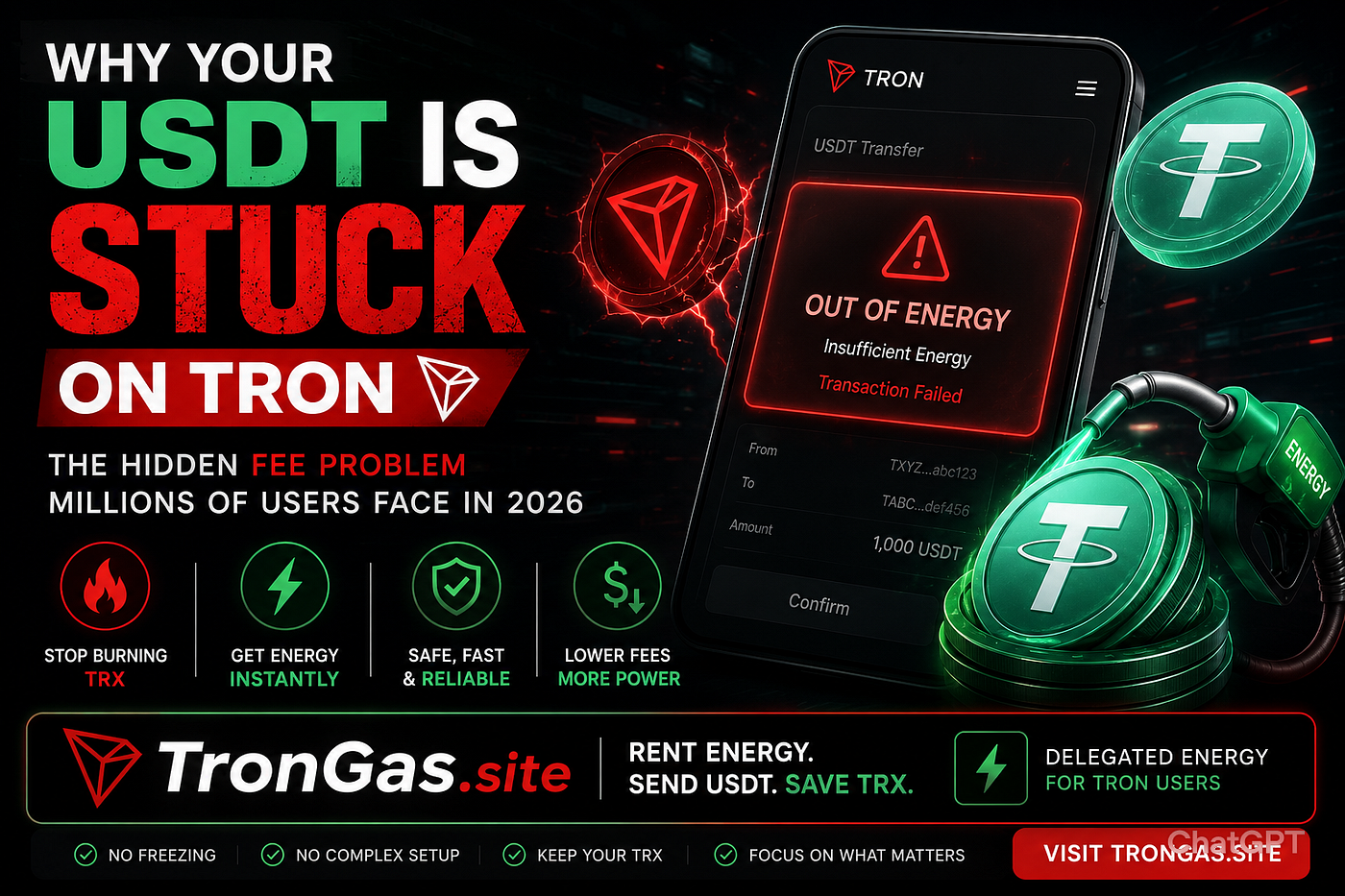
If you’ve ever tried to send USDT on the TRON blockchain and received an error message saying “Insufficient Energy”, “Out of Energy”, or…
Why Your USDT Is Stuck on TRON: The Hidden Fee Problem Millions of Users Face in 2026
If you’ve ever tried to send USDT on the TRON blockchain and received an error message saying “Insufficient Energy”, “Out of Energy”, or noticed that TRX was suddenly burned from your wallet, you’re not alone.
Every day, thousands of users face the same frustrating problem:
✅ They have USDT. ✅ They know the recipient address. ❌ But they can’t send their funds.
For many newcomers, this makes absolutely no sense.
Why should you need TRX to send USDT?
Why does a stablecoin transfer suddenly require network resources?
And why do some users pay almost nothing while others burn large amounts of TRX?
The answer lies in one of the most misunderstood parts of the TRON ecosystem: Energy. **TronGas.site**
The USDT Transfer Problem Nobo
dy Talks About
TRON became one of the largest blockchain networks for USDT transactions because of its speed and low fees.
Today, billions of dollars worth of USDT move through the TRON network every day. Users choose TRON because transfers are fast, exchanges support it everywhere, and transaction costs are usually lower than Ethereum.
However, there is one issue.
USDT on TRON is a TRC20 token, which means every transfer interacts with a smart contract. Smart contracts consume Energy. If your wallet doesn’t have enough Energy available, the network burns TRX instead.
This creates a confusing situation:
You may have $10,000 in USDT.
But if you don’t have enough Energy or TRX, you might not be able to move a single dollar.
Why Are TRON Users Angry About Energy Costs?
The biggest complaint across crypto communities is simple:
“Why do I need TRX just to move my USDT?”
Many users keep only USDT in their wallets.
They don’t trade TRX.
They don’t stake TRX.
They don’t want to learn complicated staking mechanics.
They simply want to send stablecoins.
Yet every transfer requires network resources.
For active traders, arbitrage users, OTC desks, payment processors, and DeFi participants, constantly managing Energy becomes a serious inconvenience.
Some users freeze TRX to obtain Energy, but this requires locking capital.
Others simply burn TRX every time they make a transaction.
Both options create unnecessary friction.
What Is TRON Energy?
Think of Energy as the fuel that powers smart contract execution on TRON.
Whenever you:
- Send USDT (TRC20)
- Swap tokens
- Interact with DeFi protocols
- Use staking platforms
- Execute smart contract functions
the network consumes Energy.
Without sufficient Energy, TRON automatically charges your wallet by burning TRX.
This is similar to gas fees on Ethereum, but the mechanism is different.
Many users discover this only after their first failed transaction.
The Real Cost of Burning TRX
Most people don’t calculate how much they spend over time.
Let’s look at a simple example.
Imagine you send USDT:
- 5 times per week
- 20 times per month
- 240 times per year
Even small transaction costs accumulate quickly.
For traders, businesses, and crypto professionals processing dozens of transactions daily, the numbers become even more significant.
The result?
Money that could remain in your portfolio gets burned permanently as network fees.
Why More Users Are Renting Energy Instead
A growing number of TRON users have started using Energy rental services rather than freezing large amounts of TRX.
The idea is simple:
Instead of locking capital or burning TRX repeatedly, users rent Energy when they need it.
This provides enough resources to perform transactions while keeping their TRX balance untouched.
One platform focused on this problem is:
The service provides delegated TRON Energy for users who need to send USDT or interact with TRON applications without managing staking requirements. According to the platform, Energy is delegated directly to the user’s wallet and can be used for TRC20 transfers and smart contract interactions.
How TRON Energy Rental Works
The process is straightforward:
Step 1: Connect Your Wallet
Compatible wallets include:
- TronLink
- Trust Wallet
- TokenPocket
Step 2: Purchase Energy
Instead of freezing TRX, users obtain delegated Energy.
Step 3: Receive Energy
The Energy is delegated to the wallet and becomes available for transactions.
Step 4: Send USDT
Transfers can be completed without burning additional TRX for Energy consumption.
Why This Matters for USDT Holders
The majority of TRON activity today revolves around stablecoins.
Users are:
- Sending USDT to exchanges
- Receiving payroll payments
- Making OTC settlements
- Trading meme coins
- Participating in DeFi
- Moving funds between wallets
Most of these users don’t want to become experts in TRON staking mechanics.
They simply want transactions to work.
That’s why Energy rental has become one of the fastest-growing sectors within the TRON ecosystem.
Common TRON Errors and Their Meaning
“Out of Energy”
Your wallet lacks sufficient Energy to execute the smart contract.
“Insufficient Resources”
You don’t have enough Energy or Bandwidth available.
“Burning TRX”
The network is charging transaction fees directly from your TRX balance.
“Transaction Failed”
Often caused by resource shortages rather than wallet problems.
Understanding these messages can save users considerable time and frustration.
The Future of USDT Transfers on TRON
As TRON adoption continues to grow, Energy management will remain a critical part of the ecosystem.
Many experts believe users will increasingly rely on automated Energy marketplaces and delegation services instead of manually freezing TRX.
The trend is already visible.
Users want:
- Faster transactions
- Lower costs
- Better user experience
- No capital lockups
- Simpler wallet management
Services focused on Energy delegation are emerging specifically to solve these issues.
Final Thoughts
The biggest misconception in crypto is that having USDT automatically means you can send USDT.
On TRON, that’s not always true.
Without Energy, your transaction may fail or burn TRX unexpectedly.
Understanding how Energy works can save money, reduce frustration, and make your TRON experience significantly smoother.
If you’re tired of failed USDT transfers, unexpected TRX burns, or managing staking requirements, it’s worth exploring solutions like **TronGas.site**, which focuses specifically on providing Energy for TRON transactions.
Keywords: TRON Energy, TRON Gas, USDT TRON Transfer, TRC20 Fees, TRON Energy Rental, TRON USDT Transaction Failed, Insufficient Energy TRON, Cheap TRON Gas, TRX Burn, TRON Network Fees, USDT Transfer Error, TRON Wallet Guide 2026.
메타데이터
- post_id
- 83ebfecccef5
- slug
- why-your-usdt-is-stuck-on-tron-the-hidden-fee-problem-millions-of-users-face-in-2026-83ebfecccef5
- url
- https://medium.com/@boyko34we/why-your-usdt-is-stuck-on-tron-the-hidden-fee-problem-millions-of-users-face-in-2026-83ebfecccef5
- canonical_url
- https://medium.com/@boyko34we/why-your-usdt-is-stuck-on-tron-the-hidden-fee-problem-millions-of-users-face-in-2026-83ebfecccef5
- author_url
- https://medium.com/@boyko34we
- status
- ok
- fetched_at
- 2026-06-16 19:09:56



