Words We Celebrate on July 4th — that are NOT in the Declaration of Independence
There’s an intriguing irony to the events leading up to July 4th, 1776, the day that we celebrate each year as the origination of our…
Words We Celebrate on July 4th — that are NOT in the Declaration of Independence
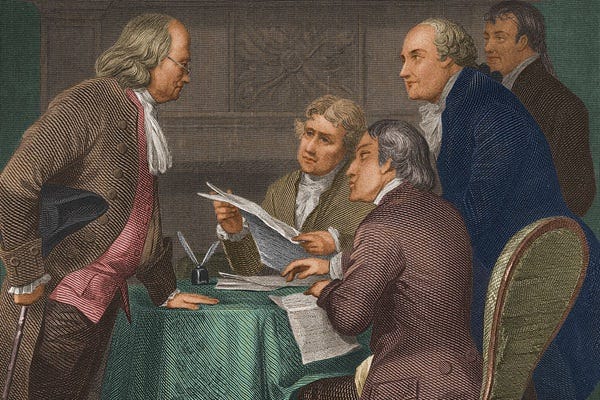
The creators of the Declaration of Independence achieved a remarkable accomplishment — proscribing the powers of their own government.
There’s an intriguing irony to the events leading up to July 4th, 1776, the day that we celebrate each year as the origination of our United States.
On that day 250 years ago, the Founding Fathers of the fledgling new nation set our for themselves a daunting task — of founding a brand-new government whose central concept was nothing less than to dramatically proscribe the powers of that very government itself.
Wait, what?
Think about it. Almost a “snake-eating-its-tail” proposition.
Along with our traditional celebration of July 4th, perhaps we should also celebrate that the Founders did NOT think too heavily about this self-referential irony. Or maybe they would have stepped away from the task. We Americans owe so much to the fact that they did NOT refrain.
And there are other ironies…

Surprisingly, the word “Freedom” doesn’t actually appear in the Declaration of Independence.
Take the word “Freedom,” for instance…
A much beloved and vaunted word for having its meaning reforged during the American Revolution. But ask yourself — how many times does the word “Freedom” appear in the Declaration of Independence?
Only once? More? Trick question.
The fact is that Mel Gibson, as Scottish Revolutionary William Wallace in “Braveheart”, intones the word “Freedom” three more times than it appears in the Declaration of Independence.
“Three more times”?
Because the word “Freedom” does not appear in the Declaration of Independence at all. Surprised? I was.
So, where DOES “Freedom” appear in our nation’s founding documents? Surely, you say, it shows up in the Constitution, written ten years after the Declaration of Independence in 1787? And you would be correct, but it’s barely even there at all. And not in the body of the document. “Freedom” shows up in the First Amendment, which it actually has to “share”— with “Freedom of Religion.”
It’s as if the word “Freedom,” having missed its “stage cue” during the opening salvo of the revolution, suddenly appears like a late 2nd act walk-on!
So, why is “Freedom” so late in the founding documents?
There is a reason. It’s not generally remarked upon today, but in creating the Declaration of Independence, the Framers were NOT asserting freedoms for themselves or for the American people, at least not directly. As pointed out, they were mostly concerned with limiting the powers of government itself.

he Ten Amendments to the Constitution were added to right the wrongs of the British government from which we were separating ourselves.
The Ten Amendments to the Constitution were added to right the wrongs of the British government from which we were separating ourselves. The rationale was to address the worst grievances first. That’s why Religion and Speech are conjoined at the top of the list, leading to proscriptions from establishing a “state religion” or proscribing the free exercise” of a religion, any religion.
Then comes the salient part with regard to Speech and Expression, so much in the news today, and even still contested in some quarters: “Congress shall make no law … abridging the freedom of speech or of the press.”
The First Amendment is the one that allows me to write this essay freely, without concern for being constrained or edited or denied expression. But you don’t have to be a writer to appreciate the beachhead of human endeavor that was being stormed here, since in England, as in many European countries, any language critical of the government was often suppressed, even found illegal.
“Freedom” does not appear anywhere else in the Constitution. None of the other nine Amendments had their own official title. However most later transcriptions have traditionally added a title to each amendment and the word “Freedom” always appears in each one.
Hey, the word “Freedom” was catching on, even back then.
On to another word we all know well and expect to show up in the Declaration of Independence…

So why isn’t “Inalienable” in The Declaration of Independence? Because the word had to duke it out with: “Unalienable”.
As in the opening lines — “we hold these truths to be self-evident, that all Men are endowed by their Creator with certain inalienable rights…”
Except it doesn’t appear there. I know; tricked you again.
Why isn’t “Inalienable” in there? Because the word had to duke it out with another word: “Unalienable.”
The apocryphal story is that Thomas Jefferson and John Adams conflicted over the terms: Jefferson was in favor of “Inalienable” while Adams preferred “Unalienable,” both being common words used at the time.
The word “Inalienable” DOES appear in Jefferson’s early drafts but even then, he felt it needed qualifying. Hence it became “inherent and inalienable.” “Inherent” got dropped later on.
Jefferson’s draft was then turned over to John Adams who had a close relationship with the printer, a man named John Dunlap. And it was here that the switcheroo was apparently made. Adams’ preference for the word “Unalienable” took hold, and it is that spelling that still reverberates these 250 years later.
But perhaps it’s fitting that the more uncommon version, “Unalienable,” made the final edit. Why? Just because it’s uncommon, even today, lending it a slightly mystical aire and even a reverential tone. In a Broadway musical version of these historical events, entitled “1776,” the word was even sung about.
And, while the old adage is likely true that history is written by the victors, we can now add a corollary — “spelling is dictated by the typographers”.

“Spelling is dictated by the typographers”.
ALL TOGETHER NOW…
On that day in 1776, and in a rather remarkable case of the whole being greater than the sum of its parts, all of these words, among many others, were assembled late into the night of July 3rd on John Dunlap’s typographical plates —
“We hold these truths to be self-evident, that all men are created equal, that they are endowed by their Creator with certain unalienable rights, that among these are Life, Liberty, and the pursuit of Happiness”.
And making history. Our history.
I think that if there had been a “mind blown” emoji in Dunlap’s type font, he surely would have used it.
Permission granted to deploy fireworks and hot dogs! Happy 4th of July to all!

John Adams said the 4th of July “ought to be solemnized with Pomp and Parade…”
메타데이터
- post_id
- 83f0adec683e
- slug
- words-we-celebrate-on-july-4th-that-are-not-in-the-declaration-of-independence-83f0adec683e
- url
- https://medium.com/@kirbytimmons/words-we-celebrate-on-july-4th-that-are-not-in-the-declaration-of-independence-83f0adec683e
- canonical_url
- https://medium.com/@kirbytimmons/words-we-celebrate-on-july-4th-that-are-not-in-the-declaration-of-independence-83f0adec683e
- author_url
- https://medium.com/@kirbytimmons
- status
- ok
- fetched_at
- 2026-07-26 17:39:23