Moses: The Prophet Who Broke The Law
What Happens When Truth Descends into Real Life
Moses: The Prophet Who Broke The Law
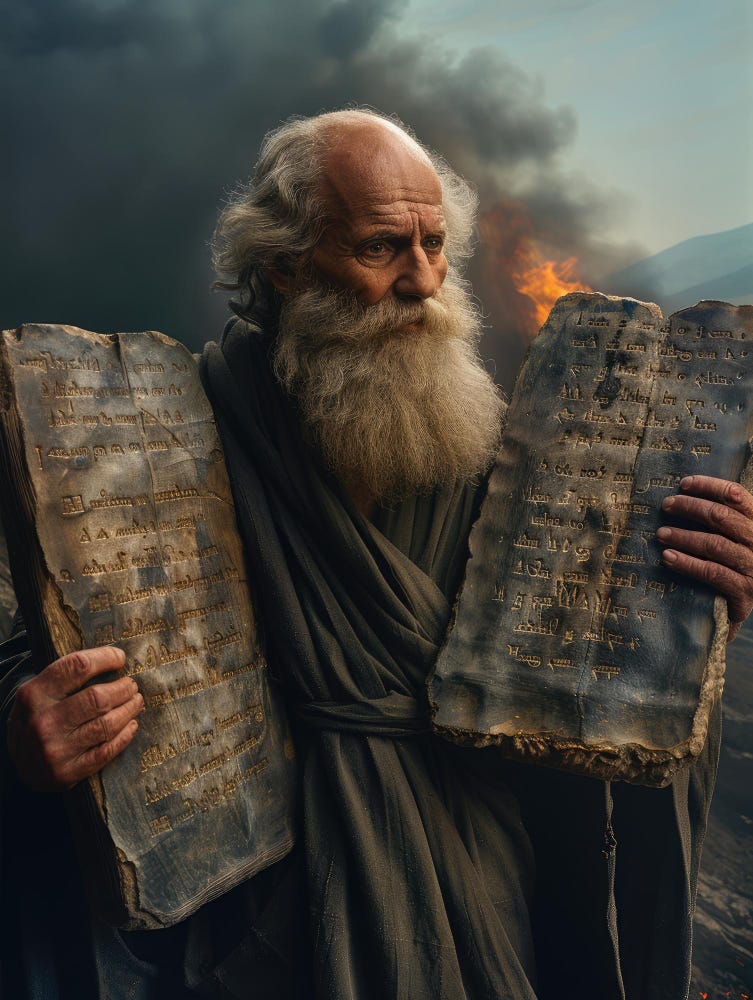
Moses comes down the mountain carrying order in his hands.
Below him, the people are dancing around a golden calf. He is astounded. Furious…
Okay, let’s step back. Before the descent, there is the ascent.
Moses goes up into Sinai and disappears from ordinary human view. The mountain is covered in cloud, thunder, lightning and fire; the people are warned not to come too near. For forty days and forty nights he remains there, removed from the clamour of the camp, receiving the pattern of a new order.
The tablets he will carry down are more than prohibitions. They give form to a people newly emerged from slavery and still learning what freedom requires. The confusion of a wandering multitude is gathered into covenant; the sprawling uncertainty of human life is condensed into words cut in stone.
There is a severe beauty in this. The mountain rises above the dust and improvisation of the camp. At its summit, everything seems to acquire definition: fidelity and betrayal, reverence and violation, right relation and wrong. Moses stands in the presence of an order that does not negotiate with mood, appetite or convenience. He has gone behind the visible disorder of a displaced people and encountered what appears to be its governing truth.
Meanwhile, below, time passes differently.
The people do not know what has become of Moses. Their leader has vanished into smoke, and the God he represents remains invisible. They are not living inside revelation but inside delay. Their fear is physical, collective and contagious. They want something present, something around which they can organise themselves. They remove their jewellery, melt it down and make a god they can see.
Thus, while Moses receives an invisible order above, the people manufacture a visible certainty below.
Then he begins to descend.
He carries not merely commandments but, one imagines, the afterglow of coherence — the conviction that beneath human confusion there really is a structure. Before he has properly re-entered the life of the people, he hears singing. He sees the calf. He sees the dancing.
Moses sees them and loses it. He throws down the tablets, and they break.

It is difficult to imagine a more complete collision between the ideal and the manifest. Words cut in stone encounter music, bodies, panic, desire and an idol made from earrings. The purity of the summit does not gently reorganise the life below. It strikes it — and, in the hands of the man carrying it, shatters.
There is something wonderfully and terribly human in the scene. The man entrusted with divine law becomes, almost immediately, the man who smashes it. The one who has stood closest to order is overwhelmed by disorder. Moses the prophet and Moses the tablet-breaker are not two different men. They are the same man, separated only by a descent.
Perhaps that descent is the real beginning of wisdom.
I keep returning to this story because Sinai is not only a place in scripture. It is also a movement of the mind. Some of us are repeatedly drawn away from the bewildering surface of things and towards whatever might lie beneath them. We ascend through thought, study, contemplation or silence in the hope that, from sufficient height or depth, the confusion will disclose its pattern.
Physicists search for forces beneath the variety of matter. Philosophers ask what remains true beneath custom and appearance. Mystics sit in silence, trying to perceive what governs the procession of experience. The methods differ, but the impulse is recognisable: behind this teeming reality, what is actually going on? Is there one principle from which the rest can be understood?
This search is often described as intellectual curiosity, and sometimes it is. But I suspect it can begin somewhere more intimate: in bewilderment.
Manifest reality is confusing. People say one thing and do another. They love us and injure us, sometimes in the same gesture. Institutions proclaim principles while operating through vanity, fear and expediency. Our feelings contradict our convictions. We understand ourselves beautifully at noon and behave incomprehensibly by evening.
For a certain kind of person, all this is not merely untidy. It is almost intolerable. The search for an underlying principle becomes an attempt to bring experience into intelligibility. The concept is not initially an ornament of the mind. It is shelter.
And then, sometimes, after enough thought, attention, suffering or silence, something begins to emerge. A pattern. A law. An ordering insight.
In Vipassana, one encounters anicca: impermanence. Sensations, pleasure and pain arise and pass away. The body that seems solid reveals itself as process; the self that seems continuous appears as an ever-changing field of reactions, memories and sensations. Seemingly separate experiences participate in the same movement of arising and dissolution.
There is immense relief in such a perception. What was chaotic becomes legible. One is no longer simply being knocked about by experience; one has glimpsed its architecture. The scattered pieces gather around a centre and, for a moment, the world makes sense.
Naturally, one wants to remain there.
Why leave the austere coherence of the mountain for the marketplace of competing needs, wounded egos and obscure motives? Once a concept has ordered experience, we hold on to it not only because it is true, but because we remember the disorder from which it rescued us.
Here insight can quietly change its function. It begins as a means of understanding life and becomes a defence against living it. We interpret rather than encounter, remaining at a slight altitude above the confusion. The insight need not be false. Something can be profoundly true and still be used defensively.
This is the ordeal of Moses’s descent. Revelation left on the mountain is of no use; yet carrying it down does not mean the people below have been transformed by it. The clarity is his, not theirs. He bears an answer to a crisis they have experienced in another register — not as a problem of first principles, but as absence and fear.
This, too, is an attempt to create order. The Israelites cannot endure invisible mystery, so they manufacture certainty in a form they can touch. Moses cannot endure the betrayal of the order he has encountered, so he destroys the form in which that order has been given. The people make an idol; the prophet breaks the law. Both acts arise from an inability, in that moment, to bear the distance between what is and what ought to be.
The symmetry is almost unbearable.
Moses shows that perceiving a deeper pattern does not free us from the confusion it describes. His proximity to divine order may even intensify his fury: having seen what human beings are called to be, he finds what they actually are intolerable. This is a hazard of conceptual power. Clarity becomes rank: I see the pattern; therefore I stand above those trapped in its surface. Truth becomes an instrument not of liberation but of hierarchy.
Descent interrupts this fantasy. One returns from contemplating impermanence and remains devastated when something beloved ends. One understands projection and continues to project. One speaks eloquently about the unreliable self and still takes a slight personally. Insight does not confer immunity from the condition it describes.
There is humiliation in this, but it is a necessary humiliation. Without it, understanding remains sterile, perhaps even dangerous. To know the law is not yet to live under it. To see the summit is not to have become the summit.
Consider someone like Tolstoy. His later life seems haunted by this distance. He sought to reorder existence around simplicity, nonviolence and renunciation, yet remained entangled in property, fame, sexuality and family conflict. The larger the ideal he grasped, the more visible became the man who could not fully inhabit it. But perhaps this is where an ideal becomes honest. A truth that has never encountered appetite, history, temperament and relationship does not yet know what it asks of a human being.
The same longing for unity enters our relationships. We search for the one person who will gather our scattered needs into coherence: the person who understands our mind, receives our wounds, shares our humour, excites our body, respects our solitude, accompanies our spiritual life and reassures the frightened child within us. We want, in effect, a human grand unified theory.
If reality overwhelms us with multiplicity, the singular person promises relief. Instead of negotiating different intimacies with imperfect people, we imagine one relationship in which everything will finally come home.
But one person can rarely contain the whole of another life. One friend meets us intellectually; another knows how to sit with grief. One shares our spiritual hunger; another makes us laugh when spirituality becomes unbearably solemn. Someone may love us deeply and still fail to understand an entire room within us.
This does not make the relationships false. Human nourishment may be ecological rather than singular. A forest does not lack integrity because it needs rain, soil, sunlight and fungi. Its wholeness lies in the relationship among many things.
Perhaps what must be singular is not the source from which all our needs are met, but the centre from which we meet their many sources. Our integrity belongs to us. Our needs may properly belong to a community.
This is more difficult than the fantasy of the One. It requires us to receive what another can genuinely give without treating what they cannot give as proof that the relationship is unreal. But multiplicity is not fragmentation. One can remain inwardly coherent while being nourished by many people, loyal to enduring values while responding flexibly to circumstance, aware of social games without mistaking them for ultimate truth.
The question is not whether we must choose between purity and falseness. It is whether we can preserve our orientation without requiring life to become geometrically faithful to it.
This is why the second tablets matter.
After the first tablets are shattered, Moses returns to the mountain. New tablets are made. The law descends again, but now it comes on the other side of idolatry, fury and breakage. The truth written upon them may be the same, but the human situation is not. Moses now knows what happens at the foot of the mountain. He knows something, too, about the violence within the bearer of the law.
The first tablets are truth before contact. The second are truth after disappointment.
The first belong to revelation. The second belong to repair.
The second tablets are not inferior. They represent an order whose authority does not depend upon human beings receiving it perfectly — one capable of surviving their failure. Covenant becomes possible not because chaos has disappeared, but because rupture is no longer the end of the story.
Perhaps the same is true of every serious insight. First, we discover it in something like purity and imagine our lives can be arranged cleanly around it. Then comes the descent. Other people refuse their assigned roles. Our nature revolts. The insight breaks — or we break something in its name.
If we are fortunate, we return to the mountain. Not to recover the innocence of the first revelation, but to ask what remains true after reality has contradicted our fantasy of how truth should work.
What comes back down may look similar, but we carry it differently — less like a weapon or proof of our elevation. We know that we, too, dance around calves of our own making; that moral fury can be another form of disorder; that a person can glimpse something vast and still be petty, frightened and absurd.
This knowledge need not make us cynical. It may make us tender.
From the summit, another person’s confusion can look like stupidity or bad faith. On the ground, we remember what fear does to perception, loneliness to judgment and shame to love. We recognise why people create idols — and our own impulse to smash what is sacred when others fail to honour it.
The test of an insight may therefore be not merely whether it is true, but what kind of person it makes of the one who holds it. Does it make others appear smaller? Or does it enlarge our capacity to remain present amid contradiction without surrendering discernment?
The purpose of ascent cannot be to remain forever above life. Nor can it be to return with a perfect system and force the marketplace to resemble the mountaintop. We ascend so that we may see. We descend so that what we have seen may be humbled, tested and made human.
Perhaps wisdom is not permanent residence in conceptual clarity. It is the ability to move between order and disorder without being possessed by either: to climb high enough to perceive a pattern, to come down far enough to feel the dust, and to allow each realm to correct the other.
Moses’s greatness, then, may lie not only in his having spoken with God. It may lie in the fact that after rage, failure and broken stone, he climbed again.
The first tablets were carried by a man who had encountered divine order.
The second were carried by a man who had also encountered himself.

메타데이터
- post_id
- 841573c3f4ff
- slug
- moses-the-prophet-who-broke-the-law-841573c3f4ff
- url
- https://medium.com/@charlesadede/moses-the-prophet-who-broke-the-law-841573c3f4ff
- canonical_url
- https://medium.com/@charlesadede/moses-the-prophet-who-broke-the-law-841573c3f4ff
- author_url
- https://medium.com/@charlesadede
- status
- ok
- fetched_at
- 2026-08-12 17:13:33