Understanding Springs fundamental concepts still matters — even in the age of AI
There’s a new kind of statement I keep hearing in discussions with my colleagues, in team chats, in comment sections under Spring-related…
Understanding Springs fundamental concepts still matters — even in the age of AI
There’s a new kind of statement I keep hearing in discussions with my colleagues, in team chats, in comment sections under Spring-related posts: “Why bother learning Spring / Spring Boot when AI can just generate the code for me?”
Fair question. Let’s talk about it.
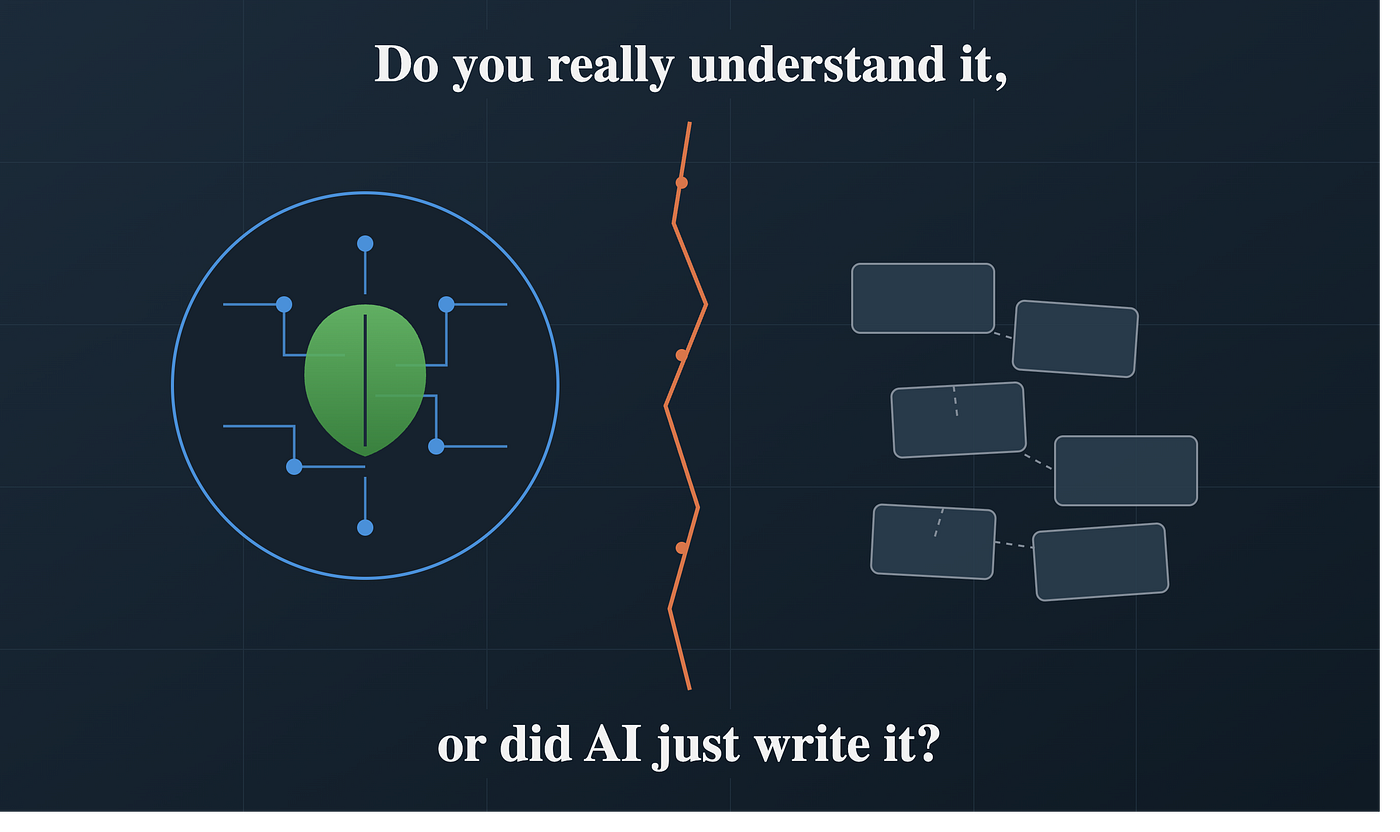
AI generated ;-)
AI wrote it. Can you fix it?
Let’s say you ask an AI to generate a feature in an existing Spring Boot application for you. It works. Tests pass. You ship it. 🎉
Now, three months later, you encounter a bug in production related to that new feature. Or let’s assume, that a new requirement comes in that doesn’t quite fit in the existing structure of the codebase. What happens? Someone has to open that code and change it.
Can you?
If you don’t understand why the AI tool of your choice wrote the code the way it did — why that paticular class is managed as a bean within the application context, why that configuration class exists at all, why there is a particulary service layer — you’re not maintaining code anymore. You’re guessing.
And let’s be completely honest: Guessing is never a good approach to professional software development. What makes the problem even worse is that, on the one hand, you spend far more time reading code than writing it. On the other hand, an AI can write a lot of code in a short amount of time.
By the way, this applies not only to Spring, but to all technologies where you ask an AI to generate code for.
Maintenance isn’t optional
Here’s the thing no AI-Hype-Article tells you: shipping the first version is the easy part. The real value of software — the reason your company or your personal project is investing in it — comes from the fact that it keeps working, keeps evolving, and keeps supporting the business over time.
Software that nobody can safely touch after it’s written isn’t an asset!
Maintenance is where the real cost of software lives, and it’s the phase where truths such as “I don’t really know how this works” becomes catastrophically expensive.
Functional requirements are not the whole story
There’s a second danger to not knowing the fundamentals of the technology of your choice. When you (or an AI on your behalf) focus entirely on “does it do what the ticket says,” it’s incredibly easy to lose sight of the requirements nobody put a checkbox next to: maintainability, testability, scalability, security — the quality requirements.
Unfortunately, quality requirements for a system are of essential importance. The system’s architecture — its guidelines, framework, internal structure, and development processes — is derived from these requirements (or at least it should be).
You easily end up with a system that fulfills every user story perfectly on paper, while underneath important quality requirements are not met. The system might not be maintainable by human developers in a efficient manner for example, or personal data might be not protected everywhere. This happens not because the AI is bad, but because nobody was steering with the full picture in mind.
AI is a tool, not a replacement for understanding
None of this is an argument against using AI in your daily work. Use it. It’s a fantastic accelerator. But an accelerator only helps you when you know your goal, when you know the bigger picture and have a solid understanding of it.
Understanding concepts like the Spring IoC container, bean lifecycles, configuration strategies, and architectural boundaries isn’t academic nostalgia. It’s what lets you review, steer, and maintain whatever the AI hands you — instead of just hoping it works now and forever without needing to touch it again. This won’t happen. It never happened before the age of AI and it will never happen!
Something is brewing on YouTube 🎬
I’m currently building out a YouTube course that teaches exactly these fundamentals — the core concepts of Spring and Spring Boot that every developer should have, AI or no AI. The first videos are already out: https://youtu.be/z17vURILPiM?si=JhMcxXQnGkdngnq8
If that sounds useful to you, go ahead and subscribe to the channel — more is on the way.
So: Don’t just assume that the AI will do everything right. Make sure you understand what you’re doing. That’s always a good idea!
메타데이터
- post_id
- 8422aa8bb356
- slug
- understanding-springs-fundamental-concepts-still-matters-even-in-the-age-of-ai-8422aa8bb356
- url
- https://medium.com/@schulte.ansgar/understanding-springs-fundamental-concepts-still-matters-even-in-the-age-of-ai-8422aa8bb356
- canonical_url
- https://medium.com/@schulte.ansgar/understanding-springs-fundamental-concepts-still-matters-even-in-the-age-of-ai-8422aa8bb356
- author_url
- https://medium.com/@schulte.ansgar
- status
- ok
- fetched_at
- 2026-07-14 09:29:11