Hydrocarbons: The Backbone of Organic Chemistry
From the gasoline in your car to the plastic of your phone case, and even the wax of a candle — what do these utterly different substances…
Hydrocarbons: The Backbone of Organic Chemistry
From the gasoline in your car to the plastic of your phone case, and even the wax of a candle — what do these utterly different substances have in common?
They are all built from hydrocarbons, the simple yet powerful compounds of carbon and hydrogen that form the universal language of organic chemistry.
Hydrocarbons are the simplest organic compounds, made entirely of carbon and hydrogen. Despite their simplicity, they form the foundation of organic chemistry and modern life — from fuels and plastics to pharmaceuticals and biological molecules. Understanding hydrocarbons helps us understand how organic reactions work and how complex molecules are built.

What Are Hydrocarbons?
Hydrocarbons are organic compounds composed only of carbon ( C ) and hydrogen (H). Carbon’s ability to form four stable covalent bonds allows hydrocarbons to exist as chains, branches, or rings.
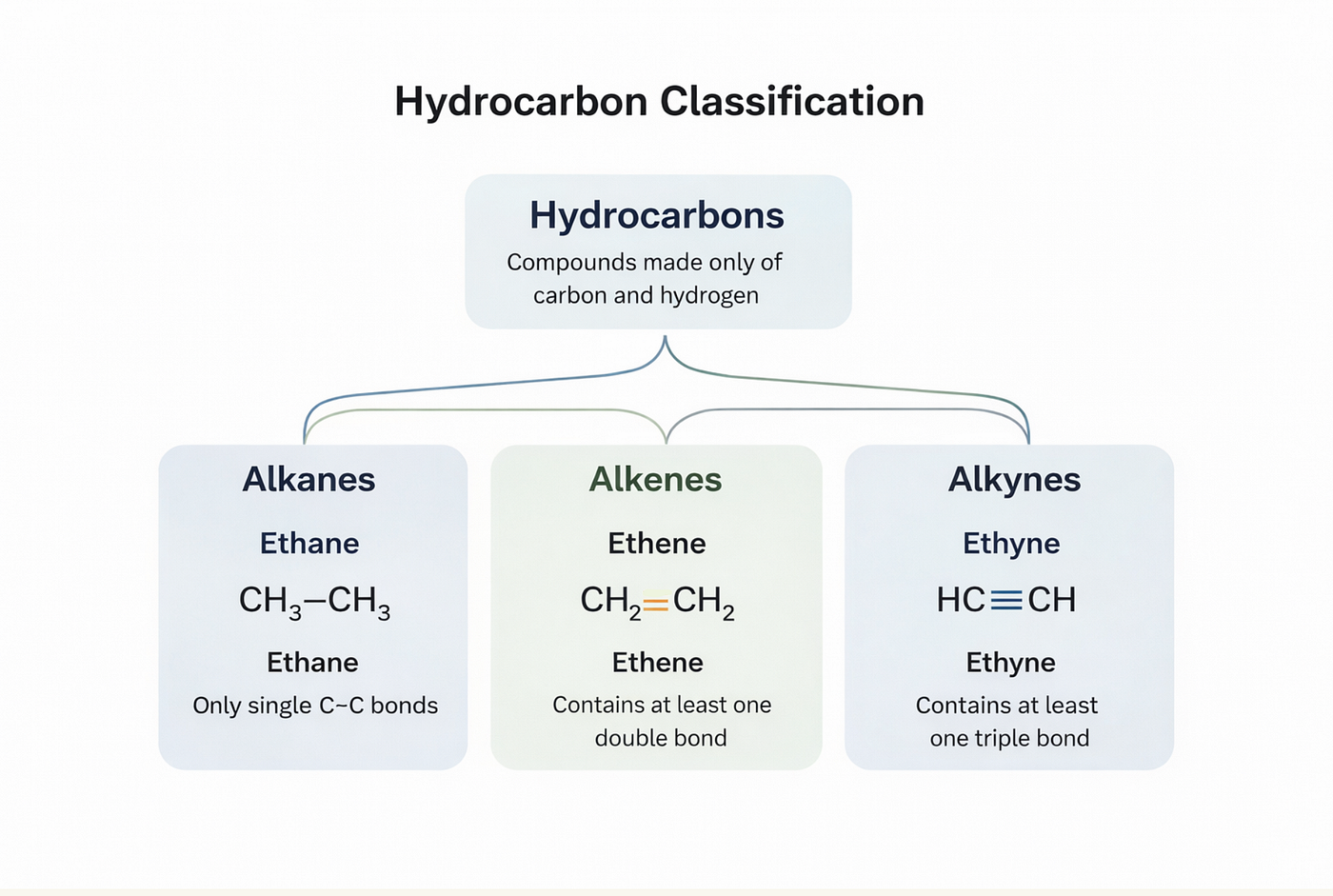
They are broadly classified into three main types:
- Alkanes — single bonds only
- Alkenes — at least one double bond
- Alkynes — at least one triple bond
This allows carbon atoms to link together into chains and rings like molecular Lego blocks , with hydrogen atoms capping the unused connections.

Why Are Hydrocarbons Important?
Hydrocarbons are important because they:
- Serve as fuels (petrol, diesel, natural gas)
- Act as starting materials for plastics, solvents, and medicines
- Help explain reaction mechanisms in organic chemistry
- Form the structural basis of many biological molecules
Without hydrocarbons, modern industry and daily life would not function as we know it.

When Do We Encounter Hydrocarbons?
We encounter hydrocarbons:
- Every day through fuel combustion
- In manufacturing processes (polymers, rubbers)
- During chemical reactions studied in laboratories
- In natural sources such as crude oil and natural gas
They are constantly involved in both natural and industrial chemical processes.

Where Are Hydrocarbons Found?
Hydrocarbons are found:
- In fossil fuels (coal, oil, natural gas)
- In petrochemical industries
- In organic synthesis laboratories
- As building blocks within larger organic molecules
Their availability and versatility make them central to organic chemistry.

How Do Alkanes, Alkenes, and Alkynes Differ?

1. Alkanes (Single Bonds)
- General formula: CₙH₂ₙ₊₂
- Contain only single covalent bonds
- Are saturated hydrocarbons
- Relatively less reactive
Example: Methane (CH₄), Ethane (C₂H₆)
Key reactions: Combustion, substitution

2. Alkenes (Double Bonds)
- General formula: CₙH₂ₙ
- Contain at least one C=C double bond
- Are unsaturated hydrocarbons
- More reactive than alkanes
Example: Ethene (C₂H₄), Propene (C₃H₆)
Key reactions: Addition reactions (hydrogenation, halogenation)

3. Alkynes (Triple Bonds)
- General formula: CₙH₂ₙ₋₂
- Contain at least one C≡C triple bond
- Highly unsaturated and reactive
Example: Ethyne (C₂H₂)
Key reactions: Addition reactions, combustion

How Do Hydrocarbons React?
Saturated hydrocarbons (contain the maximum possible hydrogen).
Reactivity increases with the degree of unsaturation:
- Type of bond (single, double, triple)
- Bond strength and electron density
General trend: Alkanes < Alkenes < Alkynes (in reactivity)
This trend explains why unsaturated hydrocarbons are widely used in chemical synthesis (could bond with more hydrogen).

How We Can Use Hydrocarbons Safely
Understanding hydrocarbons helps us:
- Use energy resources responsibly
- Develop cleaner fuels and alternatives
- Reduce environmental pollution
- Make informed decisions about sustainability
Scientific awareness leads to ethical and environmentally conscious choices.

Conclusion
Hydrocarbons are more than just fuel — they are the fundamental alphabet of organic matter. By understanding these simple molecules of carbon and hydrogen, we decode the logic behind the vast complexity of the chemical world, from living cells to synthetic materials.
Simple molecules often carry the greatest importance. By understanding hydrocarbons, we begin to understand how chemistry shapes the world around us — one bond at a time.
메타데이터
- post_id
- 8440bcdd0a48
- slug
- hydrocarbons-the-backbone-of-organic-chemistry-8440bcdd0a48
- url
- https://medium.com/@SR28PRO/hydrocarbons-the-backbone-of-organic-chemistry-8440bcdd0a48
- canonical_url
- https://medium.com/@SR28PRO/hydrocarbons-the-backbone-of-organic-chemistry-8440bcdd0a48
- author_url
- https://medium.com/@SR28PRO
- status
- ok
- fetched_at
- 2026-06-12 10:20:10