Your Next AI Agent Might Run on the Laptop You Already Own
Gemma 4 12B is not just another open model release. For solo builders, it points to a cheaper, more private way to automate work with text…
Your Next AI Agent Might Run on the Laptop You Already Own
Gemma 4 12B is not just another open model release. For solo builders, it points to a cheaper, more private way to automate work with text, screenshots, audio, and long project context on local hardware.
TL;DR
- A 12B-class local multimodal model changes the cost structure for solo builders, not because it replaces frontier cloud models, but because it can handle repeatable private work locally.
- The practical opportunity is not “run a chatbot on your laptop.” It is “run a small agent that can read screenshots, listen to audio, inspect documents, call tools, and keep your client data off a remote API by default.”
- The catch: encoder-free multimodal design reduces moving parts, but it can push more raw perception work into the language model, so workflows still need narrow scopes, tests, logs, and human approval gates.
The most important AI release for a solo business is rarely the biggest model.
It is the model that changes what you can afford to run every day.
That is why Gemma 4 12B is worth paying attention to. A 12-billion-parameter open-weight model that can process text, images, audio, and video locally on laptop-class hardware is not just a technical milestone. It is a different operating assumption for one-person companies.
For the past two years, most solo builders have treated multimodal AI as a cloud feature. You send a screenshot to a remote model. You upload meeting audio. You paste a long client document into a hosted chat. You connect an API key, hope the bill stays reasonable, and design around rate limits, privacy concerns, and latency.
Local models never fully disappeared, but they often felt like hobby infrastructure: useful for experiments, not reliable enough to sit inside a business workflow.
A laptop-ready multimodal model pushes against that assumption.
The real unlock is not privacy. It is repeatability.
Privacy is the obvious pitch. If a model runs locally, you can analyze customer notes, invoices, call transcripts, screenshots, draft contracts, product specs, and internal operating docs without sending every artifact to a third-party endpoint.
That matters. But for solo builders, privacy alone is not the whole story.
The bigger unlock is repeatability at near-zero marginal cost.
If you run a paid newsletter, agency, coaching business, template shop, YouTube workflow, SaaS microtool, or marketplace service, you probably have dozens of small tasks that are too annoying to do manually and too low-margin to send to expensive frontier models all day.
Examples:
- Read five customer screenshots and classify the issue.
- Summarize a 90-minute client call into next actions.
- Compare a landing page screenshot against a checklist.
- Scan a folder of invoices and flag anomalies.
- Turn a rough voice memo into a structured task list.
- Review a code repository and identify the top three automation opportunities.
- Draft support replies from private customer context.
None of these requires a magical autonomous employee. They require a local worker that can take messy input, structure it, and hand you a draft or decision queue.
That is where a 12B multimodal model becomes interesting. It is small enough to be plausible on consumer hardware, but large enough to be useful for workflows that need more than keyword extraction.
Encoder-free multimodal design is a builder signal
The technical detail that matters is the encoder-free design.
Most multimodal systems use separate modules to process images or audio before handing the result to a language model. That architecture works, but it adds complexity: more components, more memory, more latency, more ways for a local setup to break.
Gemma 4 12B takes a more unified approach. Visual and audio inputs are projected directly into the model’s shared representation space instead of being routed through large separate encoders. In practical terms, the model tries to make multimodal perception feel like a native part of the same transformer rather than a bolt-on pipeline.
For a solo builder, that matters because every extra component becomes maintenance.
If your automation stack needs a vision encoder, an audio encoder, a speech model, a transcript cleanup model, a reasoning model, and a separate router, you do not have a lightweight workflow. You have a weekend project that becomes technical debt by Tuesday.
The promise of a unified local model is simpler: one runtime, one model family, fewer handoffs, and less glue code.
That does not mean it is automatically better at every task. Removing encoders can shift more burden onto the language model itself. Fine visual detail, noisy audio, long videos, and high-precision OCR may still require specialized tools. The smart move is not to replace every API. The smart move is to move the boring, frequent, private first pass onto your own machine.
The first workflows to build are not glamorous
If you are a solopreneur, do not start by building a fully autonomous “AI chief of staff.” That is how you end up debugging a robot that sends weird emails at midnight.
Start with a narrow workflow where the model can be wrong without damaging the business.
Good first candidates:
- Client call distillation: audio in, structured summary out, human approval before sending.
- Screenshot QA: product screenshot in, checklist findings out, no automatic deployment.
- Content research inbox: saved links and notes in, draft angle options out.
- Support triage: customer message plus screenshot in, category and draft reply out.
- Invoice review: PDF or screenshot in, extracted fields and suspicious items out.
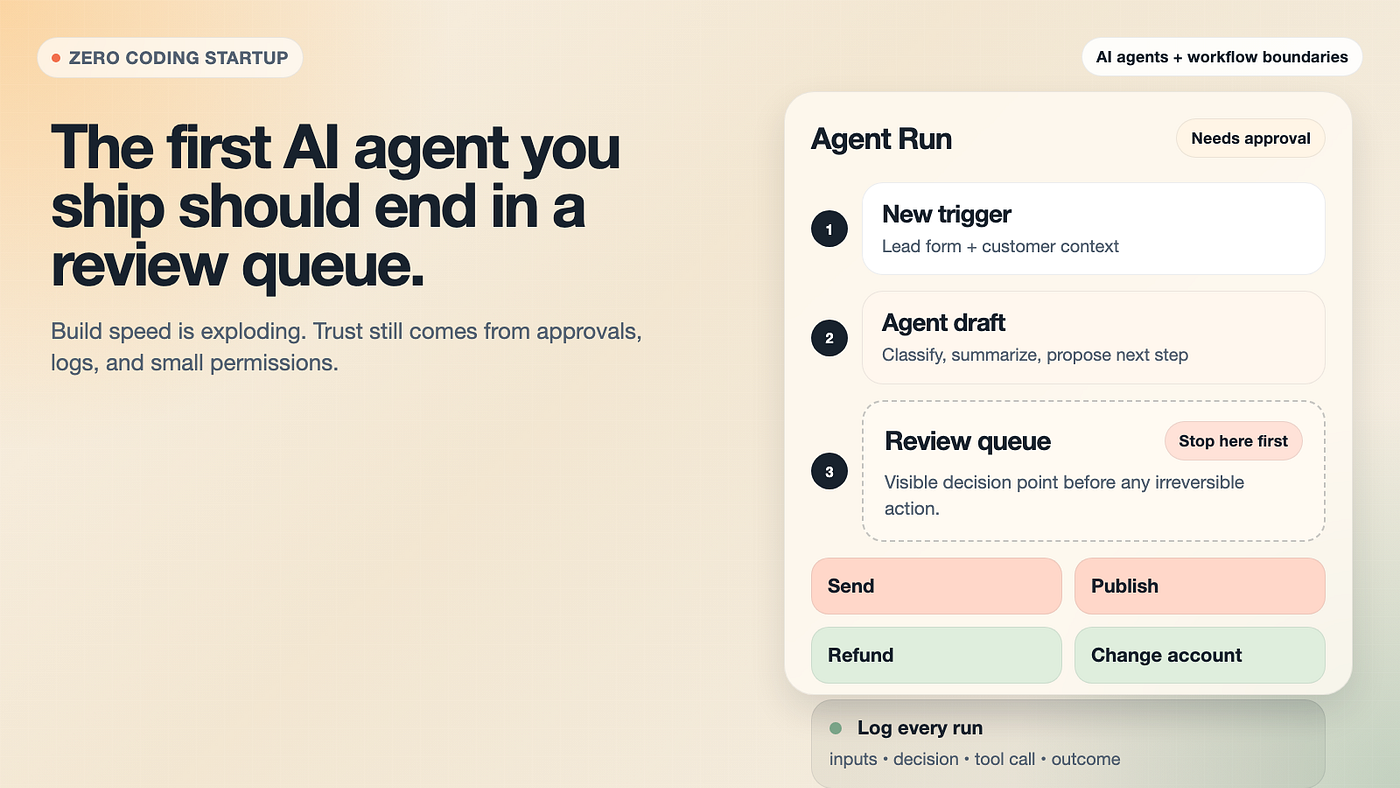
Each workflow should have the same shape:
- Input: one type of messy artifact.
- Instruction: one clear job.
- Output: one structured format.
- Review: one human checkpoint.
- Log: one place to inspect what happened.
That is the difference between useful AI automation and demo theater.
The 256K context window changes project memory
The other detail solo builders should care about is long context.
A large context window means the model can ingest more of the working surface: a codebase, a long meeting transcript, a product manual, a collection of SOPs, or a bundle of client notes. For a one-person business, that can become a local project memory layer.
Imagine a weekly operating review that runs on your own laptop:
- Pull last week’s customer emails.
- Read your sales notes.
- Scan support screenshots.
- Review product changelog entries.
- Generate a short “what changed, what broke, what to fix” memo.
You could run the first pass locally, then escalate only the high-value reasoning or final writing step to a frontier cloud model if needed. That hybrid pattern is more realistic than pretending one model should do everything.
What I would not automate yet
Local does not mean safe.
Do not give a new local multimodal agent irreversible permissions on day one. No automatic refunds. No payment movement. No customer account changes. No publishing without review. No legal language sent directly to clients.
The model may be local, open, and efficient, but your business risk is still real.
Use it first as an analyst, not an operator.
Let it read. Let it classify. Let it draft. Let it compare. Let it point out anomalies. Then keep the final action behind a human gate until the workflow has enough logs to earn trust.
The practical stack for solo builders
If you want to test this direction, keep the stack boring:
- A local model runtime for Gemma-class models.
- A folder or database for source files.
- A simple workflow runner.
- A structured output format such as JSON or Markdown.
- A review queue in email, Notion, Airtable, Linear, or a spreadsheet.
- A log of every run.
The point is not to build an impressive agent. The point is to reduce the number of small business tasks that require your full attention.
Key takeaways
- Local multimodal models are becoming practical enough for real solo workflows.
- The best use case is not replacing cloud AI; it is moving frequent, private, low-margin first-pass work onto hardware you already own.
- Encoder-free design matters because fewer components means fewer things for a solo builder to maintain.
- The right starting point is a narrow workflow with human approval, not a fully autonomous agent.
- If the model can read screenshots, audio, long documents, and code locally, your laptop starts to look less like a device and more like a private operations layer.
CTA
Pick one recurring task this week that involves a screenshot, audio note, document, or long project context. Do not automate the final action. Automate the first pass: read, classify, summarize, and queue it for review. That is where local multimodal AI starts paying for itself.
메타데이터
- post_id
- 844e8745ce10
- slug
- your-next-ai-agent-might-run-on-the-laptop-you-already-own-844e8745ce10
- url
- https://medium.com/@zerocodingstartup/your-next-ai-agent-might-run-on-the-laptop-you-already-own-844e8745ce10
- canonical_url
- https://medium.com/@zerocodingstartup/your-next-ai-agent-might-run-on-the-laptop-you-already-own-844e8745ce10
- author_url
- https://medium.com/@zerocodingstartup
- status
- ok
- fetched_at
- 2026-06-28 14:26:31