The Physics of Water: Does a Stream Actually Make a Parabola?
When water comes out of a hose, does it create a parabolic trajectory? Should it? Those are the questions we want to consider. Or maybe you…
The Physics of Water: Does a Stream Actually Make a Parabola?
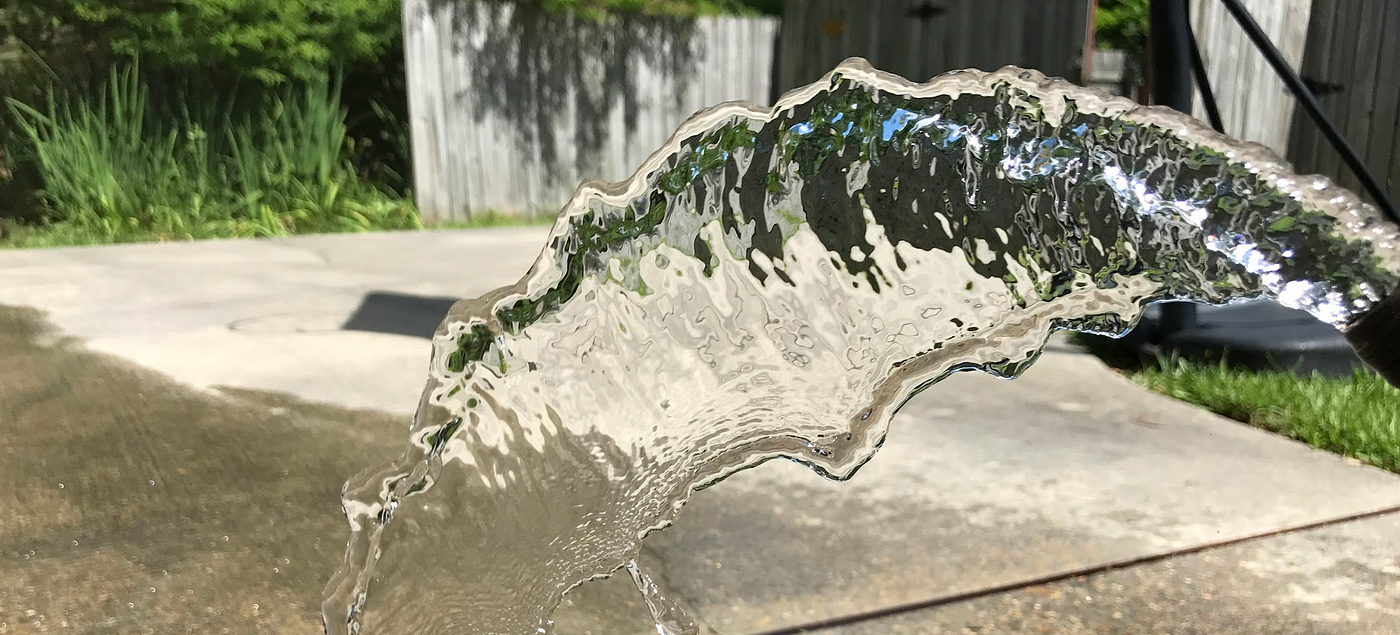
Yes, it’s water….from a hose. Image: Rhett Allain
When water comes out of a hose, does it create a parabolic trajectory? Should it? Those are the questions we want to consider. Or maybe you could just think about water — is it the same as projectile motion in your physics class? Let’s find out.
Projectile Motion Trajectory
Here’s your normal projectile motion physics. Suppose you take a ball and toss it across the room. It starts with some initial velocity vector and moves in both the x and y-directions.
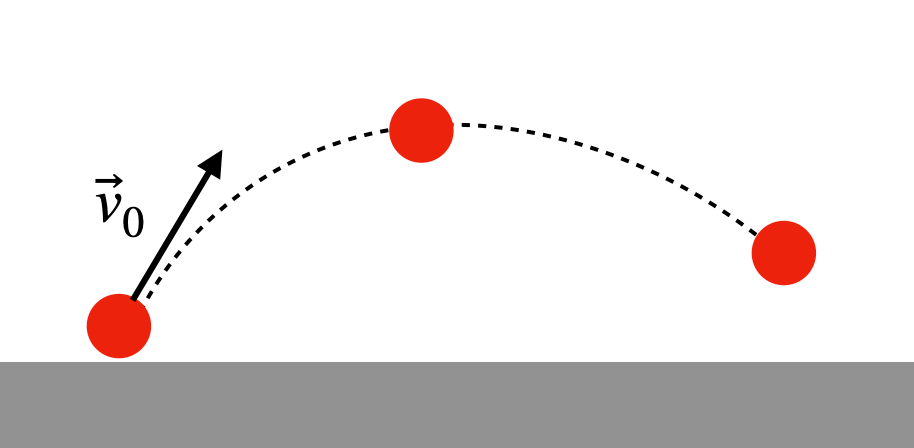
Ball launched with initial velocity vector.
The key to projectile motion is that the only force on the object during the motion is the downward gravitational force. Since the gravitational force is proportional to the mass (m) of the object, this gives a vertical acceleration of -g (where g = 9.8 m/s²). There’s no forces in the horizontal direction (assuming no air resistance) so the x-velocity is constant.
This gives the following two kinematic equations.
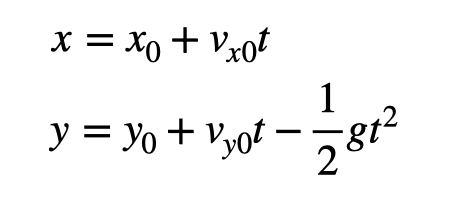
Here v_x0 and v_y0 are the initial velocities in the x and y directions with x_0 and y_0 the initial positions. The awesome part of projectile motion is that you can treat the x and y motions as independent except for one thing — time. The time (t) it takes to move in the x direction is the same time it takes to move in the y-direction.
In physics classes, we usually deal with these two motions separately. If you wanted to make a graph, it would be x-position vs. time and y-position vs. time. Here’s what that might look like for a typical ball toss. (here’s the python code for this if you want it)
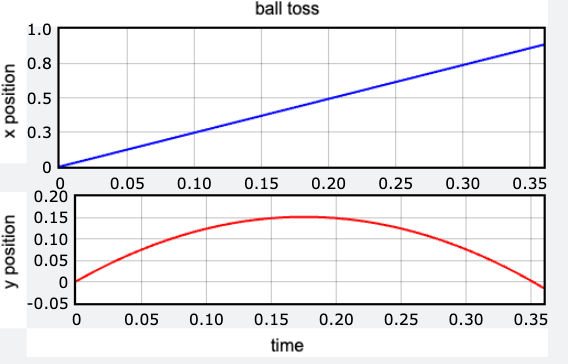
Position vs. time for x and y motions.
You can see that the x-position graph is a linear function and the y-position is a parabolic function. But what if we want to look at the trajectory? That would be a graph of y vs x. That should also be a quadratic equation. Let’s see how.
We can get an expression for the trajectory using the two kinematic equations above. The first step is to take the x-position equation and solve for time (t).
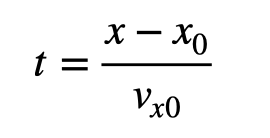
Now for the messy part. Let’s plug this expression for time into the y-position equation.
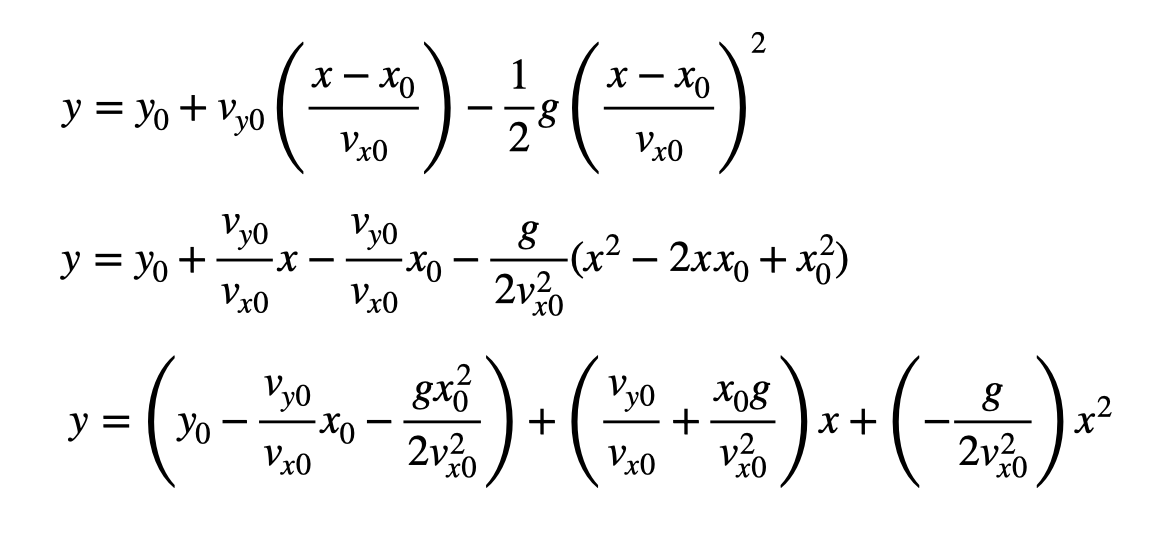
Don’t freak out — it’s just algebra. But now we have an equation in the form:
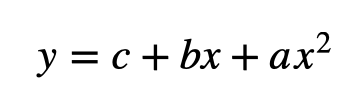
That’s a quadratic function. Oh, in case you can’t tell I put the constants in parenthesis. Here’s a plot of the new trajectory equation along with a plot of just x vs. y (which is easy to do since we used python).
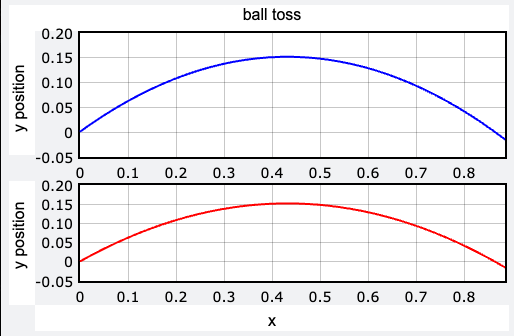
Top graph: x vs y from kinematic equations. Bottom graph: trajectory plot.
That’s a win.
Water Trajectory
Now we can move to real water. Here’s a picture of the water fountain.
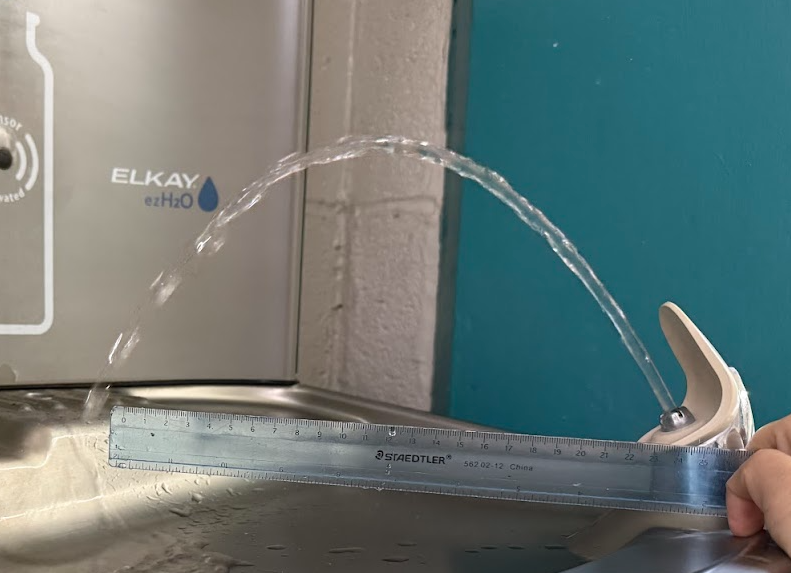
Water from a fountain. Is it parabolic? Ruler for scale.
How can we check if this water trajectory is parabolic? The answer: video analysis. Yes, I know it’s a photo and not a video — but what’s a video really but just a bunch of photos? I’m going to use Tracker Video Analysis because I love it. I can mark locations on the water and the fit data to it.
Let’s go. Here’s my plot from the video analysis (hint: go to the video settings in tracker and change the end frame to something like 20 so you can get 20 data points).
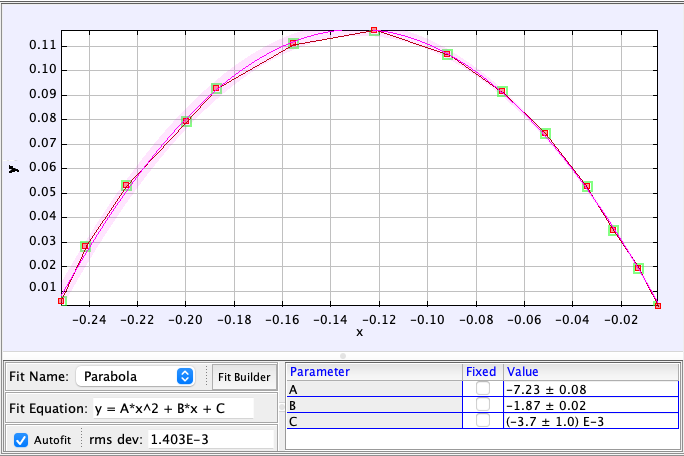
Position data from Tracker Video Analysis.
Yes, that’s a parabola. But is it legit? Let’s take a look at the A coefficient (-7.23). From our trajectory equation above, this should be equal to -g/2v_x0². We can use this to calculate the water velocity (well, the x-component of the velocity).
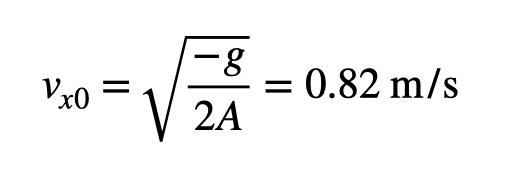
That seems reasonable. I mean, it’s a water fountain. Oh, you could also use the other coefficients to find the initial y-velocity. However, I just wanted to see if water was a parabola. I think this works.
Does this work for BIGGER water fountains? We can check. Here’s one that I saw the other day with the dog.
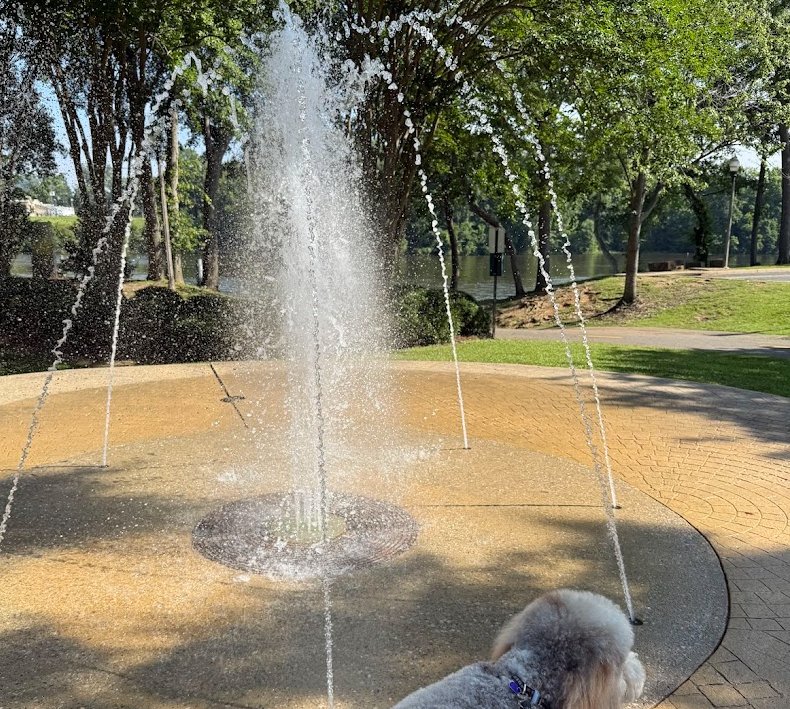
Dog and water fountain.
I don’t have a ruler for scale, but here’s a plot. Oh — I’m looking at the stream that’s moving perpendicular to the camera.
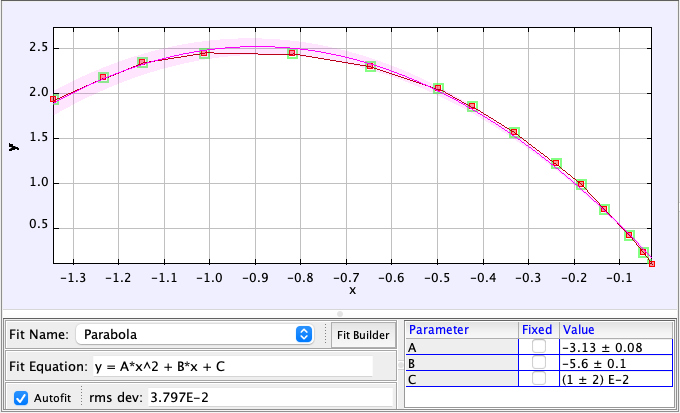
Data from Tracker Video Analysis
There you go. Parabolic again. I assume that this isn’t ALWAYS true for all water. If you get a stream going fast enough probably some weird stuff happens. You can test that for your homework assignment. How about something like this giant fountains in Las Vegas?

Photo: Rhett Allain. Fountains of Bellagio, Las Vegas, NV
메타데이터
- post_id
- 844ffbcb71e5
- slug
- the-physics-of-water-does-a-stream-actually-make-a-parabola-844ffbcb71e5
- url
- https://medium.com/@rjallain/the-physics-of-water-does-a-stream-actually-make-a-parabola-844ffbcb71e5
- canonical_url
- https://medium.com/@rjallain/the-physics-of-water-does-a-stream-actually-make-a-parabola-844ffbcb71e5
- author_url
- https://medium.com/@rjallain
- status
- ok
- fetched_at
- 2026-06-26 21:52:29