Doctor Who’s Quiet Revolution
Or, How Series 11 Changed Doctor Who Forever.
Doctor Who’s Quiet Revolution
Or, How Series 11 Changed Doctor Who Forever.
This article will contain slight discussions of sexual violence and other unpleasant things that have featured in Doctor Who. Things such as extremism and bigotry will also be mentioned. It is not the topic of this work, but is inevitable in discussing the show.

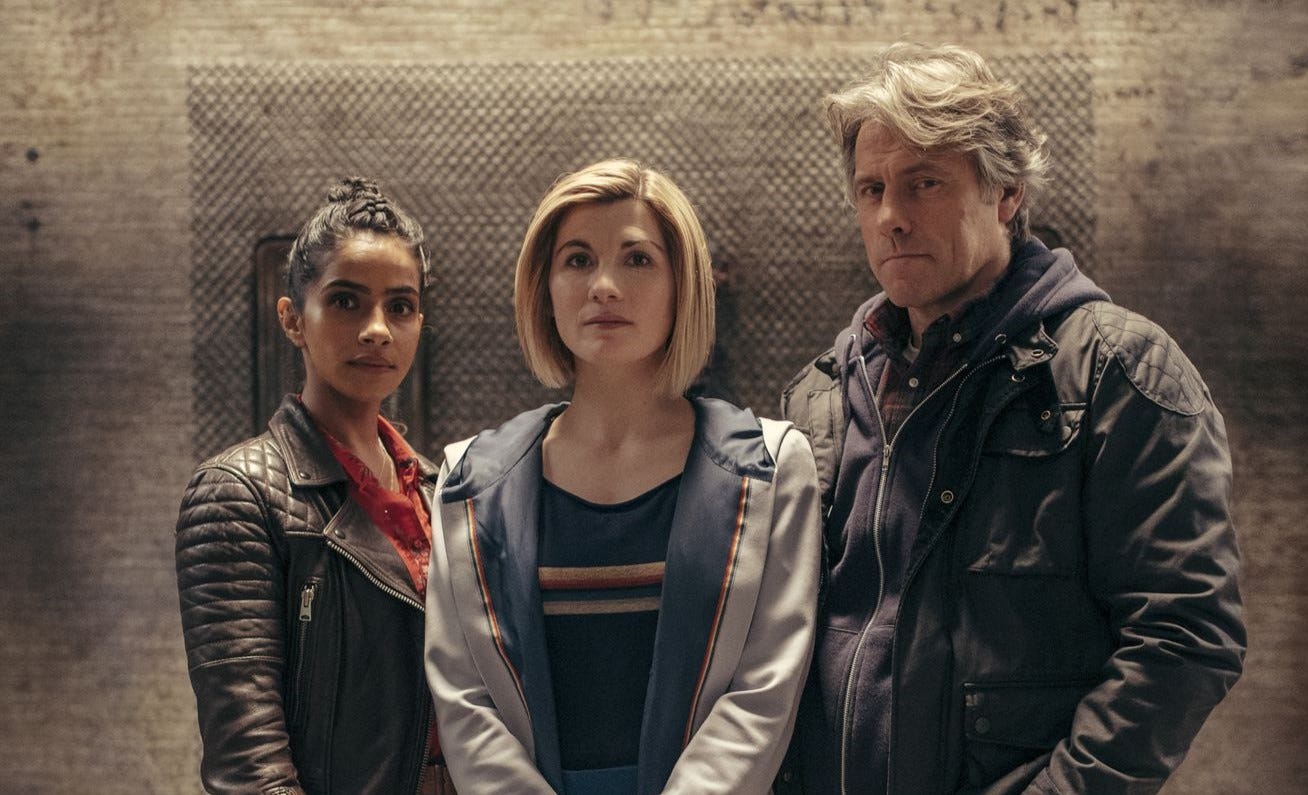
Mandip Gill as Yasmin Khan, Tosin Cole as Ryan Sinclair, Jodie Whittaker as the Doctor, Bradley Walsh as Graham O’Brien, and Sharon D Clarke as Grace O’Brien in Series Eleven’s The Woman Who Fell to Earth.
The original run of Doctor Who, twenty-six years of twenty-six seasons, has some of the most original and long-lasting science-fiction stories on television. Over its 695 episodes (which rises to 702 including the never-broadcast, often-released Shada’s six parts, and the 1996 Television Movie), the show handles some of the earliest character development on the small screen (cf. The First Doctor kidnapping Ian and Barbara in An Unearthly Child, contrasting with the same character asking Vicki if she wants to join them in The Rescue), fascism (The Daleks, Genesis of the Daleks), transhumanism (The Tenth Planet, et al.), entropy and decay (Logopolis), evolution and esotericism (Ghost-Light), spirituality (Planet of the Spiders, Kinda), and much more. The vast majority of these stories throughout all twenty-six years were made on budgets that wouldn’t finance one scene of blockbuster films — with Season Seventeen’s Script Editor Douglas Adams once saying “you really have to love the show [to work on it]”. It was this show that influenced generations of new writers, directors, and actors, some of whom would later go on to have incredible influence on the show in its future.
There are certainly some less successful stories in the so-called Classic Era, such as the often-cited The Twin Dilemma, the meandering and painfully low-budget The Web Planet, the almost completely forgotten Underworld, and the entirety of the unwatchable Season Twenty-Four. These stories can often be slightly excused by learning the behind-the-scenes information that went into their production — it is a wonder that Season Twenty-Four was even able to make it on to television screens, even if it would have been preferable that it didn’t — but it seems the greatest stories of the original run of the show, such as The Daleks’ Master Plan, The Massacre, The War Games, Inferno, City of Death, The Caves of Androzani, The Curse of Fenric, and Survival, also faced similar problems (indeed, in some cases even worse), but managed to battle through them and become ingrained in the imaginations of those who saw the episodes. The First Doctor’s era in particular consistently created brilliantly experimental stories, especially for the period of television it was made in.
It was during the post-production of one of the most consistently brilliant seasons of Doctor Who, its twenty-sixth, that the show was cancelled. With its final story accidentally managing to wrap things up as much as possible, with the Doctor’s oldest enemy the Master trapped on a dying planet, Script Editor Andrew Cartmel hastily wrote a speech spoken by the Seventh Doctor — played to perfection by Sylvester McCoy — to cap off Rona Munro’s excellent Survival:
There are worlds out there where the sky is burning, and the sea’s asleep, and the rivers dream; people made of smoke and cities made of song. Somewhere there’s danger, somewhere there’s injustice, and somewhere else the tea’s getting cold. Come on, Ace. We’ve got work to do.
The Doctor and Ace (Sophie Aldred) walk off into the distance, back “home” (to the Doctor’s timeship the TARDIS), and the show would not return in a regular schedule for almost sixteen years. The 1996 Television Movie, which ultimately plays more like an amateur’s best attempt at a Doctor Who story, could not be saved even with Paul McGann and Daphne Ashbrook giving career-defining performances. Bad scheduling on American television led to poor ratings, which meant the Movie had to rather embarrassingly stand on its own as a failed pilot for an American-centric version of the show. The rest of the 1990s saw no genuine new televised Doctor Who, barring one Red Nose Day parody.
Indeed, it took until 2005 for Doctor Who to gain a new lease of life with Executive Producer and lead writer (from hereon referred to as ‘showrunner’) Russell T. Davies and the backing of BBC Wales. This new incarnation of the show would feature a higher budget, shorter stories, romance between the Doctor and his companion — controversially first tested in the Television Movie — and an entirely new production team and cast, practically meaning the show was entirely different in all but name. This was not new in of itself — 1970’s Season Seven and 1980-81’s Season Eighteen both saw a shift in the production of Doctor Who that was radically different from what came before it — but it had never been at this scale. Christopher Eccleston, known for playing brooding and moodier characters, was cast as a still male Doctor, and Billie Piper, known up until that point as a musician, was cast as the companion Rose Tyler.
Eccleston would leave at the end of his first series (note: the Classic era of the show is segmented into ‘seasons’, the Modern era into ‘series’), to be replaced by the younger David Tennant (late of showrunner Russell T. Davies’ other BBC show Casanova), Piper at the end of the second series for Freema Agyeman, Agyeman at the end of the third for Catherine Tate, and finally Davies, Tennant, and Tate were all to leave at the end of the fourth series of this revived Doctor Who in 2010, with Tate’s final regular appearance in 2008, and a cameo in the final episode run by Davies.
Doctor Who itself would continue, performing yet another metamorphosis under new showrunner Steven Moffat, who cast relatively unknown actor Matt Smith as the Doctor, and Karen Gillan as companion Amy Pond, alongside Arthur Darvill playing her partner Rory Williams. Gillan and Darvill would be replaced in the latter half of the seventh series by Jenna Coleman as Clara, who would continue to travel with the Doctor after Smith left and was replaced with veteran actor Peter Capaldi. Coleman’s exit at the end of the ninth series saw Pearl Mackie join as Bill Potts with recurring appearances from comedian Matt Lucas playing Nardole. Finally, at the end of the tenth series since 2005, showrunner Steven Moffat left alongside Capaldi, Mackie, Lucas, and once again most of the production team, as had happened with Russell T. Davies leaving seven years earlier.
To replace Moffat would be creator of ITV’s Broadchurch, lead writer of Doctor Who spinoff Torchwood, and writer of several episodes of Doctor Who since 2005, Chris Chibnall. At this point the show had surpassed fifty years since its first episode, and there was still yet to be a female Doctor. By this time there was definitively no in-universe reason for not having a female Doctor. Numerous examples for this include previous ‘alternate Universe’ stories sanctioned by the BBC with female Doctors, such as Exile’s Arabella Weir and The Curse of Fatal Death’s Joanna Lumley (despite them both being plagued with sexism), the introduction of Michelle Gomez as Missy (a female incarnation of the Master), and references to the Doctor being a girl in the past in some later Moffat-era stories. However, it seemed this was as far as Doctor Who would go — a small hint at being progressive, but instead pandering, in Moffat’s words, to the conservative “Daily Mail readers” by having the show ultimately hold up patriarchal standards.
It seemed that the Modern era of the show had set up a formula somehow more restrictive than the Classic era — a male Doctor and a female companion, with straight romance allowed to be front and centre, whilst any queer romance is instead reduced to jokes, as with Moffat’s writing for Coleman’s character Clara Oswald, or relegated to occasional background scenes, such as Mackie’s Bill Potts. The show becomes hypermasculine — a clear example being that the Doctor does not like Agyeman’s Martha Jones (despite his request for her to travel with him) so nothing she does, including saving the Doctor in numerous episodes, is ever good enough. The in-universe explanation for this is that the romance between the Doctor and Rose left the Doctor depressed, although this struggles in any way to excuse his genuine disrespect towards Martha in several episodes. The other line of reasoning, that the Doctor is an alien and does not share human emotions, falls apart completely when used as a lens to look at his relationship with Rose. Martha’s unrequited love for the Doctor is then able to be treated as a joke in a way that male-to-female unrequited love never could be. Other details from the Classic era, such as the Doctor becoming a vegetarian following the events of The Two Doctors, were ignored when the series came back — most egregiously with the Ninth Doctor ordering “steak and chips” at a restaurant in Boom Town — to make way for this new hypermasculine version of the Doctor. Nonconsensual kisses (Flesh and Stone, The Crimson Horror) littered Moffat’s era of the show, and physical abuse — usually female-on-male — passed off as comedy throughout Davies and Moffat’s eras (Aliens of London, et al.).
By July 2017 the fatigue of this had definitely set in. Rather suddenly, everything changed. The BBC had released an announcement video, featuring the new Doctor walking in a forest, before taking off their hood to reveal Jodie Whittaker. Chibnall then said in a statement that he “always knew [he] wanted the [Thirteenth] Doctor to be a woman”. Series Eleven, and onwards, would now be female-led, for the first time ever in the show’s history. This was an announcement not entirely well received by some fans of the show. From 2005 to 2017 the show could easily be defined as ‘laddish’ — in cruder terms, ‘it’s sci-fi, but don’t worry, it’s not gay to like it!’ — and this is reflected in the fans it had gathered by the time of Whittaker’s announcement. Whilst definitely unintentional, the show had gathered a large enough amount of sexist fans ready to completely ditch the show at the first sign of one person from the other fifty percent of the population playing the main character.
In many ways, this ended up being beneficial to the show. Voices like these were, unfortunately temporarily, relegated to the fringes of the main show, allowing instead for what Whittaker regarded as the Doctor’s first priority in her statement following the Thirteenth Doctor’s announcement: “hope”. Companions were announced in October that year — Bradley Walsh as Graham O’Brien, Mandip Gill as Yasmin Khan, and Tosin Cole as Ryan Sinclair. This was another distinct move away from the previous periods of the show, who had followed a formula of one female companion with an average age of mid-twenties, with Walsh becoming the oldest companion in the show’s television history.
On the production side, the show moved to prioritise marginalised crew like it had never had previously. Malorie Blackman became the first non-white writer for televised Doctor Who, and Vinay Patel the second. Mark Tonderai became the first black director for an episode of Doctor Who, and Sallie Aprahamian and Jennifer Perrott joined the small list of female Doctor Who directors, with Joy Wilkinson doing the same for writing. New composer Segun Akinola would compose the next variation of the show’s theme, as well as the scores for each episode. Almost the entire production team barring Chibnall and incoming series producer Nikki Wilson were new. The next series — the eleventh — would feature no villains from previous eras. There would be no overarching story arc, no stories over more than one part, the episodes would now be 50 minutes long and would air on Sundays. There would be a noticeably higher budget. A Christmas Special would instead become a New Years’ Special. In almost every conceivable way, Jodie Whittaker’s time as the Doctor was shaping up to be something completely different.
At the end of Series Ten’s Christmas Special Twice Upon a Time, Peter Capaldi’s Twelfth Doctor regenerates, and Jodie Whittaker makes her very brief debut. In what has become a tradition in the Modern era of the show, the last scene of the previous showrunner (which invariably features the new Doctor) is written by the incoming showrunner, and Chibnall uses this to give the Thirteenth Doctor her first words: “Oh, brilliant!”. The new Doctor falls out of a destroyed TARDIS, into twenty-first century Earth, and the episode ends.
It was with this spirit that the first episode of a new era arrived nearly ten months later. The Woman Who Fell to Earth is nothing short of genuinely revolutionary television, finally moving the show into tune with the century it is broadcast in. The premise of the episode immediately marks it out as taking place in a universe different from what came before, allowing new viewers to not have to rely on any previous baggage. Indeed, this episode seeks to move Doctor Who away from the fairytale-inspired stories of Steven Moffat’s run, instead places the Doctor and all the chaos, disorder and disruption she brings into the real world.
It is still stunning to see Grace O’Brien — played to perfection by Sharon D. Clarke — be ‘companion material’ for the Doctor, only to be killed, accidentally, whilst trying to help save someone she didn’t know. O’Brien would not be revived; she was dead, and would stay dead. The vast majority of the story is set at night, a rather literal way of communicating that Doctor Who now has a darker tone. In one way of viewing the episode, the Doctor is not even the protagonist: her arrival, alongside that of the villains, is an aberration in this world where time travel and aliens are nothing more than fantasy, and it leads to the deaths of numerous people that could have been easily avoided otherwise. The Doctor works to save the Earth, but for those who have died, that is the end. No Moffat-style nanogenes (The Doctor Dances) or glass afterlife (Twice Upon a Time) can save characters like Grace.
This brings a new energy to the show, one that had been missing for a very long time. There is genuine danger; anyone can die. The episode structurally harbours this new energy by following the lead of the first episode of the Modern era, Rose, and focusing on the lives of those around the Doctor. Ryan leads, as a vlogger on YouTube talking about the “greatest woman” he’s ever known — revealed, of course, to be his Nan, Grace — then Grace with her husband Graham, and Yaz, a junior police officer investigating something quickly falling way out of her league. The episode forgoes the usual title sequence (making viewers wait until the credits to hear Akinola’s revamped theme music) to reflect that this episode is the start of something that is not just Doctor Who — a previously masculine focus — but instead to shift that focus onto all of its leads. The Doctor is no longer the greatest being in the Universe (reflected most explicitly in Ryan reserving a similar title for Grace instead), and we focus equally on Ryan’s loss of yet another parental figure, Graham’s struggle with grief, fear of his cancer returning, and struggle to be a grandfather to Ryan, and Yaz’s police training helping her become an equal to the Doctor in her investigative abilities, as well as hints towards her romantic attractions towards the show’s main lead. This new era of the show was not just able to fully flesh out one companion, as previous eras had struggled to, but rather balance the stories between three of them.
Whilst the rest of the stories in this series ask the same question: ‘What if the whimsical sci-fi of Doctor Who was in our very serious real world?’, they also each shift the focus onto character-driven storylines. Rosa, the episode co-written by Blackman and Chibnall, uses the horror of the racism in pre-Civil Rights Act USA to reflect on the current state of racism in the UK — Ryan and Yaz both face racist abuse and microaggressions in 21st century Britain, and Ryan is physically assaulted when trying to help a white woman in 1950s Alabama — and to redress the balance that out of all the historical figures shown in any era of Doctor Who, the vast majority of them had been white. It is a frank and unavoidable showing of the realities of living as a non-white person in a so-called ‘civilised’ country, and is indeed out of necessity a watered down version. There are valid criticisms of the show seeming to downplay some of the violence of the period, but it is the awful truth that the real threats faced by African Americans as a true showing of these would require a much stronger rating than Doctor Who is allowed as a family show. Rosa, despite its title, does not only focus on one of the many black women who fought for civil rights, but aims to hold a mirror up to 21st century America and Britain, and to show how little truly has changed other than cosmetic differences and a shift into microaggressions as outward racial abuse is ostensibly supposed to be illegal.
The alien presence in Rosa is not of an invasion or a Lovecraftian fleet, it is a racist man, intent on trying to stop what he sees as the main reason for the end of white superiority. He is, of course, incorrect — Rosa Parks would not have ended her fight for civil rights, and there were hundreds and thousands of African Americans fighting for the same, if she could not have refused to give up her seat on that particular day — showing the one of the many pillars of stupidity that lies behind racism and bigotry: a belief in any kind of ‘great man’ viewing of history and ignoring the power that lies in the solidarity shown by the civil rights movement.
Demons of the Punjab is a masterful episode that Patel writes beautifully, once again shifting Doctor Who’s focus away from overwhelmingly white human colonies (The Impossible Planet/The Satan Pit, et al.) and exploring the history of companion Yaz’s family — something never truly done previously — and their actions during the Partition of India in 1947. This is a febrile area for the show, for history outside of England at all, despite the Doctor knowing no borders, was rare. Demons intentionally creates a world where the issue is not the aliens, who are revealed to not be murderers or villains at all but rather mourners that appear to bear witness those who would otherwise die on their own. The Demons of the title are, of course, human, the Hindu nationalists that murder Bhakti and Prem to try to stop Prem marrying a Muslim woman, Yaz’s grandmother Umbreen.
It is hard to imagine any earlier incarnation of the Modern show having the correct tone to deal with this, and the sensitivity the story requires fits perfectly with Whittaker, Gill, Cole, and Walsh, in a story that also helps to inform not only the audience but the character of Yaz herself about her family history. Demons is a genuinely emotional episode — not because of any sci-fi scale destruction of galaxies or planets but for the human cost, for those murdered by extreme ideology and otherwise forgotten, for those who murder because of an extreme ideology. Broadcast in a year where far-right attacks of shootings, murders, and other such violence across the globe intensified, and Hindu ultranationalism became increasingly acceptable under India’s Prime Minister Narendra Modi, the episode can feel hardly like a historical one at all.
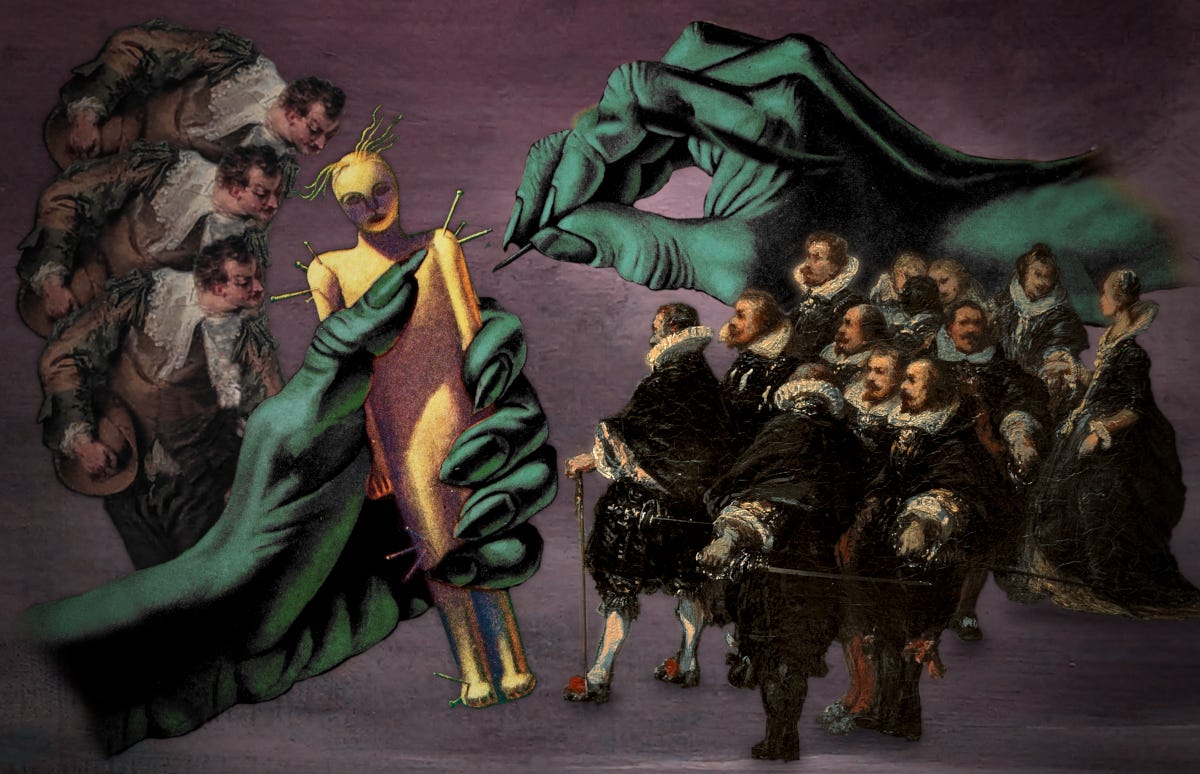
The Witchfinders places the Doctor and her companions in a situation that would not be uncommon for the First Doctor and his companions — a story set during the dark period of English history where sexism disguised itself as superstition — and features a clearly homosexual King James VI and I. The story is also notable for Wilkinson including something that a male Doctor would never face: a sexism that makes trying to save people even harder. Unlike earlier eras, where a common trope would be for characters who disagreed with the Doctor to then become easy fodder to be killed (Tooth and Claw’s Steward as a particularly egregious example), the Doctor has to power through this bigotry, and saves as many people as possible — remember, those who die stay dead — but is destined to be forgotten afterwards, rather than becoming the most important person ever to live.
The episode itself is very female-led, with King James relegated to a guest star, focusing instead on Willa Twiston’s fight against her cousin Becka Savage, and the seemingly entirely female Morax species waiting for their Queen. The Witchfinders sets itself historically but yet again has clear messages for the 21st century, with King James’ sexism coming from no true rational reasoning reflecting once again the idiocy that lies behind all forms of bigotry.
The eleventh series ostensibly comes to an end with The Battle of Ranskoor Av Kolos, a story that ties up the fate of the villains in The Woman Who Fell to Earth (allowing a sense of a complete story from the start to the end of the series). A smaller affair than the previously Universe-ending and tiring series finales of previous eras, the story again is character-focused, using the duo-species of the Ux to highlight the danger of faith in things that cannot be trusted. The series truly comes to an end, however, in the New Years’ Special Resolution (the title intentionally reminiscent of ‘… of the Daleks’ stories beginning with an R that set a story arc from the Fifth to the Seventh Doctors — as Chibnall would do with Resolution, the twelfth series’ Revolution of the Daleks, and the thirteenth’s Eve of the Daleks). This would be the first story to feature any returning villains, and of course the first to return would be the first the Doctor had ever faced. Reminiscent of the first Dalek story of the Modern era, 2005's Dalek, the episode shows how only one of the facistic creatures needs to be on Earth to create an apocalyptic threat. Resolution makes the Daleks genuinely terrifying — helped by Whittaker treating them as the threat that they are, rather than a joke like Doctors such as Tom Baker and Peter Capaldi had at some times treated them — and there is a sense that nobody is safe even just from a singular Dalek.
The story is also notable for its focus on Ryan, and his father Aaron’s return, who had previously failed to appear at his mother Grace’s funeral in The Woman Who Fell to Earth. He is not treated as a completely irredeemable villain, but, much like the rest of the series, as human. The conclusion of the story forces Ryan to save his father after he is taken over by the Dalek, and he does so without hesitation — there is no malice in his thoughts, no rationale for him to leave his father to die, because of what he has learned in his time as a companion to the Doctor and a friend to Yaz and Graham. The Doctor herself had acted as a parental figure for Ryan throughout the series, understanding his dyspraxia, helping him to overcome boundaries before trusting him to look after Hanne in It Takes You Away, the episode where Ryan finally feels able to call Graham ‘grandad’. Resolution is, as the title suggests, a resolution to this conflict, with Ryan dispelling all antagonism he previously felt towards Graham, and promising to work on his relationship with his father Aaron.
Doctor Who’s eleventh series is one of very few that works completely on its own, something that cannot be said even for series and seasons with full-length story arcs, such as Season Sixteen and Season Twenty-Three, which still find themselves relying on previously established knowledge of the show. It is — intentionally — a perfect way to introduce someone to the show, not through ignoring the stories that came before it, but by making them a part of a wider history. Fans of the show can often fail to realise that Doctor Who shares merely a name and an agreement of some sort of shared universe between its eras. The show only hurts itself by trying to keep everything from the hundreds of stories (rising to thousands including the so-called Expanded Universe), and there is worth in each era of the show divorcing itself from the last — it does not mean that the previous period is retroactively not ‘canon’, as amorphous as that term is regardless, but rather it allows the new period of the show to breathe, change, and become something new again.
Chris Chibnall, Matt Strevens, Nikki Wilson, Segun Akinola, Jodie Whittaker, Mandip Gill, Bradley Walsh, Tosin Cole, and so many others (the majority not even mentioned in this piece) understood this, and helped create an era of the show, starting with the revolutionary Series Eleven, that made change its centrepiece. The Whittaker era was able to put female stories front and centre, portray a queer romance with its main characters, delve deep into the series’ past and have the first black Doctor played by the genuinely incomparable Jo Martin, help people of colour and other marginalised communities gain a foothold in the television industry, some from previously creating short films on YouTube to being able to put an internationally recognised show on their CV, and so much more.
Series Eleven showed what Doctor Who could be. I’m thankful for what it created, and I hope that in the future this formula for the show can help new generations of writers create stories not necessarily led by straight, cis, white, middle-aged men.
메타데이터
- post_id
- 848a57d2fbea
- slug
- doctor-whos-quiet-revolution-848a57d2fbea
- url
- https://medium.com/@ecclesofficial/doctor-whos-quiet-revolution-848a57d2fbea
- canonical_url
- https://medium.com/@ecclesofficial/doctor-whos-quiet-revolution-848a57d2fbea
- author_url
- https://medium.com/@ecclesofficial
- status
- ok
- fetched_at
- 2026-06-26 03:39:16