The Premise Both Sides Share
How Protestant Theology Became the Anglo-American Consensus and What Recovery Requires
The Premise Both Sides Share
How Protestant Theology Became the Anglo-American Consensus and What Recovery Requires
The argument has been going on for forty years, and almost nobody has noticed that both sides are making it from the same ground.
The free market right and the progressive left disagree about nearly everything visible: the role of the state, the meaning of equality, the claims of national identity, the management of the economy. But underneath those disagreements they share a premise so fundamental that it rarely surfaces as a premise at all.
The sovereign individual, self-owning, choosing, responsible only for obligations voluntarily incurred, is the basic unit of reality for both of them. Community, where it appears, is instrumental: a means to individual flourishing, not a constitutive reality that precedes individual choice. Obligation, where it appears, is contractual: binding only where consented to, dissolvable where the terms no longer suit.
Thatcher and Blair are the clearest English expression of this. They are usually presented as opposites. They were applications. Thatcher applied the premise to the economy: markets liberate the individual from dependency on collective structures that have no right to his labour or her choices. Blair applied it to culture: progressive liberalism liberates the individual from identities, traditions, and social expectations that have no right to constrain personal expression. The enterprise culture and the diversity culture look like different projects. They dissolve the same thing — the claim of unchosen community on the person who was formed by it.
This is not a partisan observation. It is an anthropological one. And once you see it, the political instability of the last decade looks less like a failure of policy and more like a consequence of a premise. The Yellow Vest protests, the Brexit vote, the rise of parties nobody predicted — these are the political expression of people who experienced the dissolution of their communities as a loss and found no language in the mainstream for what had been taken from them, because the mainstream had long since agreed that what was taken from them was an obstacle rather than a gift.
The premise has a history. It did not arrive fully formed from nowhere. It has a genealogy, and that genealogy runs through a specific and identifiable strand of Protestant thought — not as accusation, not to re-litigate the Reformation, but because understanding where an idea came from is the precondition for understanding what it is doing now and whether it is possible to think differently.
That is what this piece is about. Not restoration of a world that is gone. Recovery of something that world knew, and we have since unlearned.
The argument that follows traces how this anthropology emerged from a particular strand of Protestantism, migrated into secular liberalism, structured the Thatcher–Blair consensus, and what an honest recovery would require.
Two terms will recur throughout. Both want defining before the argument begins. The older vision I will call covenantal: persons as constituted by unchosen relationships and inherited obligations, formed by communities they did not design and cannot simply exit. The newer vision is liberal: persons as sovereign units who choose their relationships, incur only the obligations they consent to, and can exit any association when the terms no longer suit. The essay is about how the second displaced the first, and what that displacement has cost.
What was there before
The pre-Reformation world is usually approached through its failures. The corruptions are real and documented, and Protestant polemicists have been cataloguing them for five centuries. But Eamon Duffy’s *The Stripping of the Altars* did something that had not been done systematically before: it approached the medieval church through its own evidence — the wills, the guild accounts, the churchwarden records, the testamentary bequests — and asked not what the reformers thought of it but what the people who lived inside it actually did.
What emerges is not the superstitious ignorance of Protestant legend, nor the golden age of Catholic nostalgia. It is a functioning system of intergenerational obligation, locally organised and personally felt. The guild member who left money for Masses to be said for his soul was not purchasing salvation through an extraction mechanism, as Luther would have it. He was maintaining his place in a network of prayer that ran in both directions across time — the living praying for the dead, the dead understood as still present to the community that remembered them. The chantry priest who said those masses was employed not by the institutional church in the abstract but by a specific community of named people, living and dead, who had a claim on his office.
The monastery was an economic as well as a spiritual institution — a hospital, a school, a source of agricultural knowledge, a holder of land in trust for purposes that extended beyond any individual lifetime. The parish held obligations across generations that no single householder could have maintained alone. The guild regulated trades not to extract rents from members but to preserve standards, train apprentices, and ensure that the knowledge and practice of a craft survived the individuals who carried it.
What underwrote all of this was a specific and coherent understanding of what a person is. Not a self-contained unit who then chooses relationships and obligations. A person constituted by relationships they did not choose and could not exit — to the living, to the dead, to those not yet born. To be a person was already to be obligated. The question was not whether you had duties you had not consented to. The question was whether you were discharging them faithfully.
This was not elite theology. It did not require Aquinas. It required a community that embodied the understanding in its practices, its architecture, its calendar, and its pattern of dying. The theology was there for those who wanted it. The formation happened whether or not you could read.
The demolition
Luther’s break was not primarily political or institutional. It was anthropological. The move that mattered was locating salvation in the individual conscience rather than in the sacramental community. This was experienced, and in many respects was, a liberation — from clerical corruption, from the sale of indulgences, from a mediating apparatus that had accumulated power alongside its genuine pastoral function. The grievances were real. The liberation was real. But the mediating institutions were not only extracting power from the people beneath them. They were also constituting persons as embedded in a web of obligation that preceded and survived the individual. When Luther dissolved them theologically, he dissolved something whose loss he had not reckoned with.
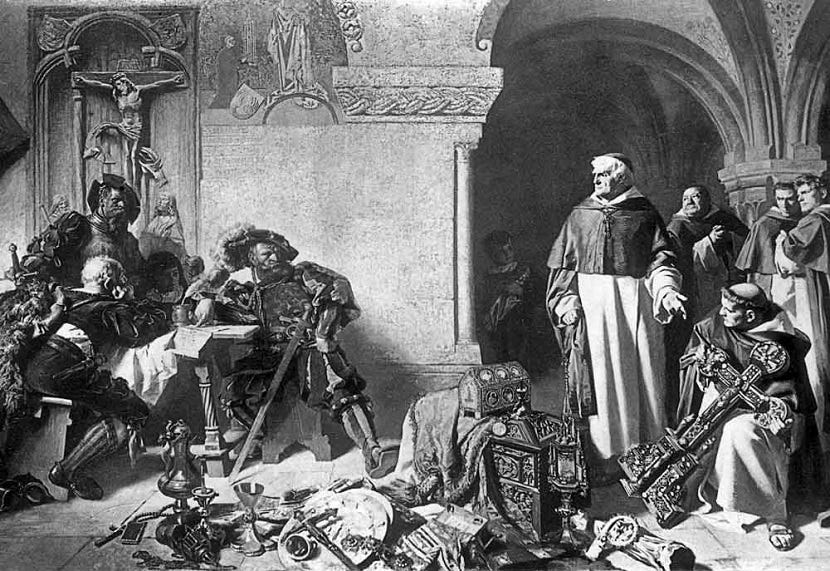
Henry dissolved them materially. The English Reformation was not primarily a doctrinal event. It was a demolition. The dissolution of the monasteries between 1536 and 1541 transferred productive land and accumulated endowment from institutions whose purpose was intergenerational — holding property in trust for the dead, the living, and the unborn — to the Tudor gentry, who held it for themselves. The chantries followed in 1547. The guilds were stripped of their religious functions and gradually stripped of their economic ones. The prayers for the dead ended. The endowments that had funded hospitals, schools, and the perpetual employment of priests to maintain the memory of the departed were redistributed upward into private hands.
Hilaire Belloc, writing in *The Servile State* in 1912, made the argument that nobody else was making at the time and that has aged better than almost anything written in that period: the dissolution of the monasteries did not merely change religion. It created the structural preconditions for industrial capitalism by concentrating productive property in a proprietary class that had not previously existed at that scale. The welfare state, when it arrived four centuries later, was not the correction of this settlement. It was its administrative completion — managed dependency replacing the covenantal mutual obligation that the dissolution had destroyed.
John Calvin extended what Luther had begun. Election is individual. The corporate dimension of the biblical covenant — obligations running laterally across community and vertically across generations — is subordinated to the vertical transaction between the individual soul and the sovereign God. The congregation assembles to witness individual encounters with grace. It does not constitute the persons who compose it.
This is not the whole of Calvin. The Reformed tradition retained a corporate political theology — the consistory, the Christian commonwealth, the theocratic element that Calvinist thinkers as late as the 1890s were still defending against the individualist tide. But that element was precisely what the Anglo-American settlement stripped out first. What migrated into liberal anthropology was not Calvinism whole but a Protestantism that had already shed its corporate and politically-directing dimensions, retaining the solitary soul before God while discarding the communal structures that soul had been embedded in.
The covenantal anthropology had not been refuted. It had been evicted — first from its theological rationale, then from its institutional embodiment, then from the imagination of a culture that had forgotten it had ever organised its life around anything else.
The migration into secular life
The solitary individual before God did not stay in the church. Over the seventeenth and eighteenth centuries he migrated into law, politics, and economics, shedding theological vocabulary as he went while retaining the anthropological structure underneath it. By the time he arrived in secular form he was so familiar that he no longer needed explaining. He was simply what a person was.
John Locke gave him political dress. Rights precede community in Locke’s account — they are not granted by social membership but possessed prior to any association, and the legitimate state exists only to protect what the individual already owns by nature. Consent is the only legitimate basis of obligation. Community is the instrument of pre-existing individual interests, not the condition of their possibility. The Protestant subject, stripped of his theological framing, had become the liberal citizen. The logic was the same. The vocabulary had changed.
Adam Smith gave him a market stall. The invisible hand is secularised Providence — the mechanism by which individual self-interest, pursued without reference to any wider obligation, produces general welfare as its unintended consequence. What this required, and what Smith largely assumed rather than argued, was that the self-interest in question was that of persons already formed by something outside the market: the Presbyterian moral culture, the embedded community obligations, the habits of honest dealing that market exchange presupposed but could not itself generate. The mechanism worked on the assumption that the formation had already happened. It had no account of what happened when it stopped happening.
Immanuel Kant completed the philosophical architecture. The autonomous moral agent owes nothing to tradition or inherited obligation that cannot be rationally justified from first principles. Moral maturity is freedom from heteronomous constraint: the capacity to legislate for oneself rather than receiving law from outside. What the medieval Christian would have recognised as a description of the fallen will, the refusal to receive obligation as given, the insistence on being the author of one’s own law, became the Enlightenment’s definition of moral achievement. The direction of travel reversed. The same destination.
Samuel Smiles is the hinge. *Self-Help*, published in 1859, is the point at which the theology-turned-philosophy becomes popular culture. The self-made man requires no aristocratic birth, no institutional membership, no inherited network of obligation — only effort, discipline, and the refusal to lean on structures that would diminish him by supporting him. This was not a description of how successful men actually operated. It was the formation of an ideal that would shape how ordinary people understood their obligations to one another for the next century and a half. You owe your condition to yourself. Your neighbour owes his condition to himself. The claim of one on the other is therefore weak — charity at best, interference at worst.
This was not inevitable, and it was not unopposed. Within the Protestant tradition itself there were serious dissenters from the individualist migration — Reformed thinkers who maintained that Calvinism was a social and political faith, not merely a theology of personal election, and who saw the laissez-faire capture of conservatism as an apostasy from their own tradition rather than its fulfilment. They lost. The individualist stream won the culture, and the corporate stream was left as a minority voice within a tradition that had already moved on.
None of these thinkers invented the autonomous individual. They found him already present in the culture that Protestant theology had been forming for a century or more, and gave him systematic expression.
Other forces were moving in the same direction. Renaissance humanism had already begun relocating the measure of things from God to man. Nominalism had loosened the metaphysical bonds between persons and the universal categories that had held them in common membership. The Enlightenment would add its own secularising pressure. But these streams entered Anglo-American political culture through a particular channel — a Protestant anthropology that had already shaped the language of conscience, the habits of worship, and the structure of the household across two centuries of popular formation before Locke wrote a word. The philosophical genealogy is contested. The cultural one is less so.
The migration was not a conspiracy. It was a consequence.
The political expression — Thatcher, Blair, and the consensus
The point that will surprise readers who have spent forty years thinking of Thatcherism and Blairism as opposites is that they are not. They are sequential applications of the same anthropology to different domains, separated by a decade and a half and united by the premise neither acknowledged.
Thatcher was necessary in some respects. The sclerotic corporatism of the 1970s had produced genuine dysfunction, and the market liberalism that replaced it restored economic dynamism the country had lost. But the same liberalism that freed the economy also dissolved the institutions the economy had been embedded in. The mining communities, the trade unions, the networks of working-class mutual obligation — these were not only economic structures. They were the secular residue of something older: communities that understood obligation as constitutive rather than contractual, that held people accountable to one another across time in ways the market neither required nor rewarded. Thatcher’s market did not merely defeat them. It replaced them with nothing, because the anthropology underlying it had no category for what they were.
The most quoted expression of that anthropology is the one she did not quite say but nearly did. “There is no such thing as society” — the full sentence qualifies it with individual men and women and families — but the qualification shows the structure as clearly as the slogan. The household is the terminal unit of social reality. Above it, there is no institution generating genuine obligation. There are only aggregates of individual choices, and the state, which exists to protect those choices from each other.
Blair was not the correction of this. He was its cultural extension. New Labour accepted every economic premise of the Thatcherite settlement — the markets, the financialisation, the flexibility — and added a progressive cultural agenda that extended individual sovereignty into every remaining domain where it had not yet reached. The enterprise culture liberated the individual in the market. The diversity culture liberated him in identity, lifestyle, and personal expression. Both treated inherited community as a constraint on the person rather than a condition of his formation. Both celebrated liberation from unchosen obligation as the direction of history.
The same anthropology produced a third consequence that neither side has faced squarely. If persons are sovereign units of production and consumption rather than members of constituted communities, then labour is a commodity, borders are inefficiencies, and the claim of an indigenous community that its continuity and coherence might be damaged by rapid demographic change cannot be registered — not because it is untrue, but because the framework has no conceptual slot for it. The argument here is not about whether any particular level of immigration is wise. It is about why the framework had no means of registering the question at all. A worldview that recognises only individuals and their choices cannot recognise the community as a good that can be harmed. The decision to open labour markets and permit mass immigration was not taken cynically, though cynicism was present. It was taken by people operating inside a framework that could not think the objection. You cannot weigh a cost you cannot see.
The fruits of that incapacity are visible now in ways they were not in 1997. The communities that absorbed the consequences — the towns, the cities, the working-class neighbourhoods that had no say in the transformation of the places they had built across generations — were told that objection was prejudice. The framework required that conclusion. If community is merely an aggregate of individual choices, then attachment to a particular community’s continuity is mere preference, and strong preference for your own community over others is by definition irrational at best, racist at worst. The liberal anthropology pathologised the objection it could not answer.
The result was a political consensus that ran, with only surface variation, from 1979 to at least 2016. No major party made a structural argument for covenantal community in that period. The people who experienced the dissolution as a loss found no language in the mainstream for what had happened to them, because the mainstream had long since agreed that what happened to them was progress.
The Brexit vote was many things. One of them was the political expression of people for whom the consensus had produced not liberation but abandonment — and who reached, however inchoately, for a vocabulary the consensus had spent forty years telling them they were not allowed to use.
The serious attempts at recovery
The argument against the dissolution was made seriously three times in the twentieth century, and three times it failed to produce the political vehicle its diagnosis required. That failure deserves attention before reaching for optimism about the current moment.
Hilaire Belloc and G.K. Chesterton made it first and most directly. The diagnosis Belloc had already pressed in his account of the English Reformation is the foundation of the distributist programme: if the dissolution of the monasteries created the concentrated proprietary class that industrial capitalism required, then the correction is not state management of that concentration but its dispersal. Wide ownership of productive property — land, tools, the means of making a living — as the material precondition of genuine community. Guild organisation of trades as the institutional form through which obligation between practitioners could be maintained across time. Subsidiarity as the political principle: decisions taken at the lowest level capable of taking them, which means most decisions are not taken by the state at all.
Chesterton gave the argument its popular form. Three acres and a cow — the formula is easy to mock, and was mocked, but the anthropological claim underneath it was not ridiculous. A person who owns the means of his subsistence is not dependent on an employer’s goodwill or a state’s administration. He has the material basis for genuine agency, genuine membership of a community, genuine stake in what happens to it. The self-made man of the Smilesian tradition was a fantasy available to the few. The smallholder was a reality that had existed, been destroyed, and could in principle be rebuilt.
Why it failed: distributism was competing against two fully confident systems, Keynesian social democracy and free market liberalism, at the moment of their maximum credibility. The post-war settlement delivered material improvements that were visible, measurable, and attributable. The long-term costs of the anthropology underlying both systems — the erosion of community, the dissolution of intergenerational obligation, the production of persons incapable of the covenantal relationships the market and the state presupposed — were not yet visible. The diagnosis was correct. The political moment had not arrived.
T.S. Eliot and C.S. Lewis made the argument from a different angle and with a different instrument. Where Belloc and Chesterton worked on the economy and the political structure, Eliot and Lewis worked on the formation question — what kind of person the culture was producing and whether that person was capable of covenantal life at all.
Eliot’s *Notes Towards the Definition of Culture* makes the claim that culture cannot be separated from the religion that animates it. Culture is not primarily intellectual, not a set of propositions or aesthetic preferences, but the sediment of practised life accumulated over generations. It is what a community does before it thinks about what it is doing: the calendar, the liturgy, the food, the festival, the way the dead are remembered. You cannot argue your way back to it. You cannot legislate it. You can only rebuild the practices that form it, slowly, in communities small enough to be actual communities, over time long enough to be actual formation.
Lewis’s *Abolition of Man* is the complementary text. The removal of the Tao — the inherited moral framework that precedes individual choice and makes it possible — does not produce liberated individuals. It produces men without chests: people educated out of the affective formation that covenantal obligation requires. The chest is not formed by argument. It is formed by habituation, by practice, by the kind of community that the Protestant-liberal anthropology had been systematically dissolving for three centuries. You cannot reason someone into the capacity for obligation. You have to form it, in childhood, in community, through practices that are not primarily intellectual.
Both understood that the recovery required was not restoration but renewal — not copying the pre-Protestant world but recovering the principles it embodied in forms available to contemporary life. Neither was optimistic about how quickly this could be done or how much of the existing culture could be saved in the process.
Alasdair MacIntyre arrived at the same conclusion from the philosophical direction. *After Virtue,* published in 1981 at the precise moment the Thatcherite settlement was being constructed, argued that the Enlightenment project of grounding morality in individual reason had failed, was always going to fail, and that the consequence was the moral fragmentation visible in every contemporary ethical debate: rival positions making incommensurable claims, no shared framework capable of adjudicating between them, every argument reduced eventually to assertion. The recovery MacIntyre pointed toward was the rebuilding of communities of practice capable of sustaining the virtues, which meant, in the end, something very close to what Eliot had said: formation before argument, community before politics, practice before programme.
Roger Scruton was the most recent and in some ways the most practically minded of the group. He understood that the recovery was a formation challenge before it was a political one — that you could not build a covenantal politics without first building covenantal communities, and that covenantal communities required the aesthetic, liturgical, and architectural dimensions of shared life that the Protestant-liberal tradition had either destroyed or reduced to personal preference. The sacred carried the community’s obligations to the dead and the unborn, holding them visible to the living.
His favourite formulation of the intergenerational obligation is the best single sentence the recovery argument has produced: we do not inherit the earth from our ancestors but borrow it from our children. Covenantal anthropology compressed into twelve words, available to anyone, requiring no theological education to understand.
The Catholic question
The obvious objection to everything argued so far is Roman. If the Protestant-liberal anthropology is the source of the dissolution, and the Catholic tradition formally retained the covenantal anthropology, then the conclusion would seem to be that Rome was right and the answer is there. The argument is available, and serious Catholic intellectuals make it. It is not quite as clean as it looks.
The formal claim is strong. Catholic social teaching from *Rerum Novarum in 1891 through [Laudato Si](https://en.wikipedia.org/wiki/Laudato_si%27)* in 2015 maintained a coherent account of the person as constituted by community, of property as holding social obligations, of subsidiarity as the organising principle of political life, and of the family as a covenantal institution rather than a contractual association of consenting adults. The Catechism preserved the theology. The encyclicals preserved the social argument. The doctrine survived the twentieth century substantially intact.
The formation did not. Among nominal Catholics — the majority who retain the affiliation without the practice — divorce rates, attitudes to sexual ethics, and ambient cultural assumptions in Western Europe and North America are largely indistinguishable from those of secular neighbours. The German *Synodal Way* is not an aberration. It is the institutional expression of what has already happened at the popular level: a Catholic laity that has absorbed the Protestant-liberal anthropology while retaining Catholic vocabulary, and now wants the vocabulary updated to match the anthropology it actually holds.
The practising minority tells a different story. Catholics who attend Mass regularly show meaningfully different outcomes — lower divorce rates, stronger retention of traditional moral teaching, greater resistance to the ambient culture. The pattern is the argument in concentrated form: where the covenantal anthropology is actually embodied in practice, it works. The problem is that the institutional Church has been unable to transmit that embodied practice to the nominal majority who retain the affiliation without the formation.
The pattern is not unique to Catholics. Protestants who maintain serious practice — weekly worship, Scripture read in community, accountability to a tradition they did not choose and cannot simply redesign — show the same formation effects. The variable is not confession but practice. Where the covenantal anthropology is embodied in regular, demanding, communal life, it holds. Where it is reduced to occasional attendance and private belief, the liberal anthropology fills the space left behind, regardless of what the tradition formally teaches.
The Catholic post-conciliar liturgical reform is part of the explanation, though only part. The *Novus Ordo* is formally Catholic. But experientially it moved the Mass closer to the Protestant individual-and-congregation model — the priest facing the people, the vernacular, the emphasis on comprehension and participation, the reduction of the liturgy’s cosmic and intergenerational dimensions to a weekly communal gathering of people who happen to share beliefs. The pre-conciliar Mass located the individual within a liturgical reality they had not designed, could not modify, and which connected them to the dead who had prayed it before them and the living who were praying it simultaneously across the world. The difference is not primarily aesthetic. It is anthropological. One form of worship forms a certain kind of person. The other forms a different kind.
Ivan Illich saw this coming earlier than almost anyone. By the 1970s he was arguing that the institutional Church had become the primary vehicle of the very modernity it claimed to resist — that the professionalisation of pastoral care, the bureaucratisation of charity, the substitution of managed services for covenantal mutual obligation, had turned the Church into an engine of the dependency it should have been countering. In many of its institutional forms it had not merely accommodated the secular world. It had become it, wearing different clothes.
The more serious Catholic intellectual tradition — Alasdair MacIntyre, Patrick Deneen, Adrian Vermeule — is making the right argument. *Why Liberalism Failed* identifies the liberal anthropology with precision and shows what it has destroyed. The integralist project attempts to recover the political theology that would ground a covenantal politics. These are minority voices, serious ones, competing against a much larger Catholic liberalism that has accepted the Protestant-liberal premises while retaining enough Catholic vocabulary to avoid noticing the contradiction.
The honest conclusion cuts both ways. The formal resources for the covenantal argument are more intact in Rome than anywhere in the Protestant tradition. The actual formation of actual Catholics in the Anglo-sphere has been as thoroughly colonised by the Protestant-liberal anthropology as anyone else’s. Which is not a reason to dismiss the Catholic argument. It is evidence of how deep the dissolution runs — that even the tradition which formally preserved the covenantal theology could not prevent the colonisation of its people’s lives by the anthropology it opposed. If doctrine alone were sufficient, the Catholic Church would be the obvious answer. The fact that it has not been sufficient is the argument in its most concentrated form: the recovery requires formation, and formation requires communities, and the communities have been dissolving for five centuries, and doctrine preserved in texts and taught in classrooms has not been able to stop it.
Where covenantal thinking survives and what recovery requires
The dissolution is not complete. A piece that traces five centuries of erosion without accounting for what has survived risks producing a counsel of despair dressed as analysis, and despair is not an honest conclusion — it is a failure of observation.
Covenantal thinking survives where practice has been maintained against the pressure to abandon it. The household that builds for its children rather than launching autonomous individuals into the market. The parish that prays the daily office and names its dead. The Jewish community that has resisted liberal assimilation for two centuries: the same mechanism Eliot identified, operating in a different tradition. Orthodox Christian communities, some Muslim communities, some Catholic ones, retaining strong intergenerational identity not because they have won the argument but because they have maintained the practice. Wherever obligation is understood as something you were born into rather than chose, the covenantal anthropology is still alive, however precariously.
The post-liberal intellectual tradition in Britain is at an early stage but it is real. Writers and thinkers drawing on Scruton, Eliot, Belloc, and the broader post-liberal canon are making the anthropological argument rather than just the policy argument — asking not which lever to pull but what kind of person the culture is forming and whether that person is capable of the obligations a free society requires. This tradition’s intellectual resources are better than its political organisation, and its central unresolved problem is the one MacIntyre identified: you cannot think your way to formation. The argument can clear ground. It cannot build what needs to be built on the cleared ground.
The distributist diagnosis has aged better than almost anyone predicted in 1912. The post-war consensus is visibly crumbling. The digital economy has made small-scale production and distributed ownership viable in ways the industrial economy did not — the craft revival, the local food movement, platform co-operativism, collaborations, community land trusts are all reaching for a theory they do not yet have. They are distributist instincts in search of a vocabulary. A political movement capable of articulating what these instincts are reaching for would be doing something new — not because the ideas are new, but because the moment for them may finally have arrived. Belloc was right about the diagnosis and wrong about the timing. The timing may be changing.
The sequencing point is the practical observation the recovery argument has most consistently produced. Rod Dreher’s *Benedict Option* instinct is probably right about priority even where it is wrong about the degree of withdrawal required. You cannot build a covenantal politics without first building covenantal communities. You cannot build covenantal communities without first forming covenantal persons. Formation before organisation. Practice before programme. Community before politics.
This is slow. It is slower than the political cycle, slower than the news cycle, slower than the attention span the current media environment has trained people to bring to serious questions. It requires the kind of institutional patience that the Protestant-liberal anthropology has spent five centuries systematically undermining — the willingness to act for people not yet born, to maintain obligations to the dead, to subordinate immediate individual interest to the continuity of something larger than oneself. These are not incidental demands. They are the capacities that the dissolution has been eroding.
Which is not a reason for paralysis. It is a description of the task. The communities that have maintained covenantal practice know things that the broader culture has lost the capacity to say. The intellectual tradition that is recovering the argument knows things that the political mainstream cannot yet hear. The question is whether these two things — the communities with the practice and the thinkers with the argument — can find each other before the dissolution goes further.
Conclusion
Return to the opening observation: left and right have been arguing about means while sharing the same premise. The premise is not neutral. It has a history. It has produced predictable consequences. And it is now producing the political instability, the civilisational disorientation, and the inability to think across generations that are the presenting symptoms of the current moment.
The pre-Protestant world is not recoverable and should not be copied. But it knew something about human beings that the Protestant-liberal tradition dissolved and has not replaced. Eliot and Lewis understood what was required: not restoration but renewal. Not repetition but recovery of the principles that the tradition embodied in forms that are no longer available to us, in forms that might be.
We do not inherit the earth from our ancestors but borrow it from our children. A culture that has forgotten this does not become freer. It becomes less capable of the obligations that freedom requires.
Richard Morrissey writes on family life, politics, theology, and culture. He publishes at Happy Family Better World and at The Formation of Young Men. His advisory practice is at richardmorrissey.org.
메타데이터
- post_id
- 84a97fbb05bb
- slug
- the-premise-both-sides-share-84a97fbb05bb
- url
- https://medium.com/@richardjmorrissey/the-premise-both-sides-share-84a97fbb05bb
- canonical_url
- https://medium.com/@richardjmorrissey/the-premise-both-sides-share-84a97fbb05bb
- author_url
- https://medium.com/@richardjmorrissey
- status
- ok
- fetched_at
- 2026-06-26 21:52:29