Event-Native TMS and WMS: The New Control Plane for Agentic Logistics
Logistics and manufacturing companies do not lose margin only because freight rates rise or warehouse labor gets expensive. They also lose…
Event-Native TMS and WMS: The New Control Plane for Agentic Logistics
Logistics and manufacturing companies do not lose margin only because freight rates rise or warehouse labor gets expensive. They also lose margin because exceptions are detected too late. For e.g.
- A carrier rejects a tender
- A Dock Appointment Slips
- An inbound ASN is inaccurate
- A wave is released without enough labor
- A high-priority order is shorted
- A temperature-sensitive load sits too long, or
- A freight invoice quietly includes accessorial charges, no one challenges.

The next generation of TMS/WMS platforms need to be event-native execution networks: every meaningful business change becomes a governed event, those events flow in real time across TMS, WMS, ERP, OMS, MES, YMS, carrier networks, IoT devices, and finance systems, and AI agents monitor them continuously to detect risk, intervene, and follow priority cases through to resolution.
Why event-driven architecture is back, but different
Event-driven architecture is not new. What is new is the expectation that every operational fact across the enterprise should be observable, machine-readable, and actionable.
The old version of EDA was often technical: publish a message when there is a change or a qualifying event or when an integration must notify another system. The modern version is business-first. It asks: What happened? Why does it matter? Which KPI is affected? Who owns the response? Which agent or human should act? What is the financial exposure? What is the SLA?
A modern logistics event is not merely shipment_update. It is a business event such as load.tender.rejected, shipment.eta.degraded, dock.appointment.missed, labor.capacity.shortfall, inventory.lot.expiring that should trigger other business processes.
Newer EDA concepts that can help define and manage events:
- CloudEvents gives organizations a common way to describe event data across services and platforms.
- AsyncAPI provides a standard way to define asynchronous/event-driven APIs and contracts.
- Event mesh can route events across cloud, private cloud, SaaS, on-premise, IoT, mobile, and legacy systems in real time.
- Event portals help teams catalog, govern, discover, visualize, secure, and manage event streams.
- Kafka and similar streaming platforms provide durable, scalable event streams for mission-critical applications, analytics, and integrations.
- OpenTelemetry and related observability practices make it possible to trace, measure, and audit what happened across distributed systems.
In short, EDA is no longer just an integration style. It is becoming the operating model for real-time enterprise control.
What leading TMS/WMS platforms are signaling
Majority of TMS and WMS providers are moving in the same broad direction, away from fixed execution platforms and toward cloud-native, AI-assisted, event-aware operating models. For logistics and manufacturing leaders, the most important signals are not the feature lists themselves, but what these platforms are trying to control, and that is freight cost, labor productivity, OTIF, inventory accuracy, exception cycle time, detention, waste, and working capital.

Common message across the ISV market
- The leading platforms are investing in AI, prediction, exception management, visibility, and automation.
- The most valuable use cases are real-time interventions that reduce cost, waste, delay, labor inefficiency, and revenue leakage.
- The architectural implication is clear: TMS and WMS platforms need to expose business events and APIs so AI agents can monitor, prioritize, intervene, and close the loop.
- The future platform is a network of independently managed services connected through events and monitored continuously by AI agents.
The CFO KPI control loop
For CFOs, the value of event-driven TMS and WMS design is not technical elegance. It is control over margin leakage. The goal is to convert operational exceptions into measurable financial interventions.

How AI agents step in
AI agents must operate inside defined policies, permissions, approval thresholds, and audit controls.
- A warehouse wave agent might subscribe to inventory, labor, automation, order priority, and carrier cutoff events. When a wave is at risk, the agent identifies which orders are threatened, checks available labor and equipment, splits the wave, moves workers, changes pick sequencing, and escalates only the unresolved exceptions to a supervisor.
- An inventory-risk agent might monitor expiring lots, slow-moving stock, demand changes, open orders, and production schedules. It can recommend FEFO release, interfacility transfer, substitution, markdown, production rescheduling, or write-off prevention actions.
- A finance-control agent might monitor freight invoices, rate contracts, proof-of-delivery events, accessorial events, claims, and accruals. It can flag overcharges, open disputes, update accrual forecasts, and expose recurring carrier or lane-level leakage.
Over time, these agents become preventive. They do not merely respond to today’s missed dock appointment; they learn that a particular lane, supplier, carrier, shift, SKU family, or facility repeatedly creates exceptions. They can recommend business process changes: new carrier score thresholds, different dock rules, updated slotting cadence, new supplier ASN penalties, preventive maintenance triggers, different safety-stock policies, or revised wave-release logic.
NextGen Architecture for TMS and WMS platforms
The target architecture is not “one big TMS” plus “one big WMS.” It is a network of independent business services, each responsible for a business capability, communicating through governed events.
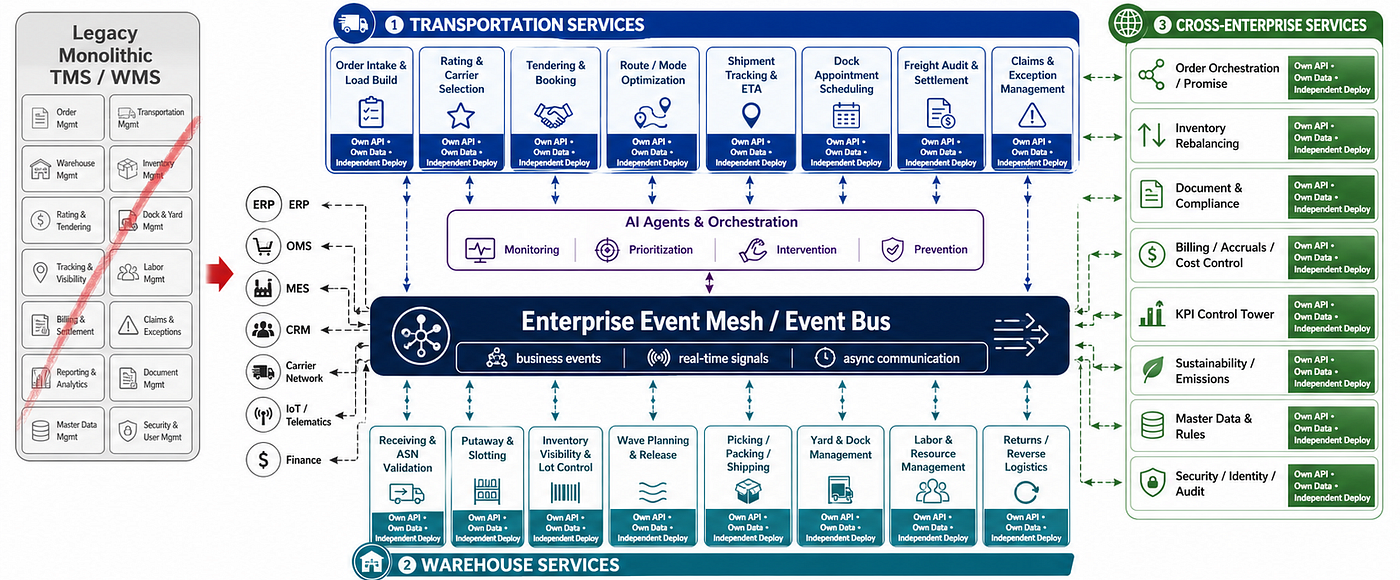
Each service should publish business events and subscribe to the events it needs. For example, the warehouse wave planning service should know about carrier cutoffs, order priority, labor capacity, automation status, inventory availability, and dock schedules. The transportation planning service should know about order readiness, warehouse constraints, dock capacity, carrier capacity, rate changes, and customer service commitments.
What needs to change inside enterprises
Most companies do not need to rip and replace every system to get there. But they do need to change their design philosophy.
- First, they need to stop treating integrations as point-to-point plumbing. Every integration should be evaluated as a possible business event stream.
- They need an enterprise event catalog. Business teams, not just IT teams, should be able to discover what events exist, what they mean, who owns them, and which KPIs they affect.
- They need to design for agent action. An event is useful only if something can respond to it. That means TMS, WMS, ERP, OMS, and MES systems need clean APIs for tendering, retendering, appointment changes, labor moves, inventory transfers, wave changes, claims, disputes, and customer notifications.
- They need guardrails. Agents must be observable, traceable, and limited by policy. Low-risk actions can be automated. Medium-risk actions can require supervisor approval. High-risk actions, such as expensive expedites, customer allocation changes, or financial write-offs, should route to humans with recommendations and evidence.
- They need closed-loop measurement. Every agent action should create follow-up events: what was recommended, what was approved, what was executed, what changed, and which KPI improved or deteriorated.
Conclusion
“TMS and WMS must become event-native, agent-monitored open platforms”
TMS and WMS platforms can no longer be designed as fixed platforms that assume stable processes, periodic batch updates, and human-managed exception queues. Logistics and manufacturing environments are too volatile, too interconnected, and too margin-sensitive for that model.
The future is a set of independent business processes and services that communicate through real-time events. Those events are governed, cataloged, observable, and tied directly to CFO-level KPIs. AI agents monitor them 24x7 for anomalies, prioritize the cases that matter most, intervene within policy, follow through until resolution, and recommend process changes to prevent recurrence.
The winning logistics architecture will not be defined by the prettiest dashboard. It will be defined by how quickly the enterprise can detect a financially material event, understand its business impact, trigger the right AI or human response, take action across systems, and measure the outcome.
In that world, TMS and WMS are not just execution systems. They become the real-time nervous system of profitable, reliable, and resilient supply chain operations.
메타데이터
- post_id
- 84d239fcfba8
- slug
- event-native-tms-and-wms-the-new-control-plane-for-agentic-logistics-84d239fcfba8
- url
- https://medium.com/@deepakkumar.eai/event-native-tms-and-wms-the-new-control-plane-for-agentic-logistics-84d239fcfba8
- canonical_url
- https://medium.com/@deepakkumar.eai/event-native-tms-and-wms-the-new-control-plane-for-agentic-logistics-84d239fcfba8
- author_url
- https://medium.com/@deepakkumar.eai
- status
- ok
- fetched_at
- 2026-06-09 15:37:30