From Clay Tablets to AI: Has Education Ever Changed?
The primary question for this short historical excursion is whether the technologies ‘actually’ transform the education process or we have…
From Clay Tablets to AI: Has Education Ever Changed?

The primary question for this short historical excursion is whether the technologies ‘actually’ transform the education process or we have been adapting the same core principles to the technologies. It should be noted, that despite the stress on technologies, in most cases it is nigh impossible (and disingenuous) to decouple technological influences on education from societal processes, and from developments in the study of pedagogy itself.
Here, I’ll provide a (very) brief overview of the important historical milestones pertaining to education technologies. For the purposes of this article, ‘education’ is understood as ‘sharing of knowledge.’
Throughout the vast majority of human history, the oral transmission of knowledge dominated.
After the invention of language itself, the next technological milestone relevant in our discussion is the invention of writing (the oldest known writing system was invented in Mesopotamia circa 3000 BCE). However, the educational uses were limited for lack of a an accessible and convenient medium (papyrus and clay tables were expensive and difficult to transport and spread). Parchment was, likewise, very expensive and its use was limited.
To the rescue came papermaking, invented in China around 150 CE and spreading throughout Asia, notably along the Silk Road, reaching Europe only around 11th century. Paper was light, (relatively) cheap, and durable, which accelerated the creation and spread of written documents. The adoption of paper was, as one scholar called it, “revolutionary” (Shatzmiller 2018), in the way it transformed the spread and dissemination of knowledge.
Perhaps the biggest technological leap in the history of the spreading of knowledge came with the invention of the printing press. As Eiseinstein (1979) points out in her extensive research, it further massively increased the availability and the speed of creation of written documents, reduced the possibilities for human errors and transformed written documents into “silent instructors:”
The ‘carriers of life in the exact sciences’ consisted more and more of equations, diagrams, tables, maps and charts that could not be conveyed by lecture or disputation and that required silent scanning to be comprehended and absorbed. Instead of taking dictation from masters, college students became increasingly able to learn mathematics by teaching themselves (535).
With the way opened for the standardization of printed texts, the printing press also laid the groundwork for the subsequent institutionalization of education
During the Industrial Revolution, modern forms of education were introduced, characterized by age-based classrooms, time constraints, standardized assessment methods, and top-down instruction. In some ways it was the reversal of freedoms allowed students by the printing press. Under the philosophies of industry, schools were modeled after factories, intended to produce obedient workers. It also returned the role of the instructor as the primary educator. While the availability of print brought about by the printing press created new ways of collaboration and a “process of feedback” between the learners and teachers (Eisenstein 631), the industrial model of education put an emphasis on uniformity and limited exploration.
Soon came some new technologies which were expected to revolutionize education:
Radio, which was primarily used to listen to important speakers or programs while still being in the classroom;
While radio was not as successful in education as some had hoped, TV presented a fresh start (Novak 2012).
A 1935 article in Short Wave Craft included the image below and proclaimed “The scene will be a commonplace one tomorrow, without a doubt” (qtd. in Novak)

“As the illustration shows we will undoubtedly have lectures of every conceivable kind present to us right in our homes, when practical television arrives, possibly a year or two off. Mathematics, geometry, and dozens of other subjects will be “apple pie”” (qtd. in Novak).
Not dissimilar to the way radio education was viewed a couple of decades prior, the use of TV in education was likewise viewed primarily as a medium for a lecturer to transmit their teaching. In other words, it was still rooted in the dependence on the human mentor.
Some honorable mentions of technological inventions used in education:
Chalkboard (1801);
Magic lantern (17th century) — an early slide projector, used in education until the middle of the 20th century.
Since the invention of the Internet, the role of the educator has been gradually redefined as “a designer of learning environments, with an emphasis on personalization and experiential learning” (Karaoulas 2025). The learner is some freedoms which were not available to them in the standardized institutional education prior. There is an increased emphasis on collaboration and learning as opposed to memorizing.
Knowledge is not merely transmitted; it is actively co-constructed by the learner (Karaoulas 2025)
The widespread adoption of AI technologies in the form of LLMs has been the most recent technological development impacting education. These tools offer the possibility for learning materials tailor-made for the needs of each individual student. This emphasizes the role of the teacher as a mentor and a supervisor of the education process. Despite the possibilities presented by personalized AI-driven learning, it does not replace the relationship between the teacher and learner.
Despite the evolution of the role of the educator, Karaoulas (2025) concludes that:
education has always been a field of relationships and dialogue, with technology emerging in various periods as a tool for reorganization rather than a replacement of the human factor
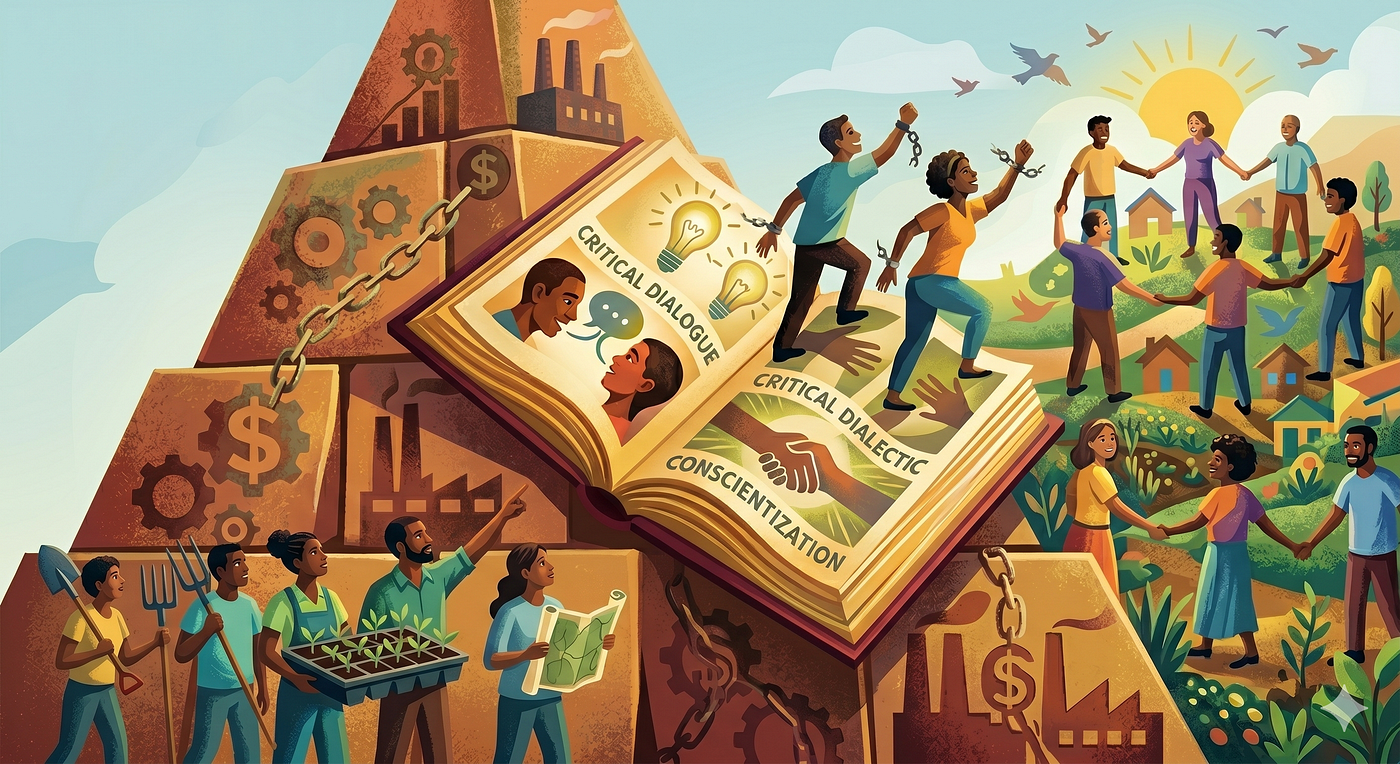
So, has the education ever really changed? Perhaps, probably not. Dominant approaches may have underwent some adjustments and evolution, new technologies presented new tools with which to approach learning and teaching, but, fundamentally, they are based on
the foundational core of pedagogical thought, as shaped by thinkers from Comenius, Rousseau, and Pestalozzi to Freire, Dewey, and Illich. Pedagogical essence is not defined by method or medium, but by intention, relationship, and the forms of meaning-making that link teacher, student, and world. (Karaoulas 2025).
Sources used:
Gemini (research, illustration)
Eisenstein, E. L. (1979). The Printing Press as an Agent of Change. Cambridge University Press.
Halper, D. L. (2021, September 15). Can Radio Really Educate? JSTOR Daily. https://daily.jstor.org/can-radio-really-educate/
KARAOULAS, A. (2025). SUPERVISION AND TEACHING IN EDUCATION: HISTORICAL DEVELOPMENT AND CONTEMPORARY TRANSFORMATION IN THE DIGITAL AGE. International Journal of Research in Education Humanities and Commerce, 06(03), 73–91. https://doi.org/10.37602/ijrehc.2025.6306
Novak, M. (2012, May 29). Predictions for Educational TV in the 1930s. Smithsonian Magazine. https://www.smithsonianmag.com/history/predictions-for-educational-tv-in-the-1930s-107574983/
Shatzmiller, M. (2018). The Adoption of Paper in the Middle East, 700–1300 AD. Journal of the Economic and Social History of the Orient, 61(3), 461–490. https://www.jstor.org/stable/26572311
메타데이터
- post_id
- 84d7ebe3dad3
- slug
- from-clay-tablets-to-ai-has-education-ever-changed-84d7ebe3dad3
- url
- https://medium.com/edtech-kisk/from-clay-tablets-to-ai-has-education-ever-changed-84d7ebe3dad3
- canonical_url
- https://medium.com/edtech-kisk/from-clay-tablets-to-ai-has-education-ever-changed-84d7ebe3dad3
- author_url
- https://medium.com/@voise37
- status
- ok
- fetched_at
- 2026-06-16 19:09:56