On network protocols — OSPF, IS-IS, BGP, PIM, IGMP, MPLS, LDP, RSVP, SR
Here’s a detailed breakdown of each protocol with diagrams:
On network protocols — OSPF, IS-IS, BGP, PIM, IGMP, MPLS, LDP, RSVP, SR
Here’s a detailed breakdown of each protocol with diagrams:
OSPF — Open Shortest Path First
Open Shortest Path First A link-state interior gateway protocol (IGP) used within a single autonomous system (AS). Routers share topology information and each calculates the shortest path using Dijkstra’s algorithm. Widely used in enterprise and ISP core networks.
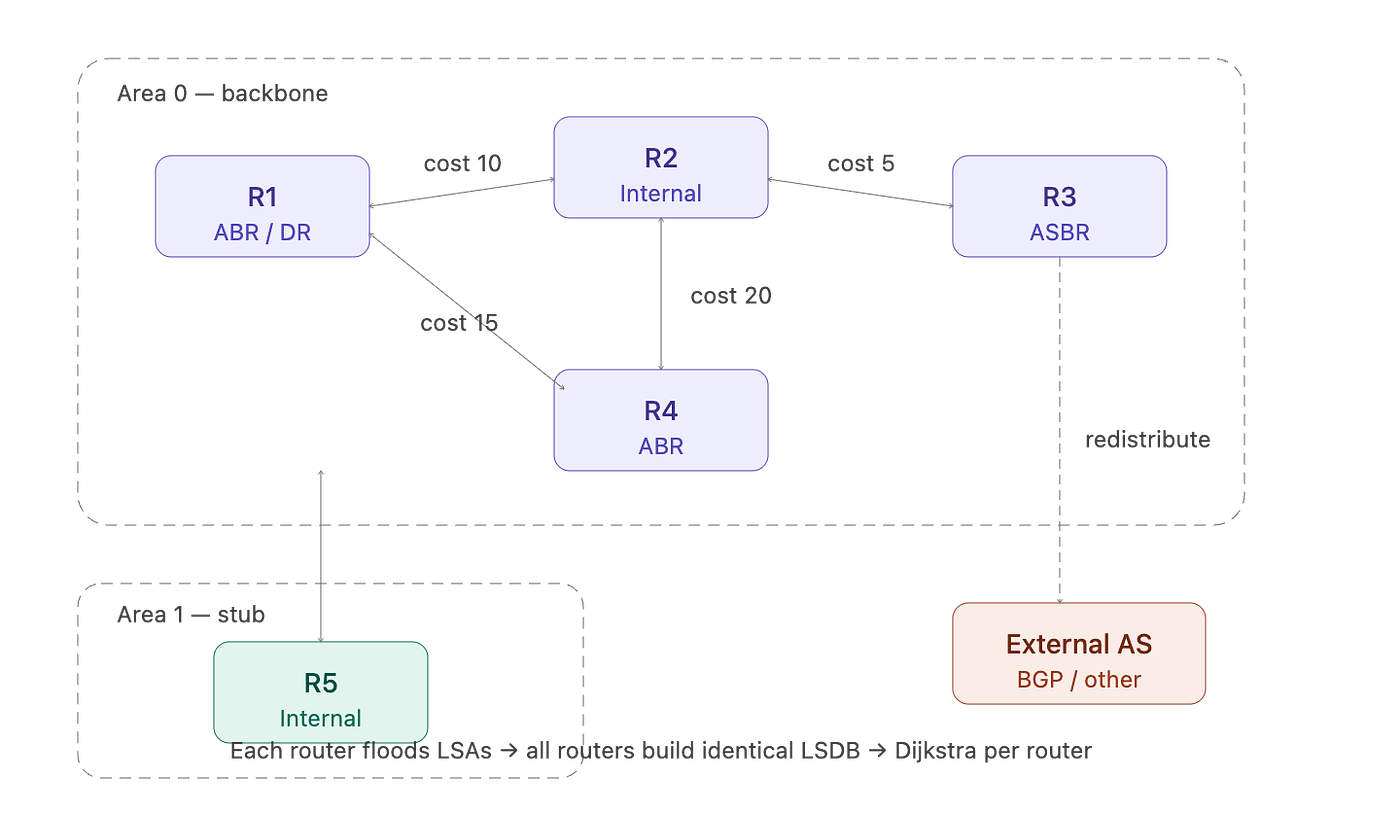
OSPF is a link-state IGP. Every router sends Link State Advertisements (LSAs) describing its directly connected links and their costs. These flood across the area until every router has an identical Link State Database (LSDB). Each router independently runs Dijkstra’s shortest-path algorithm on that database to compute its own routing table. Areas keep flooding under control — Area 0 is the mandatory backbone, and all other areas must connect to it (via Area Border Routers). OSPF reacts quickly to topology changes and supports VLSM natively.
IS-IS — Intermediate System to Intermediate System
Intermediate System to Intermediate System Another link-state IGP, similar to OSPF but originally designed for OSI networks. It’s preferred by many large ISPs and carriers because it’s protocol-agnostic (runs directly over Layer 2, not IP) and scales well.

IS-IS uses the same link-state / Dijkstra approach as OSPF but has a key architectural difference: it runs directly over Layer 2 rather than over IP. This makes it protocol-agnostic (it can carry IPv4, IPv6, or CLNS routes simultaneously) and very resilient. Its two-level hierarchy — Level 1 for intra-area and Level 2 for inter-area — maps roughly to OSPF areas but uses a flat address format called a NET (Network Entity Title). IS-IS scales exceptionally well, which is why many of the world’s largest carrier backbones prefer it over OSPF.
BGP — Border Gateway Protocol
Border Gateway Protocol The routing protocol of the internet. A path-vector protocol used between autonomous systems (eBGP) or within them (iBGP). It makes routing decisions based on policies, path attributes, and rules rather than just shortest path. Every ISP uses it.

BGP is the routing protocol of the internet. It connects Autonomous Systems (ASes) — each AS is an independently administered network with its own routing policy. BGP is a path-vector protocol: rather than advertising costs, it advertises the full AS_PATH a route traverses, which inherently prevents loops. Key attributes like LOCAL_PREF, MED, COMMUNITY, and AS_PATH length drive policy-based route selection. eBGP runs between different ASes (usually directly connected); iBGP runs within an AS to carry external routes internally, requiring a full mesh or a route reflector.
PIM & IGMP — Multicast Routing
PIM — Protocol Independent Multicast Used to route multicast traffic (one-to-many). “Protocol independent” means it works with any unicast routing protocol. Comes in two main modes: Sparse Mode (PIM-SM) for wide-area multicast and Dense Mode (PIM-DM) for local flooding.
IGMP — Internet Group Management Protocol Used by hosts (end devices) to tell their local router they want to join or leave a multicast group. PIM handles multicast routing between routers; IGMP handles the host-to-router signaling.

IGMP (host-to-router) and PIM (router-to-router) work together to deliver one-to-many traffic efficiently. A host sends an IGMP membership report to join a multicast group. The local router then uses PIM Sparse Mode to send join messages toward the Rendezvous Point (RP), building a shared tree. Once traffic is flowing, a router can switch to a source-specific shortest-path tree for efficiency. Branches where no host has joined are pruned, so traffic is only replicated where it’s actually wanted — making multicast far more efficient than unicast-to-each-receiver.
MPLS & LDP — Label Switching
MPLS — Multiprotocol Label Switching Instead of routing packets by IP address at every hop, MPLS assigns short fixed-length labels to packets at ingress and switches them by label through the network. Much faster forwarding, and enables VPNs, traffic engineering, and QoS.
LDP — Label Distribution Protocol The signaling protocol that routers use to automatically distribute and negotiate MPLS labels with each other. It maps IP prefixes to labels to build Label Switched Paths (LSPs) — essentially MPLS tunnels.

MPLS replaces per-hop IP lookups with a much faster label swap operation. At the ingress Label Edge Router (LER), a packet is classified into a Forwarding Equivalence Class (FEC) and a short label is pushed onto it. Core P routers only look at the label — no IP routing table lookup — and swap it for the next label. The egress LER pops the label and delivers by IP. LDP is the glue: it runs alongside OSPF/IS-IS, maps each IP prefix to a label, and distributes those bindings to all routers in the domain. Every router builds a Label Forwarding Information Base (LFIB) from these bindings.
RSVP-TE — Traffic Engineering Tunnels
RSVP-TE — Resource Reservation Protocol — Traffic Engineering An older signaling protocol for setting up MPLS tunnels with explicit path control and bandwidth reservation. You can tell it exactly which links to use and how much bandwidth to reserve. Still widely deployed, though being replaced in many networks.

RSVP-TE extends the original RSVP signaling protocol to set up MPLS tunnels with explicit paths and bandwidth reservations. The ingress router sends a PATH message carrying an Explicit Route Object (ERO) that lists exactly which routers to traverse — overriding normal shortest-path routing. The egress router sends back a RESV message that reserves bandwidth at every hop, creating a guaranteed-capacity pipe. Each tunnel has a priority and preemption value so higher-priority tunnels can reclaim bandwidth from lower-priority ones. RSVP-TE is powerful but operationally complex — every router must maintain per-tunnel state, and failures require re-signaling.
Segment Routing (SR)
SR — Segment Routing A modern approach to traffic engineering. Instead of complex per-flow signaling like RSVP-TE, SR encodes the entire path as a stack of segments (labels or IPv6 headers) in the packet itself. Much simpler, more scalable, and increasingly the standard for modern networks. Comes in two flavors: SR-MPLS and SRv6 (IPv6-based).

Segment Routing is the modern replacement for RSVP-TE. The key insight: instead of signaling a path to every router along the way (and requiring them to store per-tunnel state), SR encodes the entire path as a stack of segments directly in the packet header at the source. Each router simply pops the top segment and forwards accordingly — no per-flow state anywhere in the network core.
There are two flavors. SR-MPLS uses the existing MPLS label stack — a Node SID is a global label for a router, an Adjacency SID targets a specific link. SRv6 encodes segments as IPv6 addresses in a new Segment Routing Header, enabling richer programmability and native IPv6 operation. SR is distributed through IGPs (OSPF/IS-IS carry the SID advertisements), so there’s no separate LDP or RSVP-TE infrastructure to maintain — a major operational simplification.

메타데이터
- post_id
- 84dc8b8d3c6f
- slug
- on-network-protocols-ospf-is-is-bgp-pim-igmp-mpls-ldp-rsvp-sr-84dc8b8d3c6f
- url
- https://medium.com/@tjskrishna/on-network-protocols-ospf-is-is-bgp-pim-igmp-mpls-ldp-rsvp-sr-84dc8b8d3c6f
- canonical_url
- https://medium.com/@tjskrishna/on-network-protocols-ospf-is-is-bgp-pim-igmp-mpls-ldp-rsvp-sr-84dc8b8d3c6f
- author_url
- https://medium.com/@tjskrishna
- status
- ok
- fetched_at
- 2026-06-10 18:44:10
