The Outsourcing of Grounding
Generative AI and the Decline of Cognitive Discipline
The Outsourcing of Grounding
Generative AI and the Decline of Cognitive Discipline
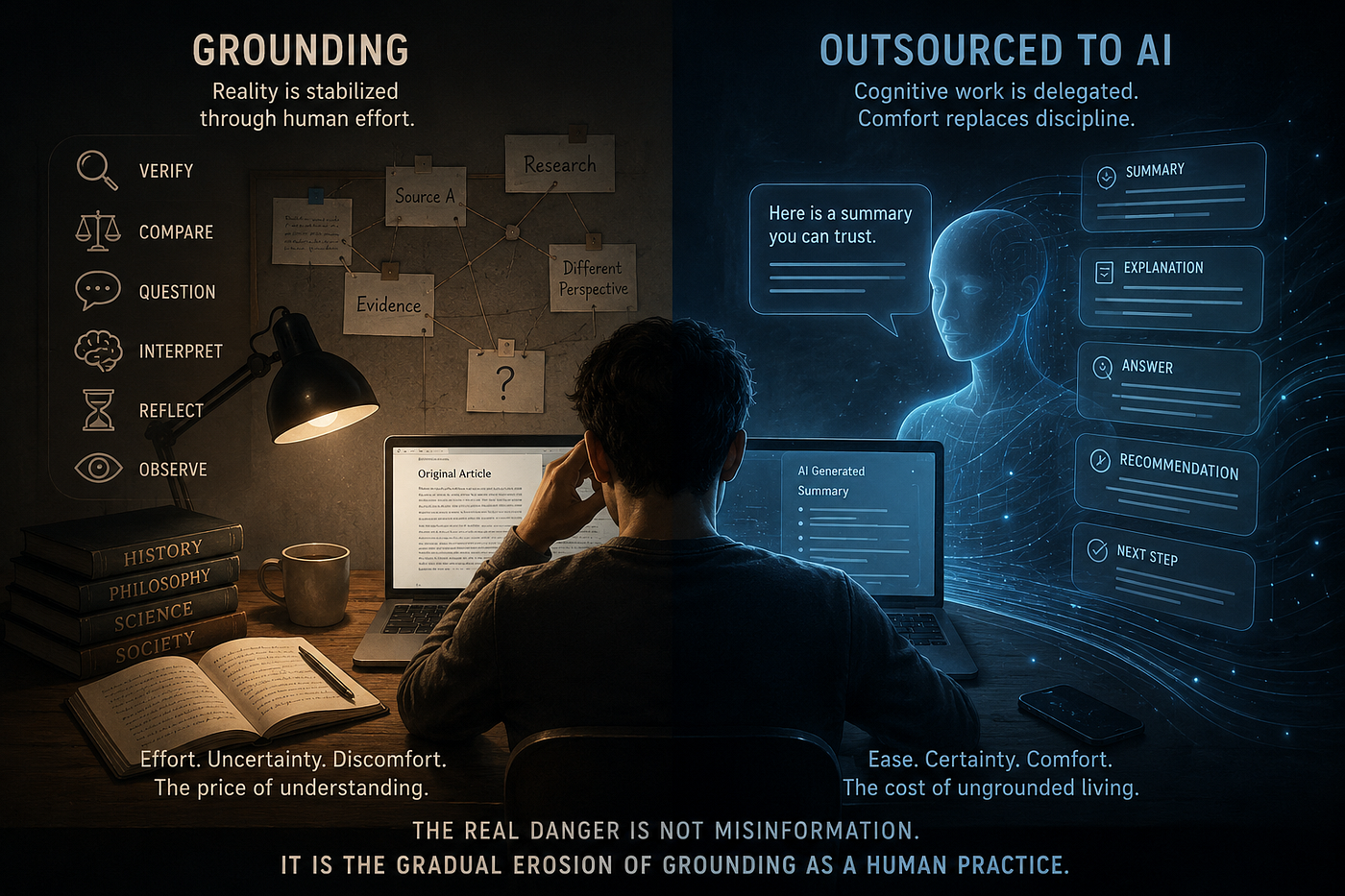
Abstract
Much of the public debate surrounding artificial intelligence focuses on misinformation, bias, and automation. While these concerns are important, they may obscure a deeper transformation taking place beneath the surface of everyday technological life. This paper argues that the most significant impact of generative AI is not simply the production of false or synthetic information, but the gradual erosion of grounding as a human cognitive practice. Historically, human beings maintained stable access to reality through active practices of verification, comparison, interpretation, and attentional discipline. Generative AI increasingly alters these practices by offering frictionless synthesis, instant interpretation, and cognitively efficient outputs that reduce the need for sustained engagement with uncertainty. The result is not merely epistemic instability, but a transformation in the conditions under which human cognition relates to reality itself.
1. Introduction: Beyond Misinformation
Public discussions about generative AI often revolve around a familiar set of concerns:
- misinformation
- deepfakes
- hallucinations
- propaganda
- manipulation
These are serious issues. However, focusing exclusively on the truth or falsity of AI-generated outputs risks missing a more profound transformation.
The deeper issue may not be that AI produces unreliable information.
It may be that AI changes the human practices that historically allowed reality to become cognitively stable in the first place.
This distinction matters.
Human beings do not access reality passively. Reality is stabilized through active cognitive practices such as:
- verification
- comparison
- interpretation
- attentional effort
- and sustained engagement with ambiguity
These practices constitute what this paper refers to as grounding.
The argument developed here is that generative AI increasingly encourages the outsourcing of these grounding practices to automated systems.
The danger, therefore, is not only informational distortion.
It is the gradual decline of cognitive discipline itself.
2. What Is Grounding?
Grounding refers to the set of cognitive and social practices through which humans stabilize perception, judgment, and understanding in relation to reality.
Grounding is not equivalent to certainty.
Rather, it is the ongoing process by which individuals test, compare, revise, and situate their interpretations against:
- evidence
- other perspectives
- lived experience
- and the resistance of the world itself
Historically, grounding required effort.
It demanded:
- attentional patience
- interpretive labor
- memory
- skepticism
- and tolerance for uncertainty
To know something was rarely instantaneous.
Knowledge emerged through processes of engagement.
In this sense, grounding is not merely epistemological.
It is disciplinary.
It forms part of the cognitive habits through which human beings maintain orientation within reality.
3. Generative AI and Cognitive Offloading
Generative AI systems fundamentally alter the relationship between humans and cognitive effort.
Increasingly, individuals rely on AI systems to:
- summarize information
- synthesize arguments
- interpret complexity
- generate explanations
- organize knowledge
- and even formulate emotional responses
This process can be described as cognitive offloading: the delegation of mental tasks to external systems.
Cognitive offloading itself is not new. Writing, calculators, search engines, and digital media all externalized aspects of cognition.
However, generative AI differs in an important respect.
Previous technologies primarily stored or retrieved information.
Generative systems increasingly perform acts of interpretation and synthesis on behalf of the user.
This distinction is critical.
The issue is no longer simply memory assistance.
It is the outsourcing of interpretive labor itself.
4. Verification Fatigue and Passive Cognition
One consequence of this shift is the emergence of what may be termed verification fatigue.
As the volume, speed, and plausibility of generated outputs increase, individuals become less willing to continuously verify information independently.
This produces several effects:
4.1 Passive Cognition
Users increasingly accept synthesized outputs without sustained engagement.
4.2 Decline of Interpretive Discipline
The effort required to critically interpret information weakens over time.
4.3 Reduced Attentional Endurance
Continuous exposure to frictionless outputs diminishes tolerance for ambiguity and cognitive difficulty.
4.4 Dependency on Generated Synthesis
Users increasingly rely on AI systems not merely for information, but for orientation itself.
These shifts do not necessarily occur consciously.
They emerge gradually through repeated interaction with systems optimized for efficiency, speed, and cognitive convenience.
5. The Shift from Grounded Cognition to Assisted Cognition
Historically, cognition was constrained by the necessity of engagement.
Humans had to:
- search
- compare
- verify
- interpret
- and remain cognitively active in relation to uncertainty
Generative AI increasingly alters this condition by making interpretation immediate and frictionless.
This creates a subtle transition:
from grounded cognition to continuously assisted cognition
The issue is not that assistance exists.
The issue is that assistance increasingly replaces rather than supports grounding practices.
Over time, this may transform how humans relate to reality itself.
6. The Psychological Dimension
The outsourcing of grounding is not merely epistemological.
It is psychological.
Grounding practices historically contributed to the development of:
- attentional discipline
- cognitive resilience
- interpretive patience
- critical reflection
- and tolerance for uncertainty
As these practices weaken, cognition becomes increasingly oriented toward:
- immediacy
- cognitive ease
- emotional efficiency
- and externally generated interpretation
This has important implications for human formation.
People may gradually lose not intelligence itself, but the habits that sustain independent cognitive orientation.
7. The Ethical Problem
Most AI ethics frameworks focus on:
- fairness
- bias
- transparency
- safety
- and misinformation
These are necessary concerns.
However, the outsourcing of grounding introduces a deeper ethical issue:
What happens when technologies reshape the cognitive disciplines through which humans maintain reality orientation?
This moves AI ethics beyond questions of harm alone.
It becomes a question of human formation.
The concern is not simply whether AI produces falsehood.
It is whether humans gradually lose the practices that historically allowed them to distinguish, stabilize, and critically engage reality at all.
8. Grounding as a Human Practice
One of the most important insights of this discussion is that grounding is not automatic.
It is practiced.
Human beings historically developed reality orientation through:
- dialogue
- disagreement
- comparison
- evidence
- embodied interaction
- and sustained cognitive effort
Generative systems increasingly mediate these processes.
The danger is therefore not only synthetic content.
It is the possibility that grounding itself becomes externally managed.
At that point, humans may no longer simply use systems for assistance.
They may begin to rely on systems to perform the work of reality stabilization on their behalf.
9. Conclusion
The greatest danger posed by generative AI may not be misinformation alone.
It may be the gradual erosion of grounding as a human cognitive discipline.
Generative systems do more than produce content.
They increasingly shape:
- attention
- interpretation
- cognitive effort
- and the conditions under which reality becomes meaningful
This transformation is subtle because it does not eliminate human cognition.
Instead, it gradually reorganizes it around systems optimized for efficiency and synthesis.
The question is therefore no longer only:
“Is this information true?”
The deeper question becomes:
“What happens when humans stop practicing the cognitive disciplines that historically grounded their relationship to reality?”
That is the ethical and psychological challenge emerging at the center of the generative AI age.
References
Martin Heidegger (1977). The Question Concerning Technology. Harper & Row.
Bernard Stiegler (1998). Technics and Time, 1: The Fault of Epimetheus. Stanford University Press.
Luciano Floridi (2014). The Fourth Revolution: How the Infosphere is Reshaping Human Reality. Oxford University Press.
Shoshana Zuboff (2019). The Age of Surveillance Capitalism. PublicAffairs.
Antonio Damasio (1999). The Feeling of What Happens: Body and Emotion in the Making of Consciousness. Harcourt Brace.
메타데이터
- post_id
- 84df9becfc81
- slug
- the-outsourcing-of-grounding-84df9becfc81
- url
- https://medium.com/where-thought-bends/the-outsourcing-of-grounding-84df9becfc81
- canonical_url
- https://medium.com/where-thought-bends/the-outsourcing-of-grounding-84df9becfc81
- author_url
- https://medium.com/@mdthusi
- status
- ok
- fetched_at
- 2026-06-15 20:49:13