A Pig With 1.5 Million Followers Taught Me Why Big Influencers Don’t Trust Small Brands
I offered her seven times more than Amazon was paying. She still picked Amazon. Here’s what that taught me about how successful creators…
A Pig With 1.5 Million Followers Taught Me Why Big Influencers Don’t Trust Small Brands
I offered her seven times more than Amazon was paying. She still picked Amazon. Here’s what that taught me about how successful creators actually think.
This is a true story from my Amazon brand last year, and it changed how I think about influencer commissions for the rest of time.
A famous pet pig with 1.5 million TikTok followers turned down my 30% affiliate commission and chose to promote my product through Amazon Associates instead, at roughly 4%.
She was nice about it. She loved the product. She still picked the lower-paying option.
For weeks I couldn’t figure out why. When I finally did, it changed how I structure every creator partnership my brand runs, and it’s the reason I ended up building Coral.ax.
This is the long version of a post I shared on Reddit, restructured as a Q&A so you can skim it, save it, and apply the lesson to your own brand.
The Story
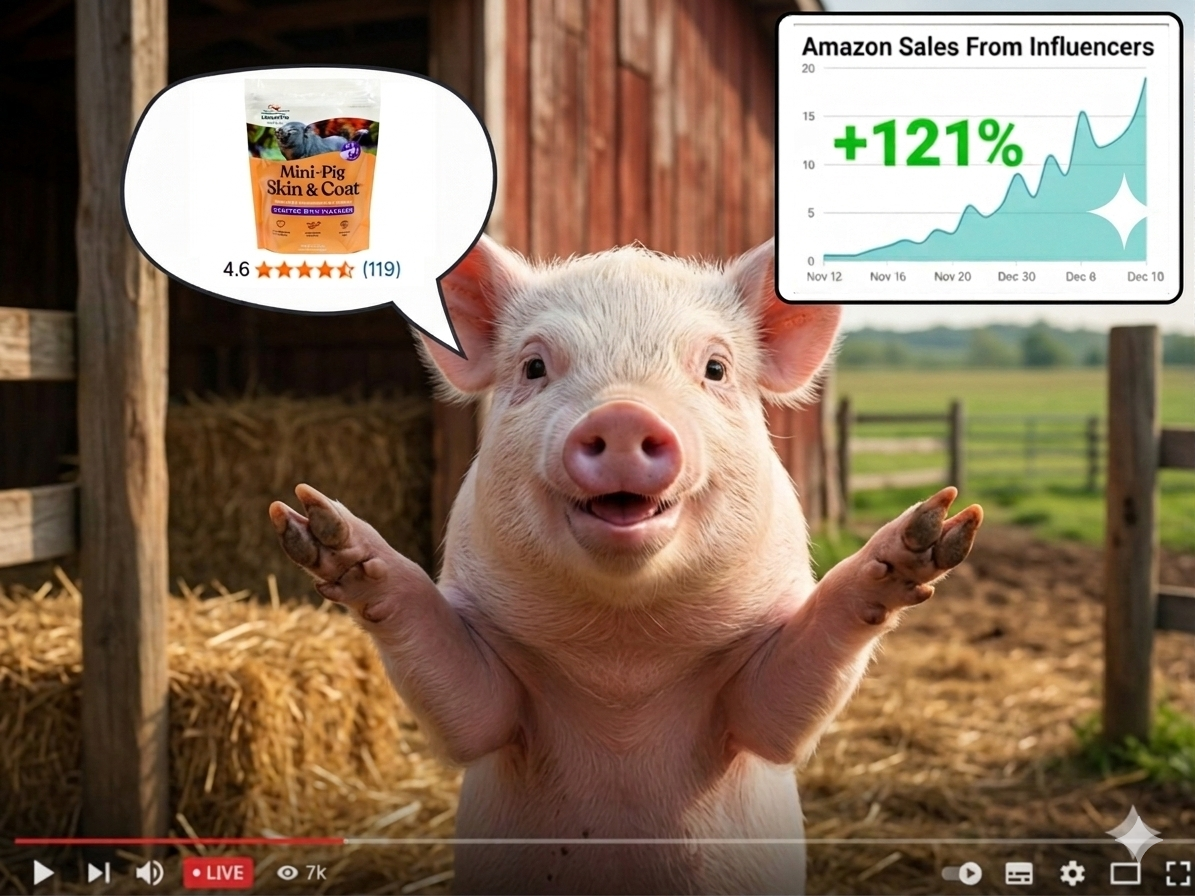
In 2025 I launched a new SKU in the pet space. A treat dispenser, slightly different from anything else on Amazon. To get the launch moving I reached out to hundreds of small Instagram creators in the 5,000 to 50,000 follower range, offering to send the product for free in exchange for honest feedback.
Dozens of them posted on launch day. The product moved.
One of those creators was Mina. She had a dog account with 6,000 followers. I shipped her the product, waited a week, and followed up.
She replied:
“OMG MY PIG LOVES IT!”
Wait. What?
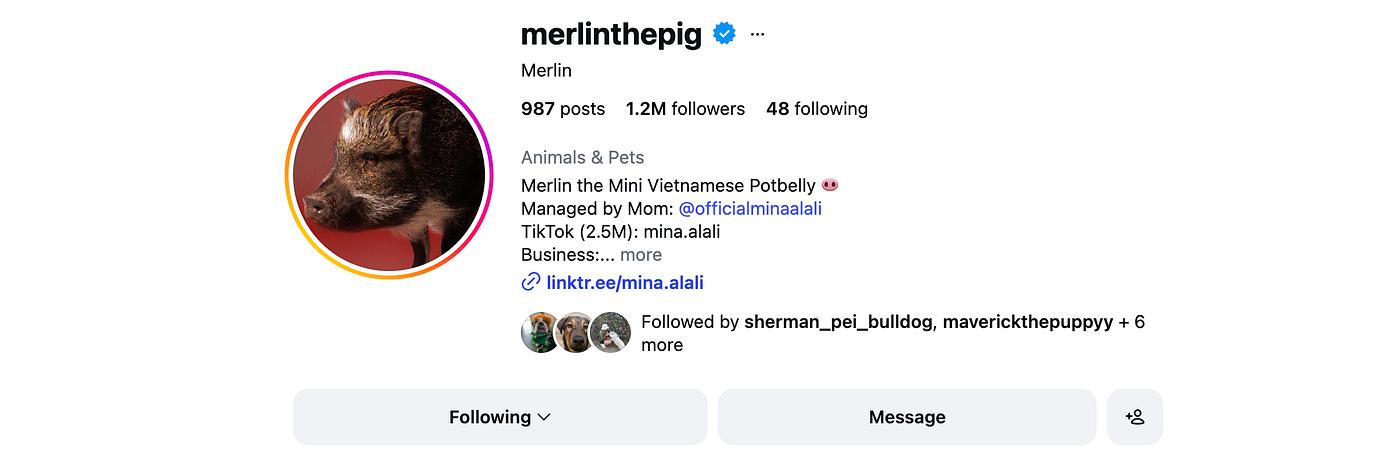
It turns out Mina has a dog with 6,000 followers, but she also has a pet pig named Merlin with 1.5M followers on Instagram and over 2.5 million on TikTok. He’s adorable. Merlin loved the treat dispenser and Mina wanted to post about it.
I was thrilled.
At the time I was offering every creator who agreed to post a 30% affiliate commission, paid manually. I generated Amazon Attribution links one at a time, screenshotted the dashboard for each creator, and sent payouts through Venmo or PayPal. With small creators it worked fine. The volume was low and they trusted my screenshots.
Mina didn’t want the 30%.
She preferred to post using Merlin’s Amazon Associates link, which pays her roughly 4%.
I had offered seven times more, and lost the deal anyway.
Why She Said No
I asked her, gently, why. She was honest about it. Two reasons.
Reason 1: Certainty of payment.
Amazon was going to pay Merlin no matter what. My brand was an unknown to her. She had no way of knowing if a small Amazon seller she’d never heard of would actually wire $4,000 in commissions to her PayPal at the end of the month. With Amazon Associates, that risk doesn’t exist.
Reason 2: Visibility into her own performance.
With Amazon Associates, Mina could see exactly how many of Merlin’s posts converted, on her own dashboard, in real time. With my setup, she had to wait for me to send screenshots. That works at 5 sales a month. It doesn’t work at 500.
The actual commission rate was the third or fourth thing she cared about. The first two were trust and transparency.
For a small hobby creator driving 3 to 5 sales per month, 30% of a few hundred dollars beats 4% any day. The dollar amount is small enough that the trust gap doesn’t matter much. Either commission is fun money.
For a creator like Mina, driving real volume, the calculus inverts completely. 30% of a number she can’t verify, paid by a brand she doesn’t know, beats 4% of a number Amazon shows her in real time and pays her on a schedule she trusts. Except it doesn’t. Not for her.
The Insight
Big influencers value certainty of getting paid over the size of the commission.
I had assumed that offering 30% versus 4% was a no-brainer. It is, for small creators who post as a hobby. It absolutely isn’t, for creators driving meaningful volume.
The bigger the influencer, the more this matters.
At Mina’s scale, she was effectively making a risk-adjusted decision: a verified 4% versus an unverified 30%. The verified number wins.
Amazon Associates, which most direct partnerships beat on raw rate, ends up being the default for almost every successful creator I’ve talked to since. Not because creators don’t understand the math. Because they understand it perfectly.
What This Means for Your Brand
Q: Does this mean I shouldn’t bother with direct affiliate partnerships?
No. It means you have to remove the trust gap that’s blocking the partnership from competing with Amazon Associates in the first place.
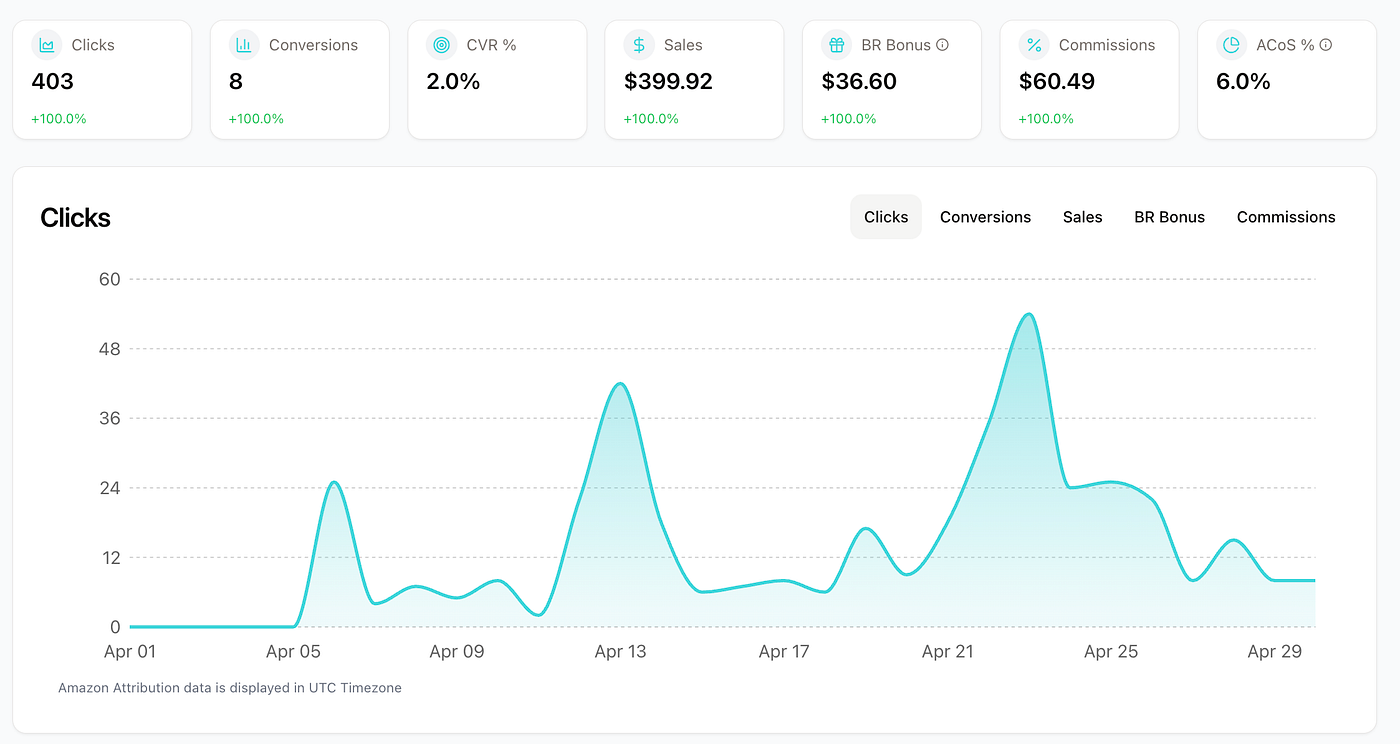
That’s a tooling problem. If your creators can see their own attribution data live, on a dashboard that pulls from Amazon Attribution directly, and if their payouts arrive automatically on a predictable schedule, then your higher commission rate becomes the deciding factor again.
Without that, you’re competing against Amazon’s reputation with screenshots and Venmo. Amazon wins that comparison every single time.
Q: How big does an influencer have to be before this matters?
Anywhere above roughly 50,000 engaged followers in a niche, the math starts to flip.
Below that, creators are usually fine with manual payouts and screenshots because the dollar amounts are small and the relationship feels personal. Above that, they’ve almost certainly been burned by a brand at least once, or know someone who has, and the trust math takes over.
By the time you’re talking to a creator with 500K plus followers, you have to assume Amazon Associates is your real competitor, not other DTC brands.
Q: Why do big creators trust Amazon over a brand offering 7x more?
Because Amazon has a multi-decade track record of paying out, a public dashboard, automated payment schedules, and a customer service team a creator can reach if anything goes wrong.
A small Amazon seller has none of that, by default.
You can have all of it though. It’s just a tooling decision.
Q: How do I make my affiliate program competitive with Amazon Associates?
Three things, in order of importance.
- Real-time visibility into the creator’s own attribution data. Not screenshots. Not a monthly summary. The same numbers you see, when you see them.
- Automated payouts on a predictable schedule, not manual transfers when you remember.
- A higher commission rate. This only matters once the first two are in place.
The first two are why I built Coral after the Mina story.
Creators on the platform see the same Amazon Attribution data I see, payouts run automatically, and the higher commission rate finally has a chance to do its job.
Q: What about creators who already have Amazon Associates? Can I still win them?
Yes, and the conversation is actually simpler than you’d think.
Most creators don’t realize that they can run a direct brand partnership and still maintain their Amazon Associates account for everything else. They can use a brand-specific affiliate link for your product and their Associates link for everything else.
Once they trust your tooling, picking up the higher commission on your specific product is an obvious upgrade. The blocker is almost never the conversation. It’s the trust.
A Side-by-Side That Makes the Math Obvious
Here’s the comparison from Mina’s side, for a creator at her volume.
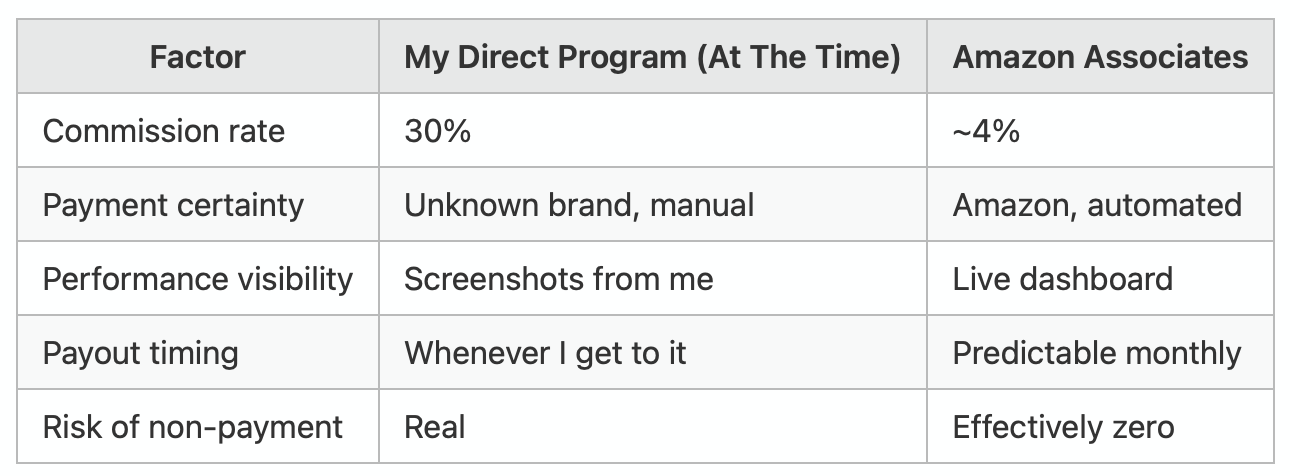
When you read it like this, the choice isn’t surprising. The 4% option is the rational one for any creator driving volume.
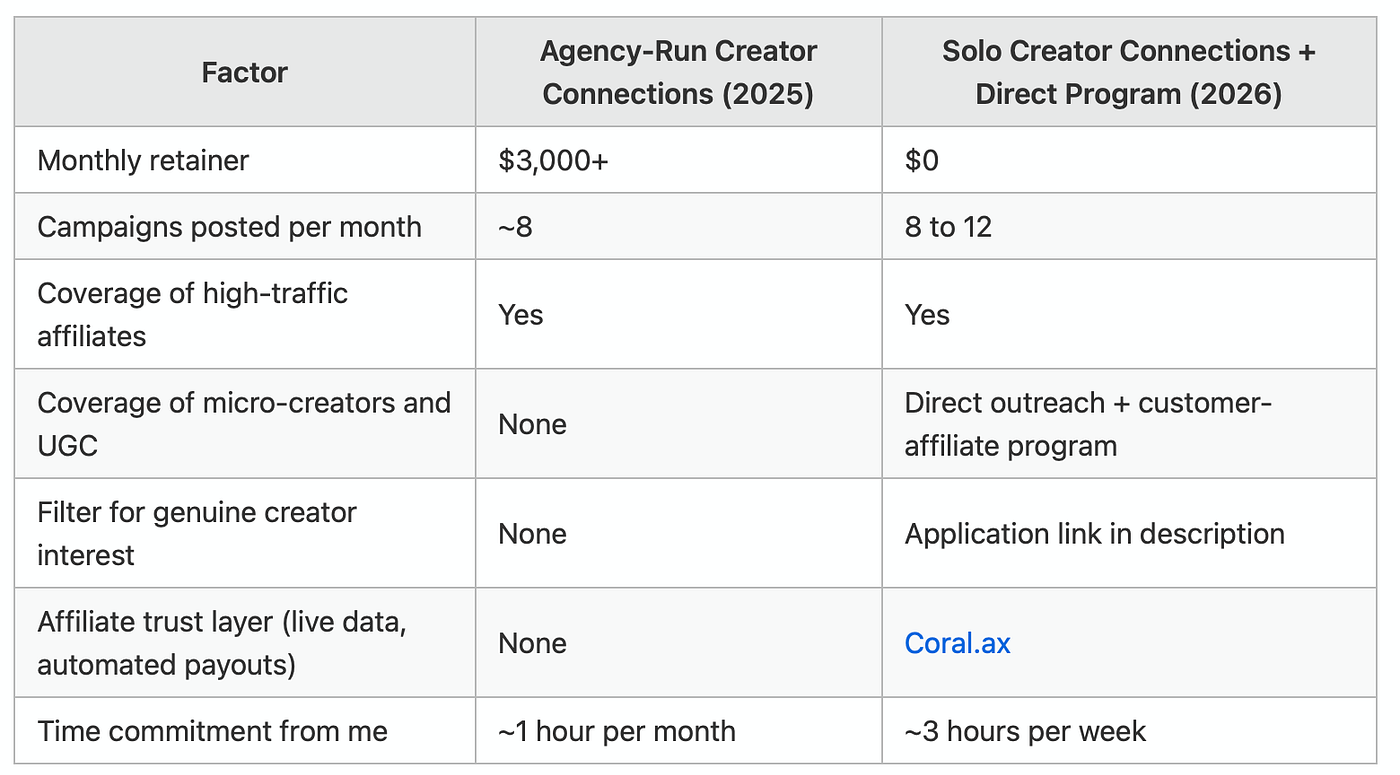
Now look at the same comparison with Coral.ax:
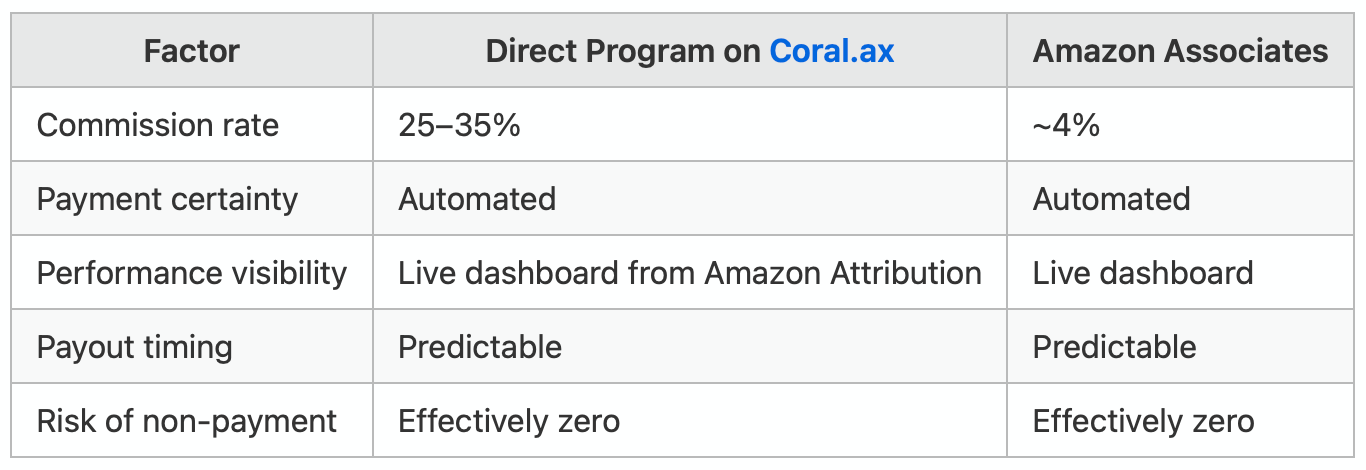
Once payment certainty and visibility are equal, the commission rate is the only differentiated variable left. And 30% beats 4%.
Warning Signs Your Affiliate Program Is Losing to Amazon Associates
If any of these are true, you’re not actually competing for serious creators:
- You generate Amazon Attribution links manually, one creator at a time.
- You screenshot dashboards and email or DM the numbers.
- You pay creators through Venmo or PayPal when you remember to.
- Your creators have no way of seeing their own performance in real time.
- You don’t have a written commission schedule that creators see before signing up.
- A creator has ever had to follow up with you for a payment.
Each one of these is a reason for a creator at scale to pick Amazon Associates instead.
TL;DR
- Big creators value certainty of payment over commission size.
- A 4% verified, automated payment beats a 30% unverified, manual one.
- Your affiliate program is competing with Amazon Associates, not other brands.
- To win, equalize on trust and transparency. Real-time data, automated payouts, predictable schedule.
- Once trust is equal, your higher commission rate becomes the deciding factor.
- Coral.ax is the tool I built to solve this end to end.
Frequently Asked Questions
Why do small creators still accept manual payouts and screenshots?
Because the dollar amounts are small enough that the relationship outweighs the risk. A creator earning $80 a month from your brand mostly cares about feeling appreciated. A creator earning $8,000 a month is running a business and treats your brand as a vendor.
Did Merlin the Pig actually drive sales for your product?
Yes, and I can’t tell you exactly how many because Amazon Associates hides that number from the brand. But to this day I still get product reviews from customers writing about how their pet pig loves the treat dispenser. So, more than zero.
Should I just give up and accept that creators will use Amazon Associates?
No, but you should accept that you have to earn the partnership at the tooling level first. The brands that win serious creators in 2026 are the ones who treat the affiliate experience as a product, not as an afterthought. Live attribution data, automatic payouts, transparent commission schedules.
How long until a creator trusts your direct program?
Roughly two payment cycles. Once they’ve seen one accurate dashboard reading they can verify against their own posts, and once they’ve received one on-time, correct-amount payout, the trust gap closes fast.
Is this only relevant for Amazon brands?
The specific dynamic with Amazon Associates as the default competitor is Amazon-specific. But the underlying lesson, that creators at scale optimize for payment certainty before commission rate, applies to every DTC channel. Shopify, Walmart, anywhere a creator could choose between an established affiliate program and a brand-direct deal.
A Final Thought
The instinct, when you’re a small brand trying to win an influencer, is to outbid the competition.
Offer more. Pay higher commissions. Throw bonuses on top.
Amazon Brand Referral Bonus will cover 10% of your commissions anyway!
That works for hobby creators. It does not work for the creators who actually move volume, because they’re not optimizing for the same variable you are. They’re optimizing for whether they’re going to get paid at all.
Mina the dog account turned out to also be Merlin the famous pig. That part was luck. Losing her to Amazon’s 4% taught me a lesson I would not have learned from any creator who said yes.
The fix is boring. Build the tooling so a creator can verify their own performance and trust their payout, and the conversation about commission rate gets a lot easier.
If you’re an Amazon brand running an affiliate program and you’re tired of competing against Amazon Associates with screenshots, Coral.ax is the tool I built specifically to close that trust gap.
If you’ve had your own Mina-and-Merlin moment, I’d want to hear about it.
메타데이터
- post_id
- 84ede627fa9c
- slug
- comparison-chart-amazon-associates-vs-manual-amazon-attribution-manuala-pig-with-1-5-84ede627fa9c
- url
- https://medium.com/@dobro_p/comparison-chart-amazon-associates-vs-manual-amazon-attribution-manuala-pig-with-1-5-84ede627fa9c
- canonical_url
- https://medium.com/@dobro_p/comparison-chart-amazon-associates-vs-manual-amazon-attribution-manuala-pig-with-1-5-84ede627fa9c
- author_url
- https://medium.com/@dobro_p
- status
- ok
- fetched_at
- 2026-06-09 21:21:26