Beyond the Model: Dissecting Reusable KFP Components in Gemini Enterprise Agent Platform Pipelines
In the rapidly evolving landscape of MLOps, efficiency isn’t just about how fast your model trains; it’s about how quickly you can iterate…
Beyond the Model: Dissecting Reusable KFP Components in Gemini Enterprise Agent Platform Pipelines
In the rapidly evolving landscape of MLOps, efficiency isn’t just about how fast your model trains; it’s about how quickly you can iterate on your entire pipeline. One of the most significant bottlenecks in machine learning engineering is the “siloed” component — a script written for one specific task that requires a complete rewrite the moment a new model or data type is introduced. By focusing on component reusability, teams can drastically reduce technical debt and accelerate the transition from experimentation to production. At Google Cloud we natively use Kubeflow Pipelines (KFP) within Gemini Enterprise Agent Platform (GEAP) Pipelines, an alternative to KFP is Tensorflow Xtended (TFX). The scope of this article is how to think about writing reusable components with KFP ie. the philosophy behind them.
The Anatomy of a Robust Training Component
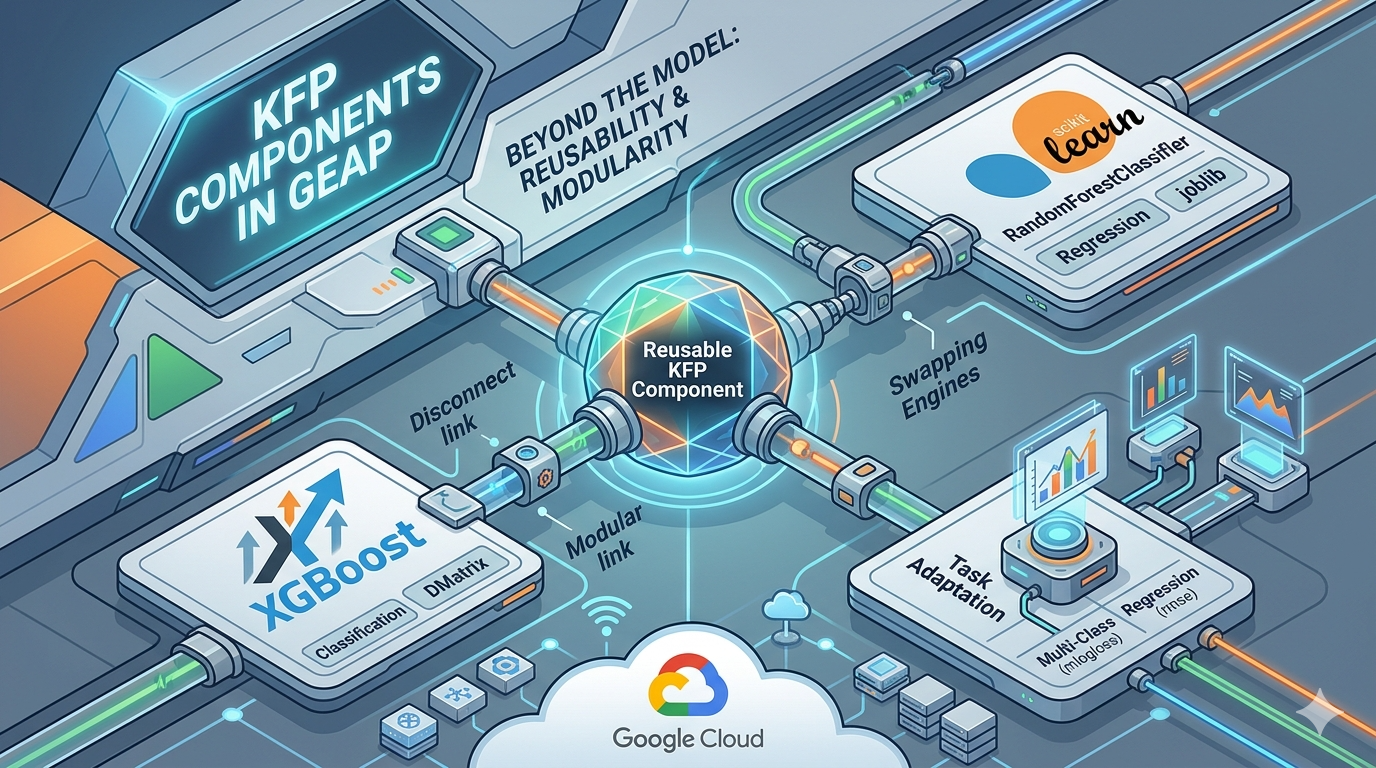
A well-structured Kubeflow Pipelines (KFP) component acts as a modular unit within a larger workflow. To understand how to make these components reusable, we must first look at the core structure of a standard Python-based training script.
- Imports: These define the environment, pulling in libraries like argparse, google.cloud, pandas, and xgboost.
- Core Training Logic: Encapsulated in functions like train_xgboost_model, this logic handles the specific requirements of the library, such as creating a DMatrix for XGBoost efficiency.
- The Orchestration Function: The model_training function serves as the main entry point, managing data loading from BigQuery or GCS, hyperparameter handling, and the final upload of the trained model artifact to a storage bucket.
- Execution Entry Point: The KFP DSL executor links the Python functions to the pipeline infrastructure.
Swapping Engines: Adapting for scikit-learn
What happens when your project requires a shift from gradient boosting to a bagging approach like RandomForestClassifier? A reusable component structure allows you to swap the underlying engine with minimal friction.
1. Update Imports
Replace XGBoost-specific imports with scikit-learn and joblib for model serialization.
from sklearn.ensemble import RandomForestClassifier
from sklearn.model_selection import train_test_split
import joblib
2. Define the New Training Logic
Create a localized training function tailored for the scikit-learn API.
def train_random_forest_model(X_train, y_train, params):
model = RandomForestClassifier(**params)
model.fit(X_train, y_train)
return model
3. Update the Orchestrator
Adjust the model_training function to handle standard pandas DataFrames instead of specialized data structures like DMatrix, and use joblib.dump for the final export.
One Component, Many Tasks: Task Adaptation
Often, you don’t need to change the model library, but the task itself. Whether you are performing multi-class classification, binary classification, or regression, the core XGBoost component can be adapted through simple parameter adjustments.
For Regression Tasks
To predict continuous values, shift the objective and evaluation metrics:
- Objective: Change from multi:softprob to reg:squarederror.
- Metric: Use rmse (Root Mean Squared Error) instead of mlogloss.
- Cleanup: Remove the num_class parameter as it is only applicable to classification.
For Binary Classification
For tasks with only two possible outcomes:
- Objective: Set to binary:logistic.
- Metric: Use logloss or auc.
The Architect’s Secret: Maximizing Reusability
The ultimate goal of a reusable component is to avoid code changes entirely when switching tasks. This is achieved by promoting internal parameters to component arguments. By making model_objective and eval_metric configurable inputs, a single component can serve multiple purposes across different pipelines.
def model_training(
datasets_path: str,
model_objective: str = ‘multi:softprob’,
eval_metric: str = ‘mlogloss’,
…
):
xgb_params = {
‘objective’: model_objective,
‘eval_metric’: eval_metric,
…
}
Conclusion: The “Write Once, Run Anywhere” Philosophy
Building reusable KFP components is more than a coding preference; it is a strategic approach to MLOps. By abstracting the training logic and parameterizing the task-specific details, you create a library of tools that are truly versatile. This “write once, run anywhere” philosophy ensures that your focus remains on solving business problems rather than managing boilerplate code. Embracing this modularity is the first step toward a mature, scalable machine learning practice.
메타데이터
- post_id
- 850764e56de5
- slug
- beyond-the-model-dissecting-reusable-kfp-components-in-gemini-enterprise-agent-platform-pipelines-850764e56de5
- url
- https://medium.com/google-cloud/beyond-the-model-dissecting-reusable-kfp-components-in-gemini-enterprise-agent-platform-pipelines-850764e56de5
- canonical_url
- https://medium.com/google-cloud/beyond-the-model-dissecting-reusable-kfp-components-in-gemini-enterprise-agent-platform-pipelines-850764e56de5
- author_url
- https://medium.com/@vipulraja
- status
- ok
- fetched_at
- 2026-07-11 04:44:24