🤿 SWIM Protocol Explained: A Scalable, Infection-Style Approach to Process Group Membership
Topics:
🤿 SWIM Protocol Explained: A Scalable, Infection-Style Approach to Process Group Membership
Topics:
- Distributed Systems
- Gossip Protocols
- Failure Detection
- Cluster Membership
- Peer-to-Peer Networks
Introduction: Membership Is Hard
Distributed systems are chaotic by nature. Nodes come and go. Some fail silently. Others become unreachable due to network partitions. How do you know who is alive and who’s not? And how do you scale that check to thousands of machines?
That’s the question SWIM answers — brilliantly.
SWIM, short for Scalable Weakly-consistent Infection-style Membership, is a lightweight, decentralized, and scalable protocol that handles group membership and failure detection with high efficiency. It was introduced in the seminal 2002 paper from Cornell University and has since influenced systems like Serf, Consul, HashiCorp Nomad, and even Akka Cluster.
Why SWIM?
Cluster membership protocols have traditionally suffered from three key issues:
- Scalability: Heartbeat-based monitoring doesn’t scale to large clusters.
- Accuracy: False positives (suspecting a healthy node) or slow convergence.
- Overhead: Heavy communication and state synchronization.
SWIM sidesteps these with an infection-style gossip mechanism and a fault detector that operates independently.
SWIM Architecture in a Nutshell
SWIM breaks down into two core components:
- Failure Detection Subsystem — actively pings nodes to see if they’re alive.
- Dissemination Subsystem — piggybacks membership updates through gossip.
Let’s break it down further.
1. Failure Detection: Probing the Living
Each node periodically:
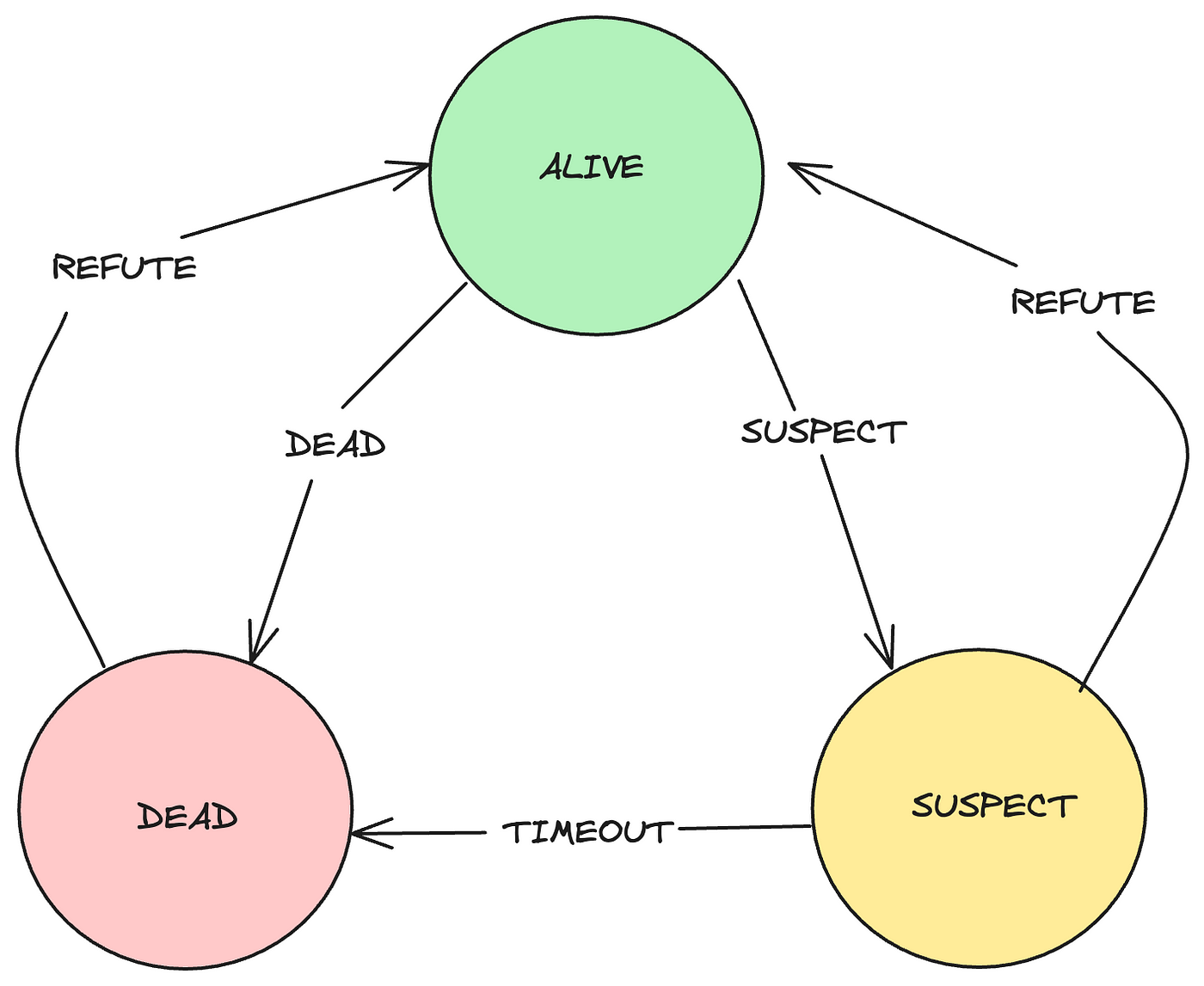
- Picks a random node and sends a ping.
- If no reply, it selects k other nodes and sends ping-requests to them.
- If none of the intermediaries receive a reply, the node is marked suspect.
- If the suspect node fails to refute the claim, it’s marked dead.
This indirect probing mechanism reduces false positives caused by transient network issues.
2. Gossip Dissemination: Sharing the News
Each probe includes a few membership updates — piggybacked gossip messages.
These updates are:
- Simple key-value state changes (e.g., “Node X → suspect”)
- Propagated over multiple rounds for high probability of delivery
- TTL (Time-To-Live) limited to avoid infinite propagation
This results in weak eventual consistency across the cluster — good enough for most real-world applications.
Visual Flow

Real-World Implementations
🔹 Serf by HashiCorp
- Lightweight cluster membership using SWIM
- Used in Consul and Nomad internally
🔹 Akka Cluster (Scala)
- Uses a SWIM-inspired failure detector in its cluster sharding
🔹 Redis Cluster
- Similar concepts of gossip for node health dissemination
Key Strengths of SWIM
✅ Scalable to thousands of nodes ✅ Decentralized — no leader required ✅ Low Overhead — fixed-size messages, periodic checks ✅ Adaptive — randomized peer selection ensures robustness ✅ Modular — clean separation of failure detection and dissemination
Enhancements Over Time
Several extensions to SWIM have been proposed:
- Lifeguard: Reduces false positives with local health scores.
- Bimodal Multicast: For more resilient dissemination.
- SWIM+ / HyParView: Combines with structured overlay for better delivery guarantees.
Code Snippet (Simplified Python)
class SWIMNode:
    def __init__(self, id, peers):
        self.id = id
        self.peers = peers
        self.membership = {}

    def ping(self, peer):
        if not peer.is_alive():
            self.suspect(peer)

    def suspect(self, peer):
        self.membership[peer.id] = 'suspect'
        self.gossip(peer.id, 'suspect')

    def gossip(self, id, status):
        for p in random.sample(self.peers, k=3):
            p.receive_update(id, status)

    def receive_update(self, id, status):
        self.membership[id] = status
Weaknesses & Design Considerations
- Eventually Consistent: May temporarily believe a dead node is alive
- Gossip Delay: Update convergence is probabilistic
- Not Suitable for strong-consistency needs (use Raft or Paxos instead)
Conclusion: SWIM With the Flow
SWIM proves that you don’t always need heavyweight consensus to manage cluster membership. With a bit of clever randomness and smart gossip, you can build resilient, self-healing distributed systems that scale to thousands of nodes.
If you’re designing a peer-to-peer, service discovery, or decentralized coordination system — SWIM is worth your consideration.
References
- D. Gupta, K. Birman, R. van Renesse. “Efficient Probabilistic Failure Detection for Large Scale Distributed Systems,” 2002.
- SWIM Protocol Deep Dive — Serf.io
- HashiCorp Engineering Blog: “Lifeguard — Improving SWIM Failure Detection”
메타데이터
- post_id
- 850e49fa7df0
- slug
- swim-protocol-explained-a-scalable-infection-style-approach-to-process-group-membership-850e49fa7df0
- url
- https://medium.com/distributed-systems-insights/swim-protocol-explained-a-scalable-infection-style-approach-to-process-group-membership-850e49fa7df0
- canonical_url
- https://medium.com/distributed-systems-insights/swim-protocol-explained-a-scalable-infection-style-approach-to-process-group-membership-850e49fa7df0
- author_url
- https://medium.com/@nikheelvs
- status
- ok
- fetched_at
- 2026-07-14 18:07:17