The Children’s Content Subscription Business Most Founders Are Sleeping On
The retention math is different from what you think. Here is why I am betting on it.
The Children’s Content Subscription Business Most Founders Are Sleeping On
The retention math is different from what you think. Here is why I am betting on it.
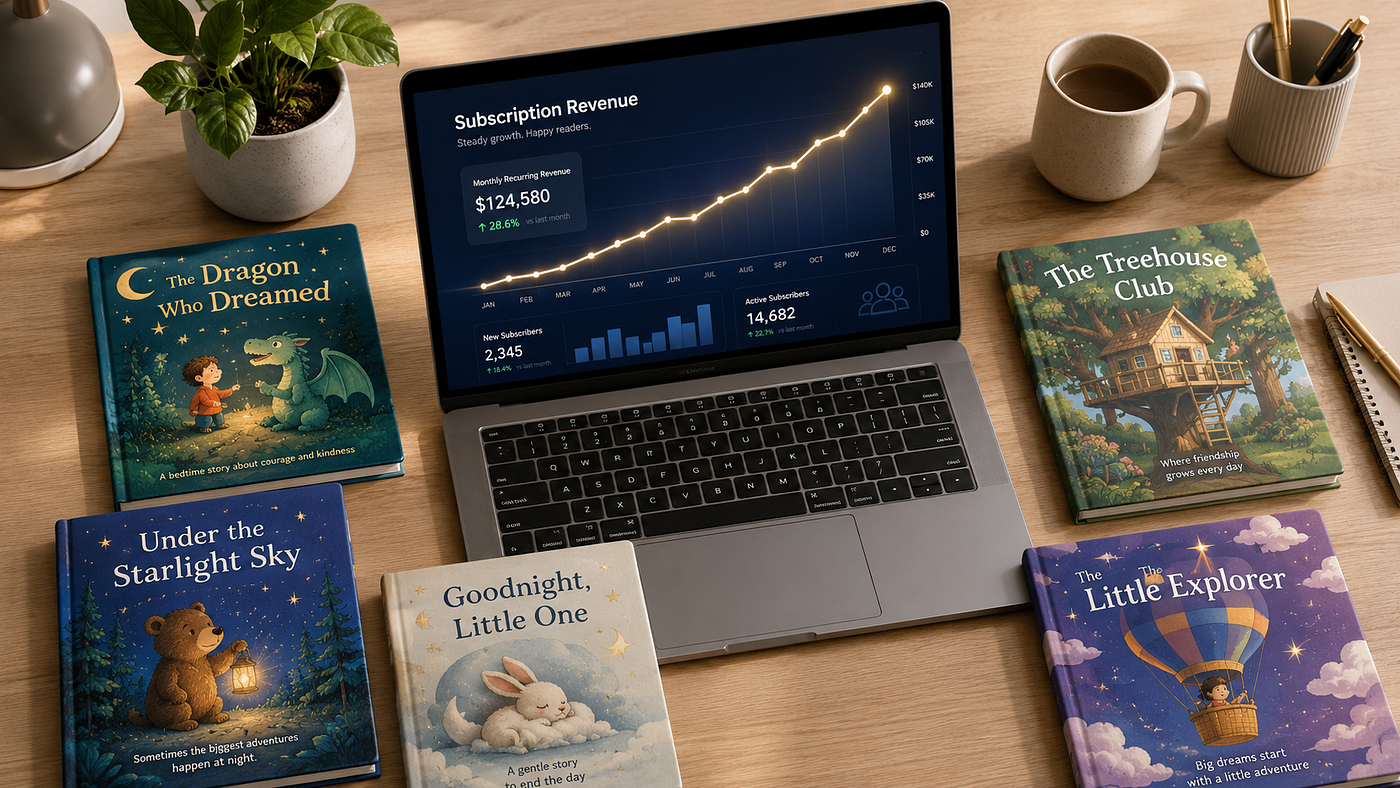
I want to make a business case for something, and I want to do it without the usual founder cheerleading.
Children’s subscription content is an underrated category. Not because nobody has tried it, but because most of the attempts have not addressed the fundamental reason it should work at all.
The basic retention math
Consumer subscriptions live and die on retention. The question is always: what drives a customer to stay?
In most adult categories, the answer is utility or habit. You stay on Spotify because you have playlists. You stay on Netflix because you are two episodes into something. You stay on your note-taking app because all your notes are in it.
In children’s content subscriptions, the retention driver should be something different and more durable: developmental progression.
A product that serves a two-year-old child is not the same product twelve months later. The child has grown. The content needs to grow with them. If it does, the family has strong reason to stay. If it does not, they churn the moment the child ages out of the current content tier.
This is a harder product problem than most adult subscription categories, but it is also a more interesting retention lever. You are not competing with inertia. You are competing with the natural rhythm of childhood.
The personalization premium
There is a ceiling on what generic children’s content can charge.
Disney Plus, which has the deepest library of children’s content in the world, charges roughly $14 a month. That compresses the market’s mental model of what children’s entertainment should cost.
Personalized content does not compete on that axis. If my child’s name is in the story, if the story references the things she cares about, if it reflects her specific world back to her, that is not the same category as a streaming library. It is closer to a private service.
Private services are priced differently. Tutoring charges $50 to $150 per hour. Custom children’s books charge $30 to $80 per item. The personalization premium in children’s products is real and documented.
The subscription model captures that premium on a recurring basis, which is a dramatically better business than one-time custom products.
What most attempts in this category get wrong
The children’s subscription products that have struggled share a common failure mode: they built libraries, not relationships.
A library of 500 personalized stories is not 500x more valuable than one great personalized story. The value is not volume. The value is the daily arrival. The ritual. The fact that tonight’s episode is new, is theirs, and is waiting.
When you build a library model in a category where the value comes from freshness, you are solving the wrong problem. You are building for the parent’s anxiety about content supply, not for the child’s need for a consistent, anticipated ritual.
The daily serial format solves this correctly. One episode per night. Always new. Always specific. The supply is practically infinite, because the child changes and the story can change with them.
The acquisition profile
Consumer subscription businesses live and die on the ratio between acquisition cost and lifetime value. In adult categories, this math is brutal. Competition is high, ad costs are high, attention is finite.
Children’s content has a different acquisition profile. Parents of young children are a highly identifiable, highly clustered audience. They congregate on specific platforms. They share recommendations within tight social graphs: the parent group chat, the daycare connection, the neighborhood Facebook group.
Word of mouth in this demographic is unusually high-quality because the recommendation comes with a specific use case: “we use this every night before bed, it calms her down, the stories are about her, she loves it.”
That is a complete, specific, trusted referral. It is the kind of acquisition no ad spend can reliably manufacture.
Why now
The AI infrastructure that makes this category possible did not exist three years ago. The ability to generate personalized, age-appropriate, narratively coherent stories at scale, in real time, for a few cents per story, is a genuinely new capability.
This is a window. AI costs will change. Competition will increase. The categories being built in this window will have compounding advantages over the followers.
Here is the bet in plain language: families who build a bedtime ritual around a personalized episode will not give it up. The child will ask for it. The parent will want to give it to them. The monthly charge will feel smaller and smaller as the ritual embeds itself into the household.
If that bet is right, the lifetime value numbers become very interesting very quickly.
I will keep reporting what I find.
Chapterling is a daily personalized bedtime story service for kids ages 0 to 7. Start a free trial at chapterling.com.
메타데이터
- post_id
- 8512331c96c0
- slug
- the-childrens-content-subscription-business-most-founders-are-sleeping-on-8512331c96c0
- url
- https://medium.com/@themegabackdoor/the-childrens-content-subscription-business-most-founders-are-sleeping-on-8512331c96c0
- canonical_url
- https://medium.com/@themegabackdoor/the-childrens-content-subscription-business-most-founders-are-sleeping-on-8512331c96c0
- author_url
- https://medium.com/@themegabackdoor
- status
- ok
- fetched_at
- 2026-06-27 07:40:21





