How the Mongol Empire Conquered the World
Whenever I read historical stories, whether from my country’s history or from abroad, I often find a connection to the Mongol Empire.
How the Mongol Empire Conquered the World
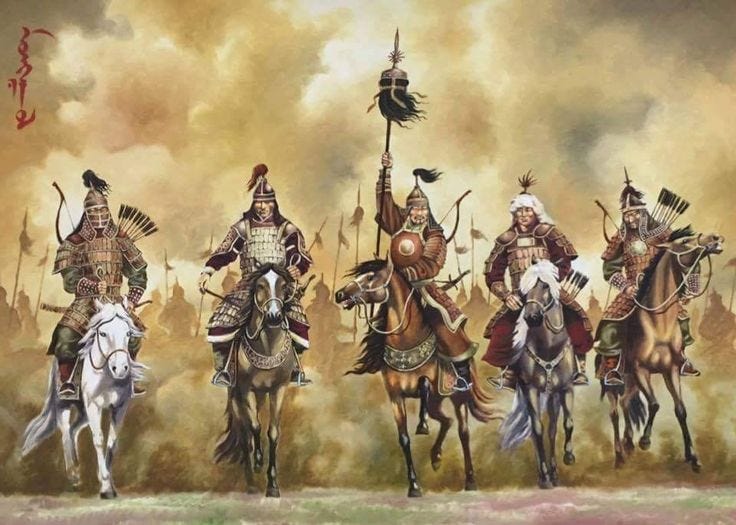
The Mongol troops in the battle/Source: Pinterest
Whenever I read historical stories, whether from my country’s history or from abroad, I often find a connection to the Mongol Empire.
I have always wondered how powerful and majestic the Mongol Empire was, given how often it appears in history.
So, I conducted a mini research project on the Mongol Empire, especially on how it managed to become the world’s most powerful empire, as will be discussed in the article below.
The Mongol Empire was the second-largest in world history, ruling from 1206 to 1368. Its territory reached 33 million square kilometers, stretching from Korea and China in the east to Eastern Europe (Russia and Hungary) in the west, as well as Persia and parts of the Middle East.

Map of the Mongol Empire/Source: Pinterest
The Mongol Empire was founded by Genghis Khan (Temujin) in 1206, after he united the nomadic tribes of the Asian steppe. To expand his territory, he created a highly effective army of fast, agile, and well-coordinated cavalry.
Within just 25 years, the Mongol Empire had grown into one of the largest empires in world history.
HOW THEY DID IT?
Genghis Khan’s Leadership

Genghis Khan/Source: Pinterest
As we know, Genghis Khan was the first emperor and the founder of the Mongol Empire. Under his leadership, he transformed a small Mongol tribe into the mighty and most powerful empire in history.
Genghis Khan was an optimistic and resilient person. As a youth, he was once captured and held by a rival clan that had rejected him, but through his determination to survive, he managed to escape and eventually rise to power.
He was the first ruler bold enough to break the traditional rule of appointing positions only to family members or relatives. Instead, he valued people to be in certain positions based on their individual ability, talent, and effort rather than social status, wealth, or family connections. As a result, his strategies were successful in nearly every conquest, largely due to the skill and expertise of the people he appointed.
He had a keen eye for opportunities. After battles, skilled prisoners of war were given the chance to serve the Mongol Empire; otherwise, they would be executed. In this way, he effectively utilized human resources to strengthen his army, recruiting capable individuals to fight on the Mongols’ side.
He was an able administrator who allowed his people to practice their own religions within the Mongol Empire. He even excluded religious leaders from war service and taxes to maintain stability and trust in his empire. He also introduced a writing system to improve communication within his society, using the Uyghur Turkic script. His style of governance created a sense of stability and comfort, which in turn strengthened loyalty to the Mongol Empire.
Military Organization and Innovation

The Mongol warriors/ Source: Historia Scripta
When other empires or territories clung to outdated tactics, the Mongols emerged and astonished the world with their innovative strategies and brilliant planning. Their meritocracy system led to the rapid rise of talented and skilled individuals, which in turn strengthened the empire’s military and administration.
Mongol tradition required its people, regardless of gender, to learn military skills from a young age. They trained in activities such as horse riding, wrestling, hunting, and archery. This provided the Mongol Empire with a vast and ready supply of human resources.
The Mongol troops also had an efficient communication system. They developed a relay network known as the Yam, which enabled them to exchange information quickly with the central government. This system also provided food supplies, military equipment, and fresh horses, serving as rest stations for Mongol troops during their campaigns.
The use of war tactics, such as placing spies in enemy areas, was also one of the reasons for the Mongols’ success. They sent spies who disguised themselves as traders, ordinary people, and in other ways to observe the enemy’s situation and condition. This helped the Mongol army plan the right strategy and gave them a better chance to win.
The Mongol Empire was also open to innovations and technologies that could benefit them. They adopted many techniques, tools, and war tactics from the regions they had conquered. For example, they used gunpowder weapons and catapults that they learned from Chinese and Afghan warfare. This gave the Mongols a better chance to win because they were not limited to one tactic, but used different strategies depending on the situation.
The Mongol army was highly motivated to win battles because of the rewards they would receive. The spoils of war were distributed fairly among those who had fought, ensuring that both commanders and ordinary soldiers benefited from the victories.
Intelligence and Diplomacy
In the process of conquering territories, the Mongols did not always attack immediately. They first sent ambassadors to deliver the emperor’s message to the rulers of a region about the planned conquest. They offered agreements by promising safety if the region agreed to submit and pay tribute to the Mongol Empire. However, if a kingdom refused, war would follow. Sending ambassadors was not only part of their conquest strategy but also a way to build diplomatic relations, maintain peace, and support trade with other regions.
The Mongols also ensured the safety of the Silk Road, which connected the East and the West, during a peaceful period known as the Pax Mongolica. This led to increased international relations and global trade. In addition, this trade route allowed the exchange of goods, ideas, and technology, which could be used to support their strategies in conquering other regions.
The Mongol Empire was the largest in history in terms of land area. Its territory stretched widely, covering most of Asia. However, this success was not achieved by chance. It was the result of strong effort, determination, and well-planned strategies. By prioritizing individual ability, maintaining discipline, and making the best use of resources, the Mongol Empire was able to surpass many other empires that failed in their expansion.
Therefore, by learning from the strategies and leadership of the Mongol Empire, how can we apply these principles in our own lives? Share this knowledge with others.
References
https://knowledge.insead.edu/leadership-organisations/7cs-leadership-lessons-genghis-khan
https://www.britannica.com/biography/Genghis-Khan/Rise-to-power
https://www.britannica.com/biography/Genghis-Khan/Rise-to-power?utm_source=chatgpt.com
https://study.com/academy/lesson/the-mongols-definition-history-conquest.html
메타데이터
- post_id
- 851847bd25bb
- slug
- how-the-mongol-empire-conquered-the-world-851847bd25bb
- url
- https://medium.com/@Sheisshie/how-the-mongol-empire-conquered-the-world-851847bd25bb
- canonical_url
- https://medium.com/@Sheisshie/how-the-mongol-empire-conquered-the-world-851847bd25bb
- author_url
- https://medium.com/@Sheisshie
- status
- ok
- fetched_at
- 2026-07-13 06:23:13






